

A business can be profitable on paper and still struggle to pay its bills. Late customer payments, payroll commitments, supplier invoices, tax obligations and unexpected expenses can all affect the money available in your business bank account.
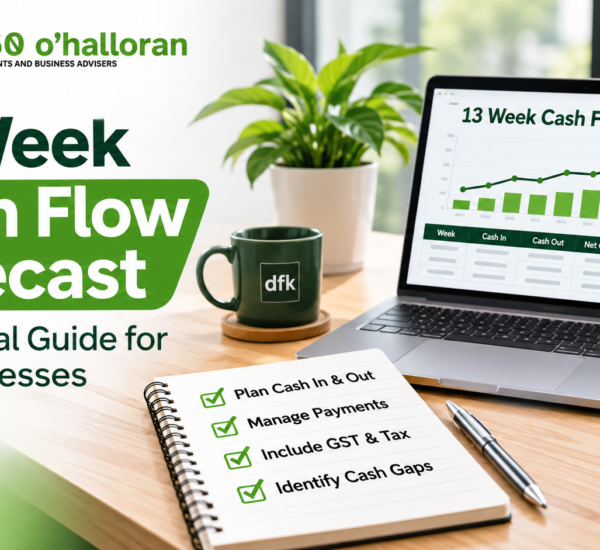
A 13 Week Cash Flow Forecast gives New Zealand business owners a practical way to look ahead. By estimating weekly cash receipts and payments over the next 13 weeks, you can identify potential cash shortages, prepare for upcoming obligations and make better-informed financial decisions.
Whether you operate a small business, professional services firm, retail business or trade operation, a rolling cash flow forecast can help you understand when money is expected to arrive, when payments are due and how much cash may be available at the end of each week.
How Does a 13 Week Cash Flow Forecast Work?
A 13 Week Cash Flow Forecast is a short-term financial planning tool that estimates a business’s weekly cash inflows, cash outflows and closing bank balance over the next 13 weeks. It starts with the current available cash balance, adds expected customer receipts and other income, and deducts payments such as wages, suppliers, rent, loan repayments and tax obligations. Businesses can use it to identify potential cash gaps early, plan payments, manage overdue invoices and assess whether they have enough cash to meet upcoming commitments. The forecast should be reviewed and updated regularly using actual financial information.
What Is a 13 Week Cash Flow Forecast?
A 13 Week Cash Flow Forecast is a weekly projection of the cash your business expects to receive and pay over approximately one quarter. It shows how your available cash balance could change from week to week based on expected transactions.
Unlike an annual budget, which usually provides a broader view of planned income and expenses, a 13-week forecast focuses on the timing of cash movements. This makes it useful for businesses that need to manage payroll, supplier payments, customer collections, tax obligations and short-term funding requirements.
A typical forecast includes:
- Opening cash balance at the beginning of each week.
- Expected customer payments and other cash receipts.
- Supplier invoices and operating expenses.
- Wages, salaries and payroll-related payments.
- GST, PAYE and provisional tax payments where applicable.
- Loan repayments, asset purchases and other planned payments.
- Projected closing cash balance at the end of each week.
The result is a forward-looking view of your business’s expected cash position, rather than simply a record of what has already happened.
Why Should NZ Businesses Use a 13 Week Cash Flow Forecast?
Cash flow forecasting helps business owners identify when money may become tight before a payment is missed. It can also support discussions with accountants, advisers, banks and other funding providers.
Business.govt.nz explains that cash flow forecasting helps businesses stay on top of income and outgoings, plan ahead, prepare for future financial commitments and make informed decisions. Its guidance also recommends considering seasonal variations and different income scenarios.
For New Zealand businesses, this is particularly useful when customer payment cycles, payroll, GST filing periods and other tax dates do not line up neatly with incoming revenue.
1. Identify potential cash shortages early
A forecast can show whether the projected bank balance may fall below the amount your business needs to meet its commitments. This gives you time to investigate the cause and consider appropriate action.
2. Improve customer payment management
By including expected customer payment dates, you can see whether overdue invoices are likely to affect your available cash. This can help you prioritise payment reminders and follow-ups.
3. Prepare for tax and payroll obligations
Including expected GST, PAYE and provisional tax payments helps prevent these commitments from being overlooked when estimating available funds.
4. Make better spending decisions
Before purchasing equipment, hiring additional staff or committing to a new expense, you can review how the decision may affect your projected cash position over the following weeks.
5. Support funding and business planning
A well-prepared forecast can help explain the timing and size of a potential funding requirement. It can also help business owners discuss financial scenarios with their accountant or bank.
How Do You Prepare a 13 Week Cash Flow Forecast?
You can prepare a 13 Week Cash Flow Forecast using a spreadsheet or suitable accounting software. The tool itself is less important than the quality of the financial information and assumptions entered into it.
Step 1: Start with your actual opening cash balance
Begin with the available balance in your business bank accounts at the start of the forecast. Check your bank statements and reconcile any transactions that have not yet been recorded in your accounting system.
Do not use your projected sales or accounting profit as a substitute for the opening cash balance. The forecast should begin with the cash that is actually available, taking account of any restricted funds or amounts already committed.
Step 2: List all expected cash inflows
Identify the money your business expects to receive during each of the next 13 weeks. Depending on your business, this may include:
- Payments from customers for outstanding invoices.
- Cash and card sales.
- Recurring service or subscription payments.
- Confirmed contract or project payments.
- Approved business funding or loan advances.
- Expected tax refunds or other business receipts.
Important: Record receipts in the week you realistically expect the money to reach your bank account, not automatically in the week you issue an invoice.
For example, if you issue an invoice on Monday with seven-day payment terms, the expected receipt may fall in the following week. If that customer has a history of paying late, adjust the expected date to reflect a realistic collection pattern.
Step 3: Review your accounts receivable
Accounts receivable represents money customers owe your business. Review your outstanding invoices and group them by expected payment date.
Consider:
- Which invoices are due this week?
- Which customers have overdue balances?
- Are any invoices disputed or awaiting approval?
- Which customers regularly pay later than their agreed terms?
- Are there significant payments that depend on project milestones?
Avoid treating every outstanding invoice as guaranteed cash. Where payment is uncertain, use a cautious estimate or prepare an alternative scenario.
Step 4: Record expected cash outflows
List the payments your business expects to make during the forecast period. Review supplier statements, payroll records, loan agreements, recurring bills and planned purchases.
Typical cash outflows include:
- Employee wages and salaries.
- PAYE and other payroll-related obligations.
- Supplier and contractor payments.
- Rent, electricity, internet and utilities.
- Insurance and professional fees.
- Software subscriptions and operating costs.
- Loan repayments and interest.
- Equipment purchases and maintenance.
- GST and provisional tax payments.
- Other planned business expenses.
Include irregular expenses as well as regular payments. An annual insurance premium, equipment repair or planned capital purchase can significantly affect the cash available in a particular week.
Step 5: Include New Zealand tax and payroll commitments
Tax payments should be included in the weeks when they are expected to leave your business account. Depending on your business structure, filing frequency and tax payment method, these may include GST, PAYE and provisional tax.
GST payments
Include your expected GST payment or refund based on your taxable activity, accounting records and filing frequency. Inland Revenue explains that GST payment dates generally align with the return due date, with specific exceptions for certain taxable periods.
Check the relevant dates and requirements through Inland Revenue’s GST payment guidance.
PAYE and payroll costs
Include the actual dates on which your business needs to pay PAYE and other applicable payroll obligations. Also account for the full cash cost of employing staff, including wages, employer contributions and other employment-related commitments where applicable.
Provisional tax
If your business is required to pay provisional tax, include the instalments relevant to your payment option and balance date. For taxpayers with a standard 31 March balance date using the standard or estimation option, the usual instalment dates are 28 August, 15 January and 7 May. Other methods and non-standard balance dates can have different payment dates.
Check your specific obligations using Inland Revenue’s provisional tax payment dates and your myIR account.
Do not assume all businesses have the same tax dates or payment amounts. Confirm your individual obligations before relying on the forecast.
Step 6: Calculate weekly net cash flow
Once you have listed the expected receipts and payments, calculate the net cash movement for each week.
Net Weekly Cash Flow = Total Cash Inflows − Total Cash Outflows
A positive result means more cash is expected to come in than go out during that week. A negative result means expected payments exceed expected receipts for that period. A negative weekly movement does not automatically mean the business is in financial difficulty; the opening cash balance and future receipts also matter.
Step 7: Calculate the projected closing balance
Use the following formula to calculate the closing cash balance:
Closing Cash Balance = Opening Cash Balance + Cash Inflows − Cash Outflows
The closing balance for one week becomes the opening balance for the next week. Repeat the calculation across all 13 weeks to create a rolling view of the projected cash position.
Step 8: Review the forecast and test different scenarios
Do not rely on a single estimate when customer payments or sales are uncertain. Prepare alternative scenarios to understand how changes in trading conditions could affect the business.
- Pessimistic scenario: Customer payments are delayed, sales are lower or unexpected costs arise.
- Realistic scenario: Income and expenses follow the most likely business assumptions.
- Optimistic scenario: Customer receipts arrive on time and sales perform better than expected.
Comparing these scenarios helps you understand the range of possible cash positions and identify which assumptions have the greatest effect.
What Does a 13 Week Cash Flow Forecast Look Like? A Worked Example
The following example demonstrates how a business can calculate its weekly cash position. The figures are illustrative only and are not actual DFK Orb360 client information or a financial benchmark.
Assume a business starts with an opening cash balance of NZ$40,000. It estimates the following customer receipts and payments over 13 weeks.
| Week | Opening Balance | Cash In | Cash Out | Closing Balance |
|---|---|---|---|---|
| 1 | $40,000 | $18,000 | $15,000 | $43,000 |
| 2 | $43,000 | $12,000 | $17,000 | $38,000 |
| 3 | $38,000 | $20,000 | $16,000 | $42,000 |
| 4 | $42,000 | $10,000 | $19,000 | $33,000 |
| 5 | $33,000 | $14,000 | $18,000 | $29,000 |
| 6 | $29,000 | $22,000 | $17,000 | $34,000 |
| 7 | $34,000 | $11,000 | $20,000 | $25,000 |
| 8 | $25,000 | $16,000 | $18,000 | $23,000 |
| 9 | $23,000 | $19,000 | $17,000 | $25,000 |
| 10 | $25,000 | $9,000 | $21,000 | $13,000 |
| 11 | $13,000 | $15,000 | $18,000 | $10,000 |
| 12 | $10,000 | $21,000 | $16,000 | $15,000 |
| 13 | $15,000 | $17,000 | $19,000 | $13,000 |
What does the example tell the business owner?
The business starts with NZ$40,000 and finishes Week 13 with a projected closing balance of NZ$13,000. Its lowest projected balance is NZ$10,000 in Week 11.
This highlights a potential pressure point. The business owner may want to check whether customer receipts are realistic, whether any supplier payments can be scheduled differently and whether the projected balance is sufficient to cover upcoming commitments.
The forecast does not establish whether NZ$10,000 is an adequate cash reserve. That depends on the business’s payroll, operating costs, payment obligations, access to funding and risk tolerance.
It is also important to check whether the figures include GST and other amounts collected or held on behalf of third parties. The table is a simplified illustration, not a substitute for a complete cash forecast.
How Can a Business Identify Cash Flow Problems Before They Happen?
A forecast becomes useful when business owners act on the information it provides. Review the projected weekly balances and look for changes that may indicate increasing pressure.
Warning signs to monitor
- Projected closing balances are falling over several consecutive weeks.
- Supplier payments are due before expected customer receipts arrive.
- Overdue invoices are increasing or major customers are paying later.
- Payroll or tax commitments may exceed the cash available on the payment date.
- The business increasingly depends on overdrafts or short-term borrowing to meet normal expenses.
- Unexpected expenses are regularly higher than the original estimates.
What should you do if your forecast shows a cash shortage?
Start by identifying the cause of the projected shortfall. It may be caused by delayed customer receipts, a seasonal drop in sales, increased supplier costs, tax payments or a planned purchase.
Depending on the circumstances, possible steps include:
- Contact customers with overdue invoices and confirm realistic payment dates.
- Review discretionary spending and non-essential purchases.
- Discuss payment timing with suppliers before an invoice becomes overdue.
- Review inventory purchasing and stock levels.
- Assess whether planned capital expenditure can be deferred.
- Discuss suitable funding options with your bank or financial adviser.
- Contact Inland Revenue early if you may have difficulty meeting a tax obligation.
Do not delay important payments or enter into new borrowing without understanding the financial and contractual implications. Any funding or payment arrangement should be assessed against the business’s actual circumstances.
What Are the Most Common 13 Week Cash Flow Forecasting Mistakes?
1. Confusing profit with available cash
Sales recorded in an income statement do not necessarily mean money has been received. A forecast should reflect the timing of cash receipts and payments rather than treating accounting revenue as available cash.
2. Assuming every invoice will be paid on time
Customer payment behaviour can differ from agreed payment terms. Review debtor history and use realistic receipt dates when estimating cash inflows.
3. Leaving out tax and payroll commitments
GST, PAYE, provisional tax and employment-related payments can affect the amount of cash available. Include the relevant amounts and dates rather than treating them as an afterthought.
4. Ignoring seasonal sales patterns
Sales may change around Christmas, public holidays, school holidays or industry-specific busy and quiet periods. Use historical information where available and document assumptions for unusual periods.
5. Forgetting one-off expenses
Equipment repairs, insurance renewals, annual fees and planned purchases can create substantial cash outflows. Include known irregular expenses in the relevant weeks.
6. Failing to update the forecast
A forecast becomes less reliable when actual transactions are not compared with estimates. Update it regularly and investigate significant differences.
How Often Should You Update a 13 Week Cash Flow Forecast?
For many businesses, reviewing the forecast weekly is a practical approach. A weekly review allows the owner or finance team to replace estimates with actual figures, adjust future assumptions and add another week to maintain the rolling 13-week period.
Businesses experiencing tight cash flow, high transaction volumes, seasonal changes or significant payment uncertainty may need to monitor their cash position more frequently.
What should you review every week?
- Actual bank balance compared with the forecast opening balance.
- Customer payments received and invoices still outstanding.
- Supplier bills and other payments due.
- Payroll and tax obligations approaching their payment dates.
- Changes in sales, costs or customer payment behaviour.
- The lowest projected closing cash balance over the forecast period.
- Any decisions required to address a potential cash shortfall.
Document significant changes to assumptions. This makes it easier to understand why the forecast has changed and whether the business’s financial position is improving or deteriorating.
Can You Prepare a 13 Week Cash Flow Forecast in Excel or Accounting Software?
Yes. A spreadsheet can be sufficient for a straightforward business forecast. It should include weekly columns for opening cash, expected receipts, expected payments, net cash movement and closing cash.
Accounting software may also help by providing access to historical transactions, unpaid invoices, bills and bank information. However, software cannot automatically guarantee accurate forecasts. Expected payment dates, future sales, one-off costs and tax assumptions still need to be reviewed.
Business.govt.nz provides guidance on cash flow forecasting and financial planning. You can start with its cash flow forecasting guide.
Choose a method that your business can maintain consistently. A simple, regularly updated forecast is generally more useful than a complicated spreadsheet that is not reviewed.
How Can an Accountant Help Improve Your Cash Flow Forecast?
Preparing a forecast involves more than entering figures into a spreadsheet. The quality of the result depends on whether the underlying information is accurate, the assumptions are realistic and the business understands what the projected balances mean.
An accountant or business adviser may help with:
- Reviewing historical financial statements and bank information.
- Assessing sales trends, customer payment patterns and outstanding invoices.
- Identifying recurring and irregular operating expenses.
- Including relevant tax and payroll commitments in the forecast.
- Preparing alternative cash flow scenarios.
- Reviewing projected cash shortages and potential funding requirements.
- Interpreting management reports to support business decisions.
For a growing business, regular financial reviews can help connect cash flow information with wider decisions about staffing, investment, expansion and business performance.
Where Can NZ Businesses Get Accounting and Cash Flow Advice?
DFK Orb360 O’Halloran provides accounting and business advisory support through its offices in Newmarket, Albany and Wellington. Businesses can contact the team to discuss their accounting requirements and the financial information they need to support business planning.
Accountants in Newmarket, Auckland
Businesses in Newmarket and surrounding Auckland areas can contact DFK Orb360 O’Halloran to discuss accounting, tax compliance, financial reporting and business advisory requirements.
Accountants in Albany and Auckland’s North Shore
Businesses in Albany and across the North Shore can contact the DFK Orb360 team to discuss their accounting and financial reporting requirements, including their business planning needs.
Business accounting support in Wellington
Businesses in Wellington can also contact DFK Orb360 O’Halloran to discuss accounting, tax and business advisory requirements.
To find out more or make an enquiry, visit the DFK Orb360 O’Halloran contact page.
13 Week Cash Flow Forecast Checklist for NZ Businesses
Use this checklist when preparing or reviewing your next forecast:
- Confirm the actual opening bank balance.
- Reconcile bank transactions and accounting records.
- Review outstanding customer invoices and expected payment dates.
- Estimate future sales and other cash receipts realistically.
- Include supplier payments and regular operating expenses.
- Include wages, salaries and applicable payroll commitments.
- Check GST, PAYE and provisional tax dates and amounts.
- Include loan repayments and planned capital expenditure.
- Calculate weekly net cash movements and closing balances.
- Identify the lowest projected cash balance.
- Test pessimistic, realistic and optimistic scenarios.
- Compare actual transactions with the forecast every week.
- Update the assumptions and extend the forecast by another week.
Frequently Asked Questions About a 13 Week Cash Flow Forecast
What is the purpose of a 13 Week Cash Flow Forecast?
The purpose is to estimate a business’s weekly cash position over the next 13 weeks. It helps business owners identify potential cash shortages, plan payments, monitor customer receipts and make informed short-term financial decisions.
How do you calculate a 13 Week Cash Flow Forecast?
Start with the opening cash balance, add expected cash inflows and subtract expected cash outflows for each week. The result is the projected closing cash balance, which becomes the opening balance for the following week.
Why is a 13-week forecast useful for small businesses in NZ?
It helps small businesses plan for customer payment delays, wages, supplier invoices, GST, PAYE and other upcoming commitments. It also provides an early indication of weeks when available cash may be limited.
What should be included in a 13 Week Cash Flow Forecast?
Include opening cash, customer receipts, other income, supplier payments, operating expenses, wages, payroll obligations, tax payments, loan repayments, planned purchases and closing cash balances.
Should GST be included in a cash flow forecast?
Yes. The forecast should reflect the actual cash your business expects to receive and pay. Include GST-related cash movements and the expected payment or refund on the relevant date, using your GST filing frequency and tax records.
Can I prepare a 13 Week Cash Flow Forecast in Excel?
Yes. A spreadsheet can track weekly opening balances, cash inflows, cash outflows and closing balances. Formula-driven calculations can help update the forecast as new information becomes available.
How often should a 13 Week Cash Flow Forecast be updated?
A weekly review is a practical approach for most businesses. Replace completed weeks with actual figures, revise future estimates and add another week to maintain the rolling forecast period.
What is the difference between cash flow and profit?
Profit measures the difference between recognised income and expenses over an accounting period. Cash flow tracks money actually received and paid. A business can be profitable but still experience a cash shortage if customers pay late or large payments fall due before receipts arrive.
What should I do if my cash flow forecast shows a negative balance?
Identify the cause of the projected shortfall, review expected customer receipts and upcoming expenses, and assess appropriate actions. These may include following up overdue invoices, reviewing discretionary spending, discussing payment timing with suppliers or seeking professional advice about funding options.
Can an accountant help prepare a cash flow forecast in Auckland?
Yes. Businesses can discuss their accounting and financial planning requirements with DFK Orb360 O’Halloran through its Newmarket and Albany offices in Auckland.
Can businesses in Wellington get cash flow planning support?
Businesses in Wellington can contact DFK Orb360 O’Halloran to discuss their accounting and business advisory requirements.
Plan Your Business Finances With Greater Confidence
A 13 Week Cash Flow Forecast gives business owners a clearer view of upcoming receipts, payments and projected bank balances. By reviewing the numbers regularly, you can identify potential cash gaps, prepare for tax and payroll commitments and make more informed decisions about business spending and growth.
Accurate forecasting depends on reliable financial records, realistic assumptions and regular reviews. It is not a guarantee of future cash availability, but it can help you prepare for different financial outcomes and respond earlier when circumstances change.
Whether your business operates in Newmarket, Albany, across Auckland’s North Shore or in Wellington, DFK Orb360 O’Halloran can discuss your accounting and business advisory requirements.
Looking for support with your business finances? Contact DFK Orb360 O’Halloran to discuss your accounting, tax and financial reporting needs.
Speak to Our Team
Complete the enquiry form below to discuss your business accounting and advisory requirements.
Disclaimer: This article is intended for general information purposes only and does not constitute financial, accounting or tax advice. Cash flow requirements and tax obligations vary depending on each business’s circumstances. Tax payment dates and requirements may change and should be checked with Inland Revenue. Speak with a qualified accountant or tax adviser before making decisions based on your individual circumstances.



 09 377 4238
 Level 2, 6 Kingdon Street, Newmarket, Auckland
 help@orb360.co.nz