
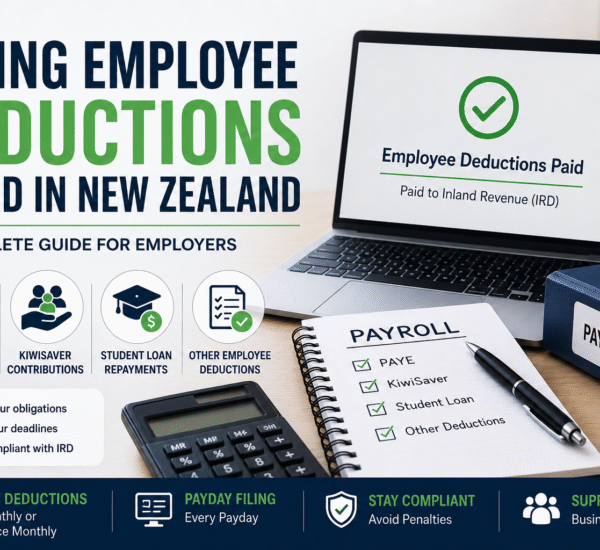
Quick Overview: New Zealand employers must deduct PAYE tax, KiwiSaver contributions, student loan repayments, and other employee deductions from wages and pay them to Inland Revenue (IRD). Most businesses pay deductions monthly by the 20th of the following month, while larger employers pay twice monthly. Payday filing requires employers to submit payroll information to IRD every payday.
Employee deductions are amounts employers withhold from employee wages before payment. These deductions are then paid to Inland Revenue (IRD).
According to Inland Revenue NZ, employers are responsible for ensuring deductions are paid accurately and on time.
PAYE stands for “Pay As You Earn.” Employers deduct PAYE tax from employee salaries before wages are paid.
The amount depends on:
Businesses seeking payroll compliance support can visit DFK ORB360.
Payroll compliance is more than simply paying employees on time. In New Zealand, employers are legally responsible for managing PAYE deductions, KiwiSaver contributions, payday filing obligations, and IRD payment deadlines accurately.
Businesses that maintain proper payroll systems benefit from:
Many businesses underestimate how quickly payroll mistakes can create larger financial problems. A missed payday filing, incorrect tax code, or delayed PAYE payment may trigger compliance reviews from Inland Revenue.
For growing businesses in New Zealand, payroll management becomes even more important as employee numbers increase. Having organised payroll processes helps businesses scale efficiently while staying compliant with changing regulations.
Modern cloud-based payroll software can automate many payroll functions, including:
Businesses using automated payroll systems are generally less likely to experience filing errors or missed deadlines.
Employers should also regularly review employee records to ensure:
In addition to compliance, strong payroll systems improve the overall employee experience. Employees expect accurate payslips, correct tax deductions, and timely salary payments. Payroll mistakes can reduce employee confidence and create administrative issues.
Businesses that proactively manage payroll obligations are also better positioned for:
As payroll regulations continue evolving in New Zealand, many companies choose to work with accounting and payroll professionals to reduce administrative burden and ensure compliance accuracy.
Professional payroll support can help businesses:
For businesses seeking payroll, tax compliance, and accounting support in New Zealand, visit DFK ORB360.
Payday filing is New Zealand’s payroll reporting system where employers submit payroll information to IRD every payday.
Payroll information includes:
Learn more at IRD Payday Filing.
If annual PAYE and ESCT are below NZD $500,000:
| Employee Pay Period | IRD Due Date |
|---|---|
| 1st–15th | 20th of same month |
| 16th–End of month | 5th of next month |
Accurate record keeping is essential when paying employee deductions to IRD in New Zealand.
Understanding the process of paying employee deductions to IRD helps New Zealand businesses avoid payroll penalties and maintain compliance with Inland Revenue requirements.
Late payments can result in:
See IRD penalties and interest rules.
Yes. Most employers in New Zealand must complete payday filing every payday.
Yes. Businesses under the PAYE threshold generally pay monthly.
IRD may charge penalties and interest.
Yes. Many businesses outsource payroll management to accounting professionals.
Understanding PAYE obligations, payday filing, and payroll compliance is essential for every employer in New Zealand.
For payroll support, tax compliance, and business advisory services, visit DFK ORB360.
From PAYE and payday filing to tax compliance and business advisory, DFK ORB360 helps New Zealand businesses simplify payroll management and stay compliant with IRD regulations.
Talk to DFK ORB360

Copyright © 2025 Marketing Transformers | All Rights Reserved.


 09 377 4238
 Level 2, 6 Kingdon Street, Newmarket, Auckland
 help@orb360.co.nz