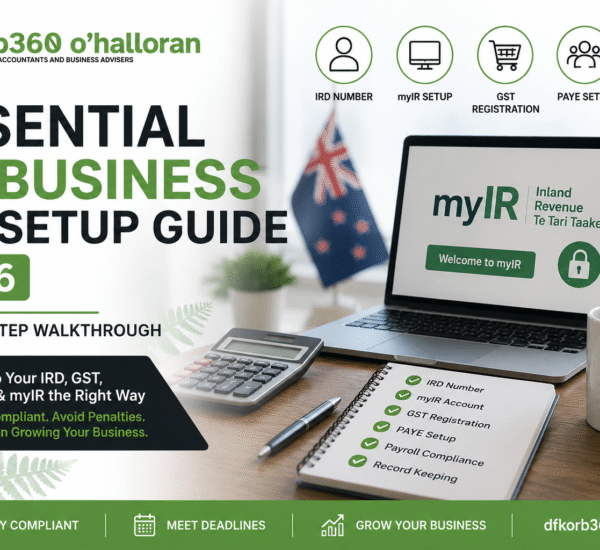
Essential NZ Business IRD Setup Guide 2026: Step-by-Step Walkthrough
Starting a business in New Zealand requires more than finding customers and generating revenue. One of the most important foundations for long-term success is ensuring your Inland Revenue setup is completed correctly.
This NZ Business IRD Setup Guide explains how to set up your IRD obligations, GST registration, PAYE requirements, payroll systems, and tax reporting responsibilities.
Quick Answer: How Do You Set Up a New Business With IRD?
Most businesses should complete the following steps:
- Obtain a Business IRD Number.
- Create a myIR account.
- Register for GST if required.
- Register as an employer if hiring staff.
- Set up PAYE reporting.
- Implement accounting software.
- Maintain proper records.
- Understand provisional tax obligations.
Why Every Business Needs an NZ Business IRD Setup Guide
A proper tax setup helps businesses avoid compliance issues, late filing penalties, payroll errors, and GST reporting problems.
Businesses that establish correct systems from day one are often better positioned for growth and future compliance requirements.
Step 1: Obtain a Business IRD Number
Your business IRD number is used to identify your organisation for tax purposes.
Official Resource:
Inland Revenue New Zealand
You may need a separate IRD number if operating as:
- Limited Company
- Partnership
- Trust
- Charity
- Certain Sole Trader Structures
Why Your Business IRD Number Matters
- Income Tax Reporting
- GST Obligations
- PAYE Reporting
- Employer Compliance
- Tax Correspondence
Step 2: Create a myIR Account
myIR is Inland Revenue’s online platform for managing tax affairs.
Through myIR you can:
- File GST returns.
- View tax balances.
- Manage PAYE reporting.
- Receive Inland Revenue correspondence.
- Update business details.
- Make tax payments.
Official myIR Information:
myIR Online Services
Step 3: Register for GST
GST registration is one of the most important tax decisions for a growing business.
When Must You Register for GST?
GST registration generally becomes compulsory when annual turnover exceeds:
$60,000 per year
Official GST Information:
GST Registration and Filing Guide
Benefits of GST Registration
- Claim GST on eligible business purchases.
- Improve business credibility.
- Prepare for future growth.
- Support financial planning.
Related DFK Orb360 Resource:
Accounting & Reporting Services NZ
Step 4: Register as an Employer
If you hire employees, employer registration becomes necessary.
Employer responsibilities include:
- PAYE deductions.
- KiwiSaver administration.
- Payday filing.
- Employee tax records.
Step 5: Set Up PAYE Correctly
PAYE ensures employee taxes are deducted and reported correctly.
PAYE Setup Checklist
- Register as an employer.
- Collect employee tax codes.
- Set up payroll software.
- Enable payday filing.
- Maintain payroll records.
Official PAYE Information:
Employing Staff and PAYE Requirements
Step 6: Understand Provisional Tax
As your business grows, provisional tax may become an important obligation.
Understanding provisional tax early can help businesses:
- Manage cash flow.
- Avoid payment surprises.
- Improve budgeting.
- Reduce compliance risks.
Related Article:
Budget 2026 Tax Changes NZ: IRD Updates & Compliance Changes
Step 7: Establish Strong Record-Keeping Systems
Good record keeping remains one of the most effective ways to maintain compliance.
Important records include:
- Sales invoices.
- Expense receipts.
- Bank statements.
- GST reports.
- Payroll records.
- Contracts and agreements.
Proper records support:
- Tax deductions.
- GST claims.
- Audit preparation.
- Business reporting.
Common Mistakes New Businesses Make
- Late GST registration.
- Incorrect business structures.
- Poor payroll systems.
- Missed tax deadlines.
- Inadequate record keeping.
Essential NZ Business IRD Setup Guide Checklist
- ✓ Business IRD Number
- ✓ myIR Account
- ✓ GST Registration
- ✓ Employer Registration
- ✓ PAYE Setup
- ✓ Payroll System
- ✓ Accounting Software
- ✓ Record-Keeping Process
- ✓ Tax Calendar
Need Help Setting Up Your Business?
DFK Orb360 helps new businesses with:
- ✓ Business IRD Registration
- ✓ GST Registration
- ✓ PAYE Setup
- ✓ Payroll Systems
- ✓ Accounting Software Setup
- ✓ Tax Compliance
- ✓ Business Advisory Services
Book a Consultation
Frequently Asked Questions
Do I Need a Business IRD Number?
Most businesses require an IRD number to meet their tax obligations.
When Is GST Registration Mandatory?
Generally when annual turnover exceeds $60,000.
What Is myIR?
myIR is Inland Revenue’s online portal for managing tax accounts.
Do Employers Need PAYE?
Yes. Employers must deduct and report PAYE for employees.
Final Thoughts
This NZ Business IRD Setup Guide provides a practical roadmap for setting up your business tax obligations correctly from day one.
By establishing proper systems early, businesses can reduce compliance risks, improve reporting accuracy, and focus on growth.
Starting a business in New Zealand? Learn how to set up your IRD number, myIR account, GST registration, and PAYE correctly with our step-by-step NZ Business IRD Setup Guide 2026.
Watch the video and avoid common compliance mistakes from day one.




 09 377 4238
 Level 2, 6 Kingdon Street, Newmarket, Auckland
 help@orb360.co.nz