Paying Deductions to Inland Revenue: Complete Employer Compliance Guide for New Zealand Businesses (2026)
Paying deductions to Inland Revenue is one of the most important payroll responsibilities for every New Zealand employer. Whether you employ one staff member or manage a growing workforce, ensuring payroll deductions are paid accurately and on time helps your business remain compliant while avoiding unnecessary penalties and interest.
Many employers assume that submitting payday filing automatically completes their payroll obligations. In reality, payday filing and paying deductions to Inland Revenue are two separate legal requirements. Employers must report employee earnings after every payday and separately pay PAYE and other payroll deductions by the applicable due date.
Missing a payroll payment deadline can lead to late payment penalties, interest charges, and unnecessary Inland Revenue compliance issues. Having accurate payroll systems and experienced advisors helps reduce these risks while allowing business owners to focus on growing their business.
In this guide, DFK Orb360 explains how paying deductions to Inland Revenue works, who needs to make payroll payments, the latest employer payment schedule, and practical payroll compliance tips for New Zealand businesses.
Quick Answer: Paying Deductions to Inland Revenue
Paying deductions to Inland Revenue means employers must pay PAYE and other payroll deductions withheld from employee wages to Inland Revenue (IRD).
These deductions commonly include:
PAYE (Pay As You Earn)
KiwiSaver employee deductions
Employer KiwiSaver contributions
Employer Superannuation Contribution Tax (ESCT)
Student Loan repayments
Child Support deductions
Payment frequency depends on the employer’s annual PAYE and ESCT liability rather than how often employees are paid.
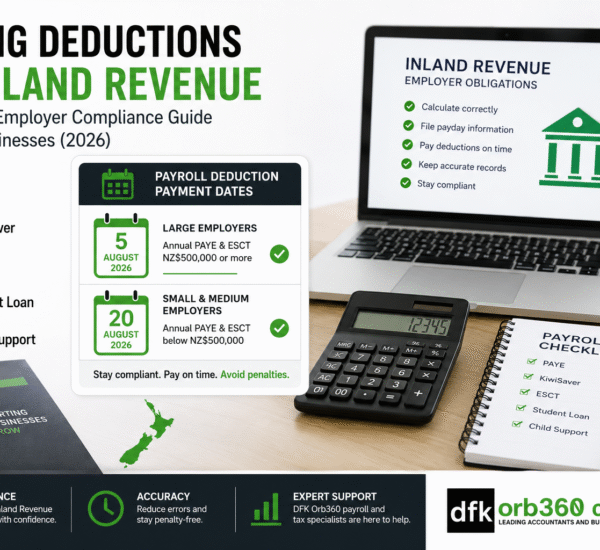
📅 Next Upcoming Payroll Deduction Payment Dates
Employer Type
Next Due Date
Large Employers (Annual PAYE & ESCT NZ$500,000 or more)
5 August 2026
Small & Medium Employers (Annual PAYE & ESCT below NZ$500,000)
20 August 2026
Current as of 29 July 2026. Payment dates may change following legislative updates or public holiday adjustments.
Why Paying Deductions to Inland Revenue Is Important
When employers deduct PAYE and other payroll taxes from employee wages, those funds belong to Inland Revenue rather than the business. Employers are responsible for safeguarding these amounts until they are paid through their Employment (EMP) account.
Failure to meet payroll payment obligations may result in:
Late payment penalties
Interest charges
Outstanding tax liabilities
Additional Inland Revenue reviews
Increased administrative costs
Cash flow challenges if payroll obligations accumulate
Businesses with reliable payroll systems and proactive payroll management are significantly less likely to experience compliance issues.
Who Needs to Pay Deductions to Inland Revenue?
Any employer that deducts PAYE from employee wages must comply with Inland Revenue payroll payment requirements.
This includes:
Limited companies
Sole traders employing staff
Partnerships
Trusts
Charities
Incorporated societies
Government organisations
Growing businesses hiring their first employees
If your business pays wages or salaries and deducts employment taxes, you are responsible for paying deductions to Inland Revenue correctly and on time.
What Payroll Deductions Must Employers Pay?
Depending on your employees and payroll setup, employers may need to pay several types of payroll deductions.
Payroll Deduction
Description
PAYE
Income tax deducted from employee wages.
KiwiSaver Employee Contributions
Retirement savings deducted from employee pay.
Employer KiwiSaver Contributions
Employer contributions paid into KiwiSaver schemes.
ESCT
Employer Superannuation Contribution Tax.
Student Loan Repayments
Loan repayments deducted through payroll.
Child Support
Deductions made where Inland Revenue requires employers to collect payments.
Accurate payroll calculations help ensure every deduction is reported correctly and paid within Inland Revenue’s required timeframe.
How Often Do Employers Pay Inland Revenue?
The frequency for paying deductions to Inland Revenue depends on your annual PAYE and Employer Superannuation Contribution Tax (ESCT) liability—not your payroll cycle.
Small & Medium Employers
If annual PAYE and ESCT total less than NZ$500,000, employers generally pay payroll deductions once each month.
Payment Due: 20th of the following month.
Example: Payroll deductions for July are generally due on 20 August.
Large Employers
If annual PAYE and ESCT exceed NZ$500,000, payroll deductions are generally paid twice each month.
Payroll Period
Payment Due
1st–15th
20th of the same month
16th–End of Month
5th of the following month*
*Some December payroll periods have alternative January due dates issued by Inland Revenue.
Why Businesses Choose DFK Orb360
Payroll legislation changes regularly, and even small payroll mistakes can create unnecessary compliance risks. At DFK Orb360, our Chartered Accountants and payroll specialists help businesses manage payroll processing, PAYE obligations, Inland Revenue compliance, payroll reporting, and ongoing employer tax responsibilities.
Whether you need outsourced payroll, payroll compliance reviews, or ongoing accounting support, our experienced team helps ensure your payroll processes remain accurate, efficient, and compliant.
Continue to Part 2: How to Pay Deductions to Inland Revenue, Employment (EMP) Accounts, myIR, Common Payroll Mistakes, Employer Compliance Checklist, and Expert Payroll Advice from DFK Orb360.
How to Pay Deductions to Inland Revenue
Employers can make payroll payments through several approved Inland Revenue payment methods. Regardless of the payment option you choose, ensure the correct Employment (EMP) account is used and payments are received before the due date.
Common payment methods include:
Online banking
myIR online payments
Direct debit (if arranged)
Debit or credit card (where available)
International payment (for overseas employers, where applicable)
Businesses should allow sufficient processing time, especially when making payments close to the due date, to avoid late payment penalties.
Understanding Your Employment (EMP) Account
Your Employment (EMP) account is the Inland Revenue account used for payroll-related tax obligations. Every payroll payment should be allocated to the correct EMP account to ensure deductions are recorded accurately.
The EMP account typically includes:
PAYE
KiwiSaver deductions
Employer KiwiSaver contributions
Employer Superannuation Contribution Tax (ESCT)
Student Loan repayments
Child Support deductions
Incorrect account references or payment details can delay processing and create unnecessary reconciliation issues.
Does Payday Filing Mean You’ve Already Paid Inland Revenue?
No.
This is one of the most common payroll misconceptions among employers.
Payday filing reports employee earnings, PAYE, KiwiSaver, and other payroll deductions to Inland Revenue after each payday. However, reporting payroll information does not transfer the money owed.
Employers must still complete the separate process of paying deductions to Inland Revenue before the applicable due date.
Payroll Requirement
Purpose
Payday Filing
Reports employee payroll information to Inland Revenue.
Paying Deductions
Transfers PAYE and payroll deductions to Inland Revenue.
Both obligations must be completed to remain fully compliant.
Common Payroll Mistakes Employers Make
Payroll errors can lead to unnecessary penalties, additional administration, and compliance reviews. Some of the most common issues include:
Missing payroll payment deadlines
Confusing payday filing with payroll payments
Incorrect PAYE calculations
Using the wrong tax code
Incorrect KiwiSaver deductions
Late employee onboarding information
Incorrect ESCT calculations
Payment reference errors
Manual payroll calculation mistakes
Regular payroll reviews and automated payroll systems can significantly reduce these risks.
What Happens if Payroll Deductions Are Paid Late?
If employers fail to pay deductions to Inland Revenue by the due date, Inland Revenue may apply:
Late payment penalties
Interest on outstanding balances
Debt recovery action
Compliance monitoring
Additional administrative requirements
If your business is experiencing temporary cash flow difficulties, it is generally better to contact Inland Revenue early rather than ignoring overdue payroll obligations.
Payroll Compliance Checklist for Employers
Use this checklist each payroll cycle to help keep your business compliant.
✅ Calculate employee wages accurately.
✅ Apply the correct PAYE tax codes.
✅ Calculate KiwiSaver contributions correctly.
✅ Calculate ESCT accurately.
✅ Complete payday filing after every payday.
✅ Pay payroll deductions before the due date.
✅ Keep payroll records up to date.
✅ Reconcile payroll reports regularly.
✅ Review payroll processes annually.
Example: Paying Deductions to Inland Revenue
ABC Construction Ltd processes payroll every fortnight.
Total PAYE deducted: NZ$14,500
KiwiSaver deductions: NZ$2,300
Employer KiwiSaver Contributions: NZ$2,300
ESCT: NZ$540
Student Loan deductions: NZ$620
After submitting payday filing through payroll software, the employer must separately pay these payroll deductions into their Employment (EMP) account before the applicable Inland Revenue payment deadline.
Reporting payroll information alone does not complete the employer’s legal obligations.
DFK Orb360 Payroll Services
Managing payroll is about more than processing employee wages. Employers must remain compliant with PAYE legislation, KiwiSaver obligations, Inland Revenue reporting requirements, and changing employment regulations.
DFK Orb360 provides professional payroll solutions for businesses across New Zealand, including:
Fully managed payroll processing
PAYE compliance support
Payroll health checks
KiwiSaver administration
Employer tax compliance
Payroll software support
IRD correspondence assistance
Payroll reporting and reconciliations
Our Chartered Accountants and payroll specialists help businesses minimise compliance risks while giving owners more time to focus on running their business.
Need help with payroll compliance? Contact DFK Orb360 to speak with our payroll and tax specialists today.
AI Summary: Paying Deductions to Inland Revenue
Paying Deductions to Inland Revenue is a legal responsibility for every New Zealand employer who deducts PAYE and other payroll taxes from employee wages. Employers must report payroll information through payday filing and separately pay payroll deductions into their Employment (EMP) account by the applicable due date. Small and medium employers generally pay monthly, while large employers pay twice each month. Keeping payroll records accurate and paying deductions on time helps businesses avoid penalties, interest, and Inland Revenue compliance issues. Many businesses choose DFK Orb360 to manage payroll compliance, PAYE obligations, and payroll reporting efficiently.
People Also Ask About Paying Deductions to Inland Revenue
What does paying deductions to Inland Revenue mean?
Paying deductions to Inland Revenue means employers transfer PAYE and other payroll deductions, including KiwiSaver contributions, ESCT, Student Loan repayments, and Child Support deductions, to Inland Revenue after processing payroll.
Who needs to pay deductions to Inland Revenue?
Any New Zealand employer who deducts PAYE from employee wages must pay deductions to Inland Revenue by the required due date.
Is payday filing the same as paying deductions to Inland Revenue?
No. Payday filing reports payroll information to Inland Revenue, while paying deductions to Inland Revenue transfers the actual payroll taxes owed.
How often do employers pay deductions to Inland Revenue?
Employers with annual PAYE and ESCT below NZ$500,000 generally pay monthly, while employers above this threshold usually pay twice each month.
What happens if payroll deductions are paid late?
Late payroll payments may result in penalties, interest charges, and additional Inland Revenue compliance action.
Can payroll deductions be paid through myIR?
Yes. Employers can use myIR and other approved payment methods to pay payroll deductions to Inland Revenue.
What deductions are included?
Payroll deductions commonly include PAYE, KiwiSaver employee deductions, Employer KiwiSaver contributions, ESCT, Student Loan repayments, and Child Support deductions.
Should employers outsource payroll?
Many growing businesses outsource payroll to reduce compliance risks, improve accuracy, and save administrative time.
Frequently Asked Questions
When is the next payroll deduction payment due?
As of 29 July 2026, the next payment dates are 5 August 2026 for large employers and 20 August 2026 for small and medium employers.
How do employers know which payment schedule applies?
The payment schedule depends on the employer’s annual PAYE and Employer Superannuation Contribution Tax (ESCT) liability.
Can employers correct payroll mistakes?
Yes. Payroll corrections can usually be made through payroll software or myIR, depending on the type of adjustment required.
Does DFK Orb360 provide payroll services?
Yes. DFK Orb360 offers outsourced payroll processing, PAYE compliance, payroll reporting, KiwiSaver administration, payroll reviews, and employer compliance support for businesses throughout New Zealand.
Why should businesses outsource payroll?
Outsourcing payroll helps improve accuracy, reduces compliance risks, saves administrative time, and ensures payroll obligations are managed by experienced professionals.
Key Takeaways
Employers are responsible for paying deductions to Inland Revenue on time.
Payday filing and payroll payments are separate legal obligations.
Payment frequency depends on annual PAYE and ESCT liability.
Late payroll payments can result in penalties and interest.
Accurate payroll systems reduce compliance risks.
Professional payroll support helps businesses remain compliant while saving valuable time.
Need Help Managing Payroll?
Payroll legislation continues to evolve, and staying compliant requires more than simply processing employee wages. Whether you need fully managed payroll services, PAYE compliance support, payroll reviews, or ongoing accounting advice, DFK Orb360 is here to help.
This guide is based on the latest employer payroll guidance published by Inland Revenue New Zealand regarding payroll deductions, employer payment obligations, Employment (EMP) accounts, and payday filing requirements.
Why Trust DFK Orb360?
DFK Orb360 is a team of experienced Chartered Accountants, tax advisors, and payroll specialists helping New Zealand businesses remain compliant while improving financial performance. Our advice is based on current New Zealand legislation, Inland Revenue guidance, and practical experience supporting businesses across a wide range of industries.
Disclaimer
This article is intended for general informational purposes only and should not be considered tax, accounting, payroll, or legal advice. Payroll obligations vary depending on your business circumstances. For advice specific to your organisation, contact the payroll specialists at DFK Orb360 or consult Inland Revenue.
Official Inland Revenue Resources
For the latest payroll legislation, payment due dates, and employer obligations, employers should always refer to Inland Revenue’s official guidance.





 09 377 4238
 Level 2, 6 Kingdon Street, Newmarket, Auckland
 help@orb360.co.nz