
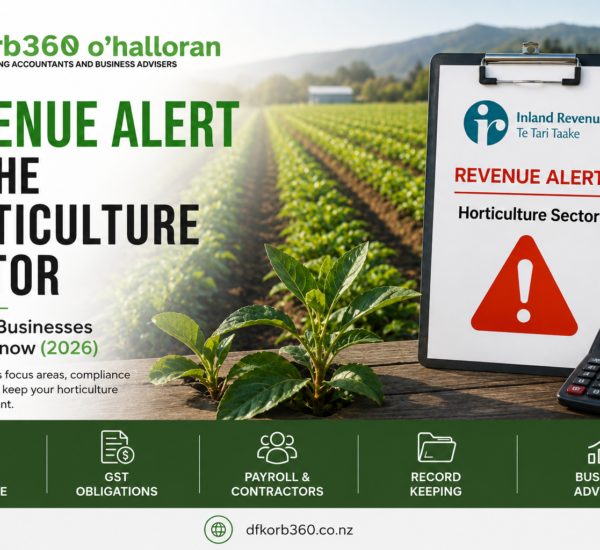
Inland Revenue (IRD) continues to strengthen its compliance efforts across industries where tax risks are considered higher. The latest Revenue Alert on the Horticulture Sector serves as an important reminder that businesses operating in horticulture must maintain accurate financial records, meet their tax obligations, and ensure their payroll and contractor arrangements comply with New Zealand tax legislation.
While the majority of horticulture businesses operate responsibly, Inland Revenue has identified recurring compliance concerns involving undeclared income, incorrect GST reporting, labour-hire arrangements, contractor payments, payroll obligations, and poor record keeping. These issues not only expose businesses to audits but may also result in penalties, interest, or prosecution where deliberate non-compliance is identified.
Whether you own an orchard, vineyard, nursery, market garden, packing operation, or provide labour services to the horticulture industry, understanding the latest IRD guidance is essential for protecting your business and maintaining compliance.
At DFK Orb360, our Chartered Accountants work closely with businesses across New Zealand to simplify tax compliance, improve financial reporting, and provide practical advice that helps business owners confidently meet their Inland Revenue obligations.
The Revenue Alert on the Horticulture Sector highlights Inland Revenue’s focus on improving tax compliance within New Zealand’s horticulture industry. IRD is paying close attention to undeclared income, cash payments, contractor arrangements, payroll obligations, GST reporting, and record keeping. Horticulture businesses can reduce compliance risks by maintaining accurate financial records, filing tax returns correctly, using reliable accounting systems, and seeking professional advice from experienced Chartered Accountants.
The Revenue Alert on the Horticulture Sector is a formal communication issued by Inland Revenue to raise awareness of tax compliance risks identified within New Zealand’s horticulture industry. Revenue Alerts are published when IRD believes certain business practices may not comply with tax legislation or where particular industries present an increased risk of tax avoidance, tax evasion, or inaccurate reporting.
The alert does not suggest that every horticulture business is non-compliant. Instead, it encourages businesses to review their accounting systems, payroll processes, contractor arrangements, GST reporting, and financial records to ensure they meet their legal obligations.
For compliant businesses, the Revenue Alert provides an opportunity to strengthen financial processes, identify potential risks early, and seek professional advice before small issues become significant compliance problems.
New Zealand’s horticulture industry plays a significant role in the country’s economy and employs thousands of permanent and seasonal workers each year. Because of the industry’s reliance on labour contractors, seasonal employment, and varying payment arrangements, Inland Revenue has identified areas where tax compliance risks may arise.
According to IRD, the Revenue Alert focuses on business practices that may result in:
By publishing the Revenue Alert on the Horticulture Sector, Inland Revenue aims to encourage voluntary compliance while reminding businesses that deliberate tax evasion and fraudulent reporting may result in audits, investigations, penalties, or legal action.
The horticulture sector often experiences complex operational challenges, including seasonal workforce fluctuations, contractor management, payroll processing, GST obligations, and inventory reporting. Without robust accounting systems, businesses may unintentionally create compliance risks that attract Inland Revenue attention.
The Revenue Alert on the Horticulture Sector highlights the importance of implementing strong financial controls, maintaining complete documentation, and ensuring every tax return accurately reflects business activity.
Businesses that proactively review their accounting processes are better positioned to reduce compliance risks, improve financial visibility, and make informed commercial decisions throughout the year.
The Revenue Alert on the Horticulture Sector identifies several areas where Inland Revenue believes businesses should exercise greater care. While many horticulture operators maintain strong compliance practices, businesses with inadequate accounting systems, poor documentation, or incorrect tax reporting may face increased scrutiny.
Understanding these common risk areas allows businesses to strengthen internal controls before they become compliance issues.
Every business must accurately report all taxable income received during the financial year. Income received through bank transfers, electronic payments, or cash transactions should be recorded completely and supported by appropriate documentation.
Incomplete income reporting may result in:
Maintaining accurate sales records, invoices, and reconciliations significantly reduces compliance risk.
GST compliance continues to be one of the most common areas reviewed by Inland Revenue. Businesses must ensure GST returns accurately reflect taxable sales and legitimate business expenses while retaining supporting documentation for every GST claim.
Common GST mistakes include:
Regular GST reviews help businesses identify errors before returns are submitted.
The horticulture industry often relies on contractors, labour providers, and seasonal workers. Inland Revenue expects businesses to correctly determine whether individuals should be treated as employees or independent contractors.
Incorrect classifications may result in:
Businesses should regularly review employment agreements and contractor arrangements to ensure compliance with current legislation.
Accurate payroll processing is essential for businesses employing seasonal or permanent staff. Employers are responsible for correctly calculating wages, PAYE, KiwiSaver contributions, holiday pay, and employer obligations.
Strong payroll systems reduce reporting errors while improving employee confidence and regulatory compliance.
Common payroll risks include:
Every business should maintain complete financial records that accurately support all tax returns and financial statements. Good record keeping not only simplifies compliance but also improves business decision-making.
Businesses should retain:
Cloud accounting software makes maintaining these records significantly easier while providing real-time financial visibility.
At DFK Orb360, we understand the operational challenges facing New Zealand’s horticulture businesses. Seasonal employment, contractor management, payroll processing, GST obligations, and financial reporting all require careful attention throughout the year.
Our Chartered Accountants work proactively with growers, orchards, vineyards, nurseries, packhouses, exporters, and agricultural businesses to ensure compliance while supporting long-term business growth.
Our services include:
Effective tax planning allows horticulture businesses to manage seasonal cash flow, understand tax obligations throughout the year, and minimise compliance risks before filing deadlines arrive.
Our tax planning services include:
Modern bookkeeping systems provide business owners with accurate financial information while reducing administrative workload. We help businesses implement efficient cloud accounting systems that improve financial visibility and simplify tax compliance.
Our bookkeeping services include:
Beyond tax compliance, DFK Orb360 helps horticulture businesses improve profitability, strengthen financial performance, and plan confidently for future growth.
Our advisory services include:
If your business operates in the horticulture industry, now is an excellent time to review your accounting systems, GST reporting, payroll processes, and tax obligations.
DFK Orb360’s experienced Chartered Accountants provide proactive advice to help horticulture businesses remain compliant, minimise tax risks, and focus on sustainable growth.
Book a consultation with DFK Orb360 today and ensure your business is prepared for today’s evolving tax compliance environment.
The Revenue Alert on the Horticulture Sector reminds New Zealand horticulture businesses that Inland Revenue is increasing its focus on tax compliance. The alert highlights risks including undeclared income, GST reporting errors, payroll compliance, contractor arrangements, and poor record keeping. Businesses can reduce compliance risks by maintaining accurate financial records, filing tax returns correctly, implementing reliable accounting systems, and working with experienced Chartered Accountants. DFK Orb360 supports horticulture businesses through bookkeeping, GST, payroll, tax planning, cloud accounting, and strategic business advisory services.
The Revenue Alert on the Horticulture Sector is an Inland Revenue (IRD) notice highlighting tax compliance risks within New Zealand’s horticulture industry. It encourages businesses to review their accounting practices, GST reporting, payroll obligations, contractor arrangements, and financial records to ensure they comply with New Zealand tax laws.
IRD issued the alert after identifying recurring compliance risks within the horticulture sector, including undeclared income, incorrect GST reporting, payroll errors, labour-hire arrangements, and inadequate record keeping. The alert aims to improve voluntary compliance while reducing tax evasion and reporting errors.
No. The Revenue Alert does not mean every horticulture business is being investigated. Instead, it serves as guidance for businesses to review their tax processes and ensure they are meeting all Inland Revenue requirements.
Businesses should retain sales invoices, purchase invoices, payroll records, employment agreements, contractor agreements, GST documentation, bank statements, receipts, and other financial records that support tax returns and financial statements.
Businesses can reduce compliance risks by maintaining accurate bookkeeping, correctly reporting GST, meeting payroll obligations, filing tax returns on time, reviewing contractor arrangements, and seeking advice from experienced Chartered Accountants.
DFK Orb360 provides bookkeeping, GST compliance, payroll services, tax planning, cloud accounting, financial reporting, and business advisory services tailored to horticulture businesses throughout New Zealand.
DFK Orb360 is one of New Zealand’s trusted Chartered Accounting and Business Advisory firms, helping businesses navigate taxation, compliance, and financial management with confidence. Our experienced team works proactively with businesses across a wide range of industries—including horticulture—to deliver practical advice, strengthen financial performance, and minimise tax risks. Whether you require bookkeeping, GST support, payroll management, tax planning, or strategic business advisory, we provide tailored solutions that help your business remain compliant and grow sustainably.
This article is intended for general informational purposes only and should not be considered accounting, taxation, financial, or legal advice. It summarises Inland Revenue’s Revenue Alert on the Horticulture Sector and outlines general compliance considerations for New Zealand businesses. Every business has unique circumstances, and professional advice should be obtained before making tax or financial decisions.
The Revenue Alert applies primarily to businesses operating within New Zealand’s horticulture industry, including growers, orchards, vineyards, nurseries, packhouses, labour providers, and related businesses with tax obligations to Inland Revenue.
Businesses that fail to meet their tax obligations may face Inland Revenue reviews, audits, penalties, interest charges, repayment of unpaid tax, or prosecution where deliberate tax evasion is identified.
Accurate GST reporting ensures businesses meet their legal obligations, avoid unnecessary penalties, and maintain accurate financial records that support business growth and decision-making.
Yes. DFK Orb360 can review your accounting systems, GST reporting, payroll processes, contractor arrangements, and financial records to identify potential compliance risks and recommend practical improvements.
Businesses should review their accounting systems regularly throughout the year rather than waiting until year-end. Ongoing reviews help identify issues early, improve financial reporting, and support better business decisions.

Copyright © 2025 Marketing Transformers | All Rights Reserved.


 09 377 4238
 Level 2, 6 Kingdon Street, Newmarket, Auckland
 help@orb360.co.nz