

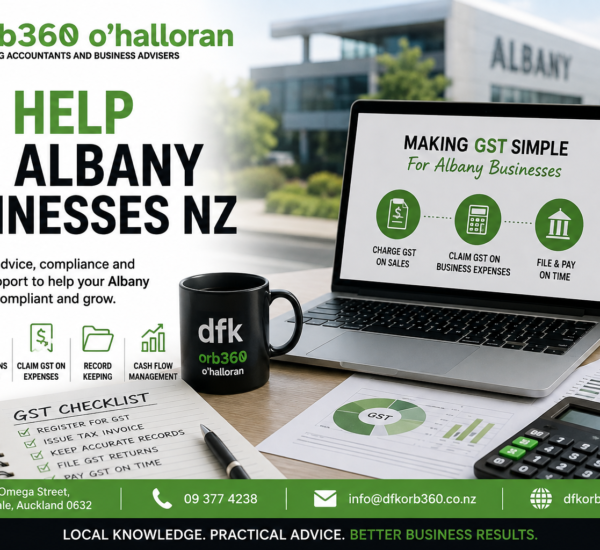
GST Help for Albany Businesses NZ
GST is an important part of running many businesses in New Zealand. Businesses may need to register for GST when their taxable turnover reaches or is expected to reach the applicable threshold, and GST-registered businesses need to manage GST on sales, eligible purchases, GST returns and record keeping.
GST help for Albany businesses NZ can help business owners understand GST registration, filing requirements, taxable supplies, business expenses, GST records and cash-flow considerations.
DFK Orb360 O’Halloran provides accounting and tax advisory services for businesses across Auckland and New Zealand, with a North Shore office in Rosedale serving businesses in Albany and surrounding areas.
Key takeaway: GST should be managed throughout the year rather than treated as a task that only needs attention when a GST return is due.
GST Help for Albany Businesses NZ: Complete Guide
GST can become complicated as a business grows. Sales increase, expenses change, new suppliers are added and business owners may need to manage GST across different types of transactions.
For business owners looking for GST help for Albany businesses NZ, understanding the basic GST rules is an important first step.
Whether you operate a trade business, professional service, retail business, consultancy, online business or another type of taxable activity, GST can affect your pricing, invoices, cash flow and financial records.
This guide explains GST registration, GST returns, expenses, records, common mistakes and practical ways Albany businesses can manage GST more effectively.
What Is the Best GST Advice for an Albany Business?
The best GST approach is to monitor turnover, understand when registration is required, keep accurate records, separate GST from business cash flow and file returns on time. Businesses should also review unusual transactions and significant purchases carefully rather than assuming every business expense receives the same GST treatment.
What Is GST in New Zealand?
Goods and Services Tax is a consumption tax that applies to most goods and services supplied in New Zealand.
GST is generally charged at 15% on taxable supplies made by GST-registered businesses, subject to specific rules and exceptions.
A GST-registered business collects GST on applicable sales and can generally claim GST on eligible business purchases used to make taxable supplies.
The difference between GST collected and eligible GST paid can determine whether the business has GST to pay or a GST refund for the relevant taxable period.
When Does an Albany Business Need to Register for GST?
A business does not automatically have to register for GST simply because it starts operating.
GST registration is generally required when taxable turnover was at least $60,000 in the previous 12 months or is expected to be at least $60,000 in the next 12 months.
Registration can also be required when a business adds GST to the prices it charges customers.
Businesses should monitor their turnover rather than waiting until the end of a financial year to determine whether the threshold has been reached.
GST help for Albany businesses NZ can be particularly useful when a growing business is approaching the GST registration threshold and is unsure what to do next.
Quick Answer: What Is the GST Registration Threshold in NZ?
A business generally needs to register for GST when its taxable turnover is at least $60,000 in the previous 12 months or is expected to reach $60,000 in the next 12 months. GST registration can also be required when GST is added to prices.
Can a Small Albany Business Register for GST Voluntarily?
A business that is below the compulsory registration threshold may still consider voluntary GST registration if it carries out a taxable activity.
Voluntary registration can have advantages and disadvantages depending on the business’s circumstances.
Once registered, the business takes on GST responsibilities, including charging GST on applicable supplies, filing GST returns and keeping the required records.
Business owners should consider their customer base, expenses, pricing, administration and expected growth before deciding whether voluntary registration is appropriate.
How Do GST Returns Work in New Zealand?
GST-registered businesses need to file GST returns for their taxable periods.
The return generally requires information about sales and income, purchases and expenses, along with relevant adjustments.
The business then works out the difference between GST collected and eligible GST paid.
If more GST was collected than paid, the difference may need to be paid to Inland Revenue. If eligible GST paid is greater, the business may be entitled to a GST refund.
GST returns must be filed even where there is no GST to pay for the relevant period.
Quick Answer: What Information Is Needed for a GST Return?
Businesses generally need information about total sales and income, purchases and expenses, and relevant GST adjustments. Accurate accounting records make it easier to prepare and review the return before filing.
When Are GST Returns Due?
GST filing dates depend on the taxable period selected by the business.
Inland Revenue generally requires GST returns and payment to be completed by the 28th day of the month following the end of the taxable period, with specific exceptions for certain periods.
Missing a filing deadline can create unnecessary compliance issues, so businesses should keep track of their filing and payment dates.
GST help for Albany businesses NZ can help owners establish a process for preparing GST information before the return deadline rather than rushing to complete everything at the last minute.
What GST Can an Albany Business Claim?
A GST-registered business can generally claim GST charged on goods and services it purchases for its taxable activity, provided the relevant requirements are met.
Common business purchases may include:
- Business equipment
- Office supplies
- Professional services
- Business software
- Advertising
- Business-related travel
- Materials and stock
- Commercial operating costs
The GST treatment of an expense depends on the nature and use of the purchase. Businesses should keep the required taxable supply information to support GST claims.
Quick Answer: Can a GST-Registered Business Claim GST on Expenses?
Generally, a GST-registered business can claim eligible GST incurred on purchases used for its taxable activity. The business needs to maintain the required records and apply the relevant GST rules to the transaction.
GST Record Keeping for Albany Businesses
Good record keeping is one of the most important parts of GST management.
Businesses need records that support their GST calculations and demonstrate how sales, purchases and expenses have been treated.
Relevant records can include:
- Sales records
- Purchase records
- Invoices and receipts
- Bank statements
- Accounting software records
- Taxable supply information
- GST calculations
- Relevant adjustment records
Inland Revenue requires businesses to keep records of cash and electronic sales and purchases for seven years.
GST help for Albany businesses NZ can include improving bookkeeping processes so that the information required for GST returns is available throughout the year.
How Does GST Affect Business Cash Flow?
GST can have a significant impact on cash flow because GST collected from customers is not necessarily money that belongs to the business.
When customers pay invoices that include GST, the business may need to account for that GST when its return becomes due.
Business owners who spend GST-inclusive revenue without considering upcoming GST obligations can face cash-flow pressure when the return and payment deadline arrives.
One practical approach is to monitor GST throughout the taxable period and maintain enough cash to meet expected obligations.
How Should Albany Businesses Price Products and Services With GST?
GST registration can affect how a business communicates prices to customers.
GST-registered businesses generally need to include GST in the price charged on applicable taxable supplies.
Business owners should make sure their invoices and pricing systems clearly reflect whether quoted prices include GST.
This is particularly important when preparing quotes for customers, negotiating contracts or comparing prices with businesses that have different GST circumstances.
GST help for Albany businesses NZ can help owners review pricing and invoicing processes so GST is handled consistently.
GST Help for Tradies and Contractors in Albany
GST can be especially important for tradies and contractors because their businesses may involve materials, subcontractors, vehicles, tools and larger project invoices.
Contractors should monitor turnover and understand whether their taxable activity requires GST registration.
They should also maintain appropriate records for business purchases and make sure GST is correctly reflected in customer invoices.
Businesses working across different job sites should consider using accounting software that makes it easier to capture expenses and maintain financial records.
7 Common GST Mistakes Albany Businesses Should Avoid
1. Registering Too Late
Businesses should monitor turnover so they know when GST registration becomes necessary.
2. Forgetting GST on Taxable Sales
Once registered, businesses need to apply GST correctly to applicable taxable supplies.
3. Claiming GST Without Supporting Records
Businesses should maintain the required information supporting GST claims.
4. Mixing Business and Personal Transactions
Mixing transactions can make bookkeeping and GST calculations more difficult and can make it harder to identify genuine business purchases.
5. Forgetting GST Payment Dates
Filing a return and paying GST are important parts of meeting GST obligations.
6. Treating GST as Business Profit
GST collected from customers should be considered when planning cash flow because some of that money may need to be paid to Inland Revenue.
7. Not Reviewing Unusual Transactions
Large purchases, asset sales, private-use assets and other unusual transactions may require specific GST treatment.
What Are GST Adjustments?
GST adjustments can arise in situations where the original GST treatment of an expense, asset or transaction needs to be reviewed.
For example, business assets that are also used privately can require consideration of the private-use component.
Adjustments can become more complicated when a business changes how an asset is used, sells an asset or changes its GST registration status.
Businesses should seek professional advice when a transaction is unusual or significant rather than relying on assumptions about its GST treatment.
GST for Online Businesses in Albany
Operating online does not remove a New Zealand business’s tax obligations.
Online retailers, service providers, consultants and other digital businesses may need to consider GST depending on their taxable turnover and the nature of their supplies.
Businesses selling to customers outside New Zealand may also need to consider whether different GST rules apply to particular supplies.
As online business models can involve domestic and international transactions, professional advice can be useful when the GST position is not straightforward.
Can Accounting Software Make GST Easier?
Accounting software can help businesses organise sales, purchases, expenses and banking information throughout the year.
Depending on the software and configuration, it may also help businesses prepare GST information and reduce manual bookkeeping.
Software does not replace professional judgement. Incorrect tax codes, missing transactions or incorrectly categorised expenses can still result in inaccurate GST information.
This is why businesses should periodically review their accounting setup rather than assuming that software automatically handles every GST situation correctly.
Local GST Support for Albany Businesses
Albany is part of Auckland’s North Shore and is home to businesses across many industries, from trades and professional services to retail, hospitality and technology.
DFK Orb360 O’Halloran has a North Shore office in Rosedale, providing convenient local access for businesses operating in Albany and surrounding areas.
For business owners looking for GST help for Albany businesses NZ, having access to an accounting firm that can also assist with tax, financial reporting and wider business advisory matters can provide a more complete approach.
How DFK Orb360 Can Help With GST
DFK Orb360 O’Halloran provides accounting and tax advisory support for businesses across Auckland and New Zealand.
GST-related support can form part of a wider accounting service that includes:
- Accounting & Reporting
- Tax Advisory
- Cloud Accounting Support
- Outsourced CFO Services
- Business Review & Improvement
The aim is to help business owners maintain accurate financial information while understanding their GST and wider tax responsibilities.
Quick Answer: Can an Accountant Help With GST Returns?
Yes. An accountant can help organise financial records, review GST calculations, identify potential issues and prepare information needed for GST filing. Professional support can be particularly useful when a business has complex transactions or limited internal bookkeeping resources.
Quick Answer: How Can a Business Avoid GST Problems?
Monitor turnover, keep accurate records, use appropriate GST accounting codes, reconcile transactions regularly and prepare GST information before the filing deadline. Businesses should also seek advice when dealing with unusual or high-value transactions.
Quick Answer: Does GST Affect Business Cash Flow?
Yes. GST collected from customers can create a future payment obligation, while eligible GST paid on business purchases may affect the amount payable or refundable. Businesses should include GST in their cash-flow planning.
Experienced Accounting and GST Support
DFK Orb360 O’Halloran is a Chartered Accounting and business advisory firm providing accounting, tax, financial reporting and advisory services to businesses and individuals across New Zealand.
The firm’s services include accounting and reporting, tax advisory, cloud accounting, outsourced CFO support, business reviews and wider business advisory services.
Its Rosedale office provides local access for businesses across Auckland’s North Shore, including Albany.
GST rules can depend on the type of transaction, how an asset or service is used and the circumstances of the business. Business owners should obtain professional advice when they are unsure about the GST treatment of a significant or unusual transaction.
People Also Ask: GST for Albany Businesses
What is GST in New Zealand?
GST is New Zealand’s goods and services tax. It generally applies at 15% to taxable supplies made by GST-registered businesses, subject to the applicable rules and exceptions.
When does a business need to register for GST?
A business generally needs to register when taxable turnover reaches or is expected to reach $60,000 in the relevant 12-month period, or when GST is added to prices.
Can a small business voluntarily register for GST?
Yes. A business carrying out a taxable activity may be able to voluntarily register even if its turnover is below the compulsory registration threshold.
Can businesses claim GST on expenses?
GST-registered businesses can generally claim eligible GST incurred on purchases used for their taxable activity, provided the relevant requirements and record-keeping rules are met.
How long should GST records be kept?
Businesses generally need to keep relevant tax records for seven years.
What happens if a GST return is filed late?
Late filing or payment can result in penalties and other compliance consequences. Businesses should check the applicable deadline and contact Inland Revenue or a tax professional if they are unable to meet an obligation.
Can an accountant help with GST in Albany?
Yes. An accountant can help with GST records, calculations, return preparation, compliance processes and broader accounting requirements.
Frequently Asked Questions About GST Help
Is GST the same for every New Zealand business?
The core GST framework applies across New Zealand, but the correct treatment can vary depending on the nature of a business’s supplies, purchases, assets and transactions.
Can DFK Orb360 help a business register for GST?
DFK Orb360 can provide accounting and tax advisory support to help business owners understand their GST registration requirements and establish appropriate accounting processes.
Can DFK Orb360 prepare GST returns?
DFK Orb360 provides accounting and tax support that can assist businesses with GST return preparation and wider GST compliance requirements.
Can DFK Orb360 help with GST errors?
Professional accounting support can help identify potential GST errors, review the underlying records and determine what corrective action may be required.
Does DFK Orb360 work with Albany businesses?
Yes. DFK Orb360 supports businesses across Auckland and New Zealand, with its Rosedale office providing convenient access for Albany and wider North Shore businesses.
Can DFK Orb360 provide accounting beyond GST?
Yes. DFK Orb360 also provides accounting, tax advisory, financial reporting, cloud accounting and business advisory services.
GST Help for Albany Businesses: Key Takeaways
- Monitor your taxable turnover to determine whether GST registration is required.
- Keep accurate sales, purchase and expense records.
- Make sure GST is correctly reflected in applicable customer invoices.
- Review GST claims and retain supporting information.
- Prepare GST returns before the filing deadline.
- Include GST obligations in your cash-flow planning.
- Seek professional advice when transactions are unusual or complex.
For businesses searching for GST help for Albany businesses NZ, DFK Orb360 can provide accounting and tax support designed around the business’s circumstances.
Need GST Help for Your Albany Business?
Speak with DFK Orb360 about GST registration, GST returns, accounting, tax and business advisory support.
Chat With DFK Orb360Get Professional GST Support in Albany
GST does not need to become a year-end headache. With accurate records, reliable accounting processes and the right professional support, business owners can manage GST more confidently throughout the year.
DFK Orb360 O’Halloran supports businesses across Albany, the North Shore, Auckland and New Zealand with accounting, GST, tax and business advisory services.



 09 377 4238
 Level 2, 6 Kingdon Street, Newmarket, Auckland
 help@orb360.co.nz