

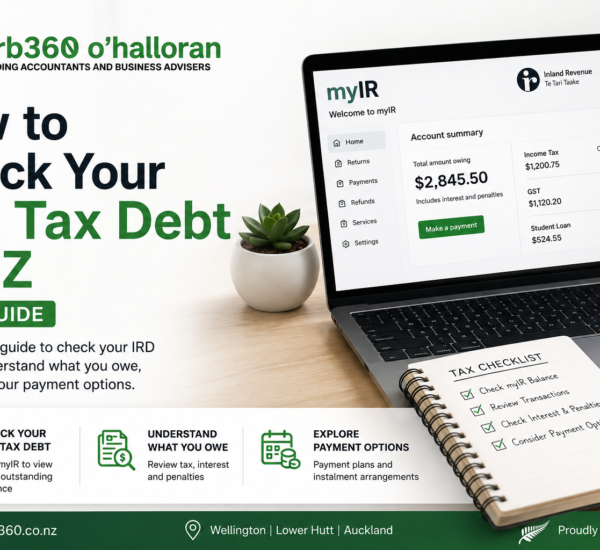
How to Check Your IRD Tax Debt in New Zealand (2026 Guide)
Last Updated: August 2026
If you want to know how to check IRD tax debt in New Zealand, the easiest way is to log in to your myIR account and review your relevant tax account, outstanding balance and transaction history.
Your myIR account allows you to view your tax information and manage certain tax payments and arrangements online. If you cannot pay your IRD tax debt in full, you may also be able to request an instalment arrangement through myIR.
Understanding how to check IRD tax debt is important if you have received an Inland Revenue notice, missed a tax payment, or simply want to confirm whether you have an outstanding tax balance.
How to Check IRD Tax Debt: Quick Answer
To check IRD tax debt, log in to your myIR account and review the relevant tax account, outstanding balance and transaction history. If you are wondering how to check IRD tax debt, myIR is the easiest place to start. Your balance may include outstanding tax, interest and applicable penalties. If you cannot pay the full amount, you may be able to request an instalment arrangement through myIR.
- Log in: Access your myIR account.
- Check your balance: Open the relevant tax account.
- Review transactions: Check assessments, payments, credits, interest and penalties.
- Check payment dates: Confirm when the amount is due.
- Cannot pay? Consider whether an instalment arrangement may be available.
- Need help? A Chartered Accountant can help review and reconcile your IRD position.
How Do I Check IRD Tax Debt?
If you are learning how to check IRD tax debt for the first time, you can start by accessing your myIR account. Inland Revenue’s online system provides access to relevant tax accounts and information about amounts owing.
- Log in to your myIR account.
- Open the relevant tax account.
- Review your outstanding balance.
- Check your transaction history.
- Review recent assessments and tax returns.
- Check payments and credits applied to your account.
- Review any interest or penalties.
- Check the relevant payment due date.
- Determine whether you can pay the amount in full.
- If you cannot pay in full, review whether an instalment arrangement may be appropriate.
Knowing how to check IRD tax debt can help you identify an outstanding balance before it becomes more difficult to manage.
View Inland Revenue’s myIR services and tasks .
Key Takeaways
- You can check your IRD tax debt through your myIR account.
- Your tax account shows your current outstanding balance and transaction history.
- Your debt may relate to income tax, GST, PAYE, provisional tax or another tax obligation.
- Interest and penalties may apply to overdue tax.
- If you cannot pay the full amount, you may be able to request an instalment arrangement.
- Checking your tax position regularly can help you avoid unexpected liabilities.
- A Chartered Accountant can help you understand your tax position and available options.
What Information Can You See About Your IRD Debt?
If you are researching how to check IRD tax debt, remember that the balance shown in myIR is only part of the picture. Your transaction history can help explain where the amount came from and whether it includes interest, penalties or previous unpaid tax.
Depending on your circumstances, your outstanding IRD balance could relate to:
- Income tax
- GST
- Provisional tax
- PAYE
- Employer tax obligations
- Fringe benefit tax
- Late-payment penalties
- Interest on overdue amounts
Your transaction history is particularly useful when you are trying to understand why the amount shown in your account does not match your expectations.
If you are a business owner, keeping your accounting records reconciled with your IRD account can help identify discrepancies and prevent unexpected tax liabilities.
For ongoing accounting support, see DFK Orb360’s Accounting & Reporting Services .
How to Check IRD Tax Debt and Find Out What You Owe
The most direct way to find out how much tax you owe IRD is to log in to myIR and review the relevant tax account. Understanding how to check IRD tax debt can help you distinguish between an amount that is currently due and an amount that has become overdue.
When reviewing your account, compare:
- Tax assessed
- Payments made
- Credits or refunds
- Interest
- Penalties
- Current outstanding balance
If the balance looks unexpected, review your transaction history and recent tax assessments before assuming that the amount is incorrect.
If you still cannot determine why you owe money, an accountant or tax adviser can help reconcile your IRD account with your tax records.
Why Do I Owe Money to IRD?
Knowing how to check IRD tax debt can help you identify whether the amount relates to income tax, GST, provisional tax, PAYE or another tax obligation.
There are several reasons an individual or business may have an outstanding IRD balance.
For Individuals
- Not enough tax was deducted during the year.
- Your income changed during the year.
- You earned income from multiple sources.
- You received income without tax being deducted.
- You became self-employed.
- Your tax assessment resulted in an amount payable.
- A previous tax liability was not paid by its due date.
For Businesses
- GST obligations were not paid on time.
- Provisional tax was underpaid or missed.
- PAYE obligations were not paid by the due date.
- Income tax remained outstanding.
- Tax calculations or filings contained errors.
- Cash-flow problems made it difficult to meet tax obligations.
- Returns or other tax filings were overdue.
Identifying which tax obligation created the debt is important because it determines what needs to be corrected and what options may be available.
Does IRD Tax Debt Include Interest and Penalties?
It can. Inland Revenue may charge penalties and interest when tax is not paid by the relevant due date.
The exact amount depends on the type of tax, the amount outstanding and the circumstances surrounding the debt.
If you are trying to understand how to check IRD tax debt, it is important to look beyond the original tax amount and review whether interest or penalties have been added.
You can read the latest information about Inland Revenue penalties and interest on the official IRD website.
This is why checking your current myIR balance is more reliable than relying on an older statement or remembering the amount you originally owed.
What If I Cannot Access MyIR?
If you cannot access your myIR account, Inland Revenue provides options to resolve common login problems and recover access to your account.
Visit Inland Revenue’s myIR login help for assistance.
If you are still unable to access your account or cannot understand your tax position, you can contact Inland Revenue directly or speak with a qualified accountant or tax adviser.
What Happens If I Cannot Pay My IRD Tax Debt?
If you cannot afford to pay your IRD tax debt in full, do not simply ignore the balance.
Once you understand how to check IRD tax debt, the next step is to determine whether you can pay the outstanding amount by the due date or need to explore an instalment arrangement with Inland Revenue.
Inland Revenue allows eligible taxpayers to request an instalment arrangement when they cannot pay their debt in full by the due date or have overdue debt.
Through myIR, you can review the amount owing and request an arrangement based on your ability to make regular payments.
Interest can continue to apply to overdue amounts under an instalment arrangement, while the treatment of late-payment penalties depends on the circumstances and the terms of the arrangement.
For more information, read DFK Orb360’s IRD Payment Plan New Zealand guide .
Can I Set Up an IRD Payment Plan Online?
Yes. Eligible taxpayers can request an instalment arrangement through myIR.
According to Inland Revenue’s current instructions, taxpayers can select “Request an instalment arrangement” from the relevant options in myIR.
If you know how to check IRD tax debt, you can first establish the exact amount owing and then determine whether an instalment arrangement may be necessary.
You will need to consider how much you can afford to pay, how frequently you want to make payments and when you want payments to begin.
Read the official IRD guide to instalment arrangements .
What Happens If I Ignore My IRD Tax Debt?
Ignoring an IRD tax debt can make the situation more difficult. Inland Revenue has continued to focus on overdue debt and returns during 2026.
In July 2026, Inland Revenue announced that it was continuing a targeted campaign involving customers with overdue debt and returns. Where debts remain unresolved, this can lead to further collection action.
Inland Revenue explains that where attempts to resolve overdue debt do not result in a positive outcome, further collection steps may be taken, including bank deductions in appropriate circumstances.
Read Inland Revenue’s 2026 overdue debt update .
The practical takeaway is simple: if you know you have an outstanding IRD balance, addressing it early is generally preferable to waiting for collection action.
What Should Businesses Do If They Have IRD Tax Debt?
For business owners, knowing how to check IRD tax debt is especially important because several tax accounts may need to be monitored, including GST, PAYE, provisional tax and income tax.
Businesses should first identify exactly which tax obligations are overdue.
- Review the business’s myIR accounts.
- Identify all outstanding tax obligations.
- Check whether returns are overdue.
- Reconcile IRD balances against accounting records.
- Calculate what the business can realistically afford to pay.
- Consider an instalment arrangement if the debt cannot be paid in full.
- Review future tax obligations to avoid creating additional debt.
Businesses can also benefit from reviewing their accounting and reporting processes to ensure tax liabilities are identified before payment deadlines.
Explore DFK Orb360’s Accounting & Reporting Services for ongoing accounting support.
What Should I Do If I Think My IRD Tax Debt Is Wrong?
If your myIR balance does not look correct, do not automatically assume that the amount is payable or that IRD has made an error.
Start by checking:
- Your relevant tax account.
- Your transaction history.
- Recent tax returns.
- Tax assessments.
- Payments made to IRD.
- Interest and penalties.
- Recent IRD correspondence.
If you still cannot reconcile the balance, contact Inland Revenue or speak with a tax professional.
DFK Orb360’s Tax Advisory services can help businesses understand their tax obligations and manage their broader tax position.
How Can a Chartered Accountant Help With IRD Tax Debt?
An experienced Chartered Accountant can help you understand why you owe IRD, reconcile your tax accounts and assess practical options for dealing with outstanding tax obligations.
If you have already learned how to check IRD tax debt but cannot reconcile the amount shown in myIR, professional advice can help you understand the balance and determine the appropriate next step.
Depending on your circumstances, professional support may include:
- Reviewing your IRD account.
- Reconciling tax payments and assessments.
- Identifying outstanding returns.
- Reviewing GST and provisional tax obligations.
- Assessing cash-flow implications.
- Reviewing tax penalties and interest.
- Helping you understand payment and instalment options.
- Communicating with Inland Revenue where appropriate.
- Developing processes to prevent recurring tax debt.
At DFK Orb360 O’Halloran Chartered Accountants , our team provides tax, accounting and business advisory support across New Zealand.
Find a DFK Orb360 office or contact our team to discuss your tax position.
People Also Ask About IRD Tax Debt
How long does IRD tax debt stay on your account?
An IRD tax debt remains outstanding until the amount has been paid, otherwise resolved, or dealt with through an arrangement or other approved process. If you are unsure how to check IRD tax debt, start by reviewing your current balance and transaction history in myIR.
Can I check if I owe IRD money before filing my tax return?
Yes. You can log in to your myIR account and review your relevant tax accounts to see whether there are existing outstanding amounts. Checking your account before filing can help you identify previous balances, payments or other transactions that may affect your current tax position.
Why has my IRD debt increased?
Your IRD debt may increase if additional tax becomes payable or if interest and applicable penalties are added to an overdue balance. Reviewing your myIR transaction history can help you understand why the amount has changed.
Can my IRD tax debt affect my business?
Yes. Unpaid tax can create cash-flow pressure and may result in additional interest, penalties or collection activity. For businesses, unresolved tax debt can also make it harder to manage GST, PAYE, provisional tax and other ongoing obligations.
What happens if I miss an IRD payment?
If you miss an IRD payment, the amount may become overdue and interest or penalties may apply depending on the type of tax and circumstances. If you have missed a payment, check your myIR account to confirm the current amount owing and consider your available payment options.
Can IRD tax debt be written off?
In some circumstances, Inland Revenue may consider specific forms of relief or remission, but this depends on the type of debt and your individual or business circumstances. Taxpayers should not assume that an outstanding balance will automatically be written off. Professional advice can help determine whether any relief may be available.
Can I pay my IRD debt in instalments?
If you cannot afford to pay your IRD debt in full, you may be able to request an instalment arrangement through myIR. The appropriate arrangement depends on your circumstances and ability to make payments.
How often should I check my IRD account?
There is no single checking schedule that applies to everyone, but regularly reviewing your myIR account can help you stay aware of upcoming payments, outstanding balances and other tax obligations. Businesses with GST, PAYE or provisional tax obligations should keep their tax position up to date throughout the year.
What is the difference between an IRD balance and IRD tax debt?
An amount shown as owing in your IRD account becomes a tax debt when it remains payable to Inland Revenue. Your account balance can include current amounts that are due as well as overdue amounts, so it is important to check the transaction history and payment due dates.
Should I pay my IRD debt immediately?
If an amount is due and you can afford to pay it, paying by the relevant due date can help you avoid additional interest and applicable penalties. If you cannot pay the full amount, check your options rather than ignoring the balance.
Can a Chartered Accountant negotiate with IRD?
A Chartered Accountant can communicate with Inland Revenue on behalf of a client where appropriate and help explain the client’s tax position. Professional support can also include reviewing tax accounts, reconciling balances and assessing available payment or compliance options.
What should I do if I have multiple IRD debts?
If you have multiple outstanding tax accounts, review each account in myIR to understand the amounts, due dates and applicable charges. A Chartered Accountant can help reconcile the accounts and develop a practical approach to managing the overall tax position.
Frequently Asked Questions About Checking IRD Tax Debt
How do I check my IRD tax debt?
Log in to your myIR account and open the relevant tax account. Review the outstanding balance and transaction history to see what you owe.
How do I check how much tax I owe IRD?
You can check how much tax you owe by logging in to myIR and reviewing the relevant tax account. Your current balance may include the original tax amount as well as applicable interest or penalties.
Can I check my IRD debt online?
Yes. You can use myIR to view relevant tax account information and manage certain payment options, including requesting an instalment arrangement where applicable.
Does IRD charge interest on tax debt?
Interest can apply to overdue tax. The amount and timing depend on the relevant tax and circumstances.
What happens if I cannot pay my IRD debt?
If you cannot pay your IRD debt in full, you may be able to request an instalment arrangement through myIR.
Does an IRD payment plan stop interest?
Not necessarily. Interest can continue to apply to unpaid tax under an instalment arrangement. The treatment of late-payment penalties depends on the circumstances and compliance with the arrangement.
Can IRD recover unpaid tax?
Yes. Inland Revenue has debt-collection powers and may take further action where overdue debt remains unresolved.
Should I speak to an accountant about IRD tax debt?
Professional advice can be useful if the debt is significant, involves multiple tax accounts, includes penalties or interest, or you are unsure why the amount is outstanding.
Need Help Managing Your IRD Tax Debt?
Knowing how to check IRD tax debt is the first step towards taking control of an outstanding tax balance. After checking what you owe, you can review your payment options and take appropriate action.
If you have checked your IRD account and discovered an outstanding balance, the next step is to understand why the debt exists and determine the most appropriate way to manage it.
DFK Orb360 O’Halloran provides tax advisory, accounting and business support across New Zealand. Our team can help you review your tax position, understand your obligations and plan your next steps.
Contact DFK Orb360 to discuss your tax situation .
About This Article
This article has been prepared and reviewed by the tax advisory team at DFK Orb360 O’Halloran , a New Zealand accounting and advisory firm providing tax, accounting, compliance and business advisory services.
Information in this article is based on current Inland Revenue guidance available at the time of publication. Tax rules, interest rates and administrative processes can change, so readers should confirm current requirements with Inland Revenue or obtain professional advice for their specific circumstances.
Disclaimer
This article is intended for general information purposes only and does not constitute tax, accounting, legal or financial advice. Tax laws, Inland Revenue guidance and regulatory requirements may change over time. Professional advice should be obtained based on your specific circumstances before taking action.



 09 377 4238
 Level 2, 6 Kingdon Street, Newmarket, Auckland
 help@orb360.co.nz