

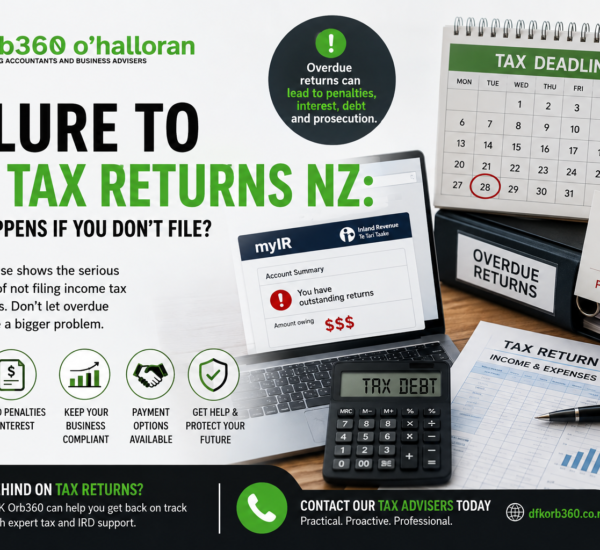
Failure to File Tax Returns NZ: What Happens If You Don’t File?
Last Updated: August 2026
The recent failure to file tax returns NZ case involving an Auckland builder highlights why businesses should take their income tax and GST filing obligations seriously.
On 7 July 2026, Inland Revenue reported that an Auckland builder was sentenced to six months of community detention after facing two representative charges relating to failing to provide information to Inland Revenue with the intention of evading the assessment or payment of income tax and GST. He was also ordered to pay $22,549.50 in reparation.
Inland Revenue said the taxpayer had regular income from building work but had not filed income tax or GST returns between 2018 and 2020. The total tax evaded was reported as $40,618.60, consisting of $26,027.10 in income tax and $14,591.50 in GST.
This case should not be interpreted as meaning that every business with a late tax return will face prosecution. However, it demonstrates why repeatedly ignoring filing obligations can create serious tax compliance risks.
For businesses that are behind on GST, income tax or other returns, the priority should be to understand what is outstanding, bring filings up to date and address any resulting IRD debt or compliance issue as early as possible.
Failure to File Tax Returns NZ: Quick Answer
Failure to file tax returns NZ can result in penalties, interest, tax debt and other IRD compliance consequences. In serious cases involving deliberate tax evasion, persistent non-compliance may lead to prosecution.
The 2026 Auckland builder case involved income tax and GST returns that were not filed between 2018 and 2020. Inland Revenue said the taxpayer had previously been convicted for similar offending and continued to fail to meet his tax obligations. He was sentenced to six months of community detention and ordered to pay $22,549.50 in reparation.
- Businesses must meet their required income tax filing obligations.
- GST-registered businesses generally need to file GST returns for each taxable period.
- Late filing can result in penalties and interest depending on the circumstances.
- Unfiled returns can make it difficult to establish your actual IRD position.
- Tax debt and filing obligations are separate issues.
- If you cannot pay your tax, you should still address your filing obligations.
- Professional tax advice can help businesses resolve multiple overdue returns and IRD issues.
What Happened in the 2026 Auckland Builder Tax Case?
The failure to file tax returns NZ case reported by Inland Revenue involved Auckland builder Christopher Allan Mankin.
Mankin registered for income tax in May 2011 and was required to file income tax returns. He registered for GST in February 2013 and was required to file GST returns every second month.
Inland Revenue said his bank accounts showed regular income from building work, but no income tax or GST returns were filed between 2018 and 2020.
The case was particularly serious because Inland Revenue reported that Mankin had previously been convicted in 2019 in relation to 34 charges involving failures to provide income tax and GST information over a five-year period.
Inland Revenue said he continued to fail to comply with his income tax and GST obligations after that conviction.
The total tax evaded was reported as:
- $26,027.10 in income tax
- $14,591.50 in GST
- Total: $40,618.60
He was sentenced to six months of community detention and ordered to pay $22,549.50 in reparation. A further $3,000 in fines was remitted in exchange for 150 hours of community work to allow him to make the reparation payments at $70 per week.
Read the official Inland Revenue media release.
Is Failure to File Tax Returns a Criminal Offence in NZ?
Not every late or overdue tax return results in a criminal offence.
There is an important difference between an administrative failure to file a return on time, having an unpaid tax bill and deliberately failing to provide information with the intention of evading tax.
In the Auckland builder case, Inland Revenue reported that the charges involved failing to provide information with the intention of evading the assessment or payment of income tax and GST. The taxpayer also had a previous conviction for similar conduct.
That is significantly different from a business that accidentally misses a filing deadline and then takes steps to correct the problem.
However, repeated and deliberate non-compliance can create substantially greater risks.
What Happens If You Don’t File a Tax Return in NZ?
The consequences of failure to file tax returns NZ depend on the type of return, the circumstances and how the taxpayer responds to the outstanding obligation.
Potential consequences can include:
- Late filing penalties.
- Interest on amounts owing.
- Estimated or default assessments in certain circumstances.
- Growing IRD tax debt.
- Collection action.
- Increased compliance risk.
- Difficulty understanding your true tax position.
- Potential prosecution in serious cases involving deliberate tax evasion.
One of the biggest mistakes a business can make is assuming that not filing means no tax is owed.
Inland Revenue may have other information available to assess a taxpayer’s position. Not filing a return does not remove the underlying tax obligation.
What Happens If a Business Doesn’t File GST Returns?
If your business is GST registered, you generally need to file a GST return for each taxable period.
This applies even where there is little or no GST to pay. A nil return may still need to be filed.
For most taxable periods, GST returns are due by the 28th of the month following the end of the taxable period, although there are exceptions for certain taxable periods.
Late filing and payment can result in penalties and interest depending on the circumstances.
For a business with multiple unfiled GST returns, the issue can become more difficult because the business may not have a clear picture of its actual GST liability.
DFK Orb360 provides tax advisory and IRD compliance services, including GST submissions, income tax returns and IRD communication.
Does an Overdue Tax Return Mean You Owe Tax?
Not necessarily.
A tax return establishes your tax position for the relevant period. Depending on your circumstances, the result may be tax payable, a refund or no additional amount.
However, if you are required to file a return, you should not ignore it simply because you believe you will not owe tax.
Filing allows your actual tax position to be established and can help you identify whether there is an outstanding liability or refund.
What If My Business Cannot Afford to Pay Its Tax?
A business being unable to pay its tax bill is different from failing to file the required returns.
If cash flow is tight, the business should still address its filing obligations so that the actual tax liability can be established.
Once the amount owing is known, payment options may be considered.
Inland Revenue provides payment arrangements for eligible taxpayers who cannot pay their tax debt in full. Businesses should assess their position early rather than allowing tax debt to continue accumulating.
DFK Orb360’s guide explains how IRD payment plans work in New Zealand, including the steps involved and when professional advice may be useful.
Can You File Overdue Tax Returns?
Yes. If your business has missed previous filing deadlines, the returns do not simply disappear.
The appropriate process depends on whether the outstanding filings relate to income tax, GST, PAYE or another tax obligation.
Before preparing overdue returns, gather relevant records such as:
- Business bank statements.
- Sales records.
- Purchase and expense records.
- GST invoices.
- Accounting records.
- Payroll information.
- Previous tax returns.
- IRD correspondence.
If multiple returns are outstanding, professional assistance can help you determine which periods are missing and what records are required.
What Should a Business Do If It Has Several Overdue Returns?
If your business has experienced failure to file tax returns NZ for several periods, do not continue postponing the problem.
A practical approach is to:
- Log into myIR.
- Review all tax accounts.
- Identify missing income tax returns.
- Identify missing GST returns.
- Check for outstanding IRD debt.
- Gather financial records for each period.
- Prepare and file the outstanding returns.
- Review penalties and interest.
- Consider payment arrangements if necessary.
- Seek professional advice if the position is complex.
The earlier a business understands its actual position, the easier it can be to make an informed plan for resolving the outstanding obligations.
What If My Business Hasn’t Filed GST Returns for Months?
If your business has missed several GST filing periods, you should address the issue as soon as possible.
A business should not assume that it can simply leave GST returns unfiled because revenue was low or there was no GST to pay.
If you are unsure which GST periods are outstanding, your first step should be to review your GST account and filing history in myIR.
If the business has incomplete accounting records, multiple unfiled returns or significant GST debt, an accountant can help organise the information and determine the appropriate next steps.
What Is the Difference Between Late Filing and Tax Evasion?
| Late or Overdue Filing | Deliberate Tax Evasion |
|---|---|
| A return is submitted after the deadline. | Information may deliberately be withheld or falsified. |
| May result in penalties or interest. | Can potentially result in prosecution. |
| Can result from an administrative mistake. | Involves deliberate conduct and intent. |
| Can generally be addressed by bringing filings up to date. | May require more serious compliance and legal attention. |
The 2026 Auckland builder case involved charges relating to an intention to evade the assessment or payment of income tax and GST. It should therefore not be treated as an example of what automatically happens to every taxpayer who files late.
Can IRD Prosecute a Business for Not Filing Tax Returns?
In serious cases, deliberate failure to comply with tax obligations can result in prosecution.
The Auckland builder case demonstrates that persistent non-compliance can become particularly serious where Inland Revenue believes there was an intention to evade tax.
Inland Revenue also reported that the taxpayer had previously been convicted for similar failures and continued to fail to meet his income tax and GST obligations.
For a business with overdue returns, the appropriate response is to establish what is outstanding and begin resolving the position rather than assuming that prosecution is inevitable.
Why Should Businesses File Tax Returns on Time?
Keeping tax filings up to date is an important part of financial and compliance management.
Timely filing can help your business:
- Understand its true tax position.
- Identify GST liabilities accurately.
- Manage cash flow more effectively.
- Reduce the risk of avoidable penalties.
- Keep IRD records accurate.
- Identify tax issues earlier.
- Make better financial decisions.
- Maintain stronger compliance processes.
For growing businesses, tax compliance should form part of the broader financial management system rather than being treated as an afterthought.
How Can an Accountant Help With Overdue Tax Returns?
If your business has fallen behind with tax filings, an accountant can help you understand the scope of the problem and work through the outstanding requirements.
DFK Orb360’s tax advisory team assists businesses and individuals with income tax returns, GST submissions, tax planning, documentation, audits and communication with Inland Revenue.
Our Tax Advisory Services are designed to help businesses remain compliant while managing their broader tax position.
Professional support can be particularly useful when you have:
- Multiple overdue tax returns.
- Unfiled GST returns.
- Outstanding IRD debt.
- Incomplete financial records.
- Penalties and interest.
- IRD correspondence.
- A business with fluctuating income.
- Concerns about an IRD review or investigation.
Behind on Your Tax Returns or GST Filings?
If your business has overdue income tax or GST returns, ignoring the issue can make your IRD position harder to manage.
DFK Orb360 can help you understand what is outstanding, organise your tax filings, review your tax position and consider the appropriate options for dealing with any resulting IRD debt.
Don’t wait for an overdue tax return to become a bigger compliance problem.
People Also Ask About Failure to File Tax Returns NZ
What should a business do first if tax returns are overdue?
If you are dealing with failure to file tax returns NZ, start by checking your myIR account and identifying exactly which returns are outstanding. Gather your accounting and financial records before preparing the missing returns.
Can a business fix overdue tax returns without an accountant?
Some straightforward overdue returns can be prepared and filed by the business itself. However, failure to file tax returns NZ becomes more complicated when several periods, GST obligations, incomplete records or IRD debt are involved.
Does failure to file tax returns NZ automatically mean tax evasion?
No. Failure to file tax returns NZ does not automatically mean tax evasion. Late filing can occur because of administrative errors, financial difficulties or other circumstances. Deliberate attempts to evade tax are treated differently.
What happens if a company has several unfiled GST returns?
Several unfiled GST returns can create compliance and cash-flow problems. If your business has experienced failure to file tax returns NZ, it should identify the missing GST periods, prepare the relevant records and establish whether any GST debt is outstanding.
Can an accountant help with IRD communication?
Yes. DFK Orb360 provides IRD compliance support and can assist with communication, documentation and broader tax matters. This can be particularly useful when a business has multiple overdue returns or has received correspondence from Inland Revenue.
What if I cannot afford to pay the tax after filing?
If you cannot afford to pay the tax immediately, filing and payment should be treated as separate issues. Once the actual liability is established, payment arrangements may be available depending on your circumstances.
Can self-employed people get behind on GST and income tax?
Yes. Self-employed people and contractors can have multiple filing obligations. Repeated failure to file tax returns NZ can result in penalties, debt and increased compliance risk.
What if IRD has already contacted my business?
Do not ignore Inland Revenue correspondence. Review what information or returns IRD is requesting and consider professional advice if the matter involves multiple overdue filings, significant debt or potential compliance concerns.
Can an accountant help with years of unfiled tax returns?
Yes. If your business has experienced failure to file tax returns NZ for multiple years, an accountant can help identify outstanding periods, organise financial records, prepare returns and review the resulting tax position.
Why should I resolve overdue tax returns quickly?
Addressing failure to file tax returns NZ early can help establish your actual tax position before penalties, interest or collection issues become more difficult to manage.
Frequently Asked Questions About Overdue Tax Returns
What is a tax return?
A tax return provides Inland Revenue with information needed to establish your tax position for the relevant period.
Do GST-registered businesses have to file GST returns?
Yes. GST-registered businesses generally need to file a GST return for each taxable period, including where there is no GST to pay.
Can I pay my IRD debt in instalments?
Depending on your circumstances, Inland Revenue may allow an instalment arrangement for overdue tax debt. DFK Orb360 can also help businesses understand their options.
What happens if I don’t pay my tax debt?
Overdue tax debt can attract interest and penalties and may lead to collection action. Businesses should address outstanding debt as early as possible.
Should I file my return if I cannot afford to pay the tax?
Generally, filing and payment are separate obligations. Filing the return helps establish the actual tax liability, after which payment options can be considered.
Can overdue GST returns be filed later?
Yes. If GST returns are overdue, the business should identify the missing taxable periods and work toward bringing its GST filings up to date.
What records are needed to prepare overdue returns?
The records required depend on the type of return but can include bank statements, sales records, expense records, GST invoices, accounting records and previous tax documents.
Need Help Getting Your Tax Affairs Back on Track?
Whether your business has missed one return or has several years of outstanding tax filings, getting the position reviewed can help you understand what needs to happen next.
DFK Orb360 provides tax advisory, accounting and IRD compliance support to businesses and individuals across New Zealand.
Speak with our tax advisory team today.
About DFK Orb360 O’Halloran
DFK Orb360 O’Halloran is a New Zealand accounting and advisory firm providing tax advisory, accounting, compliance and business advisory services. The firm supports businesses and individuals with tax compliance, GST, income tax, IRD matters and broader financial decisions.
DFK Orb360 provides tax advisory services including income tax planning, income tax return filing, GST submissions, provisional tax planning, documentation, audits and communication with Inland Revenue.
Learn more about DFK Orb360 O’Halloran.
Disclaimer
This article provides general information about New Zealand tax filing obligations and the 2026 Inland Revenue court case. It does not constitute tax, accounting, legal or financial advice. Tax laws, penalties and Inland Revenue processes may change. Professional advice should be obtained based on your individual circumstances before taking action.



 09 377 4238
 Level 2, 6 Kingdon Street, Newmarket, Auckland
 help@orb360.co.nz