

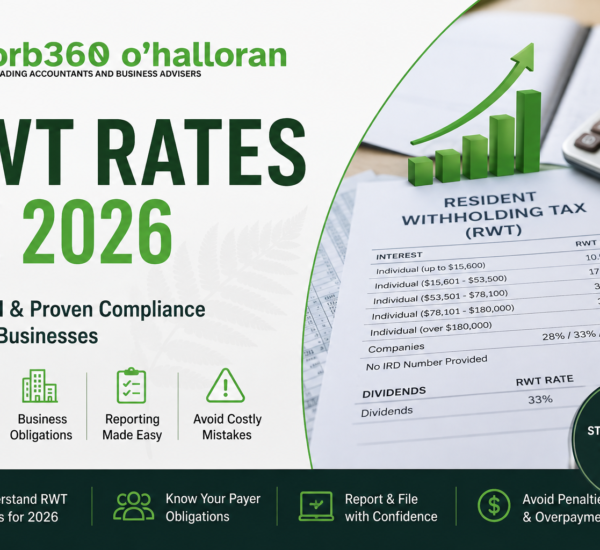
RWT for NZ Businesses: Rates, Rules & Common Compliance Mistakes
Last Updated: August 2026
Resident Withholding Tax (RWT) is an important tax obligation for New Zealand businesses that pay certain types of investment income, particularly interest and dividends. Choosing the correct RWT rates NZ 2026 and meeting reporting requirements can help businesses avoid unnecessary tax issues.
RWT is not simply a tax that applies to individuals receiving bank interest. Businesses can also have RWT obligations when they pay interest to investors or make certain dividend payments.
In 2026, Inland Revenue has also made changes to how withholding tax accounts are organised in myIR, making it important for businesses, tax agents and bookkeepers to understand where these accounts are managed.
RWT Rates NZ 2026: Quick Answer
RWT rates NZ 2026 depend on the type of income recipient and the nature of the payment. For interest, individuals can generally use rates ranging from 10.5% to 39%, while companies that have provided their IRD number and company status can use 28%, 33% or 39%.
If an interest recipient does not provide an IRD number, the non-declaration rate is generally 45%.
For dividends, the RWT rate is generally 33%, although imputation credits can affect the amount of tax ultimately payable.
- RWT mainly applies to interest and certain dividend payments.
- Companies receiving interest can generally use 28%, 33% or 39%.
- The non-declaration rate for interest is generally 45% when an IRD number has not been provided.
- The RWT rate for dividend payments is generally 33%.
- Businesses that pay investment income may have RWT registration and reporting obligations.
- Incorrect RWT treatment can create additional tax issues later.
What Is Resident Withholding Tax?
Resident Withholding Tax, commonly called RWT, is tax deducted at source from certain investment income paid to New Zealand tax residents.
For example, if a business pays interest to an investor, the business may need to deduct RWT before paying the investor the net amount.
The RWT deducted is then reported to Inland Revenue and is generally credited against the recipient’s tax liability.
This means RWT is usually not an additional tax on top of the recipient’s final income tax liability. Instead, it is a way of collecting tax during the year.
What Are the RWT Rates in New Zealand in 2026?
The correct RWT rates NZ 2026 depend on the recipient and the type of investment income.
RWT Rates on Interest
| Recipient or circumstance | RWT rate |
|---|---|
| Individual income up to $15,600 | 10.5% |
| Individual income $15,601–$53,500 | 17.5% |
| Individual income $53,501–$78,100 | 30% |
| Individual income $78,101–$180,000 | 33% |
| Individual income over $180,000 | 39% |
| Companies | 28%, 33% or 39% |
| No IRD number provided | 45% |
These rates are based on current Inland Revenue guidance.
Companies that have provided their IRD number and company status can generally use 28%, 33% or 39% for interest. If a company does not select a rate, the default is generally 28%.
Businesses should make sure the RWT rate selected is appropriate for their tax position. Using an inappropriate rate can result in an end-of-year tax bill.
Businesses should review the RWT rates NZ 2026 that apply to their investment income and make sure the correct rate is being used.
What RWT Rate Does a Company Use?
For companies receiving interest, the RWT rates NZ 2026 available are generally 28%, 33% or 39%, provided the company has given its interest payer the required IRD number and company status.
If a company does not choose a rate, RWT will generally be deducted at 28%.
Businesses should make sure the selected rate reflects their circumstances. Using an inappropriate rate can result in additional tax being payable at the end of the tax year.
What Is the RWT Rate on Dividends?
The RWT rate for dividend payments is generally 33%.
The company paying the dividend deducts RWT before making the dividend payment.
However, New Zealand companies can attach imputation credits to dividends. These credits represent tax already paid by the company and can reduce the amount of further tax payable by the shareholder.
Businesses paying dividends should therefore consider both RWT and applicable imputation rules rather than treating the 33% rate as the entire tax calculation.
Who Needs to Register for RWT?
A business may need to register as an RWT payer if it pays investment income that is subject to withholding tax.
IRD states that if investors other than banks or other financial institutions have money invested in your business and the business pays more than $5,000 a year in interest to those investors, the business needs to register as a payer for RWT on interest.
Businesses paying dividends or other investment income may have different RWT registration requirements.
Inland Revenue provides a registration process through myIR for businesses that need to register as an RWT payer.
What Are the RWT Obligations for Businesses?
If your business is required to deduct RWT, you need to make sure the tax is calculated, deducted, reported and paid correctly.
Depending on your circumstances, your business may need to:
- Register for an RWT account.
- Obtain the relevant information from recipients.
- Apply the correct RWT rate.
- Deduct RWT from applicable investment income.
- Keep accurate records.
- Report investment income to Inland Revenue.
- Pay the deducted tax to IRD.
- Provide appropriate information to recipients.
Businesses that pay investment income can use electronic reporting options through myIR.
What Happens If You Use the Wrong RWT Rate?
Using the wrong RWT rate can create problems for the recipient and may also indicate that the payer’s processes need reviewing.
For example, if too little RWT is deducted from investment income, the recipient may have additional tax to pay when their income tax position is assessed.
If too much tax is deducted, the recipient may need to claim or receive the appropriate credit through their tax assessment.
For businesses paying investment income, accurate RWT records and reporting are therefore important parts of tax compliance.
Reviewing the RWT rates NZ 2026 against your company’s current tax position can help prevent incorrect withholding.
What Happens If an Investor Does Not Provide an IRD Number?
If an interest recipient does not provide an IRD number, the applicable non-declaration rate is generally 45%.
This is significantly higher than the standard RWT rates used by most taxpayers.
Businesses paying interest should therefore have appropriate processes for collecting and recording recipient information before making payments.
What Are Common RWT Compliance Mistakes?
Some common mistakes businesses should watch for include:
- Using the wrong RWT rate.
- Failing to register as an RWT payer when required.
- Not obtaining the recipient’s IRD number.
- Applying the wrong treatment to interest payments.
- Failing to deduct RWT from applicable payments.
- Incorrectly reporting investment income.
- Failing to reconcile RWT deductions.
- Incorrectly handling dividends and imputation credits.
- Failing to keep adequate supporting records.
Understanding the RWT rates NZ 2026 is particularly important for businesses that regularly receive interest or make investment-related payments.
Even relatively small errors can become difficult to resolve when they accumulate over multiple payments or tax periods.
How Do Businesses Report RWT to IRD?
Businesses that pay investment income can report RWT through myIR.
IRD provides electronic filing options for businesses reporting investment income. The appropriate filing method depends on factors such as the number of payees and filing frequency.
For RWT on interest, information reported can include gross interest paid, RWT deducted, the RWT rate and relevant information about joint account holders.
Businesses should ensure their accounting records and RWT reporting are properly reconciled.
What Changed for RWT Accounts in myIR in 2026?
There are also changes worth noting for businesses and tax professionals using myIR.
In July 2026, Inland Revenue announced that withholding tax accounts, including RWT, were being separated into logical groups in the Intermediary Centre under client registration.
This change is particularly relevant to tax agents, bookkeepers and other representatives who manage tax accounts for clients.
If your business or accounting practice manages multiple client tax accounts, it is worth checking that your staff understand where RWT registrations are now located in myIR.
How Can Businesses Stay RWT Compliant?
A practical RWT compliance process should include regular reviews of:
- Who is receiving interest or dividend payments.
- Whether the correct IRD numbers have been collected.
- Which RWT rate applies.
- Whether RWT has been deducted correctly.
- Whether the deductions have been reported to IRD.
- Whether payments to investors reconcile with the accounting records.
- Whether the business’s RWT account is correctly registered.
Businesses that make regular investment payments should consider including RWT in their routine tax compliance checks rather than reviewing it only at year-end.
Not Sure If Your Business Is Applying the Correct RWT Rate?
RWT can become complicated when a business pays interest to investors, makes dividend payments or has multiple shareholders and investment arrangements.
DFK Orb360 can help review your RWT treatment, tax reporting and broader business tax compliance.
Our team can help you understand whether your business is using the appropriate RWT rates, meeting its reporting obligations and maintaining the records needed to support your tax position.
Don’t wait until a tax issue becomes an expensive compliance problem.
RWT for Businesses: People Also Ask
What are the RWT rates in NZ in 2026?
For interest, RWT rates can range from 10.5% to 39% for individuals depending on their circumstances. Companies that have provided their IRD number and company status can generally use 28%, 33% or 39%. The non-declaration rate is generally 45% where an IRD number has not been provided.
What is the RWT rate for companies?
Companies receiving interest can generally use 28%, 33% or 39% when they have provided their IRD number and company status to the interest payer.
What is the RWT rate on dividends in New Zealand?
The RWT rate for dividend payments is generally 33%. Imputation credits may also apply to dividends paid by New Zealand companies.
When does a business need to register for RWT?
A business may need to register as an RWT payer when it pays investment income subject to withholding tax. For example, IRD states that a business paying more than $5,000 a year in interest to investors may need to register as an RWT-on-interest payer.
What happens if an investor does not provide an IRD number?
The non-declaration rate for interest is generally 45% when the recipient has not provided an IRD number.
Can businesses file RWT through myIR?
Yes. Businesses can file investment income information electronically through myIR. Different filing options are available depending on the number of payees and filing frequency.
What happens if the wrong RWT rate is used?
Using the wrong RWT rate can result in too much or too little tax being deducted. This can affect the recipient’s final tax position and may require corrections or further tax to be paid.
Do RWT rules apply to business interest payments?
Yes. Businesses that pay interest to investors may have RWT registration, deduction and reporting obligations.
Need Help With RWT Compliance?
If your business pays interest to investors, makes dividends or you are unsure whether your RWT treatment is correct, DFK Orb360 can help.
Get your RWT and business tax obligations reviewed by experienced NZ accountants.
Official IRD Resources
Why RWT Compliance Matters for Your Business
RWT may seem like a small part of your business tax obligations, but incorrect withholding can create unnecessary work, tax adjustments and compliance issues.
Businesses that regularly pay interest or dividends should have clear processes for calculating, recording and reporting withholding tax.
A proactive review can help identify errors before they become larger problems.
About DFK Orb360 O’Halloran
DFK Orb360 O’Halloran provides accounting, tax advisory, compliance and business advisory services to businesses throughout New Zealand.
Our team helps business owners manage their tax obligations, understand compliance requirements and make informed financial decisions.
Learn more about DFK Orb360 O’Halloran.
If you are unsure which RWT rates NZ 2026 apply to your business, getting your tax position reviewed can help you avoid unnecessary compliance issues.
Disclaimer
This article provides general information about RWT and New Zealand tax compliance. It does not constitute tax, accounting or legal advice. RWT rates, thresholds, reporting requirements and Inland Revenue processes can change. Businesses should obtain professional advice based on their individual circumstances.



 09 377 4238
 Level 2, 6 Kingdon Street, Newmarket, Auckland
 help@orb360.co.nz