

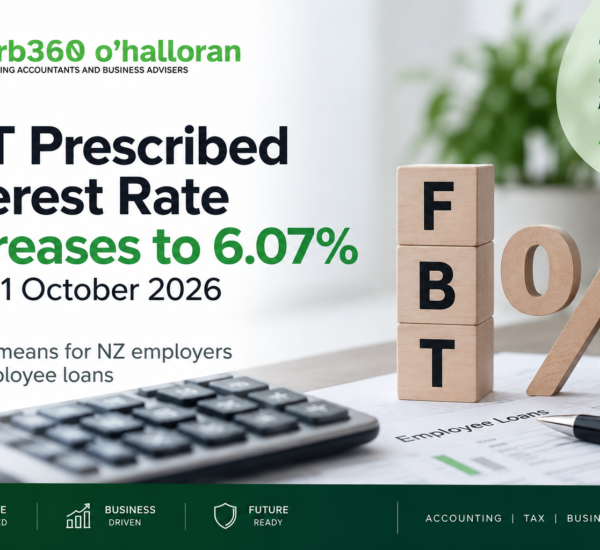
FBT Prescribed Interest Rate 2026: Quick Answer
The FBT prescribed interest rate used to calculate fringe benefit tax on low-interest, employment-related loans in New Zealand is increasing from 5.77% to 6.07%.
The new prescribed interest rate applies to the quarter beginning 1 October 2026. Employers providing low-interest or interest-free employment-related loans should review their FBT calculations and records before the new rate takes effect.
The change was announced by Inland Revenue on 8 September 2026.
FBT Prescribed Interest Rate Increases to 6.07% From 1 October 2026
Inland Revenue has announced an increase in the FBT prescribed interest rate used to calculate fringe benefit tax on low-interest employment-related loans.
From 1 October 2026, the prescribed interest rate will increase from 5.77% to 6.07%.
This change is particularly relevant to employers that provide employees with interest-free or low-interest loans. The prescribed rate is used when determining the taxable fringe benefit associated with these loans.
For businesses preparing FBT returns, the change is a useful reminder to review employee loan arrangements, loan balances, interest calculations and FBT records before the new quarter begins.
What Is the FBT Prescribed Interest Rate Change?
Inland Revenue has increased the prescribed interest rate for low-interest employment-related loans from 5.77% to 6.07%.
Key Facts at a Glance
- Previous rate: 5.77%
- New rate: 6.07%
- Increase: 0.30 percentage points
- Effective from: 1 October 2026
- Applies to: Low-interest employment-related loans
- Announced by: Inland Revenue
- Announcement date: 8 September 2026
Important: the 6.07% rate does not mean an employee automatically owes 6.07% interest on their loan. It is a prescribed rate used in the calculation of the fringe benefit for FBT purposes.
What Is Fringe Benefit Tax (FBT) in New Zealand?
Fringe Benefit Tax (FBT) is a tax that generally applies to certain non-cash benefits provided by employers to employees or shareholder-employees.
Examples can include certain private use of employer-provided vehicles, low-interest loans and other employment-related benefits.
For employers providing low-interest or interest-free employment-related loans, the prescribed interest rate is relevant because it helps determine the value of the benefit for FBT purposes.
The exact FBT outcome depends on the nature of the arrangement, the loan, interest actually charged and the applicable rules.
Why Does the 2026 FBT Prescribed Interest Rate Increase Matter?
The increase from 5.77% to 6.07% may increase the calculated value of the fringe benefit for affected employee loans.
This means employers with qualifying low-interest loans should not simply continue using the previous 5.77% rate for calculations covering periods beginning from 1 October 2026.
Businesses Most Likely to Be Affected
- Businesses providing employee loans
- Employers providing interest-free loans
- Employers charging below-market interest on employment-related loans
- Companies with shareholder-employee loan arrangements where FBT rules apply
- Businesses responsible for preparing FBT returns
- Businesses using accountants or payroll providers to manage FBT compliance
How Does the 6.07% FBT Prescribed Interest Rate Work?
A simple illustration can show the effect of the rate change.
Suppose an employer has a qualifying employee loan balance of $100,000.
Using the Previous 5.77% Rate
$100,000 × 5.77% = $5,770
Using the New 6.07% Rate
$100,000 × 6.07% = $6,070
The difference in this simplified illustration is $300.
However, this should not be interpreted as the employee owing an additional $300 in tax. It is simply an illustration of how the prescribed interest rate affects the interest-benefit calculation.
The actual FBT liability depends on the specific loan arrangement, calculation method, period involved and applicable FBT rules.
What Should Employers Do Before 1 October 2026?
Businesses with employment-related loans should review their FBT processes before the new prescribed interest rate applies.
1. Identify Employee Loans
Review your accounting records and identify any employee or employment-related loans that may be subject to FBT.
2. Review the Interest Rate Charged
Check whether interest is being charged on each relevant loan and whether the arrangement meets the conditions for the prescribed interest rate calculation.
3. Update Your FBT Calculations
Make sure your accounting or payroll process reflects the new 6.07% FBT prescribed interest rate for the applicable quarter beginning 1 October 2026.
4. Check Your Loan Records
Keep accurate records of loan balances, interest charged, repayments and relevant employee information.
5. Review Your FBT Return Process
If your business prepares FBT returns internally, review your calculation process. If an external accountant prepares your FBT returns, provide updated loan information before the relevant filing deadline.
6. Seek Professional Advice if the Arrangement Is Complex
Employee and shareholder loans can have different tax consequences depending on how they are structured. If you are unsure whether the prescribed rate applies to your situation, obtain professional tax advice before making changes.
How Can an Accountant Help With FBT Compliance?
FBT compliance is not simply about applying a percentage to a loan balance. Businesses need to consider the nature of the benefit, the applicable calculation rules, records, filing requirements and the timing of changes in prescribed rates.
A professional accountant can help your business:
- Review employee loan arrangements
- Prepare and review FBT calculations
- Identify relevant fringe benefits
- Maintain appropriate tax records
- Review FBT return information
- Understand changes to Inland Revenue requirements
- Integrate FBT considerations into wider tax planning
DFK Orb360 O’Halloran provides tax, accounting and business advisory services to businesses across Wellington and New Zealand. Our team can help businesses understand tax obligations and manage changing compliance requirements.
Need Help With FBT or Business Tax Advice?
If your business provides employee loans or other fringe benefits, professional advice can help you understand how changing tax requirements may affect your business.
Explore our Tax Accountant Wellington services for support with tax compliance, planning, GST, FBT and wider business tax matters.
You can also learn more about our Chartered Accounting services in Wellington .
Is Your Business Ready for the New 6.07% FBT Rate?
If your business provides low-interest or interest-free employment-related loans, now is a good time to review your FBT calculations before 1 October 2026.
DFK Orb360 O’Halloran can help you understand the tax implications, review your FBT position and manage your wider business tax obligations.
Tell us about your business and our team will get in touch.
FBT Prescribed Interest Rate 2026: Frequently Asked Questions
What is the FBT prescribed interest rate from 1 October 2026?
The FBT prescribed interest rate for low-interest employment-related loans increases to 6.07% from 1 October 2026.
What was the previous FBT prescribed interest rate?
The previous prescribed interest rate was 5.77%.
When does the new 6.07% FBT rate apply?
The new 6.07% prescribed interest rate applies for the quarter beginning 1 October 2026.
Who needs to consider the FBT prescribed interest rate?
Employers providing low-interest or interest-free employment-related loans should consider whether the prescribed interest rate is relevant to their FBT calculations.
Does the 6.07% rate mean employees have to pay 6.07% interest?
No. The prescribed rate is used for calculating the fringe benefit associated with qualifying low-interest employment-related loans. It does not automatically mean that the employee must personally pay 6.07% interest.
Will the rate increase automatically increase my FBT liability?
It may increase the calculated fringe benefit for affected loans, which can affect the employer’s FBT liability. The actual outcome depends on the specific loan and applicable FBT rules.
Should my business review employee loans before October 2026?
Yes. Businesses with potentially affected employee loans should review their loan balances, interest charged, records and FBT calculation process before the new rate applies.
Can DFK Orb360 help with FBT?
Yes. DFK Orb360 O’Halloran provides tax, accounting and business advisory support for New Zealand businesses, including tax compliance and FBT matters.
Official Inland Revenue Source
The information in this article is based on the Inland Revenue announcement dated 8 September 2026:
Important Tax Information
This article provides general information about the FBT prescribed interest rate in New Zealand and is not personalised tax, accounting, legal or financial advice.
FBT outcomes depend on the specific facts, loan arrangements, benefits provided, calculation method and applicable New Zealand tax rules. Inland Revenue guidance and tax legislation can change.
Businesses should obtain professional advice based on their individual circumstances before making tax or financial decisions.
Need Help Reviewing Your FBT Position?
The FBT prescribed interest rate is changing from 5.77% to 6.07% from 1 October 2026. If your business provides employee loans or other fringe benefits, DFK Orb360 O’Halloran can help you review your tax and compliance position.
Contact DFK Orb360 O’Halloran to discuss your requirements.



 09 377 4238
 Level 2, 6 Kingdon Street, Newmarket, Auckland
 help@orb360.co.nz