

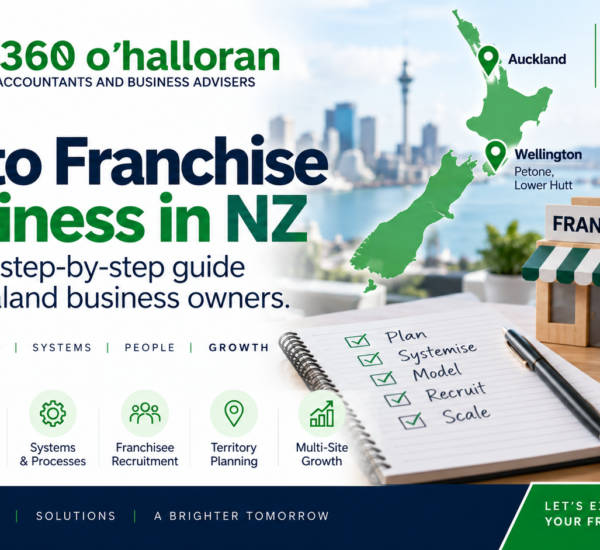
How to Franchise a Business NZ: Complete Step-by-Step Guide
Have you built a successful business and started wondering whether you could replicate it across multiple locations?
If the answer is yes, you may be asking one of the most important growth questions a business owner can ask:
How do I franchise my business?
Franchising can provide a pathway to expand a proven business model through franchisees who invest their own capital and operate businesses under an established brand and system. However, franchising is not simply a matter of selling licences or opening more locations.
Before you franchise a business in New Zealand, you need to determine whether the business is genuinely franchise-ready.
That means looking at your business model, profitability, systems, processes, intellectual property, financial projections, operations, franchisee support and ability to maintain consistency as the network grows.
This guide explains how to franchise a business NZ from the initial readiness assessment through to franchise launch and multi-location growth.
How to Franchise a Business in NZ: The Process at a Glance
- Assess whether your business is ready to franchise
- Define your franchise growth strategy
- Build the franchise business model
- Develop financial projections and feasibility models
- Document your systems and processes
- Protect and define your brand and intellectual property
- Develop franchise documentation with specialist legal advice
- Design the franchisee recruitment process
- Plan franchise territories and locations
- Prepare franchisee training and support
- Recruit your first franchisee
- Measure performance and improve the franchise network
The important point is that these steps are connected. A strong franchise model needs to make commercial sense, be operationally repeatable and give franchisees a realistic opportunity to operate the business successfully.
1. Is Your Business Ready to Franchise?
The first step in learning how to franchise a business NZ is determining whether your existing business model is suitable for replication.
A profitable business is not automatically a franchise-ready business.
You should consider whether:
- The business has a proven operating model
- The business can operate without the owner doing everything personally
- Core processes can be documented
- Customers receive a consistent experience
- The brand can be replicated across locations
- The business has sustainable financial performance
- There is sufficient market demand for additional locations
- The business can train franchisees effectively
- The franchisor can provide ongoing support
- The economics work for both the franchisor and franchisee
Your business should ideally be able to demonstrate that its success comes from a repeatable system, rather than depending entirely on the personality, relationships or day-to-day involvement of one owner.
How to Franchise a Business NZ: Is Your Business Ready?
Understanding how to franchise a business NZ starts with determining whether your current business is genuinely ready to be replicated.
Many business owners assume that a profitable business can automatically become a franchise. In reality, franchising requires a repeatable business model, documented systems, financial visibility and the ability to support franchisees as the network grows.
If your business operates in Auckland, Wellington or another New Zealand market, your local market success is only one part of the assessment. You also need to determine whether the model can work in other territories.
Franchise Readiness Questions
| Question | Why It Matters |
|---|---|
| Can the business operate without you? | A franchisee needs to be able to follow the system without relying on the owner. |
| Are your processes documented? | Franchisees need clear instructions and operating standards. |
| Is the business financially sustainable? | The model needs to work commercially before it is replicated. |
| Can the customer experience be replicated? | Consistency is critical to protecting the brand. |
| Can you support franchisees? | Franchising creates an ongoing responsibility to support the network. |
Could Your Business Be Ready to Franchise?
Not every successful business is ready to franchise.
Before investing in franchise documentation, recruitment or expansion, it is worth assessing your business model, financial performance, systems and scalability.
DFK Orb360 O’Halloran can help you assess the financial and commercial foundations of your franchise opportunity.
Book a complimentary one-hour whiteboard session to discuss your current business, your growth goals and what needs to happen before you franchise.
Explore DFK Franchise Specialist Services2. Define Why You Want to Franchise
Before you franchise a business, define what you want franchising to achieve.
Franchising should be a growth strategy rather than simply a way to solve a cash-flow or staffing problem.
Business owners may consider franchising because they want to:
- Expand into new markets
- Open multiple locations
- Access franchisee investment capital
- Build a larger brand
- Reduce the need for corporate-owned outlets
- Create a scalable business model
- Develop a network of owner-operators
- Build long-term enterprise value
The right franchise strategy depends on your objectives, industry, business model, available resources and growth ambitions.
3. Build a Franchise Business Model
A franchise business model defines how the franchisor and franchisee will work together financially and operationally.
This should include decisions around:
- Initial franchise investment
- Franchise fees
- Royalty structure
- Marketing contributions
- Territories
- Equipment requirements
- Premises and site requirements
- Technology
- Suppliers
- Training
- Ongoing support
- Performance expectations
The model needs to make commercial sense for both sides.
A franchise that generates attractive revenue for the franchisor but leaves franchisees with unrealistic margins may struggle to recruit and retain good franchisees.
4. Develop Franchise Financial Modelling
Financial modelling is one of the most important parts of preparing a business for franchising.
Before you scale the model, you should understand the economics of an individual franchise unit and the economics of the overall franchise network.
Franchisee Financial Model
A franchisee financial model may consider:
- Initial investment
- Working capital
- Expected revenue
- Gross margins
- Staff costs
- Rent and occupancy
- Marketing costs
- Franchise fees
- Royalty payments
- Operating expenses
- Break-even point
- Cash flow
- Expected return on investment
Franchisor Financial Model
The franchisor model should consider the economics of building and supporting the network.
This may include:
- Franchise recruitment costs
- Training costs
- Head-office staffing
- Technology and systems
- Marketing
- Franchisee support
- Network management
- Territory development
- Revenue from franchise fees
- Ongoing royalties
- Network profitability
DFK’s franchise proposition includes both franchisee financial modelling and a franchisor financial modelling and feasibility study to test the numbers before scaling. :contentReference[oaicite:3]{index=3}
Why Franchise Financial Modelling Matters
A financial model can show whether the franchise concept works on paper before you invest heavily in expansion.
It can help answer questions such as:
- How much does a franchisee need to invest?
- How quickly could a franchise unit reach break-even?
- What level of revenue is required?
- What margins can the franchisee realistically achieve?
- How much working capital is required?
- What happens if sales are lower than expected?
- How many franchisees are required for the franchisor model to become sustainable?
5. Document Your Business Systems and Processes
A franchise cannot rely on knowledge that exists only in the owner’s head.
Your business needs documented systems that allow a franchisee to understand how the business should operate.
This can include:
- Standard operating procedures
- Operational checklists
- Opening and closing procedures
- Customer service standards
- Sales procedures
- Marketing procedures
- Staff procedures
- Health and safety processes
- Supplier procedures
- Financial procedures
- Technology processes
- Reporting requirements
DFK’s franchise framework includes operational checklists, standard operating procedures, operations manuals, leadership development, new-store opening manuals, policies and procedures and franchise documentation. :contentReference[oaicite:4]{index=4}
6. Create a Franchise Operations Manual
A franchise operations manual helps turn your business knowledge into a repeatable operating system.
The manual should explain how franchisees are expected to operate the business and maintain the brand’s standards.
It may cover:
- Daily operations
- Customer experience
- Brand standards
- Staff management
- Supplier management
- Inventory
- Sales
- Marketing
- Financial processes
- Reporting
- Compliance
- Store opening procedures
The objective is not simply to create a large document. The objective is to create a practical system that franchisees can actually use.
7. Prepare Your Franchise Documentation
Franchise documentation should be developed with appropriate specialist legal advice.
It may include the franchise agreement, disclosure information, operating documentation, policies and other documents relevant to the franchise system.
New Zealand does not currently have franchise-specific legislation, but the Franchise Association of New Zealand operates a Code of Practice and Ethics for its members. The current Code includes requirements and recommendations around disclosure, franchisee information and financial projections for members operating under the Code. :contentReference[oaicite:5]{index=5}
This is an area where legal and financial advice should work together.
A lawyer experienced in franchising should advise on the legal documentation, while a franchise-experienced accountant or business adviser can help assess the commercial and financial proposition.
FANZ’s current Code specifically recommends that prospective franchisees obtain independent legal and financial/accounting advice before proceeding. :contentReference[oaicite:6]{index=6}
8. Develop Your Franchisee Recruitment Strategy
Finding franchisees is not simply a marketing exercise; it is about finding the right people to operate and represent your brand.
Your recruitment strategy should define:
- Ideal franchisee profile
- Required capital
- Relevant skills
- Leadership requirements
- Personality and behavioural characteristics
- Industry experience where relevant
- Training requirements
- Location preferences
- Long-term expectations
DFK’s franchise approach includes franchisee profiling using the DISC behavioural model to help assess how prospective franchisees may fit the business and its operating requirements. :contentReference[oaicite:7]{index=7}
Why Choosing the Right Franchisee Matters
A franchisee is not simply an investor; they become part of the brand’s operating network.
The wrong franchisee can create operational, financial, customer-service and brand risks.
The right franchisee can become a long-term partner who contributes to the growth and reputation of the network.
9. Plan Franchise Territories
Territory planning determines where franchisees can operate and how the network can expand without creating unnecessary conflict between locations.
A territory strategy can consider:
- Population
- Customer demographics
- Demand
- Competition
- Travel distance
- Existing customers
- Future expansion
- Territory exclusivity
- Potential sales
- Market saturation
DFK’s franchise framework includes territory mapping designed to help franchisors define and visualise territories, avoid channel conflict and model expansion scenarios before committing to them. :contentReference[oaicite:8]{index=8}
10. Build Franchisee Training and Support
Franchisee support should be designed before you start recruiting franchisees.
Training may cover:
- Business operations
- Brand standards
- Sales
- Customer service
- Technology
- Financial processes
- Staff management
- Marketing
- Reporting
- Compliance
Ongoing support may also include regular communication, performance reviews, operational audits and assistance when franchisees encounter problems.
DFK’s franchise framework includes brand and compliance standards, communication rhythms, performance benchmarks and defined support and escalation processes. :contentReference[oaicite:9]{index=9}
11. Recruit and Launch Your First Franchisee
Your first franchisee should be treated as a critical test of the franchise system.
The first franchise launch can help identify gaps in:
- Training
- Documentation
- Operations
- Technology
- Financial assumptions
- Marketing
- Site selection
- Franchisee support
Instead of assuming the model is perfect from day one, use the first franchise operation to identify what needs to be improved before expanding further.
12. Measure Franchise Performance and Scale
Franchising does not finish when the first franchisee signs an agreement.
Once the network starts growing, the focus shifts towards performance, consistency and scalability.
Useful franchise KPIs may include:
- Sales
- Gross margin
- EBITDA
- Cash flow
- Customer retention
- Customer satisfaction
- Labour costs
- Average transaction value
- Franchisee profitability
- Network growth
- Franchisee retention
DFK’s franchise performance framework focuses on building the team, improving systems, creating development plans and supporting the opening of multiple locations. :contentReference[oaicite:10]{index=10}
DFK’s 3-Phase Approach to Franchising
DFK Orb360 O’Halloran approaches franchising as a journey from business readiness to network growth.
| Phase | Focus | Typical Activities |
|---|---|---|
| Phase 1: Franchise Foundations | Prepare the business | Workshop, business model, strategic plan, onsite observation, franchise toolkit |
| Phase 2: Franchise Launch | Build and launch the franchise | Marketing, franchise recruitment, training, site identification and first franchisee |
| Phase 3: Franchise Performance | Scale the network | Development planning, team building, systems, ongoing support and multiple locations |
This framework is designed to take a business from understanding its current position through to preparing, launching and scaling its franchise network. :contentReference[oaicite:11]{index=11} :contentReference[oaicite:12]{index=12}
Thinking About Franchising Your Business?
You don’t need to have everything figured out before starting the conversation.
If you are considering franchising, DFK Orb360 O’Halloran can help you understand what needs to happen before your business is ready to scale through a franchise model.
Book a complimentary one-hour whiteboard session.
We’ll discuss your current business, your growth objectives and the financial and operational foundations required to move forward.
How Much Does It Cost to Franchise a Business in NZ?
There is no single cost to franchise a business in New Zealand. The investment depends on the complexity of the business, industry, number of locations, documentation required, technology, professional advice, recruitment and support model.
Potential costs can include:
- Franchise strategy and consulting
- Financial modelling
- Feasibility studies
- Legal and franchise documentation
- Operations manuals
- Standard operating procedures
- Technology
- Marketing
- Franchise recruitment
- Training
- Ongoing franchise support
Rather than focusing only on the upfront cost, business owners should consider the expected commercial return and whether the franchise model can create sustainable value for both the franchisor and franchisee.
Common Mistakes When Franchising a Business
One of the biggest mistakes is trying to franchise before the underlying business model is ready.
1. Franchising Too Early
A business should have a sufficiently proven and repeatable model before attempting to replicate it.
2. Underestimating Documentation
If processes are not documented, franchisees may operate the business differently from location to location.
3. Ignoring Franchisee Economics
A model that works for the franchisor may not necessarily work for the franchisee.
4. Using Unrealistic Financial Projections
Financial projections should be based on reasonable assumptions and appropriately qualified.
5. Choosing Franchisees Too Quickly
Rapid recruitment can create long-term network problems if franchisee fit is not assessed properly.
6. Focusing Only on the First Franchisee
The franchise model needs to be designed for long-term network growth, not just one additional location.
7. Treating Franchising as Passive Income
Franchising creates ongoing responsibilities around support, systems, standards, communication and network performance.
What Is the Difference Between a Franchisor and a Franchisee?
The franchisor owns and develops the brand and franchise system, while the franchisee operates a business using that system under agreed terms.
| Franchisor | Franchisee |
|---|---|
| Owns the brand and business system | Operates the individual franchise business |
| Provides systems and training | Follows the operating system |
| Provides ongoing support | Runs day-to-day operations |
| Develops the network | Invests capital into the franchise |
| Protects brand standards | Maintains brand and operating standards |
Franchise Readiness Checklist
Before you start franchising your business, ask:
- Is my business profitable?
- Can the business operate without me?
- Is the business model repeatable?
- Are our processes documented?
- Do we have clear SOPs?
- Can our customer experience be replicated?
- Do we understand the unit economics?
- Have we built a franchisee financial model?
- Have we tested different financial scenarios?
- Do we know the required franchisee investment?
- Have we considered territory strategy?
- Can we recruit and train franchisees?
- Can our team support multiple locations?
- Do we have appropriate franchise documentation?
- Do we have a plan for measuring franchisee performance?
People Also Ask: How to Franchise a Business NZ
How do I franchise my business in New Zealand?
To franchise your business in New Zealand, first assess whether the business model is repeatable and financially viable, then develop the franchise model, financial projections, operating systems, documentation, franchisee recruitment strategy and support structure. Specialist accounting, business advisory and legal advice can help you prepare the franchise properly.
What makes a business suitable for franchising?
A business is generally more suitable for franchising when it has a proven business model, sustainable financial performance, documented systems, repeatable operations and sufficient market demand. The business should also be capable of being operated by franchisees with appropriate training and support.
How long does it take to franchise a business in NZ?
There is no standard timeframe for franchising a business. The timeframe depends on the maturity of the business, complexity of the operating model, documentation, financial modelling, legal work, recruitment and preparation required. A rushed franchise launch can create avoidable problems later.
How much does it cost to franchise a business in NZ?
The cost varies significantly depending on the business and franchise model. Costs can include strategy, financial modelling, feasibility work, legal documentation, operations manuals, technology, marketing, recruitment, training and ongoing franchise support.
Do I need a franchise agreement?
A franchise arrangement should be supported by appropriate legal documentation prepared with specialist legal advice. The exact documentation required depends on the franchise structure and circumstances. A lawyer experienced in franchising should advise on the legal framework and franchise agreement.
Does New Zealand have franchise-specific legislation?
New Zealand does not currently have franchise-specific legislation. The Franchise Association of New Zealand operates a Code of Practice and Ethics for its members, which establishes standards and requirements for participating members. Businesses should obtain specialist legal advice on their own circumstances.
What financial information should I prepare before franchising?
You should understand the financial performance and economics of both the franchisee unit and the wider franchisor model. This can include revenue assumptions, margins, operating expenses, working capital, break-even, investment requirements, franchise fees, royalties and cash-flow requirements.
Should I prepare financial projections for franchisees?
Financial projections should be developed carefully and based on appropriate assumptions. If projections are provided, their basis and assumptions should be clearly documented. FANZ’s Code of Practice and Ethics contains specific provisions relating to financial projections for its members.
How do I find the right franchisees?
The right franchisee recruitment process should assess financial capability, skills, experience, behavioural fit and alignment with the brand. Franchisee profiling can help businesses evaluate whether prospective franchisees are suitable for the operating model and long-term network.
How do I create a franchise operations manual?
A franchise operations manual should document the key processes required to operate the business consistently. This may include daily operations, customer service, staff procedures, sales, marketing, technology, financial processes, compliance and brand standards.
Can an accountant help me franchise my business?
Yes. A franchise-experienced accountant can help with financial modelling, feasibility analysis, franchisee economics, cash flow, profitability and the financial structure of the franchise model. Legal documentation should be handled with appropriate specialist legal advice.
Can DFK Orb360 help me franchise my business?
Yes. DFK Orb360 O’Halloran provides franchise specialist support covering franchise foundations, financial modelling, feasibility, systems, franchisee recruitment, territory planning and franchise performance. The team can help business owners understand what needs to be prepared before scaling through franchising.
Why Work With a Franchise Specialist?
Franchising combines strategy, finance, operations, people, systems and growth planning.
That means preparing a business for franchising often requires more than traditional compliance accounting.
DFK Orb360 O’Halloran’s franchise specialist framework brings together:
- Strategic business planning
- Franchise financial modelling
- Feasibility studies
- Franchisee financial modelling
- Operational systems
- Standard operating procedures
- Franchisee profiling
- Territory planning
- Franchise recruitment
- Training and support
- Performance management
The goal is to help business owners move from a successful individual business towards a structured, scalable franchise system.
Ready to Explore Franchising Your Business?
Franchising can create significant growth opportunities, but the foundations need to be right before you start recruiting franchisees.
DFK Orb360 O’Halloran can help you assess your business, model the numbers and build a practical roadmap towards franchising.
Start with a complimentary one-hour whiteboard session to discuss your business and franchise ambitions.
Start Your Franchise JourneyRelated DFK Franchise Services
- Franchise Specialist Services
- Outsourced CFO Services
- Accounting Services NZ
- Contact DFK Orb360 O’Halloran
Important Information
This article provides general information about franchising a business in New Zealand. It is not legal, accounting, tax or financial advice for your specific circumstances.
Franchise structures, agreements, disclosure requirements, financial projections and other obligations should be assessed based on the individual business and franchise model.
Businesses considering franchising should obtain appropriate advice from professionals experienced in franchising, including specialist legal and accounting advisers.


 09 377 4238
 Level 2, 6 Kingdon Street, Newmarket, Auckland
 help@orb360.co.nz