
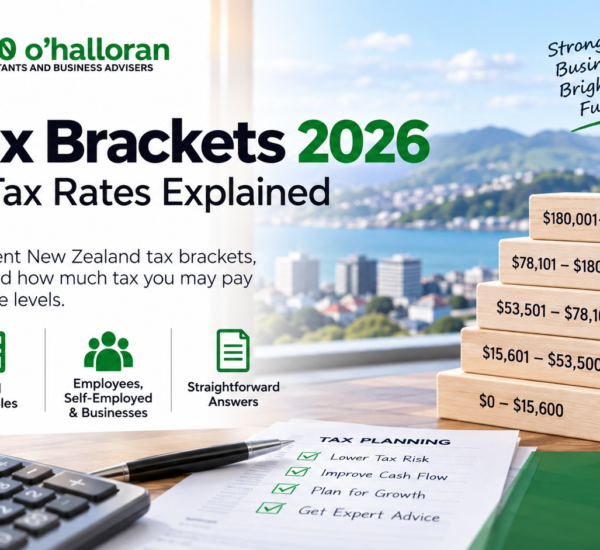
NZ tax brackets 2026 use progressive income tax rates, meaning different portions of your taxable income are taxed at different rates.
The current individual income tax rates are 10.5% on income up to $15,600, 17.5% from $15,601 to $53,500, 30% from $53,501 to $78,100, 33% from $78,101 to $180,000 and 39% on income over $180,000.
Moving into a higher tax bracket does not mean your entire income is taxed at the higher rate. Only the portion of taxable income within that bracket is taxed at that marginal rate.
For employees, PAYE deductions can also include the ACC earners’ levy and other deductions depending on individual circumstances.
Understanding how much tax you pay can be confusing, particularly when you hear terms such as tax bracket, marginal tax rate, PAYE and effective tax rate.
The NZ tax brackets 2026 determine which income tax rate applies to each portion of an individual’s taxable income. New Zealand uses a progressive tax system, so higher portions of income are taxed at higher rates.
This means that earning more money does not result in your entire income suddenly being taxed at the highest rate. Instead, each portion of taxable income is taxed according to the relevant bracket.
DFK Orb360 O’Halloran provides accounting, tax planning, GST, payroll and business advisory support for New Zealand businesses and individuals.
The NZ tax brackets 2026 for individual income use five marginal tax rates.
| Taxable Income | Marginal Tax Rate |
|---|---|
| $0 – $15,600 | 10.5% |
| $15,601 – $53,500 | 17.5% |
| $53,501 – $78,100 | 30% |
| $78,101 – $180,000 | 33% |
| $180,001 and over | 39% |
These are the current individual income tax rates published by Inland Revenue.
The easiest way to understand NZ tax brackets 2026 is to think of your taxable income as being divided into layers.
Each layer is taxed at the rate applicable to that portion of income.
For example, if your taxable income is $100,000, you do not pay 33% on the entire $100,000. The first portion is taxed at 10.5%, the next portion at 17.5%, the next portion at 30%, and the remaining amount within the relevant bracket at 33%.
This is known as a marginal tax system.
| Income Layer | Rate | What It Means |
|---|---|---|
| First $15,600 | 10.5% | The first portion of taxable income is taxed at 10.5%. |
| $15,601 – $53,500 | 17.5% | Only income within this band is taxed at 17.5%. |
| $53,501 – $78,100 | 30% | Only income within this band is taxed at 30%. |
| $78,101 – $180,000 | 33% | Only income within this band is taxed at 33%. |
| Over $180,000 | 39% | Only income above $180,000 is taxed at 39%. |
No. New Zealand’s progressive tax system applies the higher rate only to the portion of income that falls within that tax bracket.
This is one of the most common misunderstandings about NZ tax brackets 2026.
For example, if your taxable income is $80,000, only the portion above $78,100 is taxed at 33%. The income below that threshold continues to be taxed at the lower applicable rates.
You therefore do not lose your entire lower tax bracket simply because part of your income enters a higher bracket.
Using the current NZ tax brackets 2026, a taxable income of $50,000 falls across the first two brackets.
| Income Portion | Rate | Tax |
|---|---|---|
| First $15,600 | 10.5% | $1,638 |
| Remaining $34,400 | 17.5% | $6,020 |
| Total | $7,658 |
This is a simplified income-tax calculation before considering other factors such as tax credits, ACC earners’ levy or other deductions.
For taxable income of $60,000, the calculation moves into the 30% marginal bracket.
| Income Portion | Rate | Tax |
|---|---|---|
| First $15,600 | 10.5% | $1,638 |
| $15,601 – $53,500 | 17.5% | $6,632.50 |
| $53,501 – $60,000 | 30% | $1,950 |
| Total | $10,220.50 |
This is a simplified income-tax calculation and is not the same as final take-home pay.
A taxable income of $100,000 crosses four of the five individual tax brackets.
| Income Portion | Rate | Tax |
|---|---|---|
| First $15,600 | 10.5% | $1,638 |
| $15,601 – $53,500 | 17.5% | $6,632.50 |
| $53,501 – $78,100 | 30% | $7,380 |
| $78,101 – $100,000 | 33% | $7,227 |
| Total income tax | $22,877.50 |
The calculation demonstrates why your marginal tax rate and your average tax rate are not the same thing.
Your marginal tax rate is the rate that applies to your next dollar of taxable income. Your average tax rate is the total income tax you pay divided by your taxable income.
For example, someone with $100,000 of taxable income has a marginal tax rate of 33%, but the simplified income-tax calculation above is $22,877.50.
That works out to an average income-tax rate of approximately 22.88%, before considering other factors.
This distinction is important when discussing NZ tax brackets 2026 because the highest marginal rate does not represent the percentage of your entire income that goes to income tax.
Employees generally have tax deducted from salary and wages before receiving their pay. This system is known as PAYE.
PAYE deductions can include income tax and the ACC earners’ levy. Other deductions may also apply depending on the employee’s circumstances.
This means an employee’s payslip can contain deductions that are different from the income tax rate shown in the NZ tax brackets 2026.
Income tax rates and PAYE deductions should not be treated as exactly the same thing.
For example, the current PAYE rates published by Inland Revenue include the ACC earners’ levy for relevant income ranges.
| Income Range | Income Tax Rate | PAYE Rate Including ACC Levy |
|---|---|---|
| $0 – $15,600 | 10.5% | 12.25% |
| $15,601 – $53,500 | 17.5% | 19.25% |
| $53,501 – $78,100 | 30% | 31.75% |
| $78,101 – $156,641 | 33% | 34.75% |
| $156,642 – $180,000 | 33% | 33% |
| Over $180,000 | 39% | 39% |
The PAYE figures above include the 1.75% ACC earners’ levy where applicable. Individual circumstances can result in different deductions.
The ACC earners’ levy is separate from income tax but is generally deducted alongside PAYE for employees.
For the 1 April 2026 to 31 March 2027 period, the ACC earners’ levy is 1.75%, or $1.75 for every $100 of liable earnings, up to $156,641.
The maximum ACC earners’ levy for the period is $2,741.22.
This is one reason an employee’s total PAYE deduction can be higher than the income tax amount calculated using the NZ tax brackets 2026.
Self-employed people are generally taxed using individual income tax rates. Their taxable income is determined after taking into account relevant business income and allowable expenses.
For example, if a sole trader has $100,000 of taxable income, the individual progressive tax rates apply rather than simply applying the 39% rate to the entire amount.
Self-employed people should also consider GST, provisional tax, ACC levies and cash-flow requirements.
Companies are treated differently from individuals.
Most companies in New Zealand are generally taxed at a company income tax rate of 28%.
Therefore, the individual NZ tax brackets 2026 should not be used to calculate the tax liability of a standard company.
The appropriate business structure depends on factors including ownership, income, expenses, distributions and the wider circumstances of the business.
If your business has a tax liability that meets the relevant requirements, you may need to pay provisional tax during the year rather than waiting until the end of the tax year.
Provisional tax allows taxpayers to pay income tax during the year based on the applicable calculation method.
Understanding expected taxable income and the relevant NZ tax brackets 2026 can therefore help with future tax planning.
Business owners should also consider GST, cash flow, ACC obligations and the structure of the business when planning for tax.
A simplified process for estimating individual income tax is:
Inland Revenue provides an income tax calculator that can calculate basic annual tax using current and previous tax rates.
Yes. An NZ tax calculator can provide a useful estimate of basic annual income tax, but it should not automatically be treated as your final tax position.
Inland Revenue’s income tax calculator uses your total taxable income to calculate basic yearly tax.
For employees, Inland Revenue also provides a PAYE calculator that can help estimate deductions from salary and wages.
You can use the official calculators here:
Your take-home pay is not simply your gross income minus the tax rate shown beside your tax bracket.
Depending on your circumstances, deductions can include:
This means two people with the same gross salary can potentially have different take-home pay depending on their tax codes and other deductions.
The highest marginal rate only applies to the portion of income above the relevant threshold.
PAYE deductions can include the ACC earners’ levy and other deductions, so PAYE should not automatically be treated as your final income-tax liability.
Employees with more than one income source may need to use a secondary tax code. The correct tax code depends on the person’s circumstances.
A standard company generally has a different tax rate from an individual taxpayer.
Business owners can have provisional tax obligations depending on their residual income tax and circumstances.
For business owners, understanding the NZ tax brackets 2026 can help with budgeting and financial planning, particularly if you operate as a sole trader or have multiple income sources.
Business owners should consider:
Tax planning involves understanding your obligations before they become due and making financial decisions with the tax consequences in mind.
Depending on your circumstances, tax planning can involve:
Tax planning should be based on legitimate tax rules and professional advice rather than attempts to artificially avoid tax obligations.
You may benefit from professional tax advice if your income or financial circumstances are becoming more complicated.
Consider speaking with an accountant if you:
| Taxable Income | Rate |
|---|---|
| $0 – $15,600 | 10.5% |
| $15,601 – $53,500 | 17.5% |
| $53,501 – $78,100 | 30% |
| $78,101 – $180,000 | 33% |
| $180,001+ | 39% |
Business owners across Wellington may need support with more than annual tax returns. Accounting, GST, payroll, cash-flow forecasting and tax planning can all form part of managing a growing business.
DFK Orb360 O’Halloran provides accounting and business advisory support from its Wellington-region office in Petone, Lower Hutt, with services available to businesses across Wellington, Lower Hutt, Upper Hutt and Porirua.
If you are reviewing your business structure, taxable income or upcoming tax obligations, understanding the NZ tax brackets 2026 can be a useful starting point.
DFK Orb360 O’Halloran can help businesses understand their tax position, plan for upcoming obligations and make informed financial decisions.
The current NZ tax brackets are 10.5% up to $15,600, 17.5% from $15,601 to $53,500, 30% from $53,501 to $78,100, 33% from $78,101 to $180,000 and 39% above $180,000.
The lowest individual income tax rate is 10.5% and applies to taxable income up to $15,600.
The highest individual income tax rate is 39% and applies to taxable income above $180,000.
A simplified calculation gives $7,658 of income tax on $50,000 of taxable income before other factors.
A simplified calculation gives $10,220.50 of income tax on $60,000 of taxable income before other factors.
A simplified calculation gives $22,877.50 of income tax on $100,000 of taxable income before other factors.
No. New Zealand uses progressive individual income tax rates, meaning different portions of taxable income are taxed at different rates.
Each portion of taxable income is taxed at the rate applicable to that income bracket rather than applying the highest rate to the entire income.
Income tax is calculated using taxable income, with different portions taxed at different marginal rates.
The PAYE deduction depends on income, tax code and other circumstances, and PAYE can include the ACC earners’ levy.
Self-employed people are generally taxed using individual income tax rates, although business income and allowable expenses determine taxable income.
Yes. Inland Revenue provides an income tax calculator for estimating basic annual income tax using current and previous rates.
Legitimate tax planning involves understanding applicable deductions, business expenses, structures and tax rules rather than artificially avoiding tax.
Yes. An accountant can help explain how the tax brackets apply to your income and how tax planning, business structure and cash flow may affect your overall position.
DFK Orb360 O’Halloran provides accounting and business advisory support from offices in Auckland and Petone, Lower Hutt, serving businesses across the wider regions.
Understanding the NZ tax brackets 2026 can make it easier to estimate your income tax and understand why your tax rate changes as your taxable income increases.
The key point is that New Zealand uses a progressive tax system. A higher tax bracket applies only to the portion of income that falls within that bracket, not to your entire income.
For employees, actual payroll deductions can also include the ACC earners’ levy and other deductions. For self-employed people and business owners, taxable income, business expenses, provisional tax and business structure can all affect the overall tax position.
If your financial circumstances are becoming more complicated, professional tax and accounting advice can help you understand your obligations and plan ahead.
DFK Orb360 O’Halloran provides accounting, tax planning, GST, payroll and business advisory support for New Zealand businesses.
Talk to our team about your tax and financial planning requirements.
Contact DFK Orb360 O’HalloranThis article provides general information about New Zealand income tax rates and is not intended to be financial, tax or legal advice. Tax rates, thresholds and related rules can change. Individual tax outcomes can also differ depending on income sources, deductions, tax codes, tax credits and other circumstances. Check current Inland Revenue guidance or obtain professional advice for your specific situation.


Copyright © 2025 Marketing Transformers | All Rights Reserved.


 09 377 4238
 Level 2, 6 Kingdon Street, Newmarket, Auckland
 help@orb360.co.nz