

NZ Tax Guide
Income Tax Brackets NZ: Current Tax Rates, Thresholds and How They Work
If you’ve ever looked at your salary and thought, “Wait, does moving into a higher tax bracket mean I lose more of my entire income?” you’re not alone.
This is one of the most common misunderstandings about income tax brackets NZ uses.
The good news is that moving into a higher tax bracket does not mean your entire income is suddenly taxed at the higher rate.
New Zealand has a progressive income tax system. In simple terms, your income is split into different layers, and each layer is taxed at the rate that applies to it.
So, if you earn $80,000, you don’t pay 33% tax on the whole $80,000. Only the portion that falls into the 33% bracket is taxed at 33%.
Let’s break down how it actually works.
Income Tax Brackets NZ: Quick Answer
New Zealand uses a progressive individual income tax system. This means different portions of your taxable income are taxed at different rates.
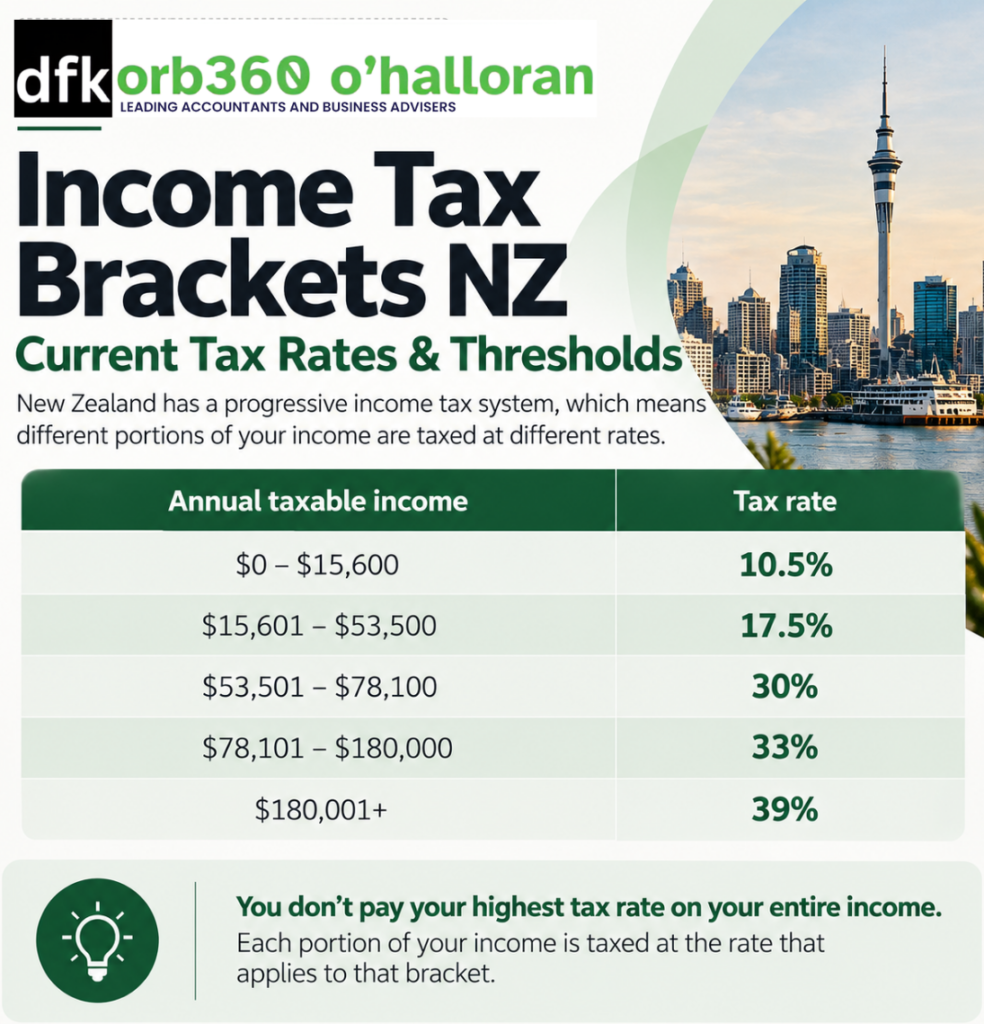
The current individual income tax rates are:
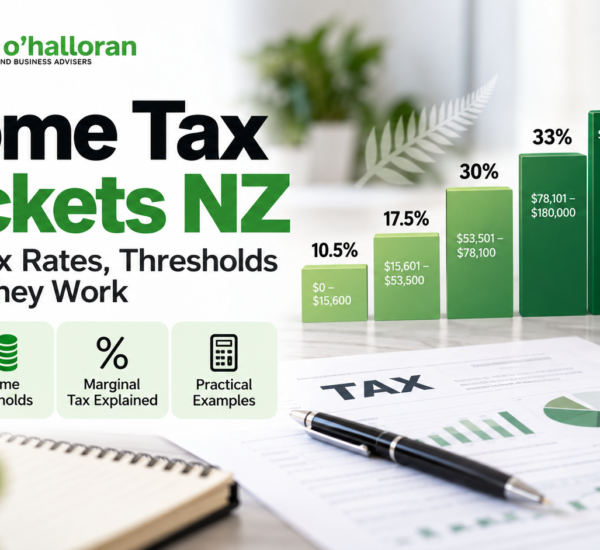
- 10.5% on income from $0 to $15,600
- 17.5% on income from $15,601 to $53,500
- 30% on income from $53,501 to $78,100
- 33% on income from $78,101 to $180,000
- 39% on income above $180,000
The important point is that your highest marginal tax rate does not apply to your entire income. Each portion of taxable income is taxed according to the bracket it falls into.
Income Tax Brackets NZ
New Zealand uses a progressive income tax system, which means different portions of taxable income are taxed at different rates. The current individual income tax rates are 10.5% on income up to $15,600, 17.5% from $15,601 to $53,500, 30% from $53,501 to $78,100, 33% from $78,101 to $180,000, and 39% on income above $180,000.
Moving into a higher tax bracket does not mean your entire income is taxed at the higher rate. Only the portion of income that falls within the higher bracket is taxed at that marginal rate. For example, someone earning $80,000 has a marginal tax rate of 33%, but the full $80,000 is not taxed at 33%.
Understanding income tax brackets NZ uses can help when considering a salary increase, bonus, second job, contracting income, investment income or changes to business income. Your actual tax position can also depend on PAYE, tax codes, ACC earners’ levy, tax credits and your individual circumstances.
What Are the Income Tax Brackets in NZ?
For individuals, the current New Zealand income tax rates are:
| Annual taxable income | Tax rate |
|---|---|
| $0 – $15,600 | 10.5% |
| $15,601 – $53,500 | 17.5% |
| $53,501 – $78,100 | 30% |
| $78,101 – $180,000 | 33% |
| $180,001+ | 39% |
These are the current individual income tax rates listed by Inland Revenue. New Zealand’s individual tax system is progressive, meaning the rates increase as taxable income increases. :chatgpt-content-reference{index=”1″}
The important thing to remember is that these are marginal tax rates. Your highest tax rate only applies to the portion of income that falls within that particular bracket.

How Do Income Tax Brackets NZ Work?
Think of your income as being divided into a series of steps.
The first portion is taxed at the lowest rate. Once your income moves into the next bracket, only the additional income is taxed at the next rate.
For example:
- Your first $15,600 is taxed at 10.5%.
- The portion between $15,601 and $53,500 is taxed at 17.5%.
- The portion between $53,501 and $78,100 is taxed at 30%.
- The portion between $78,101 and $180,000 is taxed at 33%.
- Anything above $180,000 is taxed at 39%.
This is what makes the system progressive.
Does Moving Into a Higher Tax Bracket Mean All Your Income Is Taxed More?
No.
Moving into a higher tax bracket does not mean all your income is taxed at that higher rate.
Only the income within the new bracket is taxed at the higher rate.
What Is Marginal Tax in NZ?
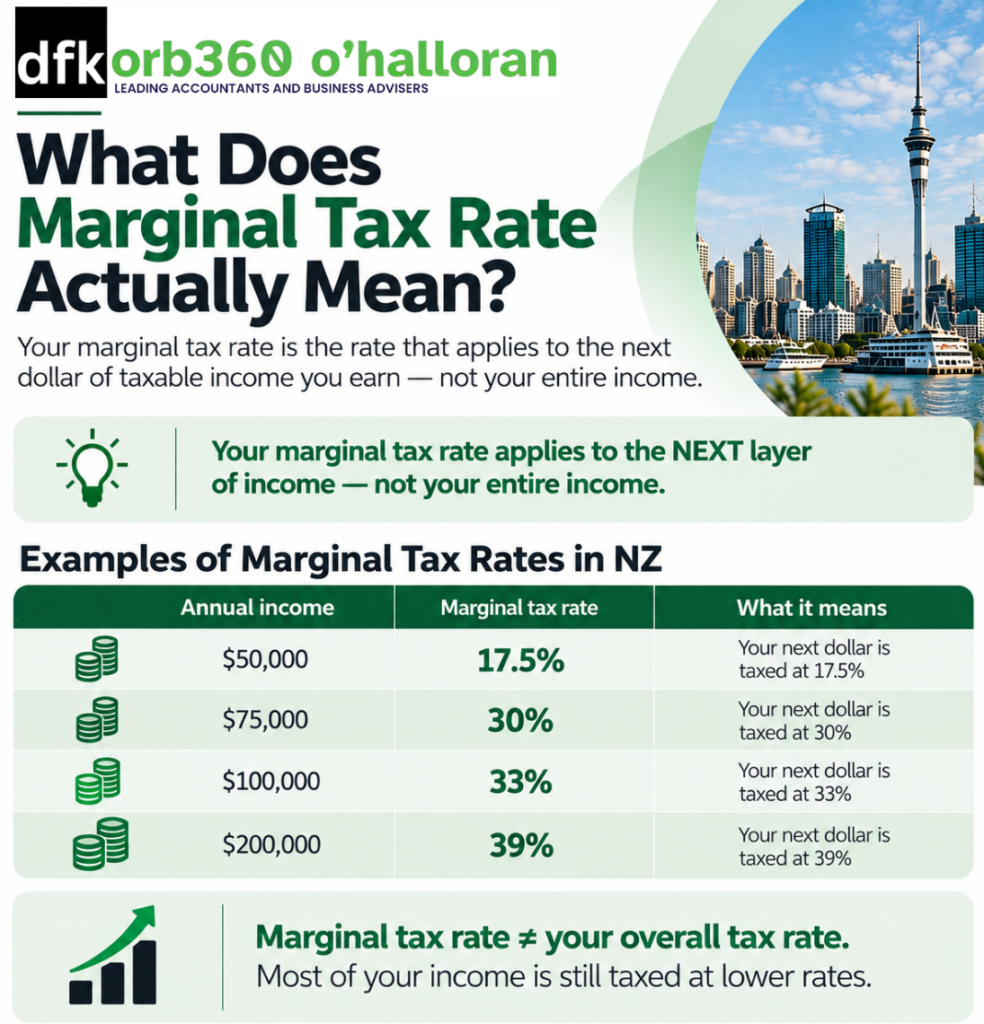
Your marginal tax rate is essentially the rate that applies to the next dollar of taxable income you earn.
For example, if you earn $100,000, your marginal tax rate is 33%.
That doesn’t mean you’re paying 33% tax on the entire $100,000.
Your income is still taxed through the lower brackets first.
This distinction is important when you’re considering a pay rise, bonus, additional work or another source of income.

What Is the Tax Rate on $80,000 in NZ?
Let’s make this practical.
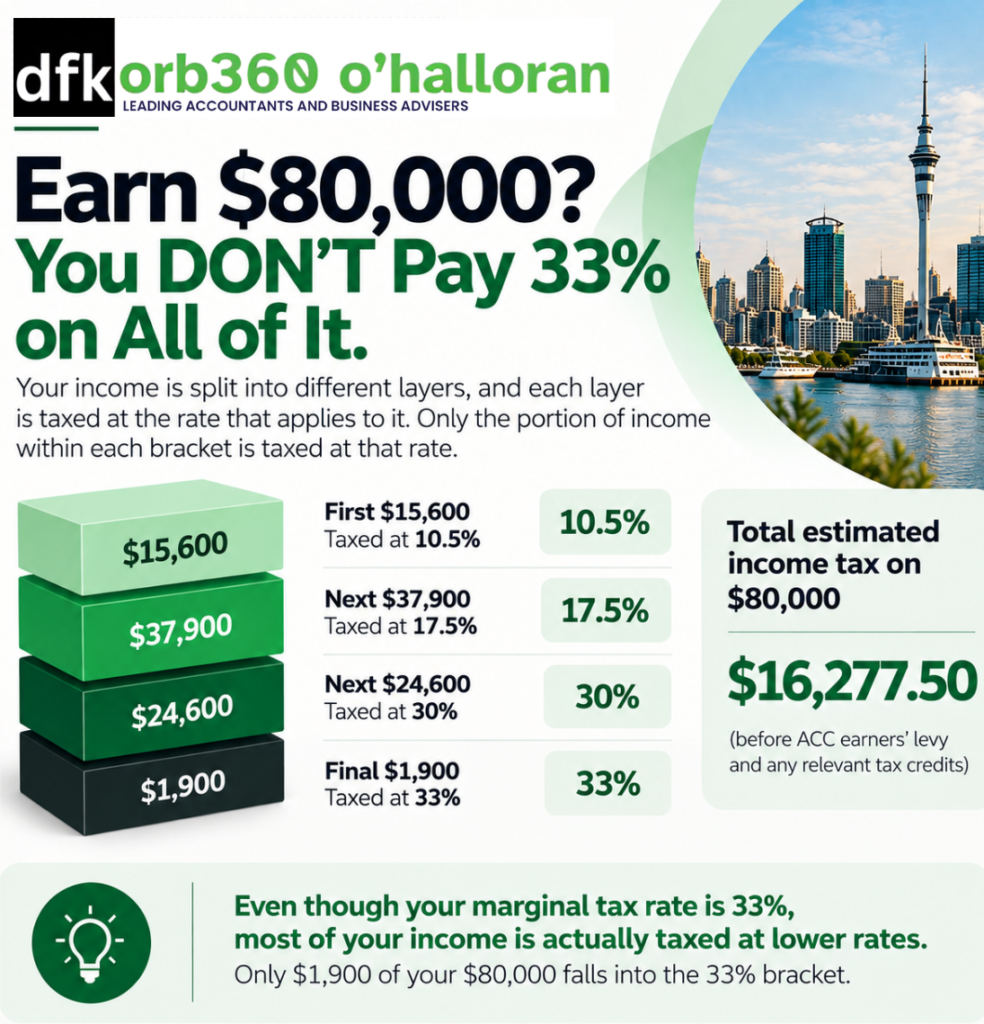
Suppose your taxable income is $80,000.
You might look at the tax table and see that $80,000 falls into the 33% bracket.
It’s easy to assume:
“So I pay 33% tax on $80,000.”
That’s not how it works.
Instead, your income is split across the brackets:
- First $15,600 taxed at 10.5% → $1,638
- Next $37,900 taxed at 17.5% → $6,632.50
- Next $24,600 taxed at 30% → $7,380
- Final $1,900 taxed at 33% → $627
That gives estimated income tax of $16,277.50, before other applicable items such as ACC earners’ levy and any relevant tax credits.
So although your marginal tax rate is 33%, most of your income is actually taxed at lower rates.
That’s the key difference between your marginal tax rate and your overall tax paid.

Not Sure How Your Tax Bracket Applies to You?
Your marginal tax rate is only one part of your overall tax position. If you have multiple income sources, a salary change, contracting income or a business, it can be useful to look at the full picture.
What Happens If Your Salary Goes Up?
This is where understanding tax brackets becomes really useful.
Imagine your salary increases from $78,000 to $80,000.
You haven’t suddenly made your entire salary subject to the 33% rate.
Instead, only the additional amount that falls above the $78,100 threshold is taxed at 33%.
So earning more does not mean that your entire income gets pushed into the new rate.
This is why the common fear that “I’ll actually take home less if I get a raise because I’ll move into the next tax bracket” doesn’t work the way people often think.
You pay the higher marginal rate only on the portion that falls into that bracket.
NZ Income Tax Rates Explained
Here’s a closer look at each bracket.
$15,600: 10.5%
The first $15,600 of taxable income is taxed at 10.5%.
$53,500: 17.5%
Once your income goes above $15,600, the next portion up to $53,500 is taxed at 17.5%.
$78,100: 30%
The portion between $53,501 and $78,100 is taxed at 30%.
$180,000: 33%
Income between $78,101 and $180,000 is taxed at 33%.
Over $180,000: 39%
Only the portion of taxable income above $180,000 is taxed at the highest individual rate of 39%.
How Much Tax Would You Pay on Different Incomes?
Here are some simple examples to put the brackets into perspective.
| Taxable income | Marginal rate | Approx. income tax* |
|---|---|---|
| $50,000 | 17.5% | $7,658 |
| $75,000 | 30% | $14,720.50 |
| $80,000 | 33% | $16,277.50 |
| $100,000 | 33% | $22,877.50 |
| $200,000 | 39% | $57,077.50 |
*Approximate income tax before other applicable items such as ACC earners’ levy, tax credits and individual circumstances.
The marginal rate column is not the percentage of your entire income that you pay in tax.
What Is the Highest Income Tax Rate in NZ?
The highest individual income tax rate is currently 39%.
But there’s an important distinction here.
The 39% rate applies only to the portion of taxable income above $180,000. :chatgpt-content-reference{index=”2″}
For example, if you earn $200,000, the entire $200,000 isn’t taxed at 39%.
Only the final $20,000 falls into the 39% bracket.
What Is the Difference Between Income Tax and PAYE?
If you’re an employee, you may be more familiar with the term PAYE.
PAYE stands for Pay As You Earn. It is the system through which your employer deducts tax from your wages or salary and pays it to Inland Revenue on your behalf.
Your tax code helps determine how much is deducted.
If you have more than one source of income, you may also need to use a secondary tax code. Inland Revenue provides different secondary tax codes based on estimated annual income. :chatgpt-content-reference{index=”3″}
For example, someone working a full-time job and earning additional income from another job may have different PAYE deductions from someone with only one employer.
What About the ACC Earners’ Levy?
Income tax isn’t necessarily the only deduction you’ll see from your pay.
Employees generally also pay an ACC earners’ levy on eligible earnings.
For the period from 1 April 2026 to 31 March 2027, the ACC earners’ levy is 1.75%, subject to the applicable maximum earnings threshold.
This is one reason your total deductions may not match a simple income-tax-bracket calculation.
Do Income Tax Brackets Apply to Businesses?
Not necessarily.
The income tax brackets above are individual tax rates.
If you’re running a business, the tax treatment can depend on how your business is structured and how you’re receiving income.
For example, the tax considerations for:
- a sole trader
- a company
- a partnership
- a shareholder
- someone receiving salary and dividends
can be quite different.
If you’re a business owner, looking only at your personal tax bracket may not give you the full picture.
What Happens If You Have More Than One Income?
This is another area where things can get confusing.
You might have:
- a full-time salary
- rental income
- freelance income
- a second job
- investment income
- business income
Your overall tax position depends on your circumstances and the type of income you’re receiving.
If you have multiple income sources, it’s worth checking that you’re using the appropriate tax codes and putting enough money aside for your eventual tax obligations.
Common Misunderstandings About NZ Tax Brackets
“I’m in the 33% bracket, so 33% of my salary goes to tax.”
Not quite.
Only the portion of your income within the 33% bracket is taxed at 33%.
“Getting a pay rise could make me worse off.”
Moving into a higher bracket doesn’t make your entire salary subject to the higher rate.
The higher rate applies only to the additional income within that bracket.
“My marginal tax rate is my overall tax rate.”
No.
Your marginal rate applies to your highest layer of taxable income. Your overall tax paid as a percentage of income can be lower.
“PAYE is a separate tax rate.”
PAYE is the mechanism used to deduct tax from many employment payments. The underlying income tax rates determine the tax calculation.
Why Understanding Tax Brackets Matters
Knowing how income tax brackets NZ works can be particularly useful when your income changes.
For example, you may be:
- negotiating a salary increase
- starting a second job
- receiving a bonus
- moving from employment into contracting
- starting a business
- receiving income from investments
- planning your personal finances
Understanding your marginal tax rate can help you make sense of how additional income may affect your tax position.
About This Income Tax Brackets NZ Guide
This guide has been prepared by DFK Orb360 O’Halloran to explain New Zealand’s individual income tax brackets, marginal tax rates and the practical effect of moving between tax thresholds.
Tax rates and tax rules can change. This article should be read as general information rather than individual tax advice. For a specific tax position, professional advice should be obtained based on your circumstances.
Frequently Asked Questions About Income Tax Brackets NZ
What are the income tax brackets in NZ?
The current individual income tax rates are 10.5%, 17.5%, 30%, 33% and 39%, with each rate applying to a different layer of taxable income.
What is the highest income tax rate in NZ?
The highest individual income tax rate is 39%, applying to the portion of taxable income above $180,000.
Does earning more put me into a higher tax bracket?
It can, but only the portion of income that falls into the higher bracket is taxed at the higher rate.
What is marginal tax in NZ?
Marginal tax refers to the rate that applies to the next layer of taxable income you earn.
Is all my income taxed at my highest tax rate?
No. New Zealand uses a progressive tax system, so different portions of your income are taxed at different rates.
What is the tax rate on $80,000 in NZ?
The marginal tax rate at $80,000 is 33%. However, only the portion above $78,100 is taxed at 33%.
What is the tax rate on $100,000 in NZ?
The marginal tax rate at $100,000 is 33%. The lower portions of your income are still taxed at the lower applicable rates.
What is the tax rate on income over $180,000?
The portion of taxable income above $180,000 is taxed at 39%.
Are income tax rates the same for companies?
No. Companies have separate tax rules and rates from individuals.
Does PAYE use income tax brackets?
PAYE deductions take the applicable tax rates and tax codes into account. People with multiple income sources may need a secondary tax code.
Income Tax Brackets NZ: The Bottom Line
The easiest way to think about income tax brackets NZ is to picture them as layers rather than one single rate.
You don’t suddenly pay the highest rate on everything you earn just because your income crosses a threshold.
Instead, each portion of your taxable income is taxed at the rate that applies to that portion.
So if you’re considering a pay rise, taking on additional work or reviewing your business income, don’t let the phrase “higher tax bracket” make the calculation sound more complicated than it is.
Your actual tax position can depend on much more than your income level, so it’s worth looking at the full picture rather than just your marginal rate.
Need Help Understanding Your NZ Tax Position?
Tax brackets are only one part of your overall tax position. If you’re unsure how a salary increase, additional income, contracting, investments or a business structure could affect your tax, our team can help you understand the numbers.
Talk to DFK Orb360 O’Halloran about your accounting, tax and business advisory requirements.
If you’re reviewing your wider business finances, you can also explore our income tax and business tax guidance or learn more about our business advisory and profitability support.
Book a Free Initial Consultation
Tell us a little about your requirements and our team will get in touch.
Official IRD Resources
Disclaimer
This article provides general information about New Zealand individual income tax brackets and should not be treated as personalised tax, financial or legal advice.
Tax rates, thresholds and related rules may change. Your actual tax position can depend on your income sources, tax codes, deductions, tax credits, ACC levies and individual circumstances.
For advice relating to your specific circumstances, speak with a qualified tax professional.


 09 377 4238
 Level 2, 6 Kingdon Street, Newmarket, Auckland
 help@orb360.co.nz