

GST & Tax Compliance | New Zealand
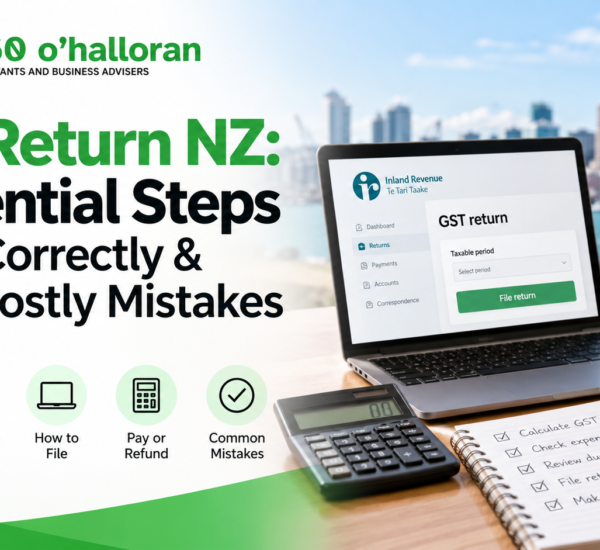
GST Return NZ: How to File, Due Dates & What Businesses Need to Know
Filing a GST return NZ correctly is an important part of running a GST-registered business in New Zealand. Your GST return tells Inland Revenue (IRD) how much GST your business has collected, how much eligible GST you can claim, and whether you need to make a payment or receive a refund.Understanding a GST return NZ is important for any GST-registered business.
This guide explains GST returns in New Zealand, including GST filing dates, taxable periods, what information you need, how to file through myIR, common mistakes and when professional GST accounting support can help.
What Is a GST Return NZ?
A GST return is a report submitted to Inland Revenue for a particular taxable period. It records the GST your business has collected on taxable sales and the eligible GST you can claim on business purchases and expenses.
The difference generally determines whether your business needs to pay GST to Inland Revenue or is entitled to a GST refund. GST-registered businesses must file a GST return for every taxable period, even when there is no GST to pay.
For most taxable periods, the GST return and payment are due on the 28th of the month following the end of the taxable period. There are specific exceptions for taxable periods ending 31 March and 30 November.
About This GST Return NZ Guide
Written by: DFK Orb360 O’Halloran Content Team
Reviewed by: DFK Orb360 O’Halloran Chartered Accounting Team
Expertise: New Zealand accounting, GST compliance, taxation and business advisory
Last reviewed: October 2026
This article provides general information about GST returns in New Zealand. GST obligations can depend on your accounting basis, taxable activities, filing frequency and individual business circumstances. For advice specific to your business, speak with a qualified accountant or tax adviser.
What Is a GST Return in New Zealand?
A GST return in New Zealand is a periodic return that GST-registered businesses use to report their GST position to Inland Revenue.
GST is generally charged at 15% on most taxable supplies in New Zealand. A GST-registered business collects GST from customers and may claim eligible GST on business purchases and expenses used to make taxable supplies.
Your GST return brings these amounts together for the relevant taxable period. Depending on the result, you may have GST to pay to Inland Revenue or may be entitled to a refund.
Inland Revenue requires a GST return to be filed for every taxable period, including periods where the return is nil.
Learn more about the broader GST rules in our GST Guide NZ.
What Do You Report in a GST Return?
The information required for your GST return NZ depends on your business activity and accounting basis, but your return generally involves working out the GST associated with your taxable supplies and eligible purchases.
Information you may need includes:
- GST-inclusive or GST-exclusive sales and income
- GST collected on taxable supplies
- Eligible business purchases and expenses
- GST paid on eligible purchases
- Zero-rated supplies where applicable
- GST adjustments
- Other information required for your GST position
Good record keeping is essential. Your accounting records, invoices, receipts and supporting documentation should allow you to substantiate the figures included in your GST return.
Not every business expense automatically qualifies for a GST claim. Whether GST can be claimed depends on the nature and use of the purchase and the applicable GST rules.
GST Return NZ Due Dates
Understanding the GST return due date NZ rules is important because your GST return and any payment are generally due on the same date.
For most taxable periods, your GST return is due by the 28th of the month after the end of your taxable period.
| Taxable period ending | General GST return due date |
|---|---|
| 31 January | 28 February |
| 28/29 February | 28 March |
| 31 May | 28 June |
| 31 July | 28 August |
| 30 September | 28 October |
| 31 March | 7 May |
| 30 November | 15 January |
The exact due date depends on your taxable period. Inland Revenue states that the GST return and payment are generally due on the same date. Late filing or payment can result in penalties and interest.Knowing your GST return NZ due date can help you avoid late filing and payment issues.
Always check the current due date for your particular taxable period rather than relying solely on a generic calendar.
How Often Do You File GST Returns in NZ?
GST returns can generally be filed monthly, two-monthly or six-monthly, depending on the business and the filing frequency selected or required.
Monthly GST returns
Businesses with sales over $24 million in a 12-month period generally must file monthly GST returns. Other businesses can also choose monthly filing in appropriate circumstances.
Two-monthly GST returns
Two-monthly filing is a common option for businesses with sales below the threshold that applies to mandatory monthly filing. It can help businesses keep their GST obligations and cash flow under regular review.
Six-monthly GST returns
Businesses with sales under $500,000 in a 12-month period may be eligible to file every six months. While this reduces the number of returns, it can mean dealing with a larger amount of financial information at once.
The most suitable filing frequency depends on your business circumstances, cash flow and accounting processes. Inland Revenue provides guidance on choosing a GST accounting basis and filing frequency.
How to File a GST Return in NZ
One of the most common questions businesses ask is: How do I file a GST return in NZ?
GST returns can generally be filed online through myIR or through compatible accounting software that supports GST filing.
Step 1: Check your taxable period
Confirm the start and end dates of the GST period you are filing.
Step 2: Reconcile your accounting records
Make sure your sales, purchases, GST transactions and bank records are complete and reconciled.
Step 3: Review GST collected
Check the GST associated with taxable sales and other taxable supplies for the period.
Step 4: Review eligible GST claims
Check your business purchases and expenses and identify GST that is eligible to be claimed under the applicable rules.
Step 5: Check adjustments
Depending on your business, GST adjustments may need to be considered before completing the return.
Step 6: Submit the GST return
Review the figures carefully before submitting through myIR or supported accounting software.
Step 7: Pay GST or manage your refund
If your return results in GST payable, make the payment by the relevant due date. If you are entitled to a refund, ensure your bank details and other information are correct.
Will You Pay GST or Receive a GST Refund?
Your GST return NZ calculation generally compares the GST you’ve collected with eligible GST you’ve paid on business purchases and expenses.
GST payable
If the GST you’ve collected is greater than your eligible GST claims, you will generally have an amount to pay to Inland Revenue.
GST refund
If your eligible GST claims exceed the GST collected, you may be entitled to a GST refund, subject to the applicable rules.
A GST refund is not automatically a sign that your business has made a mistake. For example, a business making significant taxable purchases or investments may have more GST to claim during a particular period.
Common GST Return Mistakes Businesses Make
Errors in GST returns can create unnecessary compliance issues. Some common areas businesses should watch include:
- Missing the filing deadline – forgetting a GST return can lead to penalties.
- Claiming private expenses – not every purchase made by a business is automatically claimable.
- Missing eligible business expenses – incomplete records can result in legitimate GST claims being overlooked.
- Entering transactions in the wrong period – timing matters when preparing GST returns.
- Failing to reconcile accounts – unreconciled accounting records can produce inaccurate GST figures.
- Ignoring adjustments – certain transactions may require GST adjustments.
- Using incorrect GST treatment – zero-rated, exempt and standard-rated supplies are not treated in the same way.
Regular bookkeeping and GST reconciliation can make the GST filing process considerably easier.
What Happens If You Miss a GST Return Deadline?
If you cannot file your GST return or make the required payment by the due date, Inland Revenue may apply penalties and interest depending on the circumstances.
Importantly, a GST return still needs to be filed even if you do not have GST to pay. A nil GST return is still a return and should not simply be ignored.
If you have missed a deadline, act promptly rather than waiting for the next filing period. Review the return, submit what is outstanding and address any payment issues with Inland Revenue.
Should You Use an Accountant for GST Returns?
Many business owners can manage GST filing themselves using myIR or accounting software. However, professional support can be valuable when your transactions become more complex or you want greater confidence in your GST compliance.
A GST accountant can help with:
- GST registration and filing frequency
- GST return preparation and review
- GST reconciliation
- Reviewing GST claims
- GST adjustments
- IRD compliance matters
- GST queries and reviews
- Accounting system and bookkeeping processes
- Identifying potential GST risks before filing
If your business has property transactions, mixed-use assets, overseas transactions, unusual supplies, rapid growth or complex ownership structures, professional advice can be particularly useful.
DFK Orb360 O’Halloran provides GST services in New Zealand, including GST return preparation, GST compliance and related accounting support.
GST Return Support From DFK Orb360 O’Halloran
At DFK Orb360 O’Halloran, we help New Zealand businesses manage GST compliance as part of their wider accounting and tax obligations.
Rather than treating a GST return as an isolated filing task, our team can help businesses maintain accurate financial records, review GST treatment and understand how GST obligations fit into their broader financial position.
Our Chartered Accounting team supports businesses with GST filing, tax compliance, bookkeeping, financial reporting and business advisory services.
GST Return Accountants Across Auckland & Wellington
DFK Orb360 O’Halloran provides GST return and accounting support to businesses across Auckland, Wellington, Lower Hutt and throughout New Zealand.
GST Return Accountant Auckland – Newmarket
Our Newmarket team supports businesses with GST returns, tax compliance, accounting and business advisory.
Level 2, 6 Kingdon Street, Newmarket, Auckland
GST Return Accountant Rosedale & North Shore
Our Rosedale office supports businesses across Rosedale, Albany, the North Shore and wider Auckland with GST and accounting requirements.
1D/43 Omega Street, Rosedale, Auckland 0632
GST Return Accountant Wellington & Lower Hutt
Our Petone office provides GST, tax, accounting and business advisory support for businesses across Lower Hutt, Wellington and the wider Wellington region.
48 Richmond Street, Petone, Lower Hutt 5012
You do not need to be located near one of our offices to work with us. DFK Orb360 O’Halloran also supports businesses remotely across New Zealand.
Need Help With Your GST Return?
Unsure about your next GST return, filing frequency, GST claims or upcoming IRD deadline? Talk to the DFK Orb360 O’Halloran team.
Complete the form below and our team can discuss your GST and accounting requirements.
GST Return NZ FAQs
What is a GST return in NZ?
A GST return is a report submitted to Inland Revenue that accounts for the GST collected on taxable supplies and eligible GST paid on business purchases and expenses during a taxable period.
When is a GST return due in New Zealand?
For most taxable periods, a GST return is due by the 28th of the month following the end of the taxable period. There are exceptions for taxable periods ending 31 March and 30 November.
Do I need to file a GST return if I have no GST to pay?
Yes. GST-registered businesses generally need to file a GST return for every taxable period, including when the return is nil.
How to File a GST Return NZ?
GST returns can generally be filed through myIR or compatible accounting software. Before filing, businesses should reconcile their accounting records and review GST collected, eligible GST claims and any required adjustments.
How often do I need to file GST returns?
GST returns can generally be filed monthly, two-monthly or six-monthly. The appropriate filing frequency depends on factors including turnover and the business’s circumstances.
Can an accountant file my GST return?
Yes. A business can authorise an accountant or other nominated person to help manage and file GST returns. An accountant can also help with GST reconciliation, claims, adjustments and compliance.
What happens if I file my GST return late?
Late filing and payment may result in penalties and interest. If you have missed a deadline, it is generally better to address the outstanding return promptly rather than wait for the next filing period.
Can I get a GST refund?
You may be entitled to a GST refund when your eligible GST claims exceed the GST collected, subject to the applicable GST rules and your business circumstances.
Where can I get help with GST returns in Auckland or Wellington?
DFK Orb360 O’Halloran provides GST return, accounting and tax support from offices in Newmarket and Rosedale in Auckland and Petone in Lower Hutt, as well as remotely across New Zealand.



 09 377 4238
 Level 2, 6 Kingdon Street, Newmarket, Auckland
 help@orb360.co.nz