

Updated: 13 October 2026
Reviewed by: Riz Khan, CPA and Associate Partner at DFK Orb360 O’Halloran
The 2026–27 tax year in New Zealand runs from 1 April 2026 to 31 March 2027 for taxpayers using the standard balance date. Preparing early for tax deadlines, business expenses, GST, provisional tax and income tax obligations can help you manage cash flow and make informed financial decisions.
A New Zealand tax planning checklist gives business owners, sole traders, contractors, property investors and individuals a practical way to review their financial position before the end of the tax year. Instead of waiting until a return is due, you can identify missing records, forecast payments and seek advice about transactions that may have tax consequences.
This guide from DFK Orb360 O’Halloran explains ten practical tax-planning steps, important records to maintain, official resources to consult and questions to discuss with your accountant.
What should your New Zealand tax planning checklist include?
Your tax planning checklist should cover income and expense records, eligible deductions, provisional tax, GST, payroll, investment income, cash flow and filing deadlines. You should also review significant business or property transactions before committing to them and confirm current requirements with Inland Revenue (IRD).
The exact steps depend on your income sources, business structure, balance date and tax obligations.
1. Reconcile your income and financial records
Accurate records are the starting point for effective New Zealand tax planning. Missing income, unreconciled bank accounts and incomplete invoices can make it difficult to prepare accurate tax returns or estimate your tax liability.
Before the end of the 2026–27 tax year, review:
- Business sales, service income and other receipts.
- Bank accounts, credit card transactions and accounting software.
- Customer invoices, outstanding debts and supplier bills.
- Receipts and supporting documents for business expenses.
- Interest, dividends, rental income and other relevant income.
- Shareholder transactions, drawings and other business-related movements.
Business owners should compare actual revenue and expenses with their budgets. If your profit is substantially different from expectations, your provisional tax estimates and cash-flow forecasts may also need reviewing.
Practical tip: Schedule a monthly bookkeeping review rather than leaving every reconciliation until March. This makes it easier to identify errors and prepare for upcoming payments.
2. Review business expenses and eligible tax deductions
Which business expenses can you claim in New Zealand? Generally, an expense must meet the relevant tax requirements and have an appropriate connection to earning taxable income. Private expenses and some capital costs are treated differently.
Review these categories:
- Operating costs: Eligible rent, utilities, insurance, software subscriptions and professional fees.
- Vehicle expenses: Business-related vehicle costs, with appropriate records and private-use adjustments.
- Home-office expenses: Eligible costs associated with business use of a home workspace.
- Equipment and assets: Computers, machinery, furniture and other purchases that may require depreciation or specific tax treatment.
- Staff expenses: Eligible employment costs and related obligations.
- Repairs and maintenance: Costs that qualify as deductible expenses under the applicable rules.
Keep invoices and supporting records for the expenses you claim. If a purchase has both business and personal use, you may need to apportion the expense. Capital expenditure may also need to be depreciated rather than deducted immediately.
Do not purchase unnecessary items solely to obtain a tax deduction. A deduction may reduce taxable profit, but it does not make the full cost of an item free.
For advice about your circumstances, explore DFK Orb360 O’Halloran’s tax advisory services in New Zealand.
3. Check your provisional tax obligations
Provisional tax is a system that allows eligible taxpayers to pay income tax in instalments during the year. It can be relevant to businesses, sole traders, contractors, landlords and other taxpayers whose income is not fully taxed at source.
Inland Revenue generally requires provisional tax when residual income tax from the previous return exceeds $5,000, subject to the applicable rules and circumstances.
Use this checklist:
- Review your latest income tax assessment.
- Confirm whether you need to pay provisional tax.
- Compare expected taxable income with your current estimates.
- Check your calculation method and instalment dates.
- Set aside money for upcoming payments.
- Discuss significant changes in income with your accountant.
For taxpayers with a standard 31 March balance date, the standard provisional tax instalments are generally due on 28 August, 15 January and 7 May. Other calculation methods and GST filing arrangements can result in different dates.
Check Inland Revenue’s provisional tax payment dates before making a payment.
If your income has changed significantly, do not change your estimate without understanding the consequences. Incorrect estimates can create additional tax costs, including interest in applicable circumstances.
4. Review GST registration, returns and payments
GST is an important part of tax compliance and cash-flow management for many New Zealand businesses. The standard GST rate is 15%, although different rules apply to certain supplies.
Review your GST position by checking:
- Whether your business needs to register for GST.
- Whether sales and purchases have been recorded in the correct taxable periods.
- Whether your GST returns reconcile with your accounting records.
- Whether you hold the required taxable supply information for expenses.
- Whether private use, exempt supplies or unusual transactions require adjustments.
- Whether your filing frequency and payment dates are correct.
GST collected from customers should not automatically be treated as money available for operating expenses. Forecast your GST liability and set aside funds for payment after considering eligible input tax and other adjustments.
Read the official Inland Revenue GST guidance for registration, returns, claims and payment requirements.
Why Is Tax Planning Important for New Zealand Businesses?
Tax planning is important for New Zealand businesses because it helps manage tax obligations, improve cash flow and prepare for upcoming payments. A proactive New Zealand tax planning checklist allows business owners to review deductible expenses, forecast provisional tax, reconcile GST, check payroll obligations and identify potential tax issues before filing deadlines. Regular financial reviews can also help businesses make informed decisions about investments, equipment purchases and business growth. For accurate guidance, consult Inland Revenue (IRD) or speak with a qualified tax professional at DFK Orb360 O’Halloran.
5. Check payroll, PAYE and employer tax obligations
Employers should review payroll throughout the year to ensure that employee and employer tax obligations are being handled correctly.
Include these items in your tax planning checklist:
- PAYE deductions and payment records.
- Payday filing and employee details.
- KiwiSaver deductions and employer contributions, where applicable.
- Employer superannuation contribution tax (ESCT), where applicable.
- Fringe benefit tax (FBT) for relevant employee benefits.
- Records for employees who have joined or left the business.
If your business provides vehicles or other benefits to employees, review the relevant tax rules before assuming a particular treatment applies.
Use Inland Revenue’s employer guidance to check current requirements and filing responsibilities.
6. Review your income sources and tax position
Your tax position may include more than salary or business income. Depending on your circumstances, you may need to consider interest, dividends, rental income, self-employment earnings, overseas income and other taxable amounts.
If you have more than one job, check that your tax codes are appropriate for your employment arrangements. Secondary tax deductions help account for additional employment income, but your final income tax liability depends on your total taxable income and the rules that apply.
Individuals should review the current New Zealand individual income tax rates published by Inland Revenue rather than relying on outdated rate tables.
Business owners should also consider how changes in revenue, remuneration or ownership transactions may affect their overall tax position.
7. Review rental property and investment income
Property owners and investors should maintain accurate records of rental income, expenses, acquisitions and disposals. Property-related tax treatment depends on the facts of the transaction and the legislation applicable at the time.
Review:
- Rental income and property-related expenses.
- Mortgage interest and applicable deductibility rules.
- Repairs and maintenance compared with capital improvements.
- Records for property purchases and sales.
- Potential bright-line or other property-sale tax considerations.
- Interest, dividends and relevant overseas investment income.
Do not assume that every property expense is deductible or that a property sale is automatically tax-free. If you are planning to sell property, change ownership or make a significant investment, obtain advice before committing to the transaction.
For further information, visit Inland Revenue’s official website.
8. Forecast tax payments and business cash flow
A profitable business can still face financial pressure if cash is tied up in unpaid invoices, inventory, debt repayments or capital expenditure.
Include expected income tax, provisional tax, GST and payroll-related payments in your cash-flow forecast. Compare those amounts with expected customer receipts and operating costs.
Ask yourself:
- What tax payments are due over the next three to six months?
- Are customers paying invoices on time?
- Will planned equipment purchases affect available cash?
- Have sales or profit changed enough to affect estimated tax?
- Is there a plan for a larger-than-usual tax bill?
Review these questions regularly rather than waiting until a payment is due.
Explore DFK Orb360 O’Halloran’s tax planning services to learn more about professional support for your financial planning needs.
9. Check proposed tax changes against official guidance
New Zealand tax rules and policy proposals can change. However, an announced policy, a bill before Parliament and enacted legislation are not the same thing.
When reviewing a proposed change, check:
- Whether it is a proposal, a bill or an enacted law.
- The proposed commencement date and any transitional rules.
- The official explanation of the change.
- Whether it applies to your income, assets or business structure.
- Whether professional advice is needed before you act.
Use the Inland Revenue Tax Policy website for official information on tax policy and legislative developments.
For a broader overview of election-related tax proposals, read DFK Orb360 O’Halloran’s New Zealand Election 2026 tax policies comparison. Remember that policy announcements do not automatically change your current tax obligations.
10. Confirm important tax deadlines for 2026–27
Tax deadlines depend on the type of obligation, filing frequency, balance date and whether an extension of time applies.
| Tax obligation | What to check |
|---|---|
| Income tax return | Confirm your filing deadline and whether an extension applies. |
| End-of-year income tax | Check the payment date for your circumstances. |
| Provisional tax | Confirm instalment dates and calculation method. |
| GST | Check the dates for your taxable period. |
| PAYE and employer deductions | Confirm employer payment and payday filing requirements. |
| FBT | Check the return period and payment deadline. |
For many taxpayers without a tax-agent extension, the income tax return deadline is generally 7 July following the tax year. Other deadlines may apply depending on the taxpayer and arrangement.
Use Inland Revenue’s official 2026–27 tax due date calendar and check your myIR account for obligations specific to you.
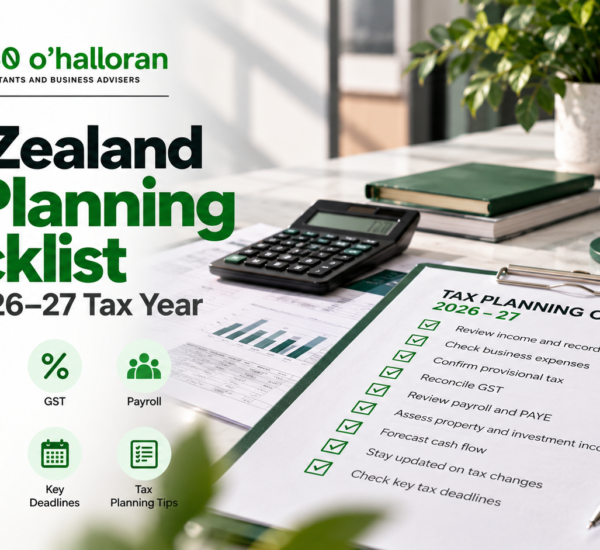
Your 2026–27 New Zealand tax planning checklist
Use this practical list during your next bookkeeping review or meeting with your accountant.
- ☐ Reconcile bank accounts and accounting records.
- ☐ Record all income and gather supporting documents.
- ☐ Review eligible expenses and the treatment of capital purchases.
- ☐ Check GST records, returns and payments.
- ☐ Review provisional tax estimates and instalments.
- ☐ Reconcile PAYE, payroll and employer obligations.
- ☐ Review rental property and investment income.
- ☐ Forecast upcoming tax payments and cash flow.
- ☐ Check current tax legislation and official updates.
- ☐ Confirm filing deadlines and any extensions.
- ☐ Discuss significant transactions with a qualified tax professional.
Frequently asked questions about New Zealand tax planning
When does the 2026–27 tax year start and end in New Zealand?
For taxpayers using the standard tax year, it starts on 1 April 2026 and ends on 31 March 2027. Some taxpayers may use a different balance date.
What should a New Zealand tax planning checklist include?
It should cover income records, eligible expenses, GST, provisional tax, payroll, investments, cash flow and tax deadlines. The exact requirements depend on your income sources and business structure.
Who needs to pay provisional tax in New Zealand?
Provisional tax may apply when residual income tax from a previous return exceeds the relevant Inland Revenue threshold. Check the current rules and your assessment to confirm whether instalments are required.
Can I claim every business expense as a tax deduction?
No. Expenses must meet the applicable tax rules. Private costs, capital purchases and mixed-use expenses may require different treatment. Keep supporting records and seek advice when you are unsure.
Where can I check New Zealand tax deadlines?
Use Inland Revenue’s official tax calendar and your myIR account. GST, provisional tax, PAYE and income tax can have different deadlines.
Can tax planning help improve business cash flow?
Yes. Forecasting tax payments alongside customer receipts, payroll and operating costs can help businesses prepare for liabilities and identify potential cash shortfalls earlier.
When should I speak to an accountant about tax planning?
Seek advice before significant business, property, investment or ownership transactions, and whenever you are uncertain about your tax obligations. Early advice can help you understand the relevant rules before making a financial commitment.
Reviewed by Riz Khan, CPA and Associate Partner
Riz Khan is a CPA and Associate Partner at DFK Orb360 O’Halloran, with more than a decade of experience in accounting, taxation and business advisory. His professional background supports DFK Orb360 O’Halloran’s focus on practical financial guidance and helping businesses understand their accounting and tax obligations.
Get professional tax planning support from DFK Orb360 O’Halloran
A well-maintained tax planning checklist can help you organise financial records, prepare for upcoming liabilities and make more informed decisions throughout the year. It is not a substitute for advice tailored to your circumstances.
DFK Orb360 O’Halloran provides tax advisory, accounting and business support to individuals and businesses. If you need help reviewing your tax position, preparing for upcoming obligations or understanding the tax implications of a significant transaction, explore our tax advisory services in New Zealand.
Need Help With Your New Zealand Tax Planning?
Planning ahead can help you manage tax obligations, prepare for upcoming payments and make informed business decisions. Whether you need help with provisional tax, GST, business expenses or year-end tax planning, DFK Orb360 O’Halloran can help you understand your options.
Talk to our team about your tax planning needs and take the next step with confidence.
Book a consultation today.
Disclaimer: This article provides general information only and is not individual tax, accounting or legal advice. Tax treatment depends on the facts of each situation and the legislation applicable at the time. Confirm current requirements with Inland Revenue or a qualified tax professional.



 09 377 4238
 Level 2, 6 Kingdon Street, Newmarket, Auckland
 help@orb360.co.nz