

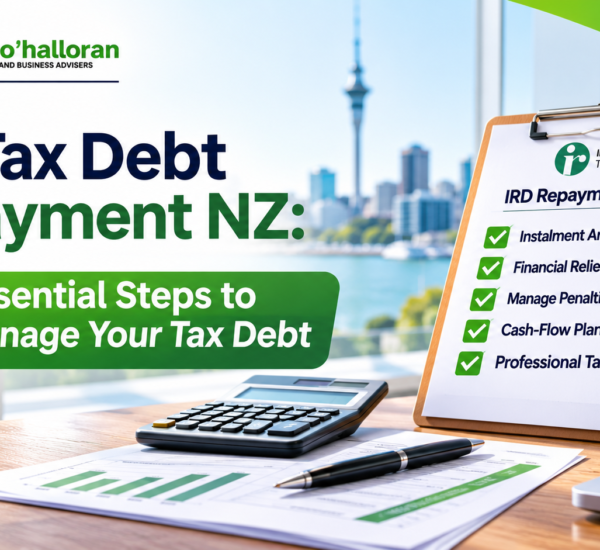
IRD Tax Debt Repayment is an important consideration for New Zealand businesses and individuals who are struggling to meet their tax payment obligations. Whether you owe GST, income tax, provisional tax, PAYE or other outstanding amounts, unpaid tax can create financial pressure through interest, penalties and potential collection action.
If you cannot pay your tax bill in full by the due date, you may have options. Inland Revenue (IRD) allows eligible taxpayers to apply for instalment arrangements and, in certain circumstances, financial relief. Understanding these options early can help you take a more structured approach to managing outstanding tax.
For business owners, addressing tax debt is also an important part of cash-flow management. Delaying action can make it harder to manage existing liabilities alongside ongoing operating expenses and future tax obligations.
How Does IRD Tax Debt Repayment Work in New Zealand?
IRD tax debt repayment allows individuals and businesses with outstanding tax obligations to explore payment arrangements with Inland Revenue. Eligible taxpayers may apply for an instalment arrangement to repay debt through agreed weekly, fortnightly or monthly payments. Depending on their circumstances, they may also qualify for financial relief, which can include the remission of certain penalties or the write-off of amounts in qualifying cases. Interest may continue to apply. Taxpayers should contact IRD early, review their financial position and understand their repayment options before further collection action occurs.
Key Takeaways
- IRD offers instalment arrangements for eligible taxpayers who cannot pay their tax in full.
- Repayment plans can be structured around weekly, fortnightly or monthly payments.
- Interest and penalties may apply to overdue tax balances.
- Financial relief may be available depending on individual or business circumstances.
- IRD may request financial information, including a business cash-flow forecast.
- Businesses should consider both existing tax debt and future tax obligations.
- Professional accounting advice can help businesses assess their financial position and prepare for discussions with IRD.
What Is IRD Tax Debt Repayment?
IRD tax debt repayment refers to the process of paying outstanding tax liabilities owed to Inland Revenue in New Zealand. Tax debt can arise when an individual or business does not pay the full amount of tax owed by the required due date.
Depending on the type of tax and the circumstances, outstanding amounts may include:
- Goods and Services Tax (GST).
- Income tax.
- Provisional tax.
- Pay As You Earn (PAYE).
- Employer-related tax obligations.
- Other tax amounts assessed by Inland Revenue.
When a taxpayer cannot pay their outstanding balance immediately, IRD may consider an instalment arrangement or an application for financial relief.
These options are designed to help eligible taxpayers address their obligations while providing Inland Revenue with a structured approach to recovering outstanding amounts.
Why Do Individuals and Businesses Accumulate IRD Tax Debt?
Tax debt can arise for several reasons. For businesses, it is often connected to cash-flow difficulties, unexpected expenses or poor tax planning rather than a single financial event.
1. Cash-Flow Problems
A business may have sufficient sales but insufficient available cash to meet its tax obligations. Late customer payments, unexpected expenses and seasonal fluctuations can all affect the ability to pay IRD on time.
2. Incorrect Tax Estimates
Businesses that underestimate taxable income or provisional tax requirements may face a larger tax bill than expected. Without regular financial reviews, these amounts can become difficult to manage.
3. Missed Tax Deadlines
Missing GST, PAYE or income tax payment deadlines can result in overdue balances, penalties and interest. Businesses should maintain a clear tax calendar and review upcoming payment obligations.
4. Poor Financial Recordkeeping
Inaccurate accounting records can make it difficult to calculate tax liabilities correctly. Missing invoices, unreconciled bank transactions and incomplete financial reporting can lead to unexpected tax adjustments.
5. Business or Personal Financial Pressure
A decline in revenue, unexpected business costs, changes in employment or other financial difficulties can affect a taxpayer’s ability to meet existing obligations.
What Are the IRD Tax Debt Repayment Options in New Zealand?
Inland Revenue provides different options for taxpayers who cannot pay their tax debt in full. The appropriate option depends on the amount owed, the taxpayer’s financial position and their ability to meet future obligations.
1. Instalment Arrangements
An instalment arrangement allows eligible taxpayers to repay outstanding tax through agreed payments over time instead of paying the full amount immediately.
Repayment frequency can generally be weekly, fortnightly or monthly, depending on the arrangement and the taxpayer’s circumstances.
When applying, taxpayers should consider:
- The total outstanding tax balance.
- How much they can realistically afford to repay.
- The proposed payment frequency.
- The first payment date.
- How they will meet future tax obligations.
Applications can be made through myIR. Inland Revenue may approve the proposal, request additional information or discuss alternative arrangements.
Important: An instalment arrangement is not simply a payment method. It is an agreed repayment arrangement with IRD. Making occasional payments without having an approved arrangement does not necessarily provide the same protection from penalties or collection action.
Official guidance: IRD instalment arrangements.
2. Financial Relief from Inland Revenue
In certain circumstances, taxpayers who cannot meet their tax obligations may be eligible to apply for financial relief.
Depending on the circumstances and Inland Revenue’s assessment, relief may include:
- Writing off certain amounts where the relevant legal requirements are met.
- Remitting eligible penalties.
- Remitting interest in qualifying circumstances.
- Combining an instalment arrangement with other forms of relief.
Financial relief is not automatic. IRD considers the taxpayer’s circumstances, financial information and applicable legal requirements before making a decision.
For businesses, this may involve providing financial information to demonstrate their current position and ability to meet obligations.
Official guidance: IRD debt and insolvency options.
3. Contacting IRD Before the Payment Due Date
If you know that you will not be able to pay your tax on time, contacting Inland Revenue before the due date is an important step.
Early communication gives you an opportunity to discuss available options and consider an appropriate repayment proposal before the debt becomes overdue.
Do not assume that making a partial payment automatically creates an instalment arrangement. If you cannot pay the full amount, you should request an arrangement through the appropriate IRD process.
4. Tax Pooling for Eligible Income Tax Debt
Tax pooling is another mechanism that may help eligible taxpayers manage certain income tax liabilities. It involves using tax pooling funds to settle tax obligations through an approved tax pooling provider, subject to the applicable requirements.
Availability depends on the type and year of the tax debt, the provider’s terms and Inland Revenue’s requirements. It is not a general solution for every form of outstanding tax.
Before considering this option, obtain advice on eligibility, costs, timing and the effect on your overall tax position.
How to Apply for an IRD Tax Debt Repayment Arrangement
If you cannot pay your outstanding tax in full, you can apply for an instalment arrangement through myIR.
Step 1: Review Your Outstanding Tax Balance
Log in to your myIR account and review the amounts owed, tax types, payment dates and any penalties or interest included in your balance.
Step 2: Calculate What You Can Afford
Review your income, business expenses, operating costs and upcoming tax obligations. Choose a repayment amount that is realistic and sustainable.
Step 3: Select Your Repayment Frequency
Depending on the available options, you can propose weekly, fortnightly or monthly repayments. Consider your business cash-flow cycle when selecting the frequency.
Step 4: Submit Your Instalment Proposal
Use myIR to select the instalment arrangement option, enter your proposed payment amount and frequency, choose the first payment date and submit your application.
Step 5: Respond to Any IRD Requests
Inland Revenue may approve your proposal, request further information or contact you to discuss your circumstances. Respond promptly and provide accurate supporting information.
Step 6: Follow the Agreed Payment Plan
If the arrangement is approved, make the agreed payments on time. Continue monitoring your tax account and ensure that new tax obligations are managed separately.
Use the official IRD guide to applying for an instalment arrangement for the latest instructions.
What Happens If You Do Not Pay Your IRD Tax Debt?
Ignoring outstanding tax debt can increase financial pressure and may lead to further action from Inland Revenue.
Depending on the tax type, payment history and circumstances, consequences may include:
Late Payment Penalties
IRD may impose late payment penalties when tax is not paid by the due date. The applicable penalty rules depend on the type of tax and the circumstances.
Use-of-Money Interest
Use-of-money interest (UOMI) may apply to overdue tax balances. Interest can increase the amount owed over time.
Collection Action
Inland Revenue may contact taxpayers to recover outstanding amounts. Where appropriate, collection action can include bank deductions or other recovery measures.
IRD’s July 2026 overdue debt update explains that it may contact customers, make further attempts to resolve outstanding balances and consider additional collection action where earlier efforts do not lead to a resolution.
Official information: IRD update on overdue debt and returns.
How Do IRD Penalties and Interest Affect Tax Debt?
When tax remains unpaid after its due date, penalties and interest may increase the outstanding balance.
IRD’s late payment penalty guidance describes a staged penalty system for applicable tax types. This can include an initial 1% penalty, a further 4% penalty after seven days and additional monthly penalties for certain outstanding balances.
However, the rules are not identical for every tax type. For example, monthly late payment penalties do not apply in the same way to GST, income tax including provisional tax, and Working for Families overpayments.
Use-of-money interest is a separate charge and may continue to apply even when an instalment arrangement is in place.
Why an approved repayment arrangement matters
IRD explains that keeping to an agreed instalment arrangement can stop further late payment penalties from being charged under the applicable rules and may help prevent further collection action. Interest may still apply to overdue amounts.
Read the current IRD late payment penalty guidance.
How Can Businesses Manage Tax Debt and Improve Cash Flow?
For business owners, managing tax debt requires more than arranging repayments. It also involves understanding why the debt occurred and making changes to prevent further financial pressure.
1. Prepare a Cash-Flow Forecast
Prepare a realistic forecast of expected income, expenses, tax payments and operating costs. This helps determine how much can be allocated towards existing tax debt without compromising essential business operations.
2. Separate Money for Tax Obligations
Consider maintaining a separate account or allocation for GST, PAYE and income tax obligations. This can help prevent money collected or reserved for tax from being used for unrelated business expenses.
3. Review GST and PAYE Regularly
Regularly reconcile accounting records and review upcoming GST and employer tax payments. These obligations should be included in your regular cash-flow planning.
4. Review Business Expenses
Identify unnecessary expenditure, review supplier costs and assess whether changes to payment terms can improve cash flow.
5. Monitor Future Tax Obligations
An arrangement for existing tax debt does not automatically cover future tax liabilities. Businesses need to continue filing returns and paying new tax obligations on time wherever possible.
How Can an Accountant Help With IRD Tax Debt Repayment?
Managing tax debt can be challenging when a business is also dealing with operating costs, payroll, supplier payments and changing revenue.
An experienced accountant can help business owners understand their financial position, review tax records and prepare for discussions with Inland Revenue.
Professional accounting support may include:
- Reviewing outstanding tax balances and relevant tax periods.
- Checking GST, PAYE and income tax records.
- Identifying discrepancies in financial reporting.
- Preparing cash-flow forecasts and repayment affordability assessments.
- Reviewing upcoming tax obligations.
- Helping organise supporting financial information for discussions with IRD.
- Developing better processes for managing future tax payments.
While Inland Revenue makes the decision on repayment arrangements and financial relief, professional advice can help taxpayers understand their position and prepare a more informed proposal.
Why Businesses Should Address Tax Debt Early
Delaying action on outstanding tax can make financial problems harder to manage. Interest and applicable penalties may continue to increase, while collection activity can create additional pressure on business cash flow.
Taking early action gives business owners more time to understand their options, review their financial records and establish a realistic plan.
If your business is experiencing difficulty meeting tax obligations, consider reviewing your position before the next payment deadline rather than waiting for the outstanding balance to grow.
How DFK Orb360 O’Halloran Can Support Your Business
Understanding your tax position is an important part of running a financially sustainable business. Whether you are dealing with outstanding GST, provisional tax, PAYE or income tax, having accurate financial information can help you make informed decisions.
DFK Orb360 O’Halloran provides accounting, taxation and business advisory services to help New Zealand businesses manage their financial responsibilities.
Our team can help businesses review financial records, understand tax obligations, assess cash-flow requirements and organise information needed when considering repayment options.
If your business is experiencing tax payment difficulties, speaking with an accounting professional may help you identify the next practical steps.
Explore DFK Orb360 O’Halloran’s accounting and business advisory services.
People Also Ask: IRD Tax Debt Repayment in New Zealand
1. Can I pay my IRD tax debt in instalments?
Yes. Eligible individuals and businesses can apply to Inland Revenue for an instalment arrangement if they cannot pay their tax debt in full. Payments can generally be arranged weekly, fortnightly or monthly, depending on the agreed plan.
2. How do I arrange a payment plan with IRD?
You can apply for an instalment arrangement through your myIR account. You will need to provide your proposed repayment amount, payment frequency and first payment date. IRD may approve the proposal, request more information or discuss alternative options.
3. Can IRD write off tax debt in New Zealand?
In certain circumstances, Inland Revenue may write off some or all of an amount owing if the relevant legal requirements are met. This can depend on factors such as serious hardship and the taxpayer’s financial circumstances. A write-off is not automatic and requires IRD’s assessment.
4. Does IRD charge interest on overdue tax?
Yes. Use-of-money interest may apply to overdue tax balances. Interest is separate from late payment penalties and may continue to accrue while an amount remains outstanding, including during an instalment arrangement.
5. What happens if I cannot pay my tax by the due date?
If you cannot pay your tax by the due date, contact Inland Revenue as soon as possible. You may be able to apply for an instalment arrangement or financial relief, depending on your circumstances. Acting early can help you understand the available options.
6. Can a business apply for IRD tax debt repayment?
Yes. Companies, partnerships, trusts and other eligible business taxpayers can apply for instalment arrangements and may also qualify for financial relief. IRD may request additional financial information, such as a twelve-month cash-flow forecast.
7. Will an IRD payment arrangement stop penalties and interest?
Keeping to an agreed instalment arrangement can stop further late payment penalties under applicable rules. However, use-of-money interest may continue to apply to outstanding tax. The treatment depends on the tax type and timing of the arrangement.
8. Can I arrange an IRD payment plan before my tax is overdue?
Yes. If you know that you will not be able to pay your tax in full by the due date, you can contact IRD or apply for an instalment arrangement before the payment becomes overdue.
9. What happens if I miss an agreed IRD repayment?
Missing an agreed payment can affect your arrangement and may lead to further penalties or collection action. Contact Inland Revenue promptly if your circumstances change or you are unable to make an agreed payment.
10. Should I speak to an accountant about my IRD tax debt?
Speaking to an accountant can help you review your tax balances, assess your cash flow, identify reporting issues and prepare financial information for discussions with Inland Revenue. An accountant can also help you plan for future tax obligations.
Struggling With IRD Tax Debt? Let’s Discuss Your Options.
Unpaid tax can place pressure on your business cash flow and make it difficult to plan ahead. Understanding your financial position and available repayment options is an important first step.
DFK Orb360 O’Halloran can help you review your accounting records, understand your tax obligations and assess practical steps for managing your business finances.
Request a consultation with our team to discuss your business’s accounting and tax requirements.
Request a Consultation With DFK Orb360 O’Halloran
Tell us a little about your business and how we can assist. Complete the form below and the DFK Orb360 O’Halloran team can follow up regarding your enquiry.
Official Information and Further Reading
Disclaimer: This article provides general information about New Zealand tax debt and repayment options. It is not individual tax, financial or legal advice. Repayment arrangements and financial relief are subject to Inland Revenue’s assessment and applicable legislation. Interest and penalties may continue to apply depending on the circumstances.



 09 377 4238
 Level 2, 6 Kingdon Street, Newmarket, Auckland
 help@orb360.co.nz