

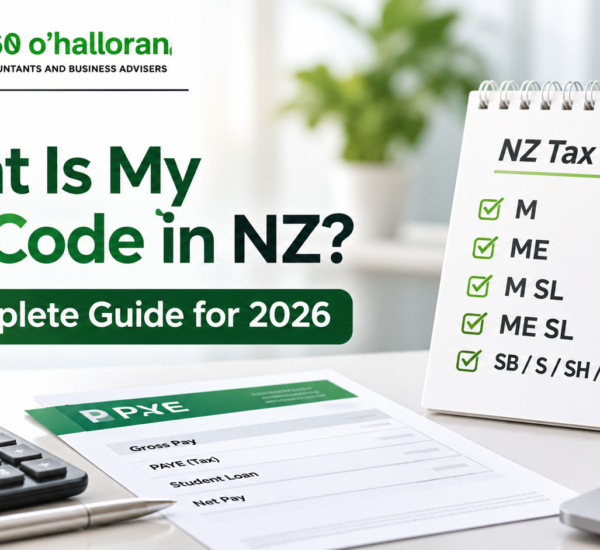
Understanding your New Zealand tax code is important because it helps your employer or income payer deduct the correct amount of tax from your salary, wages or other taxable payments. Whether you have one job, multiple income sources or a student loan, choosing the right tax code can help you avoid unexpected tax bills.
What Is My Tax Code in NZ?
Your New Zealand tax code tells your employer or income payer how much PAYE tax to deduct from your income. The correct code depends on your income sources, expected annual earnings and circumstances, including whether you have a student loan.
Common tax codes include M for main income, ME for eligible main income with the Independent Earner Tax Credit, M SL for main income with a student loan, and secondary tax codes such as SB, S, SH, ST and SA. You generally provide your tax code through Inland Revenue’s IR330 tax code declaration form.
If your income or circumstances change, you may need to update your tax code. Check your circumstances against Inland Revenue guidance or seek professional advice if you are unsure.
Key Takeaways
- Your tax code determines how much PAYE is deducted from your employment income or other taxable payments.
- You generally use one main tax code for your main or highest income source.
- Additional income sources may require a secondary tax code.
- Student loan obligations can affect the tax code you need to use.
- You can use Inland Revenue’s IR330 form and tax-code guidance to check your situation.
- Review your tax code when your income, employment or student loan circumstances change.
What Is a Tax Code in New Zealand?
A tax code is a combination of letters that tells your employer, benefit provider or other income payer how much tax to deduct from your payments. In New Zealand, this deduction is generally known as Pay As You Earn (PAYE).
Your employer deducts PAYE from your gross salary or wages and pays it to Inland Revenue (IRD) on your behalf. The amount deducted depends on your income, the applicable tax rates and the tax code you provide.
Your tax code is not the same as your tax rate. A tax code helps determine the withholding applied to a particular income source, while your final income tax liability is calculated using your taxable income and the applicable tax rules.
Choosing the correct tax code is important. If too little tax is deducted during the year, you may have tax to pay later. If too much is deducted, you may receive a refund after your tax assessment.
How Do I Know What My Tax Code Should Be?
If you are asking, “What is my tax code?”, start by considering your employment and income circumstances. The correct code depends on whether you have one income source or multiple income sources, whether you have a student loan and whether you qualify for a relevant tax credit.
Before choosing a tax code, consider these questions:
- Is this your main or highest income source?
- Do you receive income from another employer or payer?
- Do you have a student loan?
- Are you eligible for the Independent Earner Tax Credit?
- Has your expected annual income changed?
Inland Revenue provides an online tool and an IR330 tax code declaration form to help individuals identify the appropriate code. Your personal circumstances should be checked against the current IRD guidance rather than selecting a code based on your job title alone.
Official guidance: What tax code should I use? – Inland Revenue
Common New Zealand Tax Codes Explained
New Zealand has several tax codes for different income and employment situations. The following table explains some of the common codes. It is a general guide, not a substitute for checking the IRD tax-code declaration.
| Tax Code | General Explanation |
|---|---|
| M | A common code for a person’s main income source, where the individual does not use a student-loan variation or an applicable ME code. |
| ME | A main-income tax code for individuals who qualify for the Independent Earner Tax Credit (IETC), subject to the applicable eligibility requirements. |
| M SL | A main-income tax code that includes student loan deductions. |
| ME SL | A main-income code for an eligible IETC recipient who also has student loan repayment deductions. |
| SB | A secondary income tax code generally used when estimated annual income from all sources falls within the lowest secondary tax band. |
| S | A secondary income tax code for the next applicable annual income band. |
| SH | A secondary income tax code for a higher annual income band. |
| ST | A secondary income tax code for a higher annual income band. |
| SA | A secondary income tax code for the highest annual income band. |
Other codes apply to specific payment or employment situations. For example, WT is used for certain schedular payments, while CAE, NSW and EDW apply to particular types of work and eligibility conditions. Do not select these codes unless your circumstances meet the relevant IRD requirements.
Read more: About tax codes – Inland Revenue
What Is the Difference Between M, ME and M SL?
M Tax Code
M is commonly used for a person’s main income source. It is generally relevant where the person does not need a student-loan variation and does not qualify to use the ME code.
ME Tax Code
ME is used by eligible individuals who qualify for the Independent Earner Tax Credit. Eligibility depends on Inland Revenue’s requirements, including income and other qualifying conditions. Having one job does not automatically mean you qualify.
M SL Tax Code
M SL is generally used for a person’s main income when student loan deductions are required. The SL indicates that student loan repayments should be deducted from the relevant income.
ME SL Tax Code
ME SL combines the relevant ME tax-code treatment with student loan deductions. It is only appropriate where the individual meets the requirements for the ME code and has a student loan.
If you have repaid your student loan in full or your circumstances change, you may need to provide your employer with an updated tax code declaration.
What Is a Secondary Tax Code in NZ?
If you receive taxable income from more than one source at the same time, you may need a secondary tax code for your additional income. For example, you might have a full-time job and also work part-time for another employer.
Your main income source is generally your highest income source. Other income sources may be treated as secondary income. The appropriate secondary tax code depends on your estimated annual income from all sources.
Secondary tax is a withholding method. It helps account for the fact that your combined income may fall into higher tax brackets. It does not automatically mean you are paying an additional final tax on top of your actual income tax liability.
Secondary Tax Codes and Income Bands
The following table shows the secondary tax codes and income bands published by Inland Revenue. The rates below are before ACC earners’ levies.
| Estimated Annual Income From All Sources | Secondary Tax Code | Secondary Tax Rate |
|---|---|---|
| $0 – $15,600 | SB | 10.5% |
| $15,601 – $53,500 | S | 17.5% |
| $53,501 – $78,100 | SH | 30% |
| $78,101 – $180,000 | ST | 33% |
| $180,001 and over | SA | 39% |
These bands are based on estimated annual income from all sources, not simply the amount earned from the second job. Check the current Inland Revenue guidance before choosing a code, particularly if your income changes during the tax year.
Official reference: Inland Revenue – Secondary tax codes and rates
How Does a Student Loan Affect Your Tax Code?
If you have a New Zealand student loan and earn income through employment, your tax code may need to include the SL indicator. This tells your employer to deduct student loan repayments where required.
If you have more than one income source, student loan repayment obligations may also apply to your additional income. The correct treatment depends on your income and circumstances.
If you repay your student loan in full, make sure you check whether your tax code needs to change. You should provide your employer with an updated declaration where required.
How Do I Change My Tax Code in New Zealand?
You may need to change your tax code when your employment or financial circumstances change. Examples include starting a second job, changing your expected annual income, taking out a student loan or paying off your student loan.
In general, the process is:
- Review your circumstances: Check your main income, other income sources, student loan status and eligibility for relevant tax credits.
- Check the correct code: Use Inland Revenue’s online guidance or IR330 tax code declaration.
- Complete the declaration: Fill in the required details and select the appropriate tax code.
- Give it to your employer or payer: Your employer or income payer uses the information to calculate deductions.
- Review your payslip: Check that the tax code and deductions reflect your updated circumstances.
You can find the current declaration and guidance on the official Inland Revenue website: Inland Revenue forms and guides .
What Happens If I Use the Wrong Tax Code?
Using an incorrect tax code can result in too much or too little tax being deducted from your income. This may affect your take-home pay and the amount you owe or are due to receive after your end-of-year tax assessment.
Possible consequences include:
- Under-deducted tax: You may have tax to pay after Inland Revenue reviews your income for the year.
- Over-deducted tax: You may receive a refund after your tax assessment, depending on your circumstances.
- Incorrect student loan deductions: Your repayments may not be deducted correctly if your tax code does not reflect your loan status.
- Payroll corrections: Your employer may need updated information to apply the correct deductions going forward.
If you do not provide your employer or payer with the required IR330 tax code declaration, Inland Revenue states that the non-declaration rate of 45% may apply. Check the current IRD requirements if you have not supplied a declaration.
Do Contractors and Self-Employed People Need a Tax Code?
Not everyone who earns income in New Zealand uses an employee PAYE tax code in the same way.
If you are self-employed, you generally manage your income tax obligations through your annual tax return and may need to make provisional tax payments depending on your circumstances.
Contractors receiving schedular payments may have tax deducted at source and may need to provide the relevant tax declaration for schedular payments. The applicable rules depend on the type of work and payment arrangement.
Dividends and interest generally use resident withholding tax (RWT) rather than an employee PAYE tax code.
If you are unsure how your income should be treated, check the relevant Inland Revenue guidance or speak with an accountant.
When Should You Review Your Tax Code?
Your tax code should reflect your current circumstances. It is worth reviewing it when:
- You start a new job.
- You take on a second job or another taxable income source.
- Your expected annual income changes significantly.
- You take out a student loan or repay it in full.
- Your eligibility for the Independent Earner Tax Credit changes.
- You begin receiving a benefit, pension or other taxable payment.
Reviewing your tax code can help ensure the correct amount of tax is deducted throughout the year and reduce the risk of an unexpected tax bill.
Frequently Asked Questions About NZ Tax Codes
1. What is my tax code if I have only one job?
Your tax code will depend on your income and circumstances. M is commonly used for a main income source, but you may need a different code if you have a student loan or qualify for the ME tax code. Check the IRD tax-code guidance before selecting one.
2. What is my tax code NZ if I have two jobs?
You generally use a main tax code for your main or highest income source and a secondary tax code for your additional income. The secondary code depends on your estimated annual income from all sources.
3. What is the difference between M and ME tax codes?
M is a common main-income tax code. ME is for individuals who meet the eligibility requirements for the Independent Earner Tax Credit. You should check the current IRD eligibility criteria before using ME.
4. What does M SL mean?
M SL is a main-income tax code that includes student loan deductions. It tells your employer to make student loan repayments from your employment income where required.
5. Do I pay more tax because I have a secondary tax code?
Not necessarily. Secondary tax is a withholding method used when you have more than one income source. Your final income tax is calculated based on your total taxable income and applicable tax rules for the year.
6. How do I find my tax code?
You can check the tax code you have provided to your employer, review your payslip or refer to your IRD tax information. If you are unsure whether it is correct, use Inland Revenue’s tax-code guidance and IR330 declaration.
7. Can I change my tax code during the year?
Yes. If your income or circumstances change, you may need to provide your employer or payer with an updated tax code declaration.
8. What happens if I do not give my employer a tax code?
If you do not provide the required IR330 declaration, the non-declaration tax rate of 45% may apply. Contact your employer or Inland Revenue to understand what information is required.
9. Do self-employed people need an M tax code?
Self-employed people generally manage their income tax through their tax return rather than using an employee PAYE tax code for their business income. Other rules may apply if they also receive employment or schedular income.
10. Where can I check the correct tax code for my situation?
Inland Revenue provides an online tool and the IR330 tax code declaration to help you identify the correct code. If your circumstances are complex, consider getting professional advice.
Need Help Understanding Your NZ Tax Obligations?
Choosing the correct tax code is important, but it is only one part of managing your wider tax and financial responsibilities.
Whether you need guidance on PAYE, payroll, income tax, business accounting or tax planning, DFK Orb360 O’Halloran can help you understand your obligations and make informed decisions.
Speak with our accounting and business advisory team about your situation and the support your business may need.
Book a Consultation with DFK Orb360 O’HalloranSpeak to the DFK Orb360 O’Halloran Team
Complete the form below and our team can follow up with you about your accounting or business advisory enquiry.
About DFK Orb360 O’Halloran
DFK Orb360 O’Halloran provides accounting, taxation and business advisory services to businesses in New Zealand. Our team supports business owners with financial reporting, tax compliance, accounting and business decision-making.
To learn more about our firm and services, visit DFK Orb360 O’Halloran .
Editorial and Professional Review
Published by: DFK Orb360 O’Halloran
Subject: New Zealand individual tax codes and PAYE
Last reviewed: November 2026
Professional review: Reviewed by the DFK Orb360 O’Halloran team, drawing on the firm’s accounting, taxation and business advisory expertise.
Sources: Inland Revenue guidance on tax codes, secondary tax codes, PAYE and tax-code declarations.
Disclaimer: This article provides general information about New Zealand tax codes and PAYE. It is not personalised tax, legal or financial advice. Tax treatment depends on individual circumstances and current legislation. Always check the latest Inland Revenue guidance or consult a qualified professional before making decisions about your tax position.



 09 377 4238
 Level 2, 6 Kingdon Street, Newmarket, Auckland
 help@orb360.co.nz