

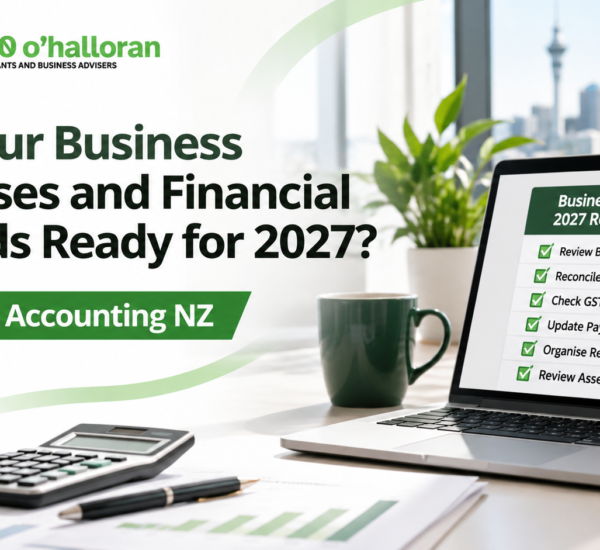
As 2026 draws to a close, New Zealand businesses should take the opportunity to review their expenses, reconcile financial records and prepare their accounting systems for the year ahead. Disorganised receipts, incorrectly coded transactions, unreconciled bank accounts and incomplete expense records can make tax preparation more difficult and affect the accuracy of financial reporting.
Are your business expenses and financial records ready for 2027? For New Zealand businesses, maintaining accurate accounts is essential for understanding financial performance, managing tax obligations and making informed decisions. Business Accounting NZ involves more than recording everyday transactions. It includes reviewing expenses, reconciling accounts, organising financial documents and ensuring your business information is ready for reporting and tax preparation.
As the year comes to an end, businesses should review their bookkeeping processes, check supporting documents and identify any gaps in their financial records. Whether you operate a small business, manage a growing company or work as a contractor, a structured Business Accounting NZ process can help you enter 2027 with greater financial clarity.
Whether you operate a small business, manage a growing company or work as a contractor, getting your financial records in order is an important part of preparing for 2027. With the right Business Accounting NZ processes, you can improve financial visibility, support accurate tax reporting and make more informed business decisions.
What Should NZ Businesses Do Before 2027?
Quick answer: Before entering 2027, New Zealand businesses should review and categorise their business expenses, reconcile bank and credit card accounts, check outstanding invoices, organise receipts and invoices, review GST records, update payroll information and maintain accurate asset records.
Inland Revenue generally requires businesses to retain tax records for at least seven tax years. Records should support reported income, expenses, GST and other tax obligations. A regular bookkeeping process and suitable accounting software can help businesses maintain accurate records and prepare for tax reporting.
Key takeaway: Financial preparation should happen throughout the year, not just when a tax return or GST filing deadline approaches.
Why Is It Important to Review Business Expenses and Financial Records Before 2027?
Your financial records provide a picture of how your business is performing. They show where revenue is coming from, what the business is spending, which customers still owe money and whether operating costs are increasing.
When records are incomplete or expenses are incorrectly categorised, business owners may find it harder to understand profitability, prepare financial statements or support tax deductions.
A structured year-end review can help your business:
- Identify missing receipts, invoices and supporting documents.
- Recognise expenses that have been incorrectly categorised.
- Review outstanding customer payments and supplier bills.
- Prepare more accurate GST and income tax information.
- Understand operating costs and changes in spending.
- Improve cash flow planning and budgeting for 2027.
- Make financial information easier to access when required.
Good accounting is not simply about recording transactions. It is about having reliable financial information that supports the decisions you make throughout the year.
Which Business Expenses Should You Review Before 2027?
Reviewing your business expenses is one of the most useful steps in preparing your accounts. Each expense should be recorded accurately, supported by appropriate documentation and assessed according to the applicable tax rules.
1. Office and Operating Expenses
Review recurring operating costs, including:
- Office rent and premises expenses.
- Electricity, internet and telephone costs.
- Office supplies and stationery.
- Software subscriptions and business applications.
- Repairs and maintenance.
- Insurance and professional service fees.
Check that recurring payments are recorded in the correct accounting period and that business-related expenses are distinguishable from private expenditure.
2. Travel and Motor Vehicle Expenses
If your business uses vehicles or incurs travel costs, review the supporting records before finalising your accounts.
Depending on the circumstances, relevant records may include:
- Vehicle running costs and fuel receipts.
- Vehicle registration and insurance expenses.
- Business travel invoices and accommodation receipts.
- Motor vehicle logbooks and business-use calculations.
- Records explaining the business purpose of travel.
Where a vehicle or other expense is used for both business and private purposes, the business portion must be calculated using an appropriate method and supported by records. Do not automatically claim the entire expense as a business deduction.
3. Staff, Payroll and Employment Costs
Businesses with employees should review their payroll records and employment-related expenses. Check that salary and wage information, PAYE deductions, employer contributions and other payroll transactions have been recorded correctly.
Review the following:
- Employee salary and wage records.
- PAYE deductions and payday filing information.
- Employer superannuation contribution tax records, where applicable.
- Staff reimbursements and expense claims.
- Leave balances and relevant employment records.
- Payroll software reports and reconciliations.
Accurate payroll information helps businesses maintain appropriate employment and tax records and identify discrepancies before they become more difficult to resolve.
4. Marketing, Advertising and Business Development Expenses
Marketing expenditure can include digital advertising, website services, design work, promotional materials, business development and professional marketing services.
Review supplier invoices, advertising platform statements and payment records to ensure these transactions are correctly recorded. Also distinguish between ordinary operating expenses and costs that may need to be treated as capital expenditure under the relevant accounting and tax rules.
5. Equipment, Technology and Fixed Assets
Review purchases of computers, machinery, furniture, tools, vehicles and other business assets.
Maintain an updated fixed asset register showing relevant information such as:
- Asset description and purchase date.
- Purchase price and supporting invoice.
- Business-use details, where relevant.
- Depreciation claimed and adjusted tax value.
- Disposal or sale information.
Some asset purchases may be subject to depreciation or other specific tax treatment rather than being claimed as an ordinary operating expense in full. Your accounting treatment should reflect the applicable rules.
What Are the Most Common Business Accounting Mistakes to Avoid?
Even businesses with accounting software can experience bookkeeping and reporting errors. Reviewing your accounting processes before 2027 can help identify problems early.
Some common business accounting mistakes include:
- Mixing personal and business expenses: This makes it harder to identify legitimate business expenditure.
- Missing receipts and invoices: Incomplete documentation can make it difficult to support reported expenses.
- Incorrect GST coding: Transactions recorded under the wrong GST category can affect GST calculations.
- Delayed bank reconciliation: Unreconciled transactions can lead to inaccurate financial reports.
- Ignoring outstanding invoices: Unpaid customer balances can affect cash flow visibility.
- Incorrect asset treatment: Capital purchases may require different accounting and tax treatment from ordinary operating expenses.
- Inconsistent bookkeeping: Leaving financial records until tax time can increase the likelihood of errors and missing information.
Good Business Accounting NZ practices involve reviewing transactions regularly, keeping supporting documents and seeking professional advice when the correct accounting or tax treatment is unclear.
What Financial Records Must a New Zealand Business Keep?
Inland Revenue requires businesses to maintain records that support their income, expenses, assets, liabilities and tax obligations. These records may be kept in paper or electronic form, provided they remain accessible and usable.
Examples of important business records include:
| Record type | Examples | Why it matters |
|---|---|---|
| Sales and income | Sales invoices, receipts, sales reports and payment records | Supports reported business income |
| Business expenses | Supplier invoices, receipts and expense claims | Supports expense calculations and deductions |
| Banking | Bank statements, credit card statements and transaction records | Helps reconcile business transactions |
| GST | Taxable supply information and relevant GST calculations | Supports GST return preparation |
| Payroll | Wage records, PAYE information and employer contribution records | Supports employment and payroll obligations |
| Assets and liabilities | Asset register, depreciation calculations, loan and finance records | Supports financial reporting and tax calculations |
How Long Should Businesses Keep Financial Records in New Zealand?
Generally, New Zealand businesses must keep their tax records for at least seven tax years. This applies to paper and electronic records.
Records should be maintained in English or Māori unless Inland Revenue has approved another language. If records are stored electronically or through cloud-based accounting systems, businesses should ensure they remain accessible, readable and capable of being retrieved when required.
It is important not to delete old accounting records simply because a financial year has ended. They may be needed to support a tax return, respond to an Inland Revenue query or verify a historical transaction.
Read the official guidance: Inland Revenue – Record Keeping.
Are You Separating Business and Personal Expenses Correctly?
Mixing personal and business transactions is a common bookkeeping problem, particularly for sole traders and small businesses.
Using a dedicated business bank account and business payment card can make it easier to identify business transactions and maintain a clear audit trail.
Before 2027, check whether:
- Personal purchases have been incorrectly recorded as business expenses.
- Business purchases made using personal funds have been properly documented.
- Mixed-use costs have been apportioned correctly.
- Director or shareholder transactions have been recorded appropriately.
- Reimbursements have been supported by receipts and explanations.
An expense should not be claimed simply because it was paid from a business account. Its deductibility depends on the relevant tax rules and the circumstances of the expenditure.
What Should You Check in Your GST and Tax Records Before 2027?
Businesses registered for GST should review their GST records as part of their regular accounting process. Incorrect transaction coding or missing taxable supply information can affect the accuracy of GST returns.
GST Record Checks
- Check that sales and purchases have been recorded in the correct GST periods.
- Review taxable supply information and supporting documents.
- Confirm that GST coding is appropriate for each transaction.
- Check that private or non-deductible expenditure has not been incorrectly included in GST claims.
- Reconcile GST reports with the accounting ledger and filed returns.
- Investigate any differences before preparing the next return.
Remember that GST treatment and income tax deductibility are not always identical. An expense may require a different treatment for GST and income tax purposes.
Income Tax and Provisional Tax Preparation
Businesses should also review their income and expenditure information to help prepare for income tax reporting and provisional tax planning.
Consider whether your records provide a clear picture of:
- Business revenue and other taxable income.
- Operating expenses and potential deductions.
- Depreciation and asset disposals.
- Outstanding debtors and creditors.
- Prior-year tax adjustments.
- Provisional tax payments and expected tax liabilities.
Provisional tax obligations depend on the business’s circumstances and applicable Inland Revenue rules. Reviewing your financial position early can help you plan for upcoming payments rather than relying on last-minute estimates.
For further information, visit Inland Revenue New Zealand.
How Can Accounting Software Improve Your Business Record Keeping?
Accounting software can help businesses organise transactions, reconcile bank accounts, manage invoices and generate financial reports. However, using software does not automatically guarantee accurate records. Transactions still need to be reviewed, coded and reconciled correctly.
When reviewing your accounting system for 2027, consider whether it allows you to:
- Import and reconcile bank transactions.
- Attach receipts and invoices to transactions.
- Track accounts payable and accounts receivable.
- Generate profit and loss statements and balance sheets.
- Monitor GST transactions and prepare relevant reports.
- Maintain payroll and asset records where required.
- Export and retrieve historical accounting information.
Businesses should also check user access, backup procedures and document storage arrangements. If records are held offshore through cloud services, Inland Revenue’s requirements for offshore record storage should be considered.
Official guidance: Inland Revenue – Computer Record Keeping for Audit.
2027 Business Accounting Checklist: What Should You Complete Before the New Year?
Use this practical checklist to identify gaps in your financial records before moving into 2027.
- Reconcile all business bank accounts and credit cards.
- Review sales invoices and outstanding customer payments.
- Check supplier invoices and unpaid business expenses.
- Organise receipts and supporting documentation.
- Review expense categories and investigate unusual transactions.
- Separate business and private expenditure.
- Check GST coding and reconcile GST reports.
- Review payroll, PAYE and employee records.
- Update the fixed asset register and depreciation information.
- Review loans, liabilities and director or shareholder transactions.
- Check provisional tax information and upcoming payment obligations.
- Confirm that accounting records are backed up and retrievable.
- Discuss unresolved accounting or tax questions with your accountant.
Completing these checks can help reduce the amount of corrective bookkeeping required later and provide a more reliable starting point for the next financial period.
When Should You Work With a Business Accountant in New Zealand?
While accounting software can help manage everyday transactions, businesses may need professional accounting support when their financial requirements become more complex.
You may benefit from speaking with a business accountant if:
- Your business has grown and its transactions have become more complicated.
- You are unsure whether certain expenses are tax deductible.
- Your GST or accounting reconciliations contain unexplained differences.
- You need help preparing financial statements or tax information.
- You are planning a new investment, asset purchase or business expansion.
- You need better visibility over cash flow, profitability and operating costs.
- You want to improve your accounting systems before the next financial year.
A business accountant can help review your records, identify areas that need attention and explain the accounting and tax considerations relevant to your circumstances.
How Can DFK Orb360 O’Halloran Help Your Business Prepare for 2027?
At DFK Orb360 O’Halloran, we understand that accurate financial information is important for managing a business and planning ahead.
Our team works with businesses to support their accounting, reporting and tax requirements. Whether you need help reviewing your financial records, improving your accounting processes or understanding your business’s financial position, having the right professional support can make the process more manageable.
We can discuss how your business may benefit from support with:
- Accounting and financial reporting: Organising financial information and supporting reliable reporting.
- Tax advisory: Reviewing tax considerations and helping businesses understand their obligations.
- GST and compliance: Supporting appropriate GST and tax record processes.
- Business advisory: Using financial information to support business planning and decision-making.
- Outsourced CFO support: Helping businesses improve financial visibility, budgeting and forecasting where appropriate.
Our approach starts with understanding your business, its financial processes and the areas where you need support.
Get Your Business Financially Ready for 2027
Do not wait until the next tax deadline to discover that your receipts are missing, expenses are incorrectly coded or financial records are incomplete.
Taking action now can help you enter 2027 with better organised accounts, a clearer understanding of your business expenses and more reliable financial information.
Are your business expenses and financial records ready for 2027?
Speak with the team at DFK Orb360 O’Halloran to discuss your accounting and financial reporting requirements. Request an initial conversation with our team and find out how we can help your business prepare for the year ahead.
Contact DFK Orb360 O’Halloran – Discuss Your Business Accounting Requirements
Frequently Asked Questions About Business Accounting in New Zealand
1. How long do businesses need to keep financial records in New Zealand?
Generally, businesses must keep tax records for at least seven tax years. Records can be stored electronically or on paper, provided they remain accessible and meet Inland Revenue requirements.
2. What business expenses can I claim in New Zealand?
Businesses may be able to claim expenses that meet the relevant tax deduction requirements. The expense must be connected to earning business income, and private or domestic expenditure is generally not deductible. Some expenses may need to be apportioned or treated as capital expenditure.
3. Do I need to keep receipts for every business expense?
You should retain invoices, receipts and other supporting documents for business expenses. These records help substantiate transactions and support your accounting and tax calculations if Inland Revenue requests them.
4. Can I keep business accounting records digitally?
Yes. Inland Revenue accepts electronic records, provided they contain the necessary information and can be retrieved and read when required. Businesses should maintain suitable backup and document storage processes.
5. Should I use a separate bank account for my business?
Using a dedicated business bank account is a practical way to separate business and personal transactions. It can make bookkeeping, bank reconciliation and expense tracking easier.
6. What financial records should I prepare before the end of the year?
Review bank statements, sales invoices, supplier bills, expense receipts, GST information, payroll records, asset registers, loan information and outstanding customer balances. The exact requirements depend on your business structure and activities.
7. Why should a small business work with an accountant?
An accountant can help a business maintain reliable financial records, understand tax obligations, prepare financial information and identify accounting issues that may need attention. The level of support depends on the business’s size and requirements.
8. What is the difference between bookkeeping and business accounting?
Bookkeeping involves recording and organising day-to-day financial transactions. Business accounting also involves reviewing financial information, preparing reports, considering tax treatment and supporting business planning and decision-making.
9. How can I prepare my business for tax time in 2027?
Keep financial records up to date, reconcile bank accounts, organise invoices and receipts, review GST transactions, check payroll records and discuss any outstanding tax or accounting questions with your accountant.
10. When should I contact a business accountant in New Zealand?
You can contact an accountant throughout the year, particularly when your business is growing, your tax obligations are changing, your records need attention or you need support with financial reporting and planning.
Important Information
This article provides general information about business accounting and record keeping in New Zealand. It is not personalised accounting, tax or legal advice. Tax treatment depends on individual circumstances and current legislation. Businesses should seek professional advice before making decisions about specific transactions or tax claims.


 09 377 4238
 Level 2, 6 Kingdon Street, Newmarket, Auckland
 help@orb360.co.nz