

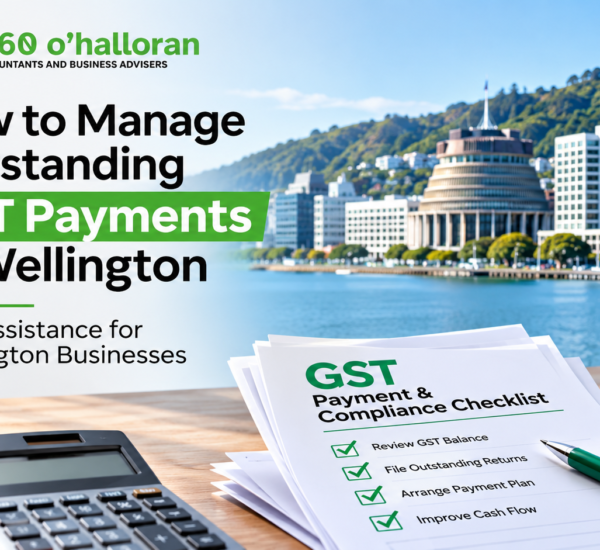
Outstanding GST payments can put pressure on your business cash flow, particularly when customer invoices are overdue, operating expenses increase or revenue becomes unpredictable. If your business is struggling to meet its Inland Revenue obligations, understanding your options early can help you take control of the situation.
GST Assistance Wellington businesses can access includes professional support with GST return preparation, reviewing outstanding tax balances, understanding Inland Revenue payment arrangements and improving GST compliance. DFK Orb360 O’Halloran provides accounting, taxation and business advisory support from its Wellington-region office in Petone, Lower Hutt, serving businesses throughout Wellington and the wider region.
Businesses in Wellington that have outstanding GST payments should first review their GST returns, confirm the amount owed and identify any missed payment deadlines. If they cannot pay in full, they can contact Inland Revenue to discuss an instalment arrangement. DFK Orb360 O’Halloran provides GST accounting, tax compliance and business advisory support to businesses across Wellington, Lower Hutt, Upper Hutt, Porirua and surrounding areas. Early action, accurate GST records and cash flow planning can help businesses manage their tax obligations more effectively.
- GST payments are generally due on the same date as the corresponding GST return.
- Most standard GST taxable periods have a payment deadline on the 28th of the following month, with two important exceptions.
- Inland Revenue may allow eligible businesses to repay overdue GST through an instalment arrangement.
- Interest and applicable penalties can increase the amount owed.
- Accurate bookkeeping and cash flow forecasting help businesses prepare for GST obligations.
- DFK Orb360 supports businesses across Wellington and the wider region from its Petone office.
Why Are Wellington Businesses Struggling with Outstanding GST Payments?
GST is collected by a business on behalf of Inland Revenue. Although it forms part of the money received from customers, it should not be treated as ordinary business income available for unrestricted spending.
Businesses can find themselves with an outstanding GST balance for several reasons. Common examples include:
- Cash flow shortages: Customer payments are delayed, but GST payment deadlines still arrive.
- Using GST collections for operating expenses: Money collected as GST is spent on wages, rent, stock or supplier payments.
- Incorrect GST calculations: Transactions, expenses or adjustments are recorded incorrectly.
- Missed filing deadlines: GST returns are not submitted on time, resulting in compliance issues.
- Business growth: Higher sales and increased transaction volumes create more complex GST obligations.
- Unexpected expenses: Repairs, staffing costs or other financial pressures affect available cash.
Identifying the underlying problem is important. Paying an existing GST debt without fixing the cash flow or bookkeeping issue may simply result in another unpaid GST balance in the next taxable period.
What Should You Do If Your Business Has Outstanding GST Payments?
If your business has missed a GST payment, avoid ignoring Inland Revenue correspondence. Start by understanding your actual tax position and taking practical steps to address the outstanding amount.
1. Check your GST balance in myIR
Log in to your Inland Revenue myIR account and review your GST account. Check which taxable periods have outstanding amounts, whether returns have been filed and whether any interest or penalties have been added.
Compare the balance shown in myIR with your accounting records. If the figures do not match, investigate the difference before making assumptions about the amount owed.
2. Identify any outstanding GST returns
Filing a GST return and paying the amount due are separate responsibilities. You must file a GST return for every taxable period, including periods where the return is nil.
If you have missed a return, work out which periods are outstanding and organise the relevant sales, purchases, expense records and supporting documentation.
Official guidance: Inland Revenue – Filing GST returns.
3. Contact Inland Revenue about payment options
If your business cannot pay the full outstanding amount, contact Inland Revenue to discuss the options available. Eligible taxpayers may be able to request an instalment arrangement.
Do not assume that making occasional payments automatically creates an approved payment arrangement. Confirm the terms directly with Inland Revenue.
4. Review your business cash flow
Prepare a realistic cash flow forecast that includes expected customer receipts, wages, rent, supplier payments, operating costs and future tax obligations.
This will help you assess how much your business may be able to pay towards existing GST debt without compromising essential business operations.
5. Get professional GST and accounting support
If you are unsure how the outstanding amount arose, whether your GST returns are correct or how to plan future payments, an experienced accounting team can help review your records and explain the next steps.
When Are GST Payments Due in New Zealand?
Understanding GST deadlines is essential for businesses operating in Wellington and throughout New Zealand. Under the standard GST filing schedule, payment is due on the same day as the corresponding GST return.
| GST taxable period ends | Standard filing and payment deadline |
|---|---|
| 31 January | 28 February |
| 28 February | 28 March |
| 31 March | 7 May |
| 30 April | 28 May |
| 31 May | 28 June |
| 30 June | 28 July |
| 31 July | 28 August |
| 31 August | 28 September |
| 30 September | 28 October |
| 31 October | 28 November |
| 30 November | 15 January |
| 31 December | 28 January |
Important: This table illustrates the standard two-monthly taxable period schedule. The 31 March and 30 November periods have special due dates. Businesses with different filing frequencies, non-standard arrangements or other circumstances should check their specific dates with Inland Revenue.
Read the official GST payment guidance from Inland Revenue.
Book Your Free Initial Consultation with DFK Orb360
Need help managing outstanding GST payments or understanding your tax obligations? Speak with our experienced team about your business’s accounting and GST requirements.
Take the first step towards better financial clarity and more confident business decisions.
Request Your Free Initial Consultation
Complete the form below and our team will be in touch.
What Happens If You Do Not Pay GST on Time?
If you miss a GST payment deadline, Inland Revenue may charge applicable late-payment penalties and use of money interest. The amount owed can increase while the debt remains unpaid.
Depending on your circumstances, you may also receive overdue payment notices or further collection correspondence.
Potential consequences include:
- Additional costs through applicable late-payment penalties.
- Use of money interest on overdue balances.
- Increased outstanding tax liabilities.
- Further communication and collection action from Inland Revenue.
- Additional pressure on business cash flow.
The applicable penalty treatment depends on the tax type and circumstances. GST should not be assumed to follow the same recurring monthly penalty rules as every other tax type.
If you cannot pay on time, contact Inland Revenue promptly to understand your options. See Inland Revenue’s late-payment penalty guidance.
Can You Arrange a GST Payment Plan with Inland Revenue?
Yes. Businesses that cannot pay their GST in full may be able to request an instalment arrangement from Inland Revenue, subject to its assessment and approval.
An instalment arrangement allows eligible taxpayers to repay outstanding tax over an agreed period instead of paying the entire balance immediately.
Before requesting an arrangement, consider preparing:
- Your current outstanding GST balance.
- The taxable periods associated with the debt.
- Details of any outstanding GST returns.
- Current business income and operating expenses.
- Expected customer receipts and cash flow.
- A realistic proposed repayment amount.
Inland Revenue may request additional information to assess the proposal. Interest may continue to apply to overdue tax during an arrangement, so make sure you understand the terms before agreeing.
You can read more about Inland Revenue instalment arrangements or how to apply through myIR.
How GST Assistance Wellington Businesses Can Benefit from Professional Accounting Support
Managing GST involves more than completing a return every few months. Businesses need to maintain accurate records, reconcile transactions, understand GST adjustments and ensure that payment obligations are included in their financial planning.
Professional GST Assistance Wellington businesses receive from an experienced accounting team can help them understand their tax position and improve the processes used to manage GST.
GST return preparation and filing
Accurate GST returns depend on reliable transaction records. Accounting support can help businesses review sales, purchases, expenses and relevant adjustments before returns are filed.
GST reconciliation
Reconciling GST records with accounting software and Inland Revenue account balances can help identify differences, missing transactions and potential errors.
GST compliance reviews
A review of GST records and filing practices can help identify areas where reporting procedures may need improvement.
GST payment planning
Businesses can incorporate upcoming GST payments into their cash flow forecasts so that tax obligations are considered alongside operating expenses.
Inland Revenue correspondence
If you receive an Inland Revenue notice, enquiry or request for information relating to GST, professional assistance can help you understand what information may be required and how to respond.
GST Assistance Across Wellington: Areas We Support
DFK Orb360 O’Halloran supports businesses throughout Wellington and the wider region from its Wellington-region office in Petone, Lower Hutt. We work with businesses across central Wellington, the Hutt Valley, Porirua and the wider region, with remote accounting support also available.
Wellington City and Central Suburbs
Businesses in Wellington CBD, Te Aro, Thorndon, Pipitea, Kelburn, Aro Valley, Mount Victoria, Newtown, Berhampore and Oriental Bay can access GST and accounting support.
Businesses operating in central Wellington may deal with professional services, hospitality, retail, technology, consulting and property-related activities. Accurate GST records and consistent filing processes are important across these industries.
Southern and Eastern Wellington
We support businesses in Newtown, Kilbirnie, Miramar, Lyall Bay, Rongotai, Hataitai, Island Bay and Seatoun.
Whether you operate a local retail business, hospitality venue, professional service or growing company, reviewing GST obligations and cash flow can help you stay organised.
Northern Wellington and Western Suburbs
Businesses in Johnsonville, Newlands, Tawa, Churton Park, Khandallah, Ngaio, Karori, Wadestown and Crofton Downs can access DFK Orb360’s accounting and GST support.
For businesses experiencing irregular income or delayed customer payments, GST forecasting and bookkeeping reviews can help improve visibility over upcoming payment obligations.
Lower Hutt and the Hutt Valley
Our Wellington-region office is located at 48 Richmond Street, Petone, Lower Hutt. We support businesses in Petone, Lower Hutt CBD, Alicetown, Moera, Woburn, Waterloo, Naenae, Taita, Stokes Valley, Wainuiomata and Eastbourne.
Businesses across the Hutt Valley can access accounting, GST compliance, tax planning and business advisory services through our Petone office or remote consultations.
Upper Hutt
We also support businesses in Upper Hutt, including Silverstream, Trentham, Wallaceville, Pinehaven and surrounding areas.
Whether you operate a trades business, professional service, retail business or company, managing GST obligations alongside everyday cash flow is an important part of financial management.
Porirua and Surrounding Areas
Businesses in Porirua, Tawa, Titahi Bay, Paremata, Plimmerton, Whitby, Aotea and surrounding communities can access DFK Orb360’s Wellington-region services.
Our team can assist with GST compliance, accounting records, tax planning and business advisory requirements.
Kāpiti Coast
We also support businesses across the Kāpiti Coast, including Paraparaumu, Waikanae, Raumati, Paekākāriki and Ōtaki.
Businesses operating across the Kāpiti Coast can work with DFK Orb360 remotely or arrange discussions with our team about their accounting and tax requirements.
Looking for GST Assistance Wellington businesses can access without travelling to an office? DFK Orb360 also provides remote accounting and tax support, allowing businesses across the region to work with our team.
How Can Businesses Avoid Future GST Payment Problems?
Managing existing GST debt is only one part of the process. Businesses should also review their internal systems to reduce the risk of future outstanding payments.
Keep GST collections separate in your cash flow planning
Consider how much GST is being collected and how much may need to be paid to Inland Revenue. Avoid treating all money received from customers as available operating income.
Reconcile your accounts regularly
Regular bank reconciliations and bookkeeping reviews can help identify missing transactions, coding errors and discrepancies before GST filing deadlines.
Use accounting software effectively
Cloud accounting systems can help businesses maintain transaction records, review GST reports and monitor their financial position. However, software settings and transaction coding still need to be checked for accuracy.
Prepare for upcoming GST payments
Use a cash flow forecast to anticipate GST liabilities and identify periods when your business may have limited available funds.
Review your GST filing frequency
Businesses should understand whether their current filing frequency is appropriate for their circumstances. Changes to filing arrangements are subject to Inland Revenue rules and eligibility.
Example: Managing an Outstanding GST Balance
Consider a hypothetical Wellington business with an outstanding GST balance of NZ$18,000 following a period of delayed customer payments.
The business reviews its accounting records, identifies the outstanding taxable periods and prepares a cash flow forecast. It then approaches Inland Revenue to discuss a possible instalment arrangement.
| Illustrative financial detail | Amount |
|---|---|
| Outstanding GST balance | NZ$18,000 |
| Proposed monthly payment | NZ$1,500 |
| Illustrative principal repayment period | 12 months |
This example assumes a fixed principal balance with no additional tax, interest, penalties or adjustments. It is not an approved Inland Revenue payment arrangement or a repayment quote.
The business must also plan for future GST payments while addressing its existing debt. Inland Revenue decides whether to accept the proposed arrangement and what terms apply.
Why Choose DFK Orb360 O’Halloran for GST Assistance Wellington Businesses Need?
DFK Orb360 O’Halloran provides accounting, tax and business advisory services to businesses across Wellington and New Zealand.
From our Petone office, our team works with business owners who need help managing tax obligations, maintaining accurate accounting records and making informed financial decisions.
Our relevant services include:
- GST services: GST registration, return preparation, filing support and compliance reviews.
- Tax advisory: Practical guidance on tax obligations and business tax planning.
- Accounting and reporting: Financial records, reporting and accounting support.
- Cloud accounting: Support with accounting systems and ongoing bookkeeping processes.
- Business advisory: Cash flow forecasting, financial analysis and business planning.
- IRD compliance support: Assistance understanding Inland Revenue correspondence and tax compliance matters.
Our aim is to help businesses understand their financial position, manage compliance responsibilities and plan ahead with greater confidence.
Need GST Assistance in Wellington? Speak with DFK Orb360
Are outstanding GST payments affecting your business cash flow? Or do you need help reviewing your GST returns, understanding your Inland Revenue obligations or improving your tax payment processes?
Speak with DFK Orb360 O’Halloran about your accounting and GST requirements.
Wellington-region office:
48 Richmond Street,
Petone, Lower Hutt 5012,
New Zealand
Call: 04 555 0401
Email: help@orb360.co.nz
Frequently Asked Questions About GST Assistance Wellington
1. How can I get GST assistance in Wellington?
You can contact an accounting firm such as DFK Orb360 O’Halloran for help with GST return preparation, GST compliance reviews, tax planning and accounting support. DFK Orb360 serves Wellington businesses from its Petone office and also offers remote support.
2. What should I do if my business cannot pay its GST on time?
Check your outstanding GST balance, make sure your returns are filed and contact Inland Revenue to discuss possible payment options. Eligible businesses may be able to request an instalment arrangement, subject to approval.
3. Can Inland Revenue arrange instalment payments for overdue GST?
Yes. Inland Revenue may allow eligible taxpayers to repay overdue GST through an instalment arrangement. The proposed payments and terms are assessed based on the taxpayer’s circumstances.
4. When are GST payments due in New Zealand?
For most standard taxable periods, GST returns and payments are due on the 28th of the month following the end of the taxable period. The 31 March period is generally due on 7 May, while the 30 November period is generally due on 15 January.
5. Does Inland Revenue charge interest on overdue GST?
Use of money interest may apply to overdue GST balances. The amount depends on the outstanding balance and applicable interest rates over the relevant period.
6. Can an accountant help correct GST return errors?
An accountant can review GST records, identify potential discrepancies and advise on the appropriate correction process. The treatment depends on the nature and size of the error and Inland Revenue’s requirements.
7. Does DFK Orb360 have a Wellington office?
Yes. DFK Orb360 O’Halloran’s Wellington-region office is located at 48 Richmond Street, Petone, Lower Hutt. The team supports businesses across Wellington and the wider region.
8. Does DFK Orb360 provide GST assistance in Lower Hutt and Upper Hutt?
Yes. DFK Orb360 supports businesses in Lower Hutt, Upper Hutt, Petone and surrounding Hutt Valley areas with GST, accounting, taxation and business advisory services.
9. Can businesses in Porirua and the Kāpiti Coast access DFK Orb360 services?
Yes. Businesses in Porirua and the Kāpiti Coast can access DFK Orb360’s services, including remote accounting and tax support.
10. How can I avoid future outstanding GST payments?
Maintain accurate bookkeeping, reconcile transactions regularly, set aside funds for GST obligations and prepare cash flow forecasts. Reviewing your accounting processes can help you plan for upcoming payment deadlines.
Businesses with outstanding GST payments should review their Inland Revenue balance, file any missing returns and explore available payment options. Professional GST Assistance Wellington businesses can access includes GST return preparation, reconciliation, compliance reviews and cash flow planning. DFK Orb360 O’Halloran supports businesses across Wellington, Lower Hutt, Upper Hutt, Porirua and the wider region from its Petone office. Taking action early can help businesses understand their tax obligations and plan their next steps.
Disclaimer: This article provides general information only and does not constitute personalised tax, accounting or legal advice. GST obligations, payment arrangements, interest and penalties depend on individual circumstances and current Inland Revenue rules. Businesses should confirm their specific position with Inland Revenue or a suitably qualified tax professional.



 09 377 4238
 Level 2, 6 Kingdon Street, Newmarket, Auckland
 help@orb360.co.nz