

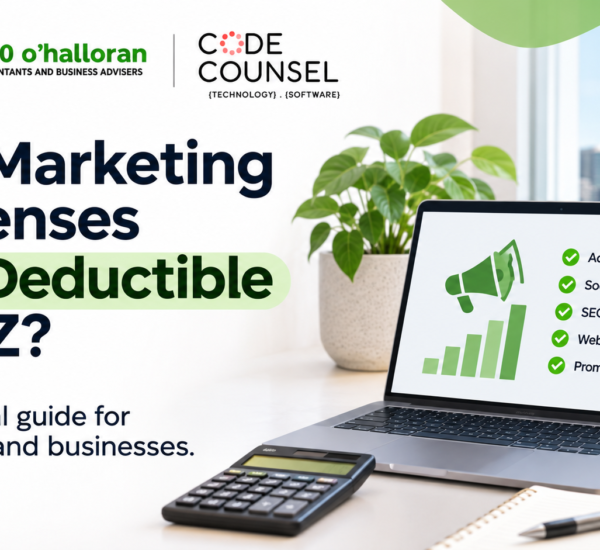
Marketing Expenses Tax Deductible NZ is an important topic for business owners planning their advertising, website, SEO and social media budgets. In New Zealand, many marketing costs may qualify as tax-deductible business expenses when they are incurred to earn business income. However, the tax treatment depends on the purpose and nature of each expense, including whether it is an ongoing operating cost or capital expenditure.
Marketing is an important investment for businesses looking to attract customers, build brand awareness and generate revenue. But are marketing expenses tax deductible in New Zealand? Generally, advertising and promotional costs incurred in earning business income can be deductible. However, the tax treatment depends on the nature of the expense, how it is used and whether it is a revenue or capital cost.
Yes, many ordinary marketing expenses are tax deductible in New Zealand when they are incurred in earning business income or in carrying on a business for that purpose. Examples may include advertising campaigns, promotional activities and eligible social media management costs. However, private expenses cannot generally be claimed, mixed-use costs must be apportioned, and capital expenditure such as developing a new website may need to be capitalised and depreciated rather than deducted immediately. Businesses should keep invoices, receipts and records supporting their claims.
Key Takeaways
- Marketing expenses are generally deductible when they have a sufficient connection with earning business income.
- Advertising, promotional campaigns and eligible marketing services may qualify as business deductions.
- Routine website maintenance and content updates may be deductible, while creating or substantially upgrading a website may be capital expenditure.
- Private or personal expenses cannot automatically be claimed as business expenses.
- Businesses should retain invoices, receipts, contracts and payment records.
- Good financial records and a clear marketing budget can make tax planning more manageable.
What Does It Mean When a Marketing Expense Is Tax Deductible?
A tax-deductible expense is a business cost that can be claimed against taxable income when it meets the relevant Inland Revenue requirements. Deductible expenses reduce the amount of business income subject to income tax.
Understanding Marketing Expenses Tax Deductible NZ rules helps business owners identify which advertising, promotional and digital marketing costs can be claimed against business income. Correct classification is important because some expenses may be immediately deductible, while capital expenditure may need to be treated differently.
Under New Zealand’s general deductibility rules, expenditure must have the required connection with deriving income or carrying on a business for the purpose of deriving income. The nature and purpose of the expenditure matter.
This means a business cannot automatically claim every payment described as marketing. The expense must relate to its income-earning activities, and other tax rules may apply.
Inland Revenue’s guidance is available here: IRD – Types of business expenses.
Which Marketing Expenses Are Tax Deductible in NZ?
Many day-to-day marketing costs can qualify as deductible business expenses when they are incurred for business purposes. The following are common examples, subject to the specific facts and applicable tax rules.
1. Online advertising and paid campaigns
Businesses may generally claim eligible advertising costs incurred to promote their products or services and generate business income.
Examples include:
- Google Ads campaigns.
- Facebook and Instagram advertising.
- LinkedIn advertising for business services.
- Display and search advertising.
- Promotional campaign costs.
Keep platform invoices, account statements, campaign records and evidence that the advertising relates to the business.
2. Social media management and content creation
Businesses that engage professionals to manage business social media accounts or create promotional content may be able to claim these costs as business expenses.
Examples may include:
- Social media management fees.
- Business-related graphic design.
- Promotional video production.
- Copywriting for advertising campaigns.
- Content planning and campaign management.
The important consideration is whether the service supports the business’s income-earning activities. Personal content or private expenses should not be treated as business marketing costs.
3. SEO and digital marketing services
Search engine optimisation and digital marketing services can form part of a business’s ongoing marketing activities.
Potentially deductible operating expenses may include:
- Monthly SEO services.
- Keyword research and content optimisation.
- Local SEO management.
- Marketing strategy and campaign management.
- Website content updates.
- Digital marketing reporting and analytics services.
Businesses should retain service agreements, invoices and a description of the work performed to support the business purpose of the expense.
4. Promotional materials and business advertising
Promotional materials used to market a business may qualify as deductible expenses when they are incurred for business purposes.
Examples can include:
- Business brochures and flyers.
- Advertising banners and signage.
- Business cards.
- Promotional printing.
- Campaign design and production.
The treatment of gifts, entertainment, hospitality and promotional giveaways can be different. Check the relevant rules before claiming these costs.
Understanding which marketing expenses are tax deductible in NZ can help businesses plan their promotional budgets and maintain accurate financial records. Eligible advertising, SEO and social media management costs may be deductible, while private expenses and certain capital costs require different treatment under Inland Revenue rules.
Keeping accurate records is an important part of claiming marketing expenses tax deductible in NZ. Invoices, agency agreements, advertising statements and payment confirmations help demonstrate that the expenditure relates to business activities.
Are Website Costs Tax Deductible in New Zealand?
Website costs require particular attention because the tax treatment can depend on whether the expenditure relates to creating a capital asset or maintaining an existing website.
Inland Revenue explains that the initial creation of a website is generally capital expenditure. The cost may need to be capitalised and depreciated rather than claimed as an immediate operating expense. By contrast, ongoing maintenance and routine content updates may be revenue expenses when they meet the general deductibility test.
| Website expense | General tax treatment |
|---|---|
| Initial website development | Generally capital expenditure; capitalise and consider depreciation treatment. |
| Routine website content updates | May be deductible as an ongoing revenue expense. |
| Minor website maintenance and bug fixes | May be deductible when the general test is met. |
| Major website reconstruction or new functionality | May be capital expenditure, depending on the work performed. |
| Website hosting | Generally deductible as an ongoing service cost when used for business. |
| Annual domain renewal | Generally deductible as an ongoing renewal expense. |
| Acquisition of a domain name | May be capital expenditure and non-deductible; assess the specific circumstances. |
Read the official Inland Revenue explanation: IRD – Website expenditure and deductibility.
Are SEO, Google Ads and Social Media Marketing Tax Deductible?
SEO, paid advertising and social media marketing costs may be deductible when they are incurred as part of a business’s income-earning activities.
For example, a New Zealand company paying a marketing agency to manage its Google Ads, improve its search visibility or create business-related social media content may be incurring ordinary operating expenses.
However, the actual service and purpose of the payment matter. A service that creates or improves a lasting capital asset may require a different tax treatment from routine campaign management.
Businesses should also distinguish between the cost of a marketing service and any separate software, equipment or asset acquired as part of the project.
Can You Claim Marketing Expenses If You Work From Home or Run a Small Business?
Sole traders, contractors and companies may be able to claim eligible business marketing costs. The rules are not limited to large organisations.
A small business that pays for online advertising, business-related content creation or social media management may be entitled to claim qualifying expenses against its business income.
If a cost has both business and private use, the business portion must be identified and appropriately apportioned. You cannot claim a private expense simply because it was paid using a business bank account.
What Marketing Expenses Cannot Be Claimed as Business Deductions?
Not every promotional or digital expense qualifies for an income tax deduction. Common issues include:
- Personal advertising: Costs incurred for private activities rather than the business.
- Private social media expenses: Personal subscriptions or content unrelated to business operations.
- Mixed-use expenses: The private portion of a cost must be excluded.
- Capital expenditure: Some website development and substantial improvements cannot be deducted immediately.
- Unsupported claims: Expenses without adequate supporting records may be difficult to substantiate.
The tax treatment depends on the actual purpose and nature of the expenditure, not simply the description written on an invoice.
What Records Should You Keep for Marketing Expense Tax Deductions?
Good record keeping is essential when claiming marketing expenses. Businesses should be able to demonstrate what they paid for, who supplied the service, when the expense was incurred and how it related to their business.
Keep the following records where relevant:
- Supplier invoices and receipts.
- Advertising platform statements.
- Marketing agency agreements and service descriptions.
- Website development and maintenance invoices.
- Proof of payment and bank statements.
- Campaign reports and work summaries.
- Records showing how mixed business and private costs were apportioned.
Inland Revenue generally requires businesses to retain tax records for at least seven tax years. Records can be paper-based or electronic.
Official guidance: IRD – Records of income and expenses.
How Does GST Apply to Marketing Expenses?
Income tax deductions and GST claims are separate considerations. A marketing expense may qualify for an income tax deduction, but the GST treatment depends on whether the business is GST registered, whether the purchase is for taxable business activity and whether the relevant GST requirements are met.
If your business is GST registered, you may be able to claim eligible input tax deductions when the relevant conditions are satisfied and you hold the required taxable supply information.
If a cost has a private component, the GST claim may also need to be apportioned. Businesses should not automatically claim GST on every marketing-related invoice.
How Can Businesses Budget for Marketing and Tax Together?
Marketing should be considered as part of the wider financial plan rather than as an isolated expense. A business may have a strong marketing campaign but still experience cash flow pressure if advertising costs, tax obligations and GST payments are not planned together.
Here are practical ways to improve financial planning:
1. Set a realistic marketing budget
Define how much the business can afford to spend on advertising, SEO, social media and other promotional activities. Review the budget against available cash and expected revenue.
2. Separate business and personal spending
Use appropriate business payment methods and maintain clear records. This makes it easier to identify legitimate business expenses and reduces the risk of incorrectly claiming private costs.
3. Track campaign expenditure
Record advertising spend, agency fees, website costs and other marketing services in the correct accounting categories. Review invoices regularly rather than waiting until the end of the financial year.
4. Monitor results alongside costs
Track leads, enquiries, conversions and revenue generated by marketing activity. This helps business owners assess whether their marketing budget is supporting commercial objectives.
5. Review tax and cash flow with an accountant
Regular financial reviews can help identify tax obligations, cash flow concerns and questions about the treatment of significant marketing expenditure.
How DFK Orb360 and Code Counsel Help Businesses Connect Marketing and Financial Planning
Marketing decisions and financial decisions are closely connected. A business needs to understand not only how much it spends on marketing, but also how those costs are recorded, how they affect cash flow and whether the investment supports its growth objectives.
DFK Orb360 O’Halloran Chartered Accountants
DFK Orb360 supports New Zealand businesses with accounting, taxation and business advisory services. The team can help business owners review financial information, understand tax obligations, maintain appropriate records and plan for cash flow.
Explore DFK’s services: DFK Orb360 accounting and business advisory services.
Code Counsel – Digital Marketing and Technology
Code Counsel works with growing businesses on digital solutions and marketing services, including website development, SEO, local SEO, lead generation, performance marketing and social media marketing.
Its focus is on helping businesses strengthen their online presence, attract relevant audiences and improve the journey from website visits to customer enquiries.
Explore digital marketing and growth services: Visit Code Counsel’s official website.
Together, the collaboration connects two important areas of business growth: financial management and digital marketing. Businesses can discuss their financial position with DFK Orb360 and their website, SEO and marketing requirements with Code Counsel.
Frequently Asked Questions About Marketing Expenses Tax Deductible in NZ
1. Are marketing expenses tax deductible in New Zealand?
Generally, yes. Marketing expenses may be deductible when they are incurred in deriving business income or in carrying on a business for that purpose. The actual purpose and nature of the cost must meet Inland Revenue’s requirements.
2. Are Google Ads tax deductible in NZ?
Google Ads costs are generally deductible when they are incurred to advertise a business and generate business income. Keep invoices, advertising account statements and payment records to support the claim.
3. Can I claim Facebook and Instagram advertising as a business expense?
Eligible Facebook and Instagram advertising costs may be claimed as business expenses when the campaigns promote the business and support its income-earning activities.
4. Is SEO tax deductible in New Zealand?
Ongoing SEO services may be deductible when they are incurred as part of a business’s income-earning activities. The treatment can differ if a project involves creating or substantially improving a capital asset.
5. Are social media management fees tax deductible?
Social media management fees may qualify as business deductions when the services relate to promoting the business and earning income. Retain the service agreement, invoices and supporting records.
6. Can I claim the cost of building a new business website?
The initial creation of a website is generally treated as capital expenditure. The cost may need to be capitalised and depreciated rather than deducted immediately. The specific treatment depends on the website expenditure and applicable depreciation rules.
7. Are website hosting and maintenance costs deductible?
Ongoing website hosting and routine maintenance costs are generally revenue expenses when used for business and when they meet the general deductibility test. Major upgrades or reconstruction may require capital treatment.
8. How long should a business keep marketing expense receipts in NZ?
Businesses generally need to keep tax records for at least seven tax years. This includes invoices, receipts, bank records and supporting information for business expenses.
9. Can a sole trader claim marketing expenses?
Yes. A sole trader may claim eligible marketing expenses incurred for business purposes. Any private or personal portion of a mixed-use expense must be excluded.
10. Can I claim GST on marketing expenses as well as an income tax deduction?
A GST-registered business may be able to claim eligible input tax deductions when the purchase relates to taxable business activity and the GST requirements are met. GST and income tax claims follow separate rules.
11. Can an accountant help me check whether my marketing costs are deductible?
Yes. An accountant can review the nature and purpose of marketing expenditure, assess whether it is revenue or capital in nature, and help determine the appropriate tax treatment based on the business’s circumstances.
12. How can DFK Orb360 and Code Counsel help my business?
DFK Orb360 provides accounting, tax and business advisory support, while Code Counsel offers digital marketing and technology services, including website development, SEO, lead generation and social media marketing. Their collaboration connects financial and digital growth support for businesses.
How do I know if my marketing expenses are tax deductible in NZ?
To determine whether marketing expenses are tax deductible in NZ, check whether the cost was incurred for business income-earning activities, whether it is revenue or capital expenditure, and whether you have supporting records. An accountant can review uncertain expenses and help establish the appropriate tax treatment.
Is Your Business Getting the Most From Its Marketing Spend?
Your marketing budget should support business growth while fitting into a sound financial plan. If you are unsure about your marketing expenses, tax position, cash flow or digital performance, now is a good time to review both sides.
Through the DFK Orb360 × Code Counsel collaboration, businesses can access support across two important areas:
- DFK Orb360: Accounting, tax and cash flow review.
- Code Counsel: Website, SEO and social media review.
Book your Free Business Growth Health Check consultation. Discuss your business finances with DFK Orb360 and your digital growth opportunities with Code Counsel.
Book a Free Consultation with DFK Orb360
Learn more about digital growth services at Code Counsel.
Final Thoughts: Make Your Marketing Spend Work Smarter
Marketing expenses can form an important part of a business’s tax and financial planning. Advertising, eligible SEO services and social media management may qualify as deductions when they meet the relevant business expense rules. Website development, private use and mixed-purpose expenditure require additional care.
Keeping accurate records, understanding the difference between revenue and capital expenditure and reviewing your marketing budget can help reduce uncertainty at tax time.
With DFK Orb360 supporting financial and tax planning and Code Counsel supporting digital marketing and technology, businesses can take a more connected approach to sustainable growth.
Reviewing marketing expenses tax deductible in NZ requirements with an accountant can help businesses distinguish eligible operating expenses from capital expenditure and maintain appropriate supporting records.
Official Sources and Further Reading
- Inland Revenue – Types of business expenses
- Inland Revenue – Website expenditure deductibility
- Inland Revenue – Records of income and expenses
- Business.govt.nz – Claiming business expenses
If you are unsure which marketing expenses are tax deductible in NZ, DFK Orb360 can help review your business expenditure, accounting records and tax position.
Disclaimer: This article is for general educational purposes only and does not constitute individual tax or accounting advice. The deductibility of an expense depends on its purpose, nature and the taxpayer’s circumstances. Website expenditure may be revenue or capital in nature depending on the work undertaken. Seek advice from a qualified tax professional before claiming uncertain expenses.


 09 377 4238
 Level 2, 6 Kingdon Street, Newmarket, Auckland
 help@orb360.co.nz