

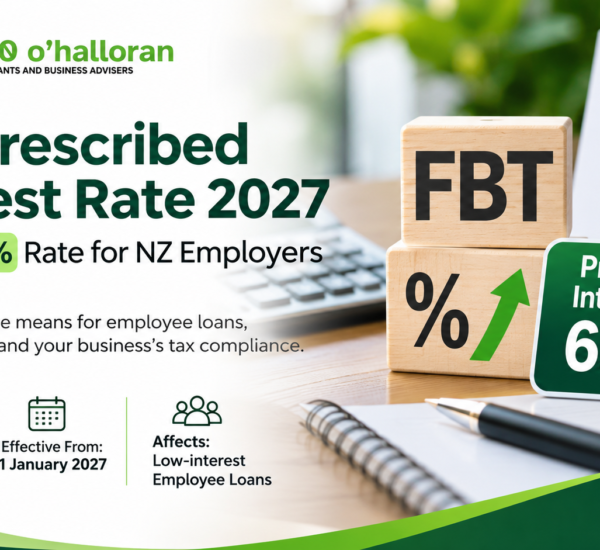
FBT Prescribed Interest Rate 2027: New 6.32% Rate for NZ Employers
New Zealand employers providing low-interest or interest-free loans to employees need to prepare for an upcoming Fringe Benefit Tax (FBT) change. Inland Revenue has confirmed that the FBT prescribed interest rate 2027 will increase from 6.07% to 6.32%, effective from 1 January 2027.
This change affects how employers calculate the taxable value of interest benefits provided through employment-related loans. Businesses should review their existing loan arrangements, interest charges and FBT reporting processes before the new rate takes effect.
FBT Prescribed Interest Rate 2027
From 1 January 2027, New Zealand’s prescribed interest rate for low-interest employment-related loans increases from 6.07% to 6.32%. Employers providing interest-free or below-market-interest loans may need to update their FBT calculations using the new prescribed rate.
- New prescribed interest rate: 6.32%
- Previous prescribed rate: 6.07%
- Effective date: 1 January 2027
- Relevant benefit: Low-interest employment-related loans
- Who should review: Employers providing employee loans or qualifying credit arrangements
- Recommended action: Review loan balances, interest charged, exemptions and FBT calculations.
Important: The 6.32% figure is the prescribed interest benchmark used to calculate the taxable value of the loan benefit. It is not the FBT tax rate.
What Is the New FBT Prescribed Interest Rate for 2027?
Inland Revenue announced the rate increase on 25 November 2026. Under determination DET 26/07, the prescribed interest rate for employment-related loans will be 6.32% for the quarter beginning 1 January 2027 and subsequent quarters until another rate is prescribed.
The previous rate of 6.07% applies to the quarter from 1 October to 31 December 2026. The new rate represents an increase of 0.25 percentage points.
Employers should use the applicable rate when calculating the taxable value of relevant low-interest employment-related loans.
| Applicable period | Prescribed interest rate |
|---|---|
| From 1 January 2027 | 6.32% |
| 1 October 2026 – 31 December 2026 | 6.07% |
| 1 January 2026 – 30 September 2026 | 5.77% |
The prescribed interest rate is reviewed periodically. Employers should check the current Inland Revenue rate table when preparing FBT calculations.
Official reference: IRD – Prescribed Interest Rates for Low-Interest Loans.
What Is FBT on Low-Interest Employee Loans?
Fringe Benefit Tax is a tax employers may need to pay on certain non-cash benefits provided to employees in connection with their employment.
A low-interest or interest-free employee loan can create a fringe benefit because the employee receives access to money at a rate below the prescribed or applicable market interest rate.
For FBT purposes, a loan can include:
- Salary and wage advances.
- Money lent to employees through other arrangements.
- Credit provided to an employee, including delayed recovery of a debt.
- An overdrawn shareholder current account.
Where the interest charged is lower than the interest calculated using the prescribed or applicable market rate on the daily loan balance, the difference may be subject to FBT.
Read more: IRD – About Low-Interest Loans and FBT.
How Does the 6.32% Rate Affect New Zealand Employers?
The increase means employers using the prescribed-rate method will need to use 6.32% from 1 January 2027 for the relevant loan balances and periods.
Where an employer charges an employee interest below the prescribed rate, the difference may create a taxable fringe benefit. The higher benchmark may therefore increase the calculated interest benefit, depending on the loan balance, interest charged and applicable calculation period.
The impact depends on several factors:
- The outstanding loan balance on each day.
- The interest rate actually charged to the employee.
- Repayments and changes to the loan balance.
- The applicable prescribed or market interest rate.
- The employer’s FBT return period and calculation method.
Understanding the FBT prescribed interest rate 2027 is important for businesses reviewing employee loan arrangements and ensuring their FBT calculations reflect the correct rate for each period.
Example: Calculating the Interest Benefit on an Employee Loan
Consider an employer that provides an employee with a loan of NZ$100,000 and charges interest at 2% per annum.
For illustration, assume the loan balance remains unchanged for a full year and the 6.32% prescribed rate applies throughout that illustrative period.
| Loan balance | NZ$100,000 |
|---|---|
| Prescribed interest rate | 6.32% |
| Interest charged to employee | 2.00% |
| Illustrative interest at prescribed rate | NZ$6,320 |
| Illustrative interest actually charged | NZ$2,000 |
| Illustrative interest benefit difference | NZ$4,320 |
In this simplified example, the annualised difference between interest at the prescribed rate and the interest charged to the employee is NZ$4,320.
Refer to IRD’s guidance on calculating the taxable value of low-interest loans for the detailed calculation requirements.
Which Businesses Should Review Their Employee Loan Arrangements?
The rate change is relevant to employers that provide employment-related loans or credit arrangements at interest rates below the prescribed or applicable market rate.
This may include:
- Businesses providing interest-free loans to employees.
- Employers offering staff loans at reduced interest rates.
- Companies providing salary advances that do not qualify for an exemption.
- Businesses with employee-related credit arrangements.
- Companies with overdrawn shareholder current accounts that fall within the FBT rules.
Not every loan or credit arrangement automatically attracts FBT. The nature of the arrangement and any applicable exemption must be assessed before deciding how it should be treated.
Are There Exemptions for Low-Interest Employee Loans?
Inland Revenue recognises specific exemptions for certain loans and credit arrangements. Employers should check whether their arrangements meet the relevant conditions before excluding them from FBT calculations.
Commercial credit available to the public
Credit offered to employees on the same basis and terms available to the general public may be excluded from FBT because the employee is receiving the same commercial rate available to other customers.
Wage advances
Certain advances against future salary or wages may be exempt where the combined amount outstanding for an employee is no more than NZ$2,000 and the employment agreement does not require the employer to provide the advance. The exemption has additional conditions and does not apply to loans secured against real property.
Employee share loans
Certain employee share loans may qualify for an exemption where the applicable requirements are satisfied.
Employers should review the current IRD guidance rather than assume an arrangement qualifies for an exemption.
Official guidance: IRD – Low-Interest Loan Rules and Exemptions.
What Should Employers Do Before 1 January 2027?
Businesses should review their employee loan arrangements before the new rate takes effect. The following checklist can help employers prepare for the change.
- Identify all relevant employee loans. Review outstanding staff loans, salary advances and other employment-related credit arrangements.
- Check the interest rates charged. Compare the interest charged to employees with the prescribed or applicable market rate.
- Review daily loan balances. Maintain accurate records of opening balances, repayments, reductions and relevant dates.
- Check applicable exemptions. Confirm whether any loan arrangement satisfies the conditions for an FBT exemption.
- Update FBT calculations. Ensure the 6.32% prescribed rate is applied from 1 January 2027 where relevant.
- Maintain supporting documentation. Retain loan agreements, repayment records, interest calculations and employee details.
- Review FBT reporting. Check that the taxable value is correctly included in the appropriate FBT return.
How DFK Orb360 O’Halloran Can Help With FBT Compliance
Changes to prescribed interest rates can affect how businesses manage employee benefits, loan arrangements and tax reporting. Incorrect calculations or incomplete records can create unnecessary compliance issues.
DFK Orb360 O’Halloran provides accounting, tax compliance and advisory support to businesses across New Zealand. Our team can help businesses review their tax obligations, assess relevant employee loan arrangements and identify areas that may require attention.
Whether you are reviewing employee benefits, checking your FBT calculations or preparing for the 2027 tax year, getting the right advice can help you make informed decisions and manage your compliance responsibilities.
Is Your Business Ready for the 2027 FBT Changes?
Don’t leave your employee loan arrangements and FBT calculations until the next return is due. Get your business ready for the new 6.32% prescribed interest rate.
Speak with DFK Orb360 O’Halloran about your FBT obligations, employee loan arrangements and wider tax compliance requirements.
Request an FBT Compliance ReviewAccounting and tax advisory support for businesses across New Zealand.
Frequently Asked Questions About the FBT Prescribed Interest Rate 2027
1. What is the FBT prescribed interest rate from 1 January 2027?
The prescribed interest rate for low-interest employment-related loans increases to 6.32% from 1 January 2027, up from 6.07%.
2. When does the new FBT prescribed rate take effect?
The new 6.32% rate takes effect on 1 January 2027 for the quarter beginning on that date. It continues to apply to subsequent quarters until another rate is prescribed.
3. Is 6.32% the actual FBT tax rate?
No. The 6.32% figure is the prescribed interest benchmark used to calculate the taxable value of the interest benefit on qualifying low-interest loans. It is not the FBT tax rate.
4. Who needs to use the prescribed interest rate?
Employers providing low-interest or interest-free employment-related loans generally use the prescribed rate to calculate the taxable value of the interest benefit, unless an applicable market-rate method or exemption applies.
5. Does FBT apply to interest-free employee loans?
Generally, yes. An interest-free employment-related loan may create a taxable fringe benefit because the employee receives an interest benefit. The calculation depends on the applicable rate, daily loan balance and relevant rules.
6. Is FBT payable on the full employee loan amount?
No. FBT is not payable on the loan principal itself. It applies to the taxable value of the interest benefit provided to the employee.
7. How is FBT calculated on low-interest employee loans?
The taxable value is generally the difference between the interest calculated using the prescribed or applicable market rate on the daily loan balance and the interest actually charged for the relevant period.
8. Does the prescribed rate apply to overdrawn shareholder current accounts?
An overdrawn shareholder current account can fall within the FBT rules for low-interest loans. The interest benefit may need to be calculated using the prescribed or applicable market rate, depending on the circumstances.
9. Are salary advances subject to FBT?
Certain wage advances may qualify for an exemption if the relevant conditions are met. These include the NZ$2,000 combined outstanding balance limit and the requirement that the employment agreement does not require the employer to provide the advance. Other conditions and exclusions apply.
10. How often does Inland Revenue review the prescribed interest rate?
Inland Revenue reviews prescribed interest rates periodically. Employers should check the official IRD rate table for the rate applying to each relevant quarter.
11. What records should employers maintain for low-interest loans?
Employers should retain loan agreements, employee details, opening and closing balances, repayment dates, interest charged and calculations supporting the taxable value for each relevant return period.
12. Where can New Zealand businesses get help with FBT compliance?
Businesses can seek support from an accountant or tax adviser familiar with New Zealand FBT requirements. DFK Orb360 O’Halloran provides tax compliance and advisory support to businesses across New Zealand.
Need Help With Your FBT Obligations?
Get clarity on your employee loan arrangements and prepare your business for the 2027 FBT rate change. Contact our team to discuss your requirements.
Talk to Our Tax Advisory TeamOfficial IRD Sources and Further Reading
- IRD – FBT Prescribed Interest Rate Increase, 25 November 2026
- IRD Tax Technical – Determination DET 26/07
- IRD – Prescribed Interest Rates for Low-Interest Loans
- IRD – Calculating the Taxable Value of Low-Interest Loans
- IRD – About Low-Interest Loans and FBT
Disclaimer: This article is intended for general information only and should not be treated as tax, legal or financial advice. FBT treatment depends on the facts of each arrangement and the rules applying to the relevant period. Employers should obtain professional advice before making decisions about their tax obligations.



 09 377 4238
 Level 2, 6 Kingdon Street, Newmarket, Auckland
 help@orb360.co.nz