

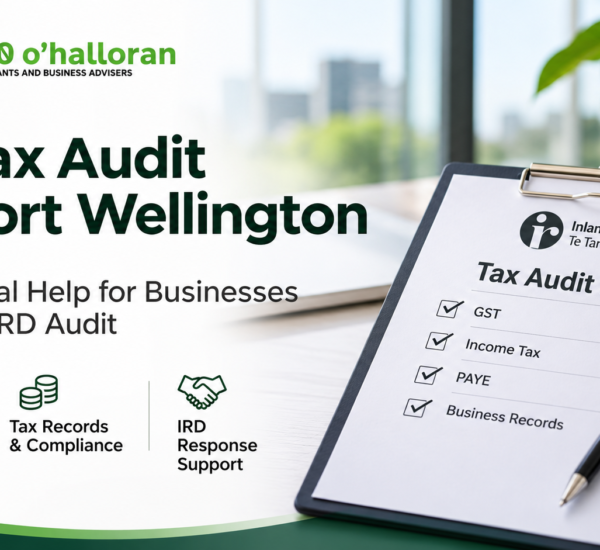
IRD Tax Audit Support Wellington is important for businesses that receive an audit notice or information request from Inland Revenue. Understanding the audit process, preparing accurate financial records and responding appropriately can help businesses manage their tax compliance obligations.
Receiving an audit notice from Inland Revenue (IRD) can create uncertainty for business owners. Whether the review concerns GST returns, income tax, PAYE, employer obligations or business expenses, responding accurately and providing the right records is important.
If your business is facing an IRD audit in Wellington, having professional accounting and tax support can help you understand the information requested, organise your records and manage the response process. DFK Orb360 O’Halloran provides accounting, tax advisory and IRD compliance support to businesses in Wellington, Lower Hutt and across New Zealand.
From our Wellington-region office in Petone, Lower Hutt, we support businesses dealing with tax compliance matters and Inland Revenue enquiries. We also work with clients remotely across the wider Wellington region.
What Is IRD Tax Audit Support in Wellington?
IRD tax audit support in Wellington involves helping businesses understand Inland Revenue audit requests, review financial records, organise supporting documents and prepare accurate responses. An IRD audit may examine income tax, GST, PAYE, fringe benefit tax (FBT) and other tax obligations.
Businesses should review the audit notice, identify the tax periods and areas being examined, preserve relevant records and respond within the stated deadlines. DFK Orb360 O’Halloran provides accounting and tax advisory support from its Petone office in Lower Hutt, serving businesses across Wellington and surrounding areas.
- An IRD audit checks whether the correct amount of tax has been paid.
- A risk review and a formal audit are not the same process.
- IRD audits can cover GST, income tax and employer returns.
- Businesses generally need to retain tax records for seven years.
- There is no fixed duration for every IRD audit.
- Early preparation and accurate responses can help manage the process.
Why Might Inland Revenue Audit a Wellington Business?
Inland Revenue conducts audits to check whether taxpayers have met their obligations under New Zealand tax legislation. A business may be selected for an audit for several reasons, and selection does not automatically mean that wrongdoing has occurred.
According to Inland Revenue’s audit guide, possible selection factors include:
- Unusual patterns or inconsistencies in tax returns.
- Financial information that differs from expected industry patterns.
- Industry or business activities included in Inland Revenue’s current compliance focus.
- Information received from other sources that suggests tax returns may be incorrect.
- A history of non-compliance with tax obligations.
- Random selection for an audit.
The reason for selection may not always be disclosed. Inland Revenue will generally communicate the area of the business or tax affairs that it intends to examine.
What Areas Can an IRD Tax Audit Cover?
The scope of an audit depends on the business, the tax type and the matters Inland Revenue wants to examine. Some audits focus on a particular transaction or return, while others may involve a wider review of business and personal financial records.
1. GST Returns and Transactions
An IRD GST audit may examine sales, purchases, taxable supplies, GST calculations, input tax claims, invoices and supporting records. Businesses should be able to explain how GST figures in their returns were calculated.
2. Income Tax and Business Expenses
An income tax audit may review reported business income, deductible expenses, accounting records, financial statements and supporting documentation. Inland Revenue may examine whether expenses have been treated correctly for tax purposes.
3. PAYE and Employer Obligations
Businesses employing staff may be asked to provide payroll records, PAYE calculations, payday filing information, employment-related payment records and other supporting documentation.
4. Fringe Benefit Tax (FBT)
Where applicable, an audit may examine benefits provided to employees, FBT calculations, motor vehicle use, low-interest loans and related employer records.
5. Business Transactions and Financial Records
Inland Revenue may review accounting transactions, shareholder current accounts, business bank accounts, journals, ledgers and other records relevant to the tax periods under examination.
IRD Risk Review vs IRD Tax Audit: What Is the Difference?
A risk review is not the same as a formal Inland Revenue audit. A risk review is generally used to evaluate whether there may be a tax compliance issue requiring further examination.
| Area | IRD Risk Review | IRD Tax Audit |
|---|---|---|
| Purpose | Evaluate potential tax compliance risks. | Examine tax and business records in more detail. |
| Information | May involve targeted information requests. | May involve detailed records, interviews and transaction testing. |
| Scope | Often narrower and focused on identified risks. | Can cover one tax issue or a broader examination. |
| Possible outcome | May conclude without a formal audit or lead to further examination. | May result in no adjustment, a refund or additional tax and penalties where applicable. |
Inland Revenue should identify whether its initial contact concerns a risk review or an audit. Read the communication carefully and check the scope before preparing your response.
What Should You Do After Receiving an IRD Audit Letter?
If your Wellington business receives an IRD audit notification, avoid rushing into a response without first understanding what Inland Revenue is asking for. A structured approach can help you manage the process.
Step 1: Read the Audit Notice Carefully
Identify the tax types, periods and transactions covered by the audit. Check the information requested, the contact details of the Inland Revenue officer and any response dates.
Step 2: Review Your Accounting and Tax Records
Compare the information requested with your accounting records, GST returns, income tax filings, payroll records and financial statements. Identify any gaps or inconsistencies that need clarification.
Step 3: Organise Supporting Documents
Prepare the relevant invoices, bank statements, receipts, payroll reports, transaction records and reconciliations. Keep documents organised by tax type and financial period so they can be located easily.
Step 4: Understand the Questions Before Responding
Make sure each question is understood. If an information request is unclear, seek clarification rather than making assumptions. Responses should be accurate, relevant and supported by records.
Step 5: Check Deadlines and Communication
Maintain a record of correspondence and submission dates. If you are unable to provide requested information within the specified timeframe, contact the Inland Revenue officer promptly to discuss the position.
Step 6: Seek Professional Accounting Support
An experienced accounting and tax advisory team can help review financial information, organise documentation, explain transactions and support the preparation of responses to audit queries.
Received an IRD Audit Notice in Wellington?
Do not leave your audit response until the last minute. Speak with DFK Orb360 O’Halloran about your accounting records, tax compliance position and the support available for your IRD audit.
Speak to Our TeamWhat Documents Should You Prepare for an IRD Audit?
The documents required depend on the scope of the audit. Inland Revenue may request records relating to the business, its transactions, tax returns and accounting systems.
| Document category | Examples of records |
|---|---|
| Accounting records | General ledger, journals, trial balance and financial statements. |
| Sales and income | Sales invoices, customer statements, receipts and revenue reconciliations. |
| Business expenses | Supplier invoices, receipts, expense claims and supporting documents. |
| Banking records | Business bank statements and relevant transaction records. |
| GST | GST returns, transaction listings, tax invoices and reconciliations. |
| Payroll and PAYE | Payroll reports, employment records, PAYE calculations and payday filing information. |
| Income tax | Income tax returns, tax reconciliations, depreciation schedules and supporting calculations. |
| Business transactions | Shareholder current accounts, loan records, contracts and relevant agreements. |
How Long Does an IRD Tax Audit Take in New Zealand?
There is no fixed timeframe for every Inland Revenue audit. The duration depends on the size and complexity of the business, the quality and availability of its records, the scope of the audit and how quickly relevant information can be provided.
Inland Revenue’s audit guide explains that it generally provides an estimated timeframe at the beginning of the audit. If that timeframe needs to be extended, the officer should discuss the extension with the taxpayer.
Businesses should therefore avoid relying on a standard number of days or weeks. A focused review of one transaction may be different from an audit covering several tax types and financial years.
What Happens If Inland Revenue Finds Errors?
An audit does not automatically result in additional tax or penalties. Inland Revenue may conclude that the returns are correct, identify an adjustment or determine that a refund is due.
If an adjustment increases the amount of tax payable or reduces a tax loss, a tax shortfall may arise. Depending on the circumstances and the applicable rules, shortfall penalties may also be considered.
Possible outcomes include:
- No change to the original tax assessment.
- A refund or credit where the taxpayer has overpaid tax.
- An adjustment resulting in additional tax payable.
- Shortfall penalties where the relevant legal requirements are met.
- Further consideration of the matter under the applicable tax dispute process if the proposed adjustment is not agreed.
The outcome depends on the facts, records, relevant tax legislation and the circumstances of the taxpayer. An audit finding should be reviewed carefully before deciding how to respond.
Can You Disagree With an IRD Audit Outcome?
Yes. If Inland Revenue proposes adjustments and you disagree, there may be a formal tax disputes process available. The process can involve a Notice of Proposed Adjustment (NOPA) and a Notice of Response (NOR), depending on the circumstances.
The formal disputes process has specific requirements and statutory time limits. These should not be confused with ordinary audit information-request deadlines. Review the documents issued by Inland Revenue and obtain appropriate advice before deciding how to respond.
For further information, read our guide to IRD Tax Dispute Support NZ.
How DFK Orb360 Supports Businesses Facing an IRD Audit in Wellington
DFK Orb360 O’Halloran provides accounting, tax advisory and IRD compliance support to businesses and individuals. Where an engagement involves an Inland Revenue audit, our team can assist with relevant accounting and tax matters, depending on the scope of the work.
Our support may include:
- Accounting record reviews: Reviewing relevant financial records and accounting information.
- Audit preparation: Helping organise supporting documents and understand the information requested.
- GST and tax compliance: Reviewing relevant GST, income tax and employer tax records.
- Financial analysis: Helping explain transactions, reconciliations and accounting balances.
- IRD correspondence support: Assisting with the preparation and organisation of responses to relevant audit queries.
- Ongoing tax advisory: Identifying compliance matters that may require further attention.
The nature of support will depend on the audit, the taxpayer’s circumstances and the agreed engagement. Where specialist legal advice is required, an appropriate legal professional should be consulted.
IRD Tax Audit Support Across Wellington and Surrounding Areas
DFK Orb360 O’Halloran supports businesses across Wellington and the wider region through its Petone office in Lower Hutt, as well as remote accounting and tax advisory services.
We work with clients in areas including:
Wellington City
Wellington CBD, Thorndon, Te Aro, Newtown, Mount Cook, Karori, Johnsonville, Kilbirnie, Miramar, Hataitai, Island Bay and surrounding suburbs.
Lower Hutt and Hutt Valley
Petone, Lower Hutt, Alicetown, Woburn, Waterloo, Naenae, Taita, Epuni, Eastbourne, Stokes Valley and surrounding areas.
Upper Hutt
Upper Hutt, Silverstream, Trentham, Heretaunga, Pinehaven and nearby business areas.
Porirua and Northern Wellington
Porirua, Tawa, Titahi Bay, Whitby, Aotea, Plimmerton and surrounding communities.
Kāpiti Coast and Wairarapa
Paraparaumu, Waikanae, Raumati, Ōtaki, Masterton, Carterton and Greytown. Remote support may be available depending on the nature of the engagement.
Our Wellington-region office is located at:
48 Richmond Street
Petone, Lower Hutt
Wellington Region, New Zealand
Phone: 04 555 0401
Businesses outside these areas can also enquire about remote accounting and tax advisory support across New Zealand.
Why Speak With DFK Orb360 About an IRD Audit?
An IRD audit can involve detailed accounting information, tax calculations and supporting documentation. Working with an accounting team that understands business financial records and New Zealand tax compliance can help you approach the process in a structured way.
DFK Orb360 O’Halloran brings together accounting, tax advisory and business support services. Our aim is to help clients understand their financial position, address relevant compliance matters and make informed decisions.
Whether you operate a small business, an established company or a growing organisation in Wellington, Lower Hutt or elsewhere in New Zealand, you can contact our team to discuss the support relevant to your circumstances.
Need Professional IRD Tax Audit Support in Wellington?
An audit notice deserves a clear and considered response. Talk to DFK Orb360 O’Halloran about your IRD audit, financial records and tax compliance requirements.
Contact our Petone, Lower Hutt office to discuss your situation and the appropriate next steps.
Request a ConsultationCall our Wellington-region office: 04 555 0401
Frequently Asked Questions About IRD Tax Audit Support Wellington
1. What is IRD tax audit support in Wellington?
IRD tax audit support in Wellington involves professional accounting and tax assistance for businesses dealing with an Inland Revenue audit. This may include reviewing financial records, organising documents, checking tax information and helping prepare responses to audit queries.
2. Why would Inland Revenue audit my Wellington business?
Inland Revenue may select a business because of unusual tax return patterns, inconsistencies in financial information, industry compliance priorities, information received from other sources, previous compliance history or random selection. An audit does not automatically mean wrongdoing has occurred.
3. What should I do after receiving an IRD audit notice?
Read the notice carefully, identify the tax types and periods being examined, check the requested documents and response dates, organise your accounting records and seek professional advice where appropriate. Avoid ignoring Inland Revenue correspondence.
4. What documents does IRD request during a business tax audit?
Depending on the audit, Inland Revenue may request financial statements, general ledgers, invoices, receipts, bank statements, GST returns, payroll records, PAYE information, income tax returns and supporting calculations.
5. How long does an IRD audit take in New Zealand?
There is no standard timeframe for every audit. The duration depends on the size and complexity of the business, the quality of its records, the scope of the audit and how quickly requested information is provided.
6. Can an accountant help with an IRD audit?
Yes. An accountant can help review financial records, organise supporting documents, explain accounting transactions and assist with preparing responses to relevant audit queries, depending on the agreed engagement.
7. Does an IRD audit mean my business has done something wrong?
No. An audit is an examination of tax and business records to check whether the correct amount of tax has been paid. A business can be selected for an audit without having deliberately or knowingly made an error.
8. Can IRD audit GST, PAYE and income tax?
Yes. Inland Revenue audits can cover income tax, GST and employer returns. Depending on the circumstances, an audit may also examine FBT, particular transactions, business expenses and other tax matters.
9. Does DFK Orb360 provide IRD audit support in Lower Hutt and Wellington?
Yes. DFK Orb360 O’Halloran supports businesses across Wellington and Lower Hutt from its Petone office. Remote accounting and tax advisory support may also be available for businesses in surrounding regions.
10. Can DFK Orb360 help businesses in Porirua and Upper Hutt?
DFK Orb360 can discuss accounting and tax advisory support for businesses in Porirua, Upper Hutt and surrounding areas. Support may be provided remotely depending on the engagement and the services required.
11. What happens if Inland Revenue finds a tax discrepancy?
Inland Revenue may propose an adjustment to the relevant tax assessment. Depending on the circumstances, this may result in additional tax, a refund or shortfall penalties. The taxpayer may have dispute resolution options if they disagree with a proposed adjustment.
12. Can I disagree with an IRD audit outcome?
Yes. If you disagree with a proposed adjustment, a formal tax disputes process may be available. The process has specific requirements and time limits, so the relevant Inland Revenue documents should be reviewed carefully.
13. When should I contact DFK Orb360 about an IRD audit?
Consider contacting DFK Orb360 when you receive an audit notice, an information request or questions about your GST, PAYE or income tax records. Seeking advice early can help you understand the scope of the request and prepare relevant information.
Official Inland Revenue Resources
For additional information about New Zealand tax audits and taxpayer obligations, refer to these official Inland Revenue resources:
- Inland Revenue – Audits
- Inland Revenue Guide IR297 – Inland Revenue Audits (2026)
- Inland Revenue – Disputes Process
Related DFK Orb360 Services
- IRD Audit Support NZ
- Tax and IRD Compliance Services
- IRD Tax Dispute Support NZ
- Chartered Accountants Wellington
- DFK Orb360 Office Locations



 09 377 4238
 Level 2, 6 Kingdon Street, Newmarket, Auckland
 help@orb360.co.nz