

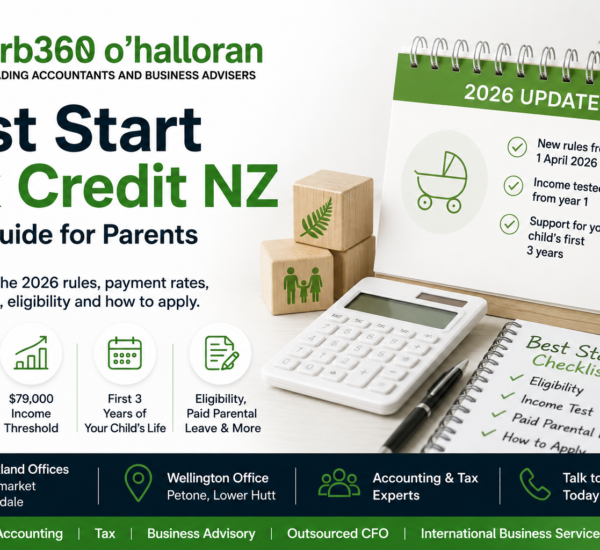
Best Start Tax Credit NZ: Complete 2026 Guide for Parents
The Best Start tax credit provides financial support to eligible New Zealand families during the first three years of a child’s life. However, the rules changed from 1 April 2026, making it particularly important for parents to understand how family income, the child’s birth date, paid parental leave and residency can affect their entitlement.
For children born on or after 1 April 2026, Best Start is now income tested from the first year. The maximum payment is currently $77 per week, or up to $4,041 for a full year, before any applicable abatement.
If you are unsure whether your family qualifies, how much you could receive, or how the 2026 changes affect you, professional tax advice can help you understand your Working for Families position.
Need Help Understanding Your Best Start Entitlement?
Working for Families calculations can become complicated when your income, family circumstances or parental leave arrangements change. DFK Orb360 O’Halloran can help you understand your tax and family income position.
Talk to our tax team about your circumstances.
Best Start Tax Credit NZ
What is Best Start? Best Start is one of the Working for Families payments administered by Inland Revenue. It provides financial support during the first three years of a child’s life.
How much is Best Start in 2026? The maximum rate is $77 per week, equivalent to up to $4,041 per year. The amount a family receives can be reduced depending on family income and other circumstances.
What changed on 1 April 2026? Best Start became income tested from the first year for children born on or after 1 April 2026. The income abatement threshold is $79,000. :contentReference[oaicite:3]{index=3}
Can you receive Best Start while receiving paid parental leave? You cannot receive Best Start and paid parental leave for the same child at the same time. Best Start can begin after paid parental leave finishes.
Who administers Best Start? Best Start is part of Working for Families and is administered through Inland Revenue.
What Is the Best Start Tax Credit?
The Best Start tax credit is a Working for Families payment designed to provide financial assistance to eligible families during the first three years of a child’s life.
Unlike an ordinary income tax deduction, Best Start is a family support payment. Eligibility depends on factors including the child’s age, family circumstances, residency requirements and family income.
Inland Revenue states that Best Start is one of four Working for Families payments. :contentReference[oaicite:5]{index=5}
How Much Is the Best Start Tax Credit in 2026?
For the 2026–27 tax year, the maximum Best Start entitlement is $77 per week, or up to $4,041 per year. However, the amount you actually receive may be lower depending on your family income and circumstances. :contentReference[oaicite:6]{index=6}
| Best Start factor | 2026–27 position |
|---|---|
| Maximum weekly payment | $77 |
| Maximum annual entitlement | $4,041 |
| Income threshold for abatement | $79,000 |
| Abatement rate | 21% |
| Maximum period | First 3 years of the child’s life, subject to eligibility |
The annual rate and rules can change, so families should check the current Inland Revenue information when estimating their entitlement.
What Changed to Best Start From 1 April 2026?
One of the most important changes to the Best Start tax credit came into effect on 1 April 2026.
Before the change, the first year of Best Start for a child born before 1 April 2026 was not income tested. From 1 April 2026, children born on or after that date are subject to income testing from their first year. :contentReference[oaicite:7]{index=7}
This means two families with children of similar ages may have different entitlements depending on when their child was born and the family’s income.
Children Born Before 1 April 2026
If your child was born before 1 April 2026, their first year of Best Start continues under the previous rules. Inland Revenue states that the first year is not dependent on family income for these children. :contentReference[oaicite:8]{index=8}
Children Born On or After 1 April 2026
For children born on or after 1 April 2026, the first year is income tested. The payment can be reduced when family income exceeds $79,000. :contentReference[oaicite:9]{index=9}
How Does the Best Start Income Test Work?
For children born on or after 1 April 2026, the maximum Best Start payment is reduced when family income exceeds $79,000.
The abatement rate is 21 cents for every dollar of family income above $79,000. :contentReference[oaicite:10]{index=10}
For example, if a family’s relevant income is $83,500, the amount above the threshold is $4,500.
The indicative abatement would therefore be:
$4,500 × 21% = $945
The maximum annual entitlement of $4,041 would then be reduced by $945, producing an indicative annual entitlement of $3,096, or approximately $59 per week. Inland Revenue provides this example in its Best Start guidance. :contentReference[oaicite:11]{index=11}
This example is for illustration only. Your actual entitlement depends on how Inland Revenue determines your family income and your individual circumstances.
Who Can Get the Best Start Tax Credit?
Best Start is part of Working for Families. To qualify for Working for Families, you generally need to be at least 16 years old, care for a dependent child, be the principal caregiver and meet the relevant residency requirements. :contentReference[oaicite:12]{index=12}
Principal Caregiver Requirement
You generally need to be the principal caregiver of the dependent child. Special rules apply where parents or caregivers share the care of a child.
In shared-care situations, your Best Start entitlement can be reduced to reflect the amount of care you provide. If you care for the child for fewer than five days per fortnight, you will not qualify for Best Start for that child under the shared-care rules. :contentReference[oaicite:13]{index=13}
Residency Requirements
Working for Families has specific residency requirements for both the caregiver and the child. Depending on the circumstances, eligibility may be established through the parent’s residency or the child’s residency. :contentReference[oaicite:14]{index=14}
Does Your Income Affect Best Start?
Yes. For children born on or after 1 April 2026, family income affects the amount of Best Start you can receive from the first year.
Inland Revenue confirms that the payment is reduced when family income exceeds $79,000. :contentReference[oaicite:15]{index=15}
Importantly, the type of income you earn does not automatically prevent you from receiving Best Start. Inland Revenue notes that eligible people may receive income from employment, self-employment, a main benefit, New Zealand Superannuation or a student allowance, although relevant income can affect the calculation. :contentReference[oaicite:16]{index=16}
What Income Is Considered for Best Start?
Working for Families uses a concept called family scheme income when determining entitlements.
Your calculation may involve more than simply looking at the salary shown on your payslip.
Depending on your circumstances, relevant income considerations can include employment income, self-employed income and other forms of income or adjustments specified under the Working for Families rules.
This is one reason why estimating your Best Start entitlement can sometimes be more complicated than simply comparing your salary with the $79,000 threshold.
Inland Revenue’s 2026 interpretation statement provides detailed guidance on Working for Families tax credits and family scheme income. Read the Inland Revenue interpretation statement . :contentReference[oaicite:17]{index=17}
Best Start and Paid Parental Leave
You cannot receive Best Start and paid parental leave for the same child at the same time.
If you qualify for both, Best Start payments begin after your paid parental leave payments finish. :contentReference[oaicite:18]{index=18}
If you are expecting your first child, Inland Revenue recommends applying for Working for Families, including Best Start, before paid parental leave finishes so that payments can start on time if you qualify. :contentReference[oaicite:19]{index=19}
How Do You Apply for Best Start?
To receive Best Start, you need to be registered for Working for Families. If you are already receiving Working for Families and have a new baby, you can update your child’s details.
If you are not already registered, you can apply through Inland Revenue. Inland Revenue states that when you register for Working for Families, it will assess you for the types of payments you qualify for. :contentReference[oaicite:20]{index=20}
Information You May Need
- Your IRD number
- Your partner’s IRD number, where applicable
- Your child’s IRD number
- Your estimated family income
- Relevant child support information
- Your bank account details
- Information about any temporary tax exemption on overseas income
Inland Revenue recommends providing accurate information and updating your details when your income or family circumstances change. :contentReference[oaicite:21]{index=21}
What Happens If Your Income Changes During the Year?
Your Working for Families entitlement can change if your family income changes. For example, receiving additional income, changing jobs, becoming self-employed or experiencing another significant financial change may affect your entitlement.
You should update Inland Revenue when relevant circumstances change. Failing to update your information can result in an overpayment that you may have to repay. :contentReference[oaicite:22]{index=22}
Best Start for Self-Employed Parents
Being self-employed does not automatically prevent you from receiving Best Start. Inland Revenue specifically states that people earning self-employed income may qualify. :contentReference[oaicite:23]{index=23}
However, self-employed parents may need to pay particular attention to their family income estimate because business income can fluctuate throughout the year.
If your expected business income changes significantly, reviewing your Working for Families position can help reduce the risk of receiving an incorrect payment amount.
Best Start for Business Owners and High-Income Families
Business owners may have more complicated family income calculations because their financial position can involve salary, shareholder income, self-employed income, investment income or other amounts.
If your family income is close to the Best Start abatement threshold, accurate income estimates become particularly important.
A tax adviser can help you understand how your business and personal income may interact with your broader tax and Working for Families position.
Best Start and Shared Care Arrangements
Parents who share care of a child should pay close attention to the Working for Families shared-care rules.
For Best Start, the entitlement can be reduced according to the proportion of care provided. Inland Revenue uses a formula based on the number of days the child is in your care during a fortnight. :contentReference[oaicite:24]{index=24}
If your care arrangements change, it is important to update Inland Revenue so your entitlement can be recalculated.
Best Start vs Other Working for Families Payments
Best Start is only one part of Working for Families. Depending on your circumstances, you may also qualify for other Working for Families payments.
| Payment | General purpose |
|---|---|
| Best Start | Support during the first three years of a child’s life |
| Family Tax Credit | Support for families with dependent children |
| In-work Tax Credit | Support for eligible working families |
| Minimum Family Tax Credit | Support for qualifying low-income working families |
The type and amount of support available depends on your family circumstances, income and eligibility.
Important Best Start Tax Credit Mistakes to Avoid
1. Assuming Everyone Gets the Same Amount
The maximum Best Start payment does not mean every eligible family will receive $77 per week. For children born on or after 1 April 2026, income testing can reduce the payment. :contentReference[oaicite:25]{index=25}
2. Using the Old First-Year Rules
The rules changed from 1 April 2026. Parents of children born on or after that date need to account for income testing from the first year.
3. Forgetting About Paid Parental Leave
Best Start cannot be paid at the same time as paid parental leave for the same child. Best Start begins after the relevant paid parental leave period ends. :contentReference[oaicite:26]{index=26}
4. Not Updating Inland Revenue
Changes in income, family circumstances or care arrangements can affect your entitlement. Not updating Inland Revenue can result in an overpayment.
5. Assuming Salary Is the Only Relevant Income
Working for Families uses family scheme income rules. Depending on your circumstances, the calculation can involve more than straightforward salary income.
Can New or Returning NZ Residents Receive Best Start?
New or returning residents need to pay particular attention to the interaction between Working for Families and the temporary tax exemption for certain foreign-sourced income.
Inland Revenue states that a person with a temporary tax exemption cannot have both the exemption and Working for Families. Applying for Working for Families can result in the loss of the temporary tax exemption. :contentReference[oaicite:27]{index=27}
If this applies to you, professional advice before applying can be particularly important because the decision may affect your wider New Zealand tax position.
Best Start Tax Credit: A Simple Example
Consider a family with a child born after 1 April 2026 and family income of $83,500.
The income above the $79,000 threshold is $4,500.
At the 21% abatement rate, the reduction is $945.
The maximum annual Best Start amount is $4,041, so the indicative annual entitlement would be $3,096, or approximately $59 per week.
This example follows Inland Revenue’s published example and demonstrates why your family income estimate matters when calculating Best Start. :contentReference[oaicite:28]{index=28}
Why Professional Tax Advice Can Help
For straightforward circumstances, Inland Revenue provides online tools and guidance to help families determine whether they may qualify for Working for Families.
However, professional advice can be useful where your circumstances involve self-employment, business ownership, investment income, overseas income, shared-care arrangements or a temporary tax exemption.
At DFK Orb360 O’Halloran, our accounting and tax professionals can help you understand your broader New Zealand tax position and how family income considerations may affect your financial planning.
Tax Advice in Auckland and Wellington
DFK Orb360 O’Halloran provides accounting and tax services for individuals, families and businesses across New Zealand.
If you are looking for professional tax advice in Auckland, our Auckland locations provide support for clients across the region.
We also provide tax and accounting services in Wellington, including support for clients in Lower Hutt and surrounding areas.
Have Questions About Your Tax Position?
Whether you are expecting a baby, self-employed, running a business or dealing with multiple sources of income, understanding your tax position can help you plan ahead.
Speak with DFK Orb360 O’Halloran for professional tax and accounting support.
Frequently Asked Questions About Best Start Tax Credit NZ
What is the Best Start tax credit?
Best Start is a Working for Families payment that provides financial support for eligible families during the first three years of a child’s life.
How much is Best Start in 2026?
The maximum Best Start rate for the 2026–27 tax year is $77 per week, or up to $4,041 per year, before any applicable reduction. :contentReference[oaicite:29]{index=29}
What is the Best Start income limit?
For children born on or after 1 April 2026, the Best Start payment begins to reduce when family income exceeds $79,000. The abatement rate is 21%. :contentReference[oaicite:30]{index=30}
Is Best Start income tested?
Yes, for children born on or after 1 April 2026, Best Start is income tested from the first year. Children born before 1 April 2026 retain the previous first-year treatment. :contentReference[oaicite:31]{index=31}
Can I get Best Start if I am self-employed?
Self-employed people can qualify for Best Start if they meet the relevant Working for Families requirements. Self-employed income is considered when working out family income. :contentReference[oaicite:32]{index=32}
Can I receive Best Start while receiving paid parental leave?
No. Best Start and paid parental leave cannot be received at the same time for the same child. Best Start can begin after paid parental leave ends. :contentReference[oaicite:33]{index=33}
Can both parents receive Best Start?
Best Start is linked to the care of the child. Shared-care arrangements can affect entitlement, and the payment may be reduced based on the proportion of care provided. :contentReference[oaicite:34]{index=34}
How do I apply for Best Start?
You need to register for Working for Families through Inland Revenue. If you already receive Working for Families, you can update your child’s details. :contentReference[oaicite:35]{index=35}
Does Best Start count as taxable income?
Best Start is a Working for Families payment administered by Inland Revenue. The tax treatment of Working for Families payments and their interaction with family income should be considered under the applicable rules for your circumstances.
Can a tax adviser help me calculate Best Start?
Yes. A tax adviser can help you understand the relevant family income information and how your business, investment or employment circumstances may affect your broader tax and Working for Families position.
Official Best Start and Working for Families Resources
- Inland Revenue – Best Start
- Inland Revenue – Working for Families Eligibility
- Inland Revenue – Apply for Working for Families
- Inland Revenue – Working for Families Residency Requirements
Final Thoughts: Best Start Tax Credit NZ
The Best Start tax credit can provide valuable financial support for eligible families, but the rules changed significantly from 1 April 2026.
The most important change is that children born on or after 1 April 2026 are subject to income testing from their first year. The maximum entitlement is currently $77 per week, with the payment reducing when family income exceeds $79,000. :contentReference[oaicite:36]{index=36}
Your entitlement may also be affected by paid parental leave, shared care, residency, family income and other circumstances.
If you are unsure how the rules apply to you, consider obtaining professional advice before making important financial decisions.
Need Professional Tax Advice?
DFK Orb360 O’Halloran helps individuals, families and businesses with tax, accounting and financial matters across Auckland, Wellington and New Zealand.
Contact our team to discuss your circumstances.
People Also Ask: Best Start Tax Credit NZ
What is the Best Start tax credit in New Zealand?
The Best Start tax credit is a Working for Families payment that provides financial support to eligible families during the first three years of a child’s life. The amount a family receives depends on eligibility, family income and the child’s date of birth.
How much is the Best Start tax credit in 2026?
The maximum Best Start tax credit payment for the 2026–27 tax year is $77 per week, or up to $4,041 per year. The actual amount may be lower depending on family income and other eligibility factors.
What is the income limit for the Best Start tax credit?
For children born on or after 1 April 2026, the Best Start tax credit is income tested from the first year. The payment begins to reduce when family income exceeds $79,000, subject to the applicable abatement rules.
Who qualifies for the Best Start tax credit?
Eligible parents and caregivers may qualify for the Best Start tax credit if they meet the Working for Families requirements, including the relevant rules around caring for a dependent child, residency and family income.
Is Best Start available for every child?
The Best Start tax credit is generally available for the first three years of an eligible child’s life, but the amount and income-testing rules can depend on when the child was born and the family’s circumstances.
Does the Best Start tax credit affect paid parental leave?
You cannot receive Best Start and paid parental leave for the same child at the same time. Where a parent qualifies for both, the Best Start tax credit can generally begin after the relevant paid parental leave period ends.
Can self-employed parents receive the Best Start tax credit?
Yes. Being self-employed does not automatically prevent a parent from receiving the Best Start tax credit. However, self-employed income can affect the family income calculation used for Working for Families.
Can I receive Best Start if I share care of my child?
Shared-care arrangements can affect the amount of the Best Start tax credit you receive. Inland Revenue has specific rules for determining entitlement where parents or caregivers share the care of a child.
How do I apply for the Best Start tax credit?
You apply for the Best Start tax credit through Working for Families with Inland Revenue. If you already receive Working for Families, you may need to update your details when you have a new child.
Can my Best Start payment change during the year?
Yes. Your Best Start tax credit entitlement can change if your family income, relationship status, care arrangements or other relevant circumstances change. Keeping Inland Revenue updated can help reduce the risk of an overpayment.
Where can I get help with Best Start tax credit questions?
If your circumstances involve business income, self-employment, investments, overseas income or other complex tax matters, DFK Orb360 O’Halloran can help you understand your broader tax position and how it may interact with your family’s financial circumstances.
Speak to DFK Orb360 O’Halloran
Disclaimer: This article is general information only and does not constitute personal tax, financial or legal advice. Working for Families rules, rates and thresholds can change. Check the latest Inland Revenue guidance or obtain professional advice based on your circumstances.
Reviewed: September 2026



 09 377 4238
 Level 2, 6 Kingdon Street, Newmarket, Auckland
 help@orb360.co.nz