

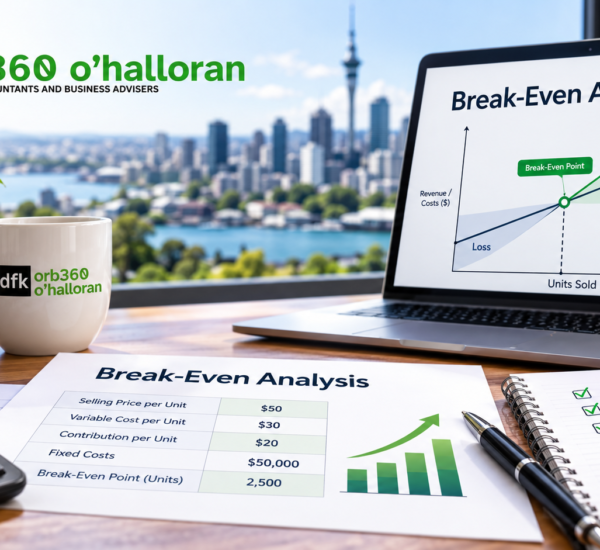
Break-Even Analysis NZ: How to Calculate Your Break-Even Point
Quick Answer: What Is Break-Even Analysis?
Break-Even Analysis NZ is a practical method businesses can use to calculate the level of sales required to cover fixed and variable costs. The break-even point is reached when total revenue equals total costs, meaning the business has neither a profit nor a loss.
Break-even analysis can help New Zealand business owners understand their required sales volume, review pricing, plan expenses and assess potential profitability before making important financial decisions.
What Is a Break-Even Point?
The break-even point is the point at which a business generates enough revenue to cover all of its relevant costs.
Below the break-even point, the business is operating at a loss based on the costs and assumptions included in the analysis. Once sales move above the break-even point, the additional contribution can begin generating operating profit, assuming the underlying assumptions remain appropriate.
A break even point NZ calculation can therefore give business owners a simple way to understand how much they need to sell before the business starts generating a profit.
Break-even analysis can be useful for an established business as well as a startup, a new product, a new service, a new location or a planned expansion.
Why Break-Even Analysis Matters for NZ Businesses
Business owners often focus on revenue targets, but revenue alone does not show how much money is required to cover the costs of running the business.
For example, a business may set a target of $500,000 in annual revenue. However, whether that target is sufficient depends on the business’s pricing, direct costs, staff costs, premises, technology, financing and other expenses.
Break-even analysis NZ businesses use can help connect those costs with a measurable sales target.
It can help answer questions such as:
- How much do we need to sell to cover our costs?
- How many units or services do we need to sell?
- What happens if our prices change?
- What happens if supplier costs increase?
- How many additional sales are required to cover a new employee?
- How much revenue is required before a new location becomes profitable?
- How could a change in the sales mix affect profitability?
How to Calculate Your Break-Even Point
A basic break even calculation NZ businesses can use requires three main pieces of information:
- Total fixed costs
- Selling price per unit
- Variable cost per unit
The standard formula is:
Break-Even Point in Units = Fixed Costs ÷ (Selling Price per Unit − Variable Cost per Unit)
The amount left after the variable cost is deducted from the selling price is known as the contribution per unit.
Contribution per Unit = Selling Price per Unit − Variable Cost per Unit
The higher the contribution per unit, the fewer units may be required to cover the business’s fixed costs, all else being equal.
What Are Fixed Costs?
Fixed costs are costs that generally do not change directly with each additional unit sold over a relevant period.
Depending on the business, fixed costs may include:
- Office or premises costs
- Insurance
- Accounting and professional fees
- Software subscriptions
- Some salaries and wages
- Loan or finance-related costs
- Base telecommunications costs
- Other recurring overheads
Fixed costs are important in a business break even point calculation because they need to be covered regardless of how many units are sold, subject to the assumptions used in the analysis.
Not every cost is strictly fixed or variable in every situation. Some costs may contain both fixed and variable components, so businesses should classify their costs carefully when preparing a financial model.
What Are Variable Costs?
Variable costs generally change in relation to the volume of goods or services sold or produced.
Examples can include:
- Raw materials
- Product packaging
- Transaction or merchant fees
- Sales commissions
- Delivery costs linked to individual sales
- Direct production costs
- Other costs that increase with sales volume
Understanding variable costs is important because they directly affect the contribution generated by each sale.
If variable costs increase while selling prices remain unchanged, the contribution per sale may fall. This can increase the number of sales required to reach break-even.
Break-Even Analysis Example for a NZ Business
Consider a hypothetical New Zealand business that sells a service for $500.
Assume the variable cost associated with delivering each service is $200, while annual fixed costs are $150,000.
The contribution per service would be:
$500 − $200 = $300 contribution per service
The break-even calculation would then be:
$150,000 ÷ $300 = 500 services
Under these assumptions, the business would need to sell approximately 500 services to cover the fixed and variable costs included in the calculation.
This example is for illustration only. Actual business calculations should use the business’s own financial information and appropriate assumptions.
Break-Even Point in Units vs Dollars
A break even analysis can be expressed in units or sales dollars.
The units approach is useful when a business sells a relatively standardised product or service.
For example:
Break-Even Units = Fixed Costs ÷ Contribution per Unit
You can then convert the required number of units into revenue by multiplying the break-even units by the selling price.
For businesses with multiple products or services, a revenue-based approach may be more appropriate. This can require additional assumptions about the expected sales mix and contribution margins of different products or services.
How Pricing Affects Your Break-Even Point
Pricing can have a significant impact on your break-even point.
If your selling price increases while variable costs remain unchanged, the contribution per sale increases. This can reduce the number of sales required to cover fixed costs.
Conversely, reducing prices may increase the number of units sold but can also reduce contribution per sale.
This is why pricing decisions should consider both expected sales volume and profitability rather than focusing only on revenue growth.
A break even calculation NZ businesses use can help model different pricing scenarios before a pricing change is implemented.
How Break-Even Analysis Helps With Business Decisions
Break-even analysis is not only a calculation. It can be used as a planning tool when evaluating different business decisions.
Hiring an Additional Employee
If hiring a new employee increases annual costs, you can estimate how much additional contribution the business needs to generate to cover that cost.
Launching a New Product
Before launching a product, you can estimate the expected selling price, variable cost and additional fixed costs. This can help establish an initial sales target.
Opening a New Location
A new location may introduce additional rent, wages, utilities, marketing and other overheads. Break-even modelling can help estimate the level of sales required to support the additional costs.
Changing Prices
If you are considering a price increase or discount, comparing different scenarios can show how the change could affect the number of sales required to cover costs.
Break-Even Analysis for Small Businesses
For small businesses, understanding the break-even point can make financial planning more practical.
Owners can use the calculation to establish a minimum sales target and then compare that target with expected demand.
For example, if a business needs to generate $40,000 of monthly sales to cover its costs but its expected monthly sales are only $30,000, the owner has an opportunity to investigate the difference before making further commitments.
The business could then review pricing, costs, sales volume, product mix or operating expenses to understand the available options.
This makes break even analysis for small business particularly useful when combined with budgeting and financial forecasting.
Using Break-Even Analysis With Your Business Budget
Your break-even point should ideally be considered alongside your business budget.
A budget provides a broader view of expected revenue and expenses, while break-even analysis helps identify the sales level required to cover relevant costs.
Together, these tools can help answer:
- What sales level is required to cover our costs?
- What sales level is included in our annual budget?
- How much profit could be generated above break-even?
- What happens if sales are lower than expected?
- How would an increase in costs affect our break-even point?
You can also compare the analysis with your business budgeting plan and update the assumptions as actual results become available.
Using Break-Even Analysis With Cash-Flow Forecasting
Break-even analysis and cash-flow forecasting are useful for different reasons.
Break-even analysis focuses on the relationship between costs, sales and profitability. A cash-flow forecast focuses on when money is expected to enter and leave the business.
A business can reach its accounting break-even point and still experience short-term cash-flow pressure if customers pay late or significant payments fall due at the wrong time.
For this reason, break-even analysis should not replace cash-flow forecasting. Instead, the two tools can be used together to provide a broader financial view.
Read our guide to cash flow forecasting in New Zealand for more information.
Break-Even Analysis and Business Profitability
Reaching break-even does not mean a business is generating a strong profit. It simply means that, based on the assumptions used, revenue is sufficient to cover the costs included in the calculation.
Once the business moves beyond its break-even point, the amount of additional contribution generated by sales can contribute towards operating profit.
This is why break-even analysis works well alongside a broader business profitability review.
Reviewing both your break-even point and actual profit margins can help you understand whether your business is simply covering costs or generating the level of profitability required to support its future plans.
How an Accountant Can Help With Break-Even Analysis
An accountant can help you prepare and interpret a break-even model using your actual financial information.
Depending on your business requirements, this may include:
- Identifying and classifying fixed and variable costs
- Reviewing gross profit margins
- Calculating contribution margins
- Preparing break-even calculations
- Modelling different pricing scenarios
- Preparing budgets and financial forecasts
- Assessing the financial impact of planned growth
- Reviewing actual results against forecasts
- Preparing management reports
- Supporting broader financial planning
For businesses requiring more detailed financial modelling and strategic financial support, DFK Orb360 O’Halloran also provides Outsourced CFO services in Wellington and support across New Zealand.
Break-Even Analysis for Businesses in Auckland and Wellington
DFK Orb360 O’Halloran works with business owners across New Zealand, including Auckland and Wellington.
Our team can assist with accounting, financial reporting, budgeting, cash-flow forecasting, profitability analysis and broader business advisory.
Our Auckland locations include Newmarket and Rosedale, while our Wellington presence includes Petone and support across the wider Wellington region.
Whether you are launching a new business, reviewing an established operation, considering a new investment or planning expansion, understanding your break-even point can provide a useful starting point for financial planning.
Break-Even Analysis Checklist
Use this checklist when preparing a break-even analysis:
☐ Identify your fixed costs
☐ Identify your variable costs
☐ Review your current selling prices
☐ Calculate contribution per unit
☐ Calculate your break-even point
☐ Convert break-even units into required sales revenue
☐ Compare break-even sales with your budget
☐ Test different pricing scenarios
☐ Model changes in costs
☐ Review your break-even point regularly
☐ Compare break-even results with your profitability and cash-flow forecasts
People Also Ask: Break-Even Analysis NZ
What is break-even analysis in NZ?
Break-even analysis NZ businesses use calculates the level of sales required to cover relevant fixed and variable costs. At the break-even point, total revenue equals total costs and the business has neither a profit nor a loss under the assumptions used.
How do you calculate a break-even point?
The basic formula is fixed costs divided by the contribution per unit. Contribution per unit is calculated by subtracting the variable cost per unit from the selling price per unit.
What is the break-even formula?
The standard break even formula NZ businesses can use is: Break-Even Point in Units = Fixed Costs ÷ (Selling Price per Unit − Variable Cost per Unit).
What costs are included in break-even analysis?
Break-even analysis generally considers fixed costs and variable costs. Fixed costs may include premises, insurance and certain salaries or subscriptions, while variable costs can include materials, transaction fees, commissions and other costs that change with sales volume.
Why is break-even analysis important for small businesses?
Break-even analysis can help small businesses understand the sales level required to cover their costs. It can also support pricing decisions, budgeting, sales targets and planning for changes such as hiring staff or expanding operations.
Can break-even analysis help with pricing?
Yes. A break-even model can show how changes in selling price affect the contribution generated by each sale and the number of sales required to cover fixed costs.
What is the difference between break-even and profit?
Break-even means revenue covers the costs included in the analysis. Profit occurs when revenue exceeds those costs. A business therefore needs to move beyond its break-even point to generate profit under the model’s assumptions.
Can break-even analysis be used for a new business?
Yes. A startup can use break-even analysis to estimate the sales volume or revenue required to cover expected costs. The model can then be compared with expected demand and used as part of a wider business plan and financial forecast.
How often should a break-even point be reviewed?
A break-even point should be reviewed when significant assumptions change, such as pricing, supplier costs, wages, rent, sales volume or product mix. Regular financial reviews can also help ensure the calculation remains relevant to current business conditions.
Can an accountant calculate my business break-even point?
Yes. An accountant can use your financial information to help identify relevant fixed and variable costs, calculate contribution margins and prepare break-even scenarios for budgeting and business planning.
Frequently Asked Questions About Break-Even Analysis
What happens if a business is below its break-even point?
If sales remain below the break-even point, the business may not be generating enough contribution to cover all of the costs included in the analysis. The owner may need to review pricing, sales volume, variable costs or fixed costs.
Does break-even analysis include tax?
Whether tax is included depends on the purpose and structure of the model. A basic break-even calculation focuses on revenue and operating costs. More detailed financial models can incorporate tax, financing and other business-specific factors where appropriate.
Can a business have more than one break-even point?
A simple business model may have one break-even point, but more complex businesses can require additional analysis. Multiple products, changing contribution margins, step costs or different sales mixes can make the calculation more complex.
Is break-even analysis the same as cash-flow forecasting?
No. Break-even analysis focuses on the relationship between sales, costs and profitability, while cash-flow forecasting focuses on the timing of expected cash inflows and outflows. The two tools can be used together but answer different financial questions.
What is break-even analysis in NZ?
Break-Even Analysis NZ is a method businesses use to calculate the level of sales required to cover relevant fixed and variable costs. At the break-even point, total revenue equals total costs and the business has neither a profit nor a loss under the assumptions used.
Final Thoughts
Break-even analysis NZ businesses can use is a practical way to connect costs with sales targets and understand how much revenue is required to cover the costs of operating a business.
It can be particularly useful when reviewing pricing, launching a new product, hiring staff, opening a new location or planning business growth.
However, break-even analysis works best when it is treated as part of a broader financial planning process. Combining your break-even calculation with budgeting, cash-flow forecasting and profitability analysis can provide a more complete view of your business’s financial performance.
The key is to keep your assumptions realistic and update the model when your costs, prices, sales volumes or business structure change.
Need Help With Your Business Break-Even Analysis?
Understanding your break-even point can help you set realistic sales targets, review pricing and plan your next stage of business growth.
Want help analysing your costs, margins or financial forecasts? Tell the DFK Orb360 O’Halloran team about your business and we’ll be in touch.
DFK Orb360 O’Halloran provides accounting, tax and business advisory services to businesses across New Zealand.
Useful Business Financial Resources
For practical guidance on business finance and financial planning, visit Business.govt.nz .
You can also review the Business.govt.nz cash-flow forecasting resources when preparing your wider financial plan.
Disclaimer: This article provides general information only and should not be treated as financial, tax, accounting or business advice for your specific circumstances. Business owners should consider their individual circumstances and seek professional advice where appropriate.



 09 377 4238
 Level 2, 6 Kingdon Street, Newmarket, Auckland
 help@orb360.co.nz