

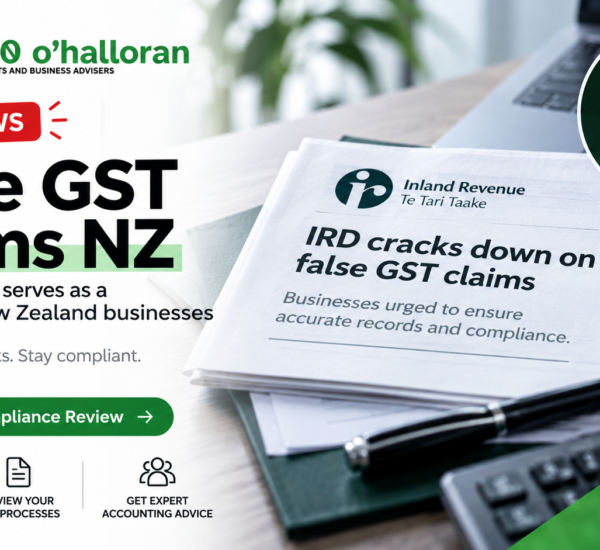
False GST Claims NZ: 7 Lessons for Businesses From the Latest IRD Case
Last updated: 8 September 2026
A recent Inland Revenue case involving more than $861,000 in claimed GST refunds is a serious reminder of why accurate GST reporting, proper record keeping and professional tax advice matter for New Zealand businesses.
The case involved a company that claimed substantial GST refunds despite there being no evidence of sales or income during the relevant period. The individual involved was subsequently convicted and sentenced to home detention and community work.
For legitimate businesses, the key message is not that an ordinary GST mistake automatically amounts to fraud. Rather, the case demonstrates the importance of submitting accurate information to Inland Revenue, maintaining supporting records and addressing genuine GST errors promptly.
False GST Claims NZ
False GST claims NZ involve knowingly providing false, misleading or incomplete information to Inland Revenue to obtain a GST refund or tax outcome that a taxpayer is not legally entitled to. A recent Inland Revenue case involved seven GST returns claiming more than $861,000 in refunds, including one return seeking a $750,000 refund. The court found that the conduct was deliberate rather than a simple filing mistake. For New Zealand businesses, the practical lesson is to keep accurate GST records, claim only eligible GST, review returns before filing and seek professional advice when a GST position is uncertain.
- Only claim GST that your business is legally entitled to claim.
- Keep invoices, receipts, bank records and other supporting documentation.
- Review GST returns before they are submitted to Inland Revenue.
- Correct genuine GST errors rather than ignoring them.
- Seek professional tax advice when a transaction or GST position is unclear.
What Are False GST Claims in New Zealand?
False GST claims NZ are claims or information submitted to Inland Revenue that are knowingly false, misleading or incomplete, particularly where the purpose is to obtain a GST refund or tax outcome that the taxpayer knows they are not entitled to.
This is different from a genuine accounting error. A business may accidentally enter an incorrect amount, misunderstand a transaction or make a calculation mistake. The circumstances surrounding the error matter, including whether the taxpayer took reasonable care and what they did after discovering the problem.
In serious cases involving deliberate conduct, Inland Revenue can pursue civil penalties or criminal prosecution.
What Happened in the Latest IRD GST Case?
In a media release dated 8 September 2026, Inland Revenue reported that a Northland woman was sentenced to 10 months’ home detention and 150 hours of community work after being found guilty on seven counts of knowingly providing false, misleading or incomplete information to Inland Revenue.
The charges related to GST returns filed between March 2016 and March 2017 for Only1 Company Limited. The company had been registered for GST and was described as a call centre operation and plasterboard stopping company.
According to Inland Revenue, the seven GST returns claimed a combined total of $861,154.06 in GST refunds. There was no evidence of sales or income from the company during that period.
One of the returns sought a GST refund of $750,000.
The defendant argued that the $750,000 figure was an error and should have been $75,000. The court rejected that explanation and found that the conduct represented an established pattern of filing false returns to obtain money to which the company was not entitled.
The sentence was imposed in the Waitakere District Court on 3 September 2026.
What This IRD Case Means for New Zealand Businesses
At DFK Orb360 O’Halloran, we believe tax compliance should be approached as an ongoing business process rather than something that only receives attention when a return is due.
Our Chartered Accounting and business advisory team works with New Zealand businesses on accounting, GST, tax compliance, financial reporting and business advisory matters. Our approach is to help business owners understand their numbers, maintain appropriate records and make informed financial decisions.
This article is based on the latest information published by Inland Revenue and is intended as general information. Tax outcomes depend on the individual facts and circumstances of each business.
For complex GST or tax matters, businesses should obtain advice from a qualified tax professional.
1. GST Refunds Must Be Supported by Genuine Transactions
A GST refund should arise from legitimate business transactions and be supported by appropriate records.
Businesses should be able to explain the transactions underlying the figures included in their GST returns. If a large refund appears unexpectedly, it is sensible to investigate the reason before filing the return.
This is particularly important where a business has unusual purchases, significant one-off transactions, asset acquisitions or major changes in its GST position.
If you are unsure whether a transaction should be included in a GST return, professional GST and accounting support in Wellington can help you understand the issue before the return is submitted.
2. Accurate GST Records Are Essential
One of the most effective ways to reduce GST compliance risk is to maintain accurate and complete financial records throughout the year.
Inland Revenue states that businesses must keep records of cash and electronic sales and purchases for 7 years.
Examples of business records can include taxable supply information, invoices, receipts, bank statements, credit card records, cashbooks and point-of-sale information.
Good record keeping helps businesses calculate GST, prepare tax returns, reconcile accounts and respond to questions from Inland Revenue.
See Inland Revenue’s guidance on records of income and expenses .
3. A GST Mistake Is Not Automatically Tax Fraud
This distinction is important for business owners.
Not every incorrect GST return represents deliberate tax evasion. Businesses can make genuine mistakes because of incorrect data entry, misunderstandings, accounting system issues or the incorrect treatment of a transaction.
The nature of the error and the taxpayer’s behaviour are important when determining what consequences may apply.
Inland Revenue’s guidance explains that different shortfall penalties can apply depending on the circumstances, including penalties for not taking reasonable care, gross carelessness, abusive tax positions and evasion.
The safest approach is to identify and address an error rather than allowing it to remain uncorrected.
4. Deliberately False GST Claims Can Have Serious Consequences
The consequences become considerably more serious when a taxpayer knowingly provides false or misleading information or deliberately obtains a refund they know they are not entitled to.
Inland Revenue states that tax evasion can include obtaining a refund or payment of tax when a person knows they are not lawfully entitled to it.
The shortfall penalty for evasion is 150% of the resulting tax shortfall. In some cases, Inland Revenue may prosecute instead of applying the civil penalty. Criminal prosecution can potentially result in imprisonment and fines.
The precise consequences depend on the circumstances and applicable law.
5. Review Large or Unusual GST Refunds Before Filing
A significant GST refund is not automatically wrong. Businesses can legitimately receive large refunds after making substantial taxable purchases or investments.
However, an unusually large refund should prompt a careful review of the underlying transactions.
Before filing, consider:
- Are all sales recorded correctly?
- Are the purchase transactions genuine?
- Do the GST claims have appropriate supporting documentation?
- Has GST been calculated correctly?
- Does the GST return reconcile with the accounting records?
- Are there unusual transactions that require additional review?
A proper review can identify errors before they become a larger compliance issue.
6. Good Financial Reporting Can Help Identify GST Problems
GST compliance does not operate separately from the rest of your business finances.
Regular financial reporting can help identify unusual movements in revenue, expenses, GST balances, accounts payable and accounts receivable.
For example, if your accounting records show a GST position that looks significantly different from previous reporting periods, investigating the reason before filing may help identify an accounting or transaction issue.
DFK Orb360 provides accounting and financial reporting support designed to give business owners better visibility over their financial position.
7. Get Professional Advice When Your GST Position Is Unclear
GST rules can become complicated when a business deals with unusual transactions, property, international activities, major assets, restructuring or other circumstances that require specific tax treatment.
If you are unsure about whether GST can be claimed, how a transaction should be treated or how to correct an error, getting advice before filing can help you make a more informed decision.
DFK Orb360 provides tax advisory services covering tax compliance, tax planning and complex tax matters for businesses across New Zealand.
What Should You Do If You Discover a GST Error?
If you discover an error in a previous GST return, don’t ignore it.
The appropriate response depends on the nature and size of the error and the relevant Inland Revenue rules.
Step 1: Identify the transaction
Find the invoice, receipt, bank transaction or other record connected with the error.
Step 2: Determine what went wrong
Establish whether the issue relates to an incorrect GST calculation, missing transaction, incorrect GST treatment or another accounting issue.
Step 3: Gather supporting records
Keep the documentation that supports the transaction and the correction.
Step 4: Assess whether the GST return needs correction
Determine whether the error needs to be corrected through the applicable Inland Revenue process.
Step 5: Get professional advice where necessary
If the error is significant, involves several GST periods or could result in penalties, speak with a qualified accountant or tax adviser.
DFK Orb360 can help businesses review their financial records and understand the accounting and tax considerations relevant to their circumstances.
GST Compliance Checklist for New Zealand Businesses
Use this checklist as a starting point for reviewing your GST processes:
- Keep accurate records of sales and purchases.
- Retain supporting GST documentation.
- Reconcile your accounting records regularly.
- Review GST calculations before filing.
- Investigate unusually large GST refunds.
- Separate personal and business transactions appropriately.
- Keep business records for the required period.
- Address discovered GST errors promptly.
- Monitor changes in your tax position.
- Seek professional advice when GST treatment is uncertain.
How Long Should a NZ Business Keep GST Records?
Inland Revenue states that businesses must keep records of cash and electronic sales and purchases for 7 years.
Inland Revenue also explains that good records help businesses work out income and expenses, calculate GST and confirm their accounts.
Keeping accurate records is therefore an important part of GST compliance and broader tax management.
What GST Penalties Can Apply in New Zealand?
The penalty that may apply depends on the circumstances behind the tax shortfall.
Inland Revenue identifies different categories of shortfall penalties, including:
- Not taking reasonable care
- Unacceptable tax position
- Gross carelessness
- Abusive tax position
- Evasion or a similar act
For example, Inland Revenue states that the penalty for not taking reasonable care is generally 20% of the tax shortfall, while the penalty for gross carelessness is generally 40%, an abusive tax position is generally 100%, and evasion is 150%.
These rules are fact-specific and should not be interpreted as meaning that every GST error attracts the same penalty.
Inland Revenue’s 2026 interpretation statement on evasion also explains the knowledge requirement relevant to the evasion shortfall penalty.
Read Inland Revenue’s 2026 guidance on the evasion shortfall penalty .
What If You Discover a Tax Problem Before IRD Does?
If you identify an issue with a tax return or tax position, it may be beneficial to address it promptly rather than waiting for Inland Revenue to identify the issue.
Inland Revenue provides information about voluntary disclosure and circumstances in which a shortfall penalty may be reduced when a taxpayer makes a qualifying disclosure.
The timing and circumstances of a disclosure matter, so professional advice can be valuable before contacting Inland Revenue about a potentially significant issue.
See Inland Revenue’s guidance on lowering a shortfall penalty .
How DFK Orb360 Helps New Zealand Businesses With GST Compliance
DFK Orb360 O’Halloran is a Chartered Accounting and business advisory firm supporting businesses across New Zealand.
Our services include accounting and financial reporting, tax advisory, GST and tax compliance, business advisory and outsourced CFO support.
For Wellington businesses, our team provides accounting and tax support from our Petone office and works with businesses throughout the wider Wellington region.
Our Wellington accounting team can assist with GST filing, tax compliance, financial reporting, cash-flow planning and broader business advisory requirements.
Concerned About Your GST or Business Financial Position?
If you’re unsure whether your GST records are accurate, have identified a potential error or simply want greater visibility over your business finances, a professional review can help you understand where you stand.
Book a Business Financial Health Check with DFK Orb360.
The review can help you identify areas that may require attention across your financial reporting, cash flow, tax obligations and overall business performance.
Complete the form below and a member of the DFK Orb360 team will get in touch.
Frequently Asked Questions About False GST Claims NZ
What are false GST claims in New Zealand?
False GST claims NZ can involve knowingly submitting false, misleading or incomplete information to Inland Revenue to obtain a GST refund or tax outcome that the taxpayer is not legally entitled to receive.
Can a genuine GST mistake result in a penalty?
A genuine GST mistake can potentially result in a tax shortfall and penalty depending on the circumstances. Inland Revenue considers factors such as reasonable care, the nature of the error and the resulting tax shortfall.
How long do I need to keep GST records in New Zealand?
Inland Revenue states that businesses must keep records of cash and electronic sales and purchases for 7 years.
What happens if I claim GST incorrectly?
The consequences depend on why the claim was incorrect, the amount involved and the taxpayer’s conduct. A genuine error may be treated differently from a deliberate attempt to obtain a refund the taxpayer knows they are not entitled to.
Can businesses correct GST mistakes?
Businesses can correct GST errors through the applicable Inland Revenue processes. The appropriate method depends on the circumstances and nature of the error.
Can an accountant help with GST compliance?
Yes. An accountant can help review financial records, GST calculations, supporting documentation and tax compliance processes and can provide advice relevant to the business’s circumstances.
Can false GST claims lead to criminal prosecution?
Serious tax offences can result in criminal prosecution. Inland Revenue states that certain knowledge and evasion offences can result in fines and, in serious cases, imprisonment.
What should I do if I am worried about a GST return I already filed?
Gather the relevant records and seek professional advice promptly. Depending on the circumstances, the GST return may need to be corrected or the issue may need to be addressed with Inland Revenue.
Key Takeaway: GST Accuracy Matters
The latest false GST claims NZ case demonstrates the serious consequences that can arise when false or misleading information is deliberately provided to Inland Revenue.
For legitimate New Zealand businesses, the practical lessons are straightforward: maintain accurate records, review GST returns carefully, claim only eligible GST, address genuine errors and seek professional advice when you’re unsure.
Good GST compliance is not simply about avoiding penalties. It gives business owners greater confidence that their financial information is accurate and that important decisions are based on reliable numbers.
If you’d like an independent view of your business’s financial position, request a Business Financial Health Check with DFK Orb360.



 09 377 4238
 Level 2, 6 Kingdon Street, Newmarket, Auckland
 help@orb360.co.nz