

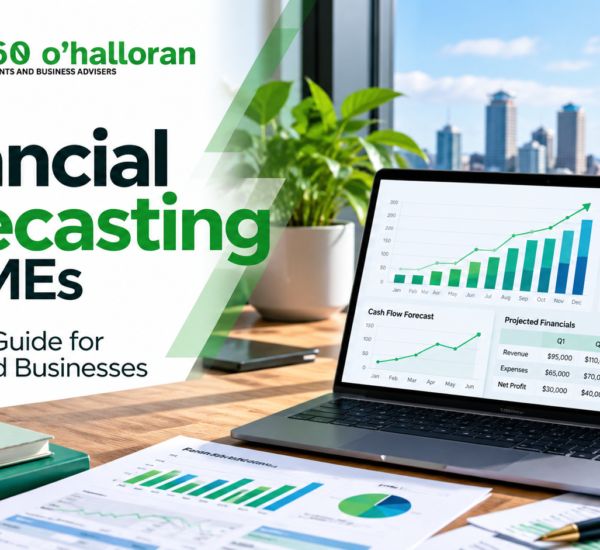
Running a small or medium-sized business involves making financial decisions every day. From managing operating costs and paying staff to planning investments and preparing for tax obligations, business owners need a clear understanding of their financial position.
Financial forecasting for SMEs provides that visibility. It helps business owners estimate future income, expenses, cash flow and financial requirements so they can plan ahead rather than react to problems after they arise.
What is financial forecasting for SMEs?
Financial forecasting for SMEs is the process of estimating a business’s future revenue, expenses, cash flow and financial position using historical financial information, current performance and expected business activity.
For New Zealand businesses, regular forecasting can help identify potential cash shortages, plan for GST and other tax obligations, manage operating costs, assess growth opportunities and make informed decisions about hiring, investment and borrowing.
A practical starting point is to prepare a cash flow forecast, create realistic financial scenarios and compare actual results against forecasts regularly.
Key Takeaways
- Financial forecasting helps SMEs understand their expected financial position.
- Cash flow forecasting identifies when money may be available or in short supply.
- Reliable forecasts should use actual financial records and realistic assumptions.
- Businesses should consider seasonal changes, tax payments, wages and supplier costs.
- Comparing forecasts with actual results helps improve future planning.
- An accountant or business adviser can help turn financial forecasts into practical business decisions.
What Is Financial Forecasting?
Financial forecasting is the process of estimating a business’s future financial performance over a defined period. It uses historical accounts, current financial information, market conditions and expected business changes to develop a picture of what may happen financially.
A financial forecast can cover a few weeks, several months or multiple years, depending on the decision being considered.
For example, an SME might prepare a forecast to understand whether it can:
- Afford to hire an additional employee.
- Purchase equipment or upgrade business premises.
- Manage a seasonal reduction in sales.
- Take on a new project or customer contract.
- Expand into another location or market.
- Meet upcoming tax, supplier and wage commitments.
- Apply for finance or discuss funding with a bank.
Forecasting is not about predicting the future with complete certainty. It is about using the best available information to prepare for different possible outcomes.
Why Is Financial Forecasting Important for SMEs?
Small and medium-sized businesses often have less financial flexibility than larger organisations. A delayed customer payment, unexpected expense or decline in sales can affect their ability to meet everyday commitments.
Financial forecasting helps business owners identify these pressures earlier and consider appropriate actions.
1. Improve cash flow management
A business can be profitable on paper but still experience a cash shortage if customers pay late or expenses fall due before money is received.
A cash flow forecast helps estimate when payments are expected, when expenses must be paid and how much cash may remain available.
2. Plan business growth
Expansion often involves additional costs, including wages, equipment, rent, stock and marketing. Forecasting helps estimate whether the business can support these costs and how much additional funding may be required.
3. Prepare for tax obligations
Businesses need to plan for tax-related payments rather than treating them as unexpected expenses. Forecasting can help owners account for relevant GST, PAYE, provisional tax and other obligations based on their circumstances.
4. Make informed hiring and investment decisions
Before hiring staff or purchasing assets, business owners can use forecasts to estimate the ongoing financial impact and assess whether the proposed decision is affordable.
5. Identify financial risks early
Forecasting can reveal potential cash shortages, rising expenses, declining margins or reliance on a small number of customers. Identifying these trends early gives businesses more time to respond.
Financial Forecasting vs Budgeting: What Is the Difference?
Budgeting and forecasting are related, but they serve different purposes. A budget generally sets out the financial targets and spending plans for a period, while a forecast estimates what is likely to happen based on current information.
| Area | Budgeting | Financial Forecasting |
|---|---|---|
| Main purpose | Set financial targets and spending limits. | Estimate future financial performance. |
| Timeframe | Often prepared annually. | Updated as business conditions change. |
| Focus | Planned income and expenditure. | Expected income, costs and cash position. |
| Business use | Monitor performance against targets. | Support decisions and prepare for changes. |
For effective financial management, SMEs should use both. A budget sets the direction, while a regularly updated forecast helps determine whether the business is on track.
How to Prepare a Financial Forecast for Your SME
Creating a financial forecast does not need to be complicated. A spreadsheet or accounting software can provide a useful starting point, provided the information is accurate and the assumptions are realistic.
Step 1: Review your current financial position
Start by reviewing your latest financial information. This may include:
- Profit and loss statements.
- Balance sheets.
- Bank statements.
- Accounts receivable and accounts payable.
- Sales and expense records.
- Existing loan and finance commitments.
For established businesses, reviewing the previous 12 months can help identify seasonal patterns and changes in revenue or expenses. New businesses can use market research, supplier estimates and relevant industry benchmarks to develop initial assumptions.
Step 2: Forecast your revenue
Estimate how much income the business expects to receive during each forecast period.
Consider:
- Existing customer contracts and recurring revenue.
- Expected sales and new customer opportunities.
- Seasonal demand and quieter trading periods.
- Changes in pricing or sales volume.
- Customer payment patterns and potential delays.
Avoid relying entirely on your most optimistic sales target. Base projections on available evidence and document the assumptions behind your estimates.
Step 3: Estimate your expenses
List the costs the business expects to incur during the forecast period.
These may include:
- Employee salaries, wages and related employment costs.
- Rent, utilities and insurance.
- Stock, materials and supplier payments.
- Marketing and software subscriptions.
- Loan repayments and interest.
- Professional fees and operating costs.
- GST, PAYE, provisional tax and other relevant tax payments.
- Planned equipment purchases and other major expenses.
Remember to include irregular expenses, not just monthly bills. Annual insurance renewals, equipment repairs and scheduled tax payments can have a significant impact on cash availability.
Step 4: Prepare a cash flow forecast
A cash flow forecast estimates the money entering and leaving the business over time. It should show the opening cash balance, expected receipts, expected payments and closing cash balance for each period.
A basic calculation is:
Closing cash balance = Opening cash balance + Cash received − Cash paid
This calculation can be repeated for each week or month. The closing balance for one period becomes the opening balance for the next.
When preparing the forecast, use expected payment dates rather than assuming that every invoice will be paid immediately.
Step 5: Create realistic, optimistic and cautious scenarios
One forecast may not capture every possible business outcome. Preparing different scenarios can help owners understand how sensitive their finances are to changes in sales, costs or customer payments.
| Scenario | Assumptions to consider | Questions to ask |
|---|---|---|
| Cautious | Lower sales, delayed payments or higher costs. | Can the business meet its commitments? |
| Expected | Most likely sales and operating costs. | Does the business have sufficient cash for planned activities? |
| Optimistic | Higher sales, new contracts or improved margins. | Can the business support additional growth? |
These scenarios are planning tools, not guarantees. Their value comes from understanding what the business may need to do under different conditions.
Step 6: Compare actual results with your forecast
A forecast should be reviewed regularly rather than prepared once and left unchanged.
Compare actual revenue and expenses against projected figures. Investigate significant differences and update future months to reflect what has changed.
For example, if customer payments are consistently arriving later than expected, adjust the timing of cash receipts. If supplier costs increase, update the expense assumptions.
Practical Example: A Small Business Cash Flow Forecast
Consider a hypothetical New Zealand SME that wants to understand its cash position for the coming month.
Illustrative monthly cash flow
| Cash flow item | Forecast amount (NZD) |
|---|---|
| Opening cash balance | $12,000 |
| Expected customer receipts | $45,000 |
| Supplier and operating payments | -$25,000 |
| Wages and employment costs | -$12,000 |
| Other scheduled payments | -$11,000 |
| Closing cash balance | $9,000 |
What does this tell the business owner?
Based on these assumptions, the business expects to finish the month with $9,000 in cash. However, the owner should still check the timing of receipts and payments, upcoming tax obligations and any expenses not included in the forecast.
This is a simplified example for illustration only. Actual forecasts should reflect the business’s individual circumstances and payment schedules.
Financial Forecasting Considerations for New Zealand SMEs
New Zealand businesses should consider local tax and compliance obligations when preparing their forecasts. These commitments can affect when cash leaves the business, even when the business is generating sales and reporting a profit.
GST planning
Businesses registered for GST need to consider the timing of GST collected, GST paid and payments due to Inland Revenue. GST collected should not automatically be treated as money available for general business spending.
Forecasting should account for the business’s GST filing and payment cycle and its expected position for each period.
PAYE and employment costs
Employers should include PAYE deductions and payment obligations in their cash planning, alongside wages, KiwiSaver contributions where applicable, and other employment-related costs.
Provisional tax planning
Businesses that are required to pay provisional tax should plan for the relevant instalments. Forecasting taxable income and expected tax payments can help reduce the risk of unexpected cash pressure.
Seasonal trading patterns
Many SMEs experience changes in demand throughout the year. Retail, hospitality, tourism, construction and professional services businesses may all have different seasonal patterns.
Use historical trading information where available and consider known events, holidays, customer behaviour and industry conditions when estimating future revenue.
For tax-specific information, refer to Inland Revenue (IRD) and seek advice based on your business circumstances.
Common Financial Forecasting Mistakes SMEs Should Avoid
Even a well-designed forecast can be misleading if the underlying assumptions are unrealistic or the information is not updated.
1. Overestimating revenue
Assuming every sales opportunity will convert can create an unrealistic picture of future cash flow. Separate confirmed revenue from potential sales.
2. Forgetting payment timing
Revenue recorded in your accounts does not necessarily mean the money has reached your bank account. Forecast when customers are expected to pay.
3. Leaving out irregular expenses
Repairs, insurance renewals, annual subscriptions and tax payments should be considered even if they do not occur every month.
4. Treating profit and cash as the same thing
Profitability and cash availability are different measures. A business can report a profit while facing short-term cash pressure.
5. Failing to update the forecast
Business conditions change. A forecast that does not reflect actual performance, new costs or changing sales patterns can quickly become unreliable.
6. Making decisions using only one scenario
Planning for the expected outcome alone may leave a business unprepared for a decline in sales or an unexpected increase in costs.
How Often Should SMEs Review Their Financial Forecasts?
The right review frequency depends on the size, complexity and financial position of the business.
- Weekly: Review cash flow when cash is tight, payment timing is uncertain or the business has frequent transactions.
- Monthly: Compare actual results with the forecast and update expected income and expenses.
- Quarterly: Review broader business performance, margins, upcoming commitments and growth plans.
- Before major decisions: Update forecasts before hiring, borrowing, investing, expanding or taking on a significant contract.
Many SMEs benefit from maintaining a rolling forecast that is updated as new information becomes available. This helps keep financial planning relevant to the business’s current position.
How Yasodha Kishorkumar Supports SMEs at DFK Orb360

Yasodha Kishorkumar
Manager – Business Advisory and Consulting
Yasodha has over seven years of New Zealand public practice experience and works closely with business owners and SMEs, providing guidance across accounting, taxation and business advisory matters.
Her areas of expertise include financial reporting, taxation compliance, statutory obligations and business operations. She combines technical knowledge with a commercial mindset to help clients navigate challenges, understand their financial position and make informed business decisions.
At DFK Orb360, this practical, client-focused approach supports businesses in managing their financial responsibilities, improving performance and working towards their long-term objectives.
Financial forecasting is most useful when it connects accounting information with real business decisions. Working with an experienced accounting and business advisory team can help SME owners interpret their numbers, assess financial risks and plan their next steps with greater clarity.
Frequently Asked Questions About Financial Forecasting for SMEs
1. What is financial forecasting for SMEs?
Financial forecasting for SMEs is the process of estimating future revenue, expenses, cash flow and financial performance using historical accounts, current business information and realistic assumptions.
2. Why is financial forecasting important for small businesses?
It helps small businesses anticipate cash shortages, plan expenses, prepare for tax payments, assess growth opportunities and make informed decisions about hiring, borrowing and investment.
3. What should an SME include in a financial forecast?
A financial forecast should include expected sales, customer payment timing, operating expenses, wages, supplier payments, tax commitments, loan repayments, planned investments and opening and closing cash balances.
4. What is the difference between a cash flow forecast and a profit forecast?
A cash flow forecast estimates when money will enter and leave the business. A profit forecast estimates revenue and expenses over a period to determine expected profitability. They answer different questions and should be considered together.
5. How far ahead should an SME forecast?
The timeframe depends on the business and the decision being made. SMEs may use weekly or monthly cash flow forecasts for short-term planning and a longer rolling forecast to assess future costs, investment and growth.
6. Can a small business prepare its own financial forecast?
Yes. A small business can begin with a spreadsheet or accounting software using its financial records and expected income and expenses. An accountant can help review the assumptions and ensure relevant costs and obligations have been considered.
7. How does financial forecasting help with tax planning in New Zealand?
Forecasting helps businesses plan for expected GST, PAYE, provisional tax and other relevant payments. The specific obligations and timing depend on the business’s circumstances and should be confirmed with Inland Revenue or an appropriately qualified adviser.
8. How often should a business update its financial forecast?
Many SMEs review their forecasts monthly, while businesses with tighter cash flow may need weekly reviews. Forecasts should also be updated when significant changes occur, such as new contracts, rising costs or planned investments.
Want a Clearer Picture of Your Business’s Financial Future?
Do not wait until cash flow becomes a problem. Understand your numbers, plan for upcoming commitments and make more confident decisions about your business’s future.
DFK Orb360 O’Halloran works with New Zealand businesses on accounting, taxation and business advisory matters. Talk to our team about your financial planning and business goals.
Book a Free ConsultationSpeak with our team: help@orb360.co.nz | +64 9 377 4238
Request a Consultation
Complete the form below and our team will be in touch.


 09 377 4238
 Level 2, 6 Kingdon Street, Newmarket, Auckland
 help@orb360.co.nz