

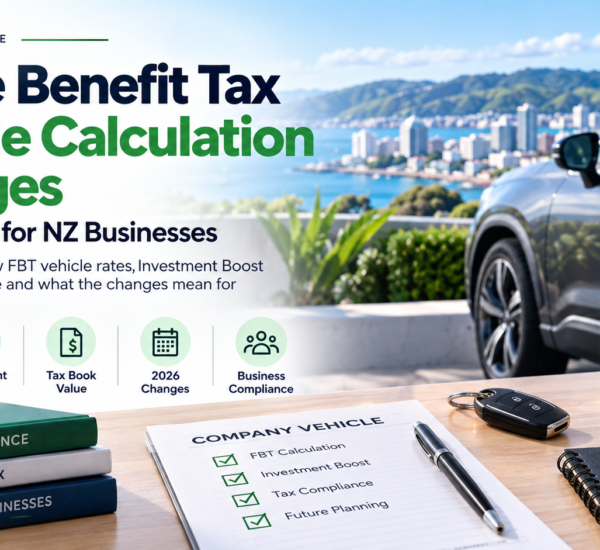
Fringe Benefit Tax Vehicle Calculation Changes: 2026 Guide for NZ Businesses
Fringe Benefit Tax Vehicle Calculation Changes: Quick Answer
Fringe benefit tax vehicle calculation changes took effect from 1 April 2026 for motor vehicles where Investment Boost has been claimed. The changes affect the percentage used when calculating the taxable value of a vehicle benefit under the tax book value method.
For quarterly FBT returns, the Investment Boost rates are 10.35% including GST or 11.90% excluding GST. For income-year or annual returns, the rates are 41.40% including GST or 47.61% excluding GST.
A minimum tax book value of $7,317 applies where Investment Boost has been claimed. The changes mean employers using company vehicles should review their FBT calculations and accounting records for the 2026 tax year and beyond.
Need Help With FBT Vehicle Calculations?
Changes to FBT vehicle calculations can affect employers using company vehicles, particularly where Investment Boost has been claimed. DFK Orb360 O’Halloran can help businesses review their FBT treatment, calculations and broader tax compliance.
Talk to our Chartered Accounting team about your FBT obligations.
What Are the Fringe Benefit Tax Vehicle Calculation Changes?
The 2026 changes affect how employers calculate the taxable value of motor vehicle fringe benefits where the vehicle’s tax book value includes an Investment Boost reduction.
Previously, the tax book value method used the standard FBT valuation rates. From 1 April 2026, specific higher valuation rates apply when Investment Boost has been claimed on the vehicle.
The changes are important for employers because Investment Boost reduces the tax book value of qualifying assets. The FBT rules now provide specific rates for vehicles whose tax book value reflects that reduction.
This means businesses should not automatically use the standard tax book value rate when calculating FBT for an Investment Boost vehicle.
2026 FBT Vehicle Rates: Investment Boost vs Standard Rates
The applicable percentage depends on whether Investment Boost has been claimed and whether the business uses a GST-inclusive or GST-exclusive calculation.
| Return Type | Tax Book Value – No Investment Boost | Tax Book Value – Investment Boost |
|---|---|---|
| Quarterly – GST inclusive | 9% | 10.35% |
| Quarterly – GST exclusive | 10.35% | 11.90% |
| Income year / annual – GST inclusive | 36% | 41.40% |
| Income year / annual – GST exclusive | 41.40% | 47.61% |
The new Investment Boost rates apply from 1 April 2026 where Investment Boost has been claimed for the vehicle.
10.35% vs 11.90%: Which FBT Vehicle Rate Applies?
The difference between 10.35% and 11.90% relates to whether the calculation is made on a GST-inclusive or GST-exclusive basis.
For a quarterly return, the Investment Boost tax book value rate is:
- 10.35% on a GST-inclusive basis.
- 11.90% on a GST-exclusive basis.
Businesses need to use the basis that applies to their FBT calculation rather than choosing whichever percentage produces the lower taxable value.
Businesses affected by the fringe benefit tax vehicle calculation changes should review their vehicle valuation methods before completing their next FBT return.
The fringe benefit tax vehicle calculation changes are particularly relevant when Investment Boost has reduced the tax book value of a company vehicle.
Understanding the fringe benefit tax vehicle calculation changes can help employers identify whether their existing FBT processes need to be updated.
For businesses with several company vehicles, the fringe benefit tax vehicle calculation changes should be reviewed across the entire vehicle fleet rather than on a vehicle-by-vehicle basis only.
41.40% vs 47.61%: Annual FBT Vehicle Calculation
Businesses filing income-year or annual FBT returns use annual percentages rather than the quarterly rates.
- 41.40% GST-inclusive where Investment Boost has been claimed.
- 47.61% GST-exclusive where Investment Boost has been claimed.
The annual calculation also takes account of the number of days the vehicle was available for private use.
How Is FBT Calculated on a Company Vehicle?
The taxable value of a motor vehicle fringe benefit depends on factors including the valuation method, the vehicle value, the number of days available for private use and the applicable FBT percentage.
Quarterly and Annual Returns
For quarterly and annual returns, the general calculation is:
Private use days × cost price or tax book value ÷ 90 × applicable percentage
The number of days used for this calculation cannot exceed 90 for a quarterly calculation.
Income-Year Returns
For an income-year return, the calculation is generally:
Private use days × cost price or tax book value ÷ 365 × applicable percentage
Businesses also need to consider exempt days, employee contributions and other applicable FBT rules when calculating the taxable value.
Cost Price vs Tax Book Value for FBT
Employers generally have a choice between using the cost price method and the tax book value method, subject to the applicable FBT rules.
| Method | General Basis |
|---|---|
| Cost price | Uses the vehicle’s original cost price and the applicable FBT percentage. |
| Tax book value | Uses the vehicle’s tax book value and the applicable FBT percentage. |
If Investment Boost has been claimed, the tax book value can reflect the Investment Boost deduction. This is why the specific Investment Boost FBT rates introduced from 1 April 2026 are important.
Once an employer chooses a valuation method for a vehicle, the method generally needs to continue to be used until the earliest applicable change point under the FBT rules.
How Does Investment Boost Affect FBT?
Investment Boost is a tax depreciation measure that can reduce the tax book value of qualifying assets.
For motor vehicles, this can affect the amount used when an employer calculates FBT using the tax book value method.
From 1 April 2026, Inland Revenue introduced specific FBT valuation rates for vehicles where Investment Boost has been claimed.
The key point for employers is that the Investment Boost reduction should not simply be ignored when calculating the vehicle’s tax book value.
What Is the $7,317 Minimum Tax Book Value?
A minimum tax book value applies when an employer uses the tax book value method.
For vehicles where Investment Boost has been claimed, the minimum tax book value is $7,317.
For vehicles where Investment Boost has not been claimed, the minimum tax book value is $8,333.
| Investment Boost | Minimum Tax Book Value |
|---|---|
| No | $8,333 |
| Yes | $7,317 |
The minimum value exists because an employee may continue to have a private-use benefit even after the vehicle has significantly depreciated.
Example: FBT Vehicle Calculation With Investment Boost
Consider a company vehicle where:
- The tax book value after applicable depreciation and Investment Boost is $30,000.
- The vehicle is available for private use for 90 days during a quarter.
- The employer uses the GST-inclusive tax book value method.
- Investment Boost has been claimed.
The quarterly Investment Boost rate is 10.35% on a GST-inclusive basis.
The simplified calculation would therefore be:
90 ÷ 90 × $30,000 × 10.35% = $3,105 taxable value
The $3,105 is the taxable value of the fringe benefit before considering any applicable employee contribution or other adjustments.
The actual FBT payable is then determined using the applicable FBT rules and rate for the employer’s circumstances.
Why Private Use Matters for FBT Vehicle Calculations
FBT applies because the employee has access to a non-cash benefit. For motor vehicles, private availability is a key factor in calculating the taxable value.
Private use can include situations where the vehicle is available to an employee outside their business activities, subject to the detailed FBT rules.
Employers should therefore maintain accurate records showing:
- Which employee has access to the vehicle.
- The vehicle’s make, model and registration number.
- The number of days the vehicle is available for private use.
- Any exempt or unavailable days.
- Employee contributions, where applicable.
- The valuation method being used.
How Do Exempt and Unavailable Days Affect FBT?
Not every day needs to be treated in exactly the same way when calculating the taxable value of a vehicle benefit.
Where exempt days apply, these can affect the number of days used in the calculation.
Employers should maintain records supporting the number of private-use, exempt and unavailable days used in their calculations.
For pooled vehicles, the rules can also depend on how employees use the vehicles and whether the vehicles are trading stock.
What Happens With Pooled Company Vehicles?
Businesses with multiple vehicles available to employees may need to apply specific rules when determining the vehicle value used for FBT.
The treatment can depend on how the vehicles are used.
| Situation | Vehicle Value |
|---|---|
| Employee mainly uses the same vehicle | Value of that vehicle |
| Car dealership with pooled trading-stock vehicles and no employee mainly uses one vehicle | Average value of vehicles in the pool |
| Other pooled vehicle situations | Highest value of available vehicles |
Businesses with pooled vehicles should check the specific Inland Revenue rules before completing their FBT return.
How Does FBT Work for Leased Vehicles?
Leased vehicles can also be subject to FBT where they are available for an employee’s private use.
The employer may use the cost price or tax book value method where the applicable requirements are met.
For leased vehicles, the lessor may need to provide information about the vehicle’s cost price or tax book value, including an Investment Boost deduction where relevant.
What About Electric and Hybrid Company Vehicles?
The 2026 Investment Boost vehicle calculation changes apply to the relevant FBT valuation rules for motor vehicles. Businesses should not assume that an electric or hybrid vehicle automatically receives a separate FBT valuation rate under the current 2026 rules.
The tax treatment of a particular vehicle should be reviewed based on the vehicle, the employer’s circumstances and the FBT rules applicable to the relevant period.
There are also proposed changes to the motor vehicle FBT rules for benefits provided after 1 April 2027. Those proposals include separate rates for standard, hybrid and electric vehicles, but they should not be treated as current law until enacted.
What Changes Are Proposed From 1 April 2027?
The Government has proposed further changes to simplify the motor vehicle FBT rules for benefits provided after 1 April 2027.
The proposal includes a category-based approach with different rates for standard vehicles, hybrid vehicles and electric vehicles.
The proposed rates include:
| Vehicle Category | Proposed Annual Cost-Base Rate | Proposed Annual Tax Book Value Rate |
|---|---|---|
| Standard vehicle | 22.8% | 47.25% |
| Hybrid vehicle | 19.6% | 40.50% |
| Electric vehicle | 17.0% | 35.00% |
These are proposed rates for benefits provided after 1 April 2027 and should not be confused with the FBT rates currently applying from 1 April 2026.
Businesses should monitor the legislation and Inland Revenue guidance before changing their FBT systems based on the proposed 2027 rules.
7 Common FBT Vehicle Calculation Mistakes
1. Using the Wrong FBT Rate
Employers may accidentally use a standard tax book value rate when Investment Boost has been claimed.
2. Ignoring the Investment Boost Reduction
The tax book value calculation needs to reflect the applicable Investment Boost treatment.
3. Using the Wrong GST Basis
The GST-inclusive and GST-exclusive calculations use different percentages. Businesses should use the correct basis consistently.
4. Forgetting the Minimum Tax Book Value
The minimum tax book value needs to be considered when the vehicle’s calculated value falls below the applicable minimum.
5. Incorrectly Counting Private-Use Days
The number of days available for private use is an important part of the taxable-value calculation.
6. Poor Vehicle Records
Missing vehicle, employee-use or availability records can make it harder to support an FBT calculation.
7. Treating Proposed 2027 Rules as Current Law
Businesses should distinguish between the 2026 rules currently in force and proposed changes that may apply from 1 April 2027.
Fringe Benefit Tax Vehicle Calculation Changes: Employer Checklist
| Check | Action |
|---|---|
| Investment Boost | Check whether Investment Boost was claimed on the vehicle. |
| Valuation method | Confirm whether cost price or tax book value is being used. |
| GST basis | Confirm whether the calculation is GST-inclusive or GST-exclusive. |
| FBT rate | Use the rate applicable to the vehicle and return type. |
| Minimum value | Check whether the applicable minimum tax book value applies. |
| Private-use days | Review the number of days the vehicle was available for private use. |
| Employee contributions | Record any relevant employee contribution. |
| Vehicle records | Maintain supporting records for the FBT calculation. |
| 2027 changes | Monitor proposed changes before changing systems or processes. |
What Should NZ Businesses Do Now?
Businesses providing company vehicles should review their FBT calculations to determine whether the 2026 changes affect them.
A practical review should include:
- Identify vehicles for which Investment Boost has been claimed.
- Confirm the FBT valuation method being used.
- Review the vehicle’s tax book value.
- Check the applicable minimum tax book value.
- Confirm the GST-inclusive or GST-exclusive basis.
- Review private-use days and vehicle availability records.
- Check the percentage used in the FBT calculation.
- Update accounting or payroll processes where necessary.
- Keep records supporting the calculation.
If your business has multiple company vehicles, pooled vehicles or complex employee-use arrangements, a professional review can help identify calculation issues before an FBT return is filed.
How DFK Orb360 O’Halloran Can Help With FBT
FBT calculations can become complicated when a business has multiple vehicles, different employees, Investment Boost deductions, pooled vehicles or changing vehicle arrangements.
DFK Orb360 O’Halloran can support businesses with broader tax and accounting requirements, including reviewing FBT calculations and helping businesses understand their tax obligations.
Our support can include:
- FBT calculation reviews
- Company vehicle tax treatment
- Investment Boost considerations
- Tax compliance
- GST and tax advice
- Business tax planning
- Accounting and financial reporting
- Business advisory
Our team can also help businesses review how changes in tax rules may affect their broader accounting and cash-flow planning.
Learn more about DFK Orb360 O’Halloran tax advisory services
Fringe Benefit Tax Vehicle Calculation Changes: Frequently Asked Questions
What changed to FBT vehicle calculations in 2026?
From 1 April 2026, new FBT valuation rates apply to motor vehicles where Investment Boost has been claimed. The changes affect the tax book value method used to calculate the taxable value of the vehicle benefit.
What is the FBT rate for an Investment Boost vehicle?
For quarterly returns, the Investment Boost tax book value rate is 10.35% GST-inclusive or 11.90% GST-exclusive. Income-year and annual returns use 41.40% GST-inclusive or 47.61% GST-exclusive.
What is the minimum tax book value for an Investment Boost vehicle?
The minimum tax book value is $7,317 where Investment Boost has been claimed. Where Investment Boost has not been claimed, the minimum tax book value is $8,333.
How is FBT calculated on a company car?
FBT on a company vehicle is calculated using factors including private-use days, the vehicle’s cost price or tax book value and the applicable FBT percentage. The calculation differs depending on the return type and valuation method.
What is the difference between cost price and tax book value for FBT?
The cost price method uses the vehicle’s original cost price, while the tax book value method uses its tax book value. Investment Boost can affect the tax book value used for FBT purposes.
Does Investment Boost affect FBT?
Yes, Investment Boost can affect the tax book value used when calculating FBT on a motor vehicle. Specific FBT valuation rates apply to vehicles where Investment Boost has been claimed from 1 April 2026.
Do the 2027 FBT vehicle changes apply now?
No. The proposed 2027 motor vehicle FBT changes are not the same as the rules currently applying from 1 April 2026. Businesses should monitor the legislation and Inland Revenue guidance before relying on proposed future rates.
Does FBT apply to leased company vehicles?
FBT can apply to leased vehicles that are available for an employee’s private use. The applicable valuation method and vehicle information should be reviewed under the FBT rules.
Can FBT apply to pooled vehicles?
Yes, pooled motor vehicles can be subject to FBT. The vehicle value used in the calculation can depend on how employees use the vehicles and whether the vehicles are trading stock.
Can an accountant help with FBT vehicle calculations?
Yes, an accountant can review FBT vehicle calculations, valuation methods, Investment Boost treatment, private-use days and supporting records. Professional review can be useful where a business has multiple vehicles or complex arrangements.
Need Help With Fringe Benefit Tax Vehicle Calculations?
The 2026 FBT vehicle calculation changes may affect businesses that have claimed Investment Boost on company vehicles.
If you are unsure which FBT rate applies, how to calculate the taxable value or whether your current process needs updating, DFK Orb360 O’Halloran can help review your position.
Speak with our Chartered Accounting team about your FBT requirements.
Official FBT Resources
For the latest FBT rules and calculation requirements, businesses should refer to Inland Revenue’s official guidance.
- Inland Revenue – Fringe Benefit Tax
- Inland Revenue – Calculating Taxable Value for Private Use of Vehicles
- Inland Revenue – Ways to Value Motor Vehicles for FBT
- Inland Revenue – FBT Changes Now in Effect
- Inland Revenue – Fringe Benefit Tax Guide IR409
- Inland Revenue Tax Policy – Proposed FBT Changes
Fringe Benefit Tax Vehicle Calculation Changes: Key Takeaways
- New FBT vehicle valuation rates apply from 1 April 2026 where Investment Boost has been claimed.
- For quarterly returns, the Investment Boost rates are 10.35% GST-inclusive and 11.90% GST-exclusive.
- For income-year and annual returns, the Investment Boost rates are 41.40% GST-inclusive and 47.61% GST-exclusive.
- The minimum tax book value is $7,317 for vehicles where Investment Boost has been claimed.
- The minimum tax book value is $8,333 where Investment Boost has not been claimed.
- Businesses need to consider private-use days when calculating the taxable value.
- Employers should keep accurate vehicle and employee-use records.
- Proposed 2027 FBT changes should be distinguished from the rules currently in force.
- Businesses with multiple or pooled vehicles may need to review the specific FBT rules that apply.
- Professional tax advice can help businesses review FBT calculations and compliance.
Disclaimer
This article provides general information about fringe benefit tax and motor vehicle FBT calculation changes in New Zealand. It is not financial, legal or tax advice for your specific circumstances. Tax legislation and Inland Revenue guidance can change, and the correct FBT treatment depends on the facts of each business and vehicle arrangement. Proposed future changes should not be treated as enacted law. Businesses should check the latest Inland Revenue guidance or speak with a qualified tax professional before making decisions about their FBT obligations.


 09 377 4238
 Level 2, 6 Kingdon Street, Newmarket, Auckland
 help@orb360.co.nz