
Published: 26 June 2026 | Last Updated: 26 June 2026 | Author: DFK Orb360 Tax Team
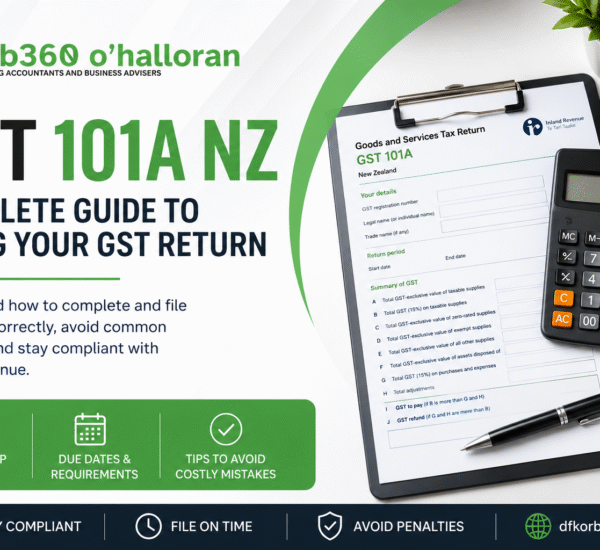
GST 101A NZ is the Goods and Services Tax return used by eligible New Zealand businesses to report GST collected on sales and GST paid on business purchases. The return helps Inland Revenue (IRD) determine whether you need to pay GST or receive a refund. Businesses can generally file their GST return online through myIR or, where applicable, using the GST101A paper return.
GST 101A NZ is a Goods and Services Tax return used by eligible GST-registered businesses to report GST collected on taxable supplies and GST paid on business expenses during a GST period. Inland Revenue uses the information to calculate whether additional GST is payable or whether a GST refund is due.
GST 101A NZ is one of the forms used by Inland Revenue (IRD) for GST reporting. Businesses registered for GST must report the GST collected from customers and the GST paid on eligible business purchases for each filing period.
Although many businesses now file their GST returns electronically through myIR, understanding how the GST 101A return works remains important for business owners, accountants, and anyone responsible for GST compliance.
If your business is registered for GST, you are generally required to submit GST returns for each filing period, even if you had no sales or purchases during that period.
GST filing obligations may apply to:
Your filing frequency may be monthly, two-monthly, or six-monthly depending on your GST registration and business circumstances.
The GST 101A return records the GST activity for a specific GST period. The information generally includes:
Accurate bookkeeping throughout the year makes completing the GST return significantly easier and reduces the likelihood of reporting errors.
Most New Zealand businesses now submit GST returns electronically using myIR. Filing online is generally faster, provides immediate confirmation of submission, and allows businesses to view previous returns and payment history.
Depending on your circumstances and Inland Revenue requirements, some businesses may still receive or use a GST101A paper return.
Submitting an accurate GST return helps businesses remain compliant with New Zealand tax legislation and reduces the risk of Inland Revenue enquiries.
Incorrect GST reporting may result in:
Maintaining accurate accounting records and reviewing GST calculations before filing can significantly reduce these risks.
Good record keeping is one of the easiest ways to simplify GST compliance.
Businesses should retain:
Keeping complete records helps support GST claims and provides evidence if Inland Revenue requests additional information.
Your GST return due date depends on your filing frequency and GST period. Missing the filing deadline may result in penalties and interest.
Businesses should regularly review their GST filing calendar and ensure GST returns are lodged on time. Using accounting software or working with a chartered accountant can help reduce the risk of missed deadlines.
Completing GST 101A NZ correctly starts with understanding what information Inland Revenue requires for each GST return period. Whether you file monthly, two-monthly, or six-monthly, the same principles apply—accurately report your taxable sales, business purchases, GST collected, and GST claimed.
Before submitting your GST return, ensure your accounting records have been reconciled and that all invoices and receipts relate to the correct GST period.
| Before You File | Completed |
|---|---|
| Reconcile bank accounts | ✔ |
| Review all sales invoices | ✔ |
| Check supplier tax invoices | ✔ |
| Verify GST claimed on expenses | ✔ |
| Review GST adjustments | ✔ |
| Confirm GST payable or refund | ✔ |
| Submit before the due date | ✔ |
Auckland business owner Sarah operates a digital marketing agency and files GST returns every two months.
During her GST period she records:
Using accurate bookkeeping records, Sarah completes her GST 101A NZ return, calculates the GST collected and GST paid, then submits the return through myIR before the filing deadline.
Because her records are complete and reconciled, she avoids common filing errors and remains compliant with Inland Revenue requirements.
| GST 101A | Online myIR Filing |
|---|---|
| Traditional GST return format | Digital GST filing |
| May be issued in paper format where applicable | Available through myIR |
| Manual completion | Electronic submission |
| Longer processing time | Faster confirmation |
| Physical record keeping | Digital filing history |
GST 101A NZ is a GST return used by eligible GST-registered businesses to report GST collected on sales and GST paid on eligible business purchases during a GST period.
Yes. Most businesses file GST returns electronically through Inland Revenue’s myIR service, which provides a faster and more convenient filing process.
Late GST returns may result in penalties, interest charges, and additional Inland Revenue compliance action depending on your circumstances.
Yes. Businesses should retain tax invoices, receipts, accounting records, bank statements, and other supporting documentation for GST reporting purposes.
Preparing and filing a GST 101A NZ return doesn’t have to be complicated. Whether you’re a sole trader, company, partnership, or growing business, our experienced chartered accountants can help ensure your GST returns are accurate, compliant, and submitted on time.
Our GST services include:
Need expert GST assistance?
Contact DFK Orb360 today to discuss your GST obligations and receive tailored advice from our experienced tax specialists.
For the latest GST filing requirements and due dates, visit the Inland Revenue GST Return Filing Guide.
You can file your GST return online through myIR, Inland Revenue’s secure online service.
Learn more about GST registration, filing frequencies, and accounting methods on the Official Inland Revenue GST Information page.
Businesses should also review Inland Revenue’s guidance on GST filing and payment obligations.


Copyright © 2025 Marketing Transformers | All Rights Reserved.


 09 377 4238
 Level 2, 6 Kingdon Street, Newmarket, Auckland
 help@orb360.co.nz