

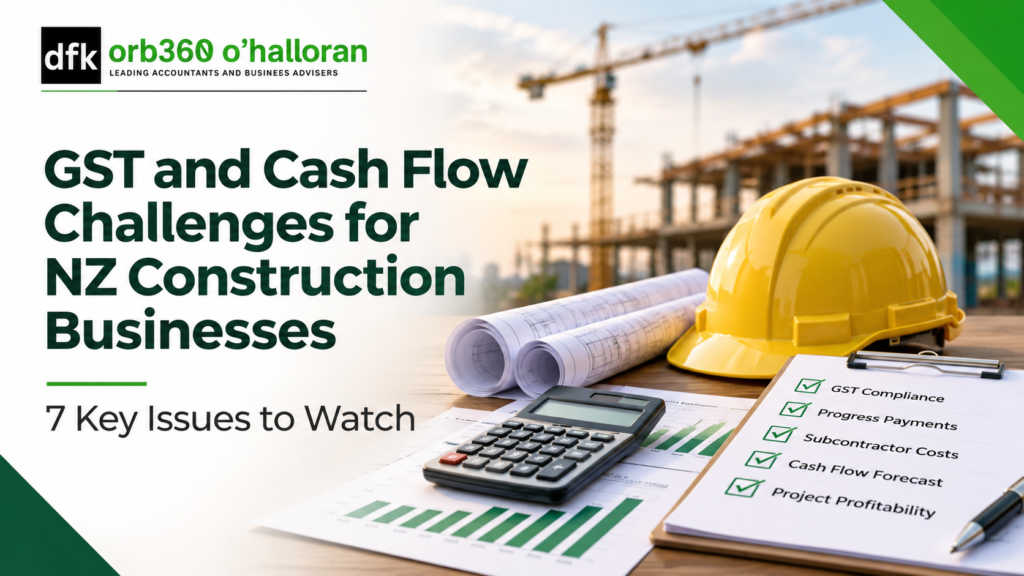
GST and cash flow for construction businesses in NZ can be difficult to manage because project costs, progress payments, subcontractor invoices and tax obligations do not always occur at the same time. A construction company may have completed significant work and issued an invoice but still be waiting for payment while facing supplier bills, wages, equipment costs and an upcoming GST return.
Understanding GST and Cash Flow for Construction Businesses NZ is essential for managing project costs, supplier payments, subcontractor expenses and tax obligations. With careful financial planning, construction businesses can improve cash flow visibility and prepare for upcoming tax payments.
For builders, contractors, subcontractors and construction companies, managing cash flow requires more than monitoring the bank balance. It involves understanding when project income will be received, when expenses must be paid and how GST affects the money available to operate the business.
This guide explains common GST and cash flow challenges for NZ construction businesses, how progress payments and GST accounting methods can affect working capital, and practical ways to improve financial management.
Construction businesses in New Zealand need to manage GST alongside project expenses, progress payments, subcontractor costs, payroll and supplier commitments. Cash flow pressure can arise when GST becomes payable before customer invoices are collected, particularly for businesses using the invoice basis of GST accounting. Construction businesses should understand their GST accounting basis, maintain accurate project records, monitor payment claims, plan for tax obligations and prepare regular cash flow forecasts. An accountant can help review GST compliance, project profitability, cash flow and financial reporting.
GST and Cash Flow for Construction Businesses NZ: Key Challenges
- Construction businesses often have a gap between completing work, invoicing clients and receiving payment.
- GST obligations can affect cash flow, especially when GST is accounted for before customer payment is received.
- Progress payments, retentions and variations need accurate project-level records.
- Subcontractor costs, supplier invoices, wages and equipment expenses must be included in cash flow planning.
- Choosing and understanding the appropriate GST accounting basis is important.
- Regular project reviews and cash flow forecasts can help identify potential funding gaps.
- Professional accounting support can help construction businesses manage GST, reporting and financial planning.
Why Are GST and Cash Flow Difficult for Construction Businesses in NZ?
Construction businesses often work on projects that run for several weeks or months. During this time, they may need to pay for materials, subcontractors, employees, equipment hire, insurance and other operating costs before receiving the full amount owed by the customer.
At the same time, GST returns and other tax obligations continue to follow their applicable filing and payment dates.
This can create a timing problem: a business may have recorded income or issued invoices but may not yet have received the corresponding cash.
For example, a contractor may complete a stage of a project, submit a progress claim and incur GST obligations under its accounting basis. If the customer takes time to pay, the contractor may need to fund the tax and project expenses from existing working capital.
Business.govt.nz explains that cash flow forecasting helps businesses anticipate income and outgoings, plan for future expenses and prepare for tax obligations.
Read more: Business.govt.nz – Cash Flow Forecasting.
How Does GST Work for Construction Businesses in New Zealand?
GST is a tax on most goods and services supplied in New Zealand. The standard GST rate is 15%.
A business generally needs to register for GST when its taxable turnover was at least $60,000 in the past 12 months, or is expected to reach that amount in the next 12 months. A business can also register voluntarily if it meets the relevant requirements.
Once registered, a construction business must account for GST on its taxable supplies, file GST returns according to its assigned taxable period and pay any net GST due to Inland Revenue.
What GST Accounting Methods Can Construction Businesses Use?
New Zealand businesses may use different GST accounting bases, subject to eligibility and IRD requirements.
| GST accounting basis | How it works | Cash flow consideration |
|---|---|---|
| Invoice basis | GST is generally accounted for in the period when invoices are issued or received, according to the relevant GST rules. | GST may need to be paid before the customer has paid the invoice. |
| Payments basis | GST is generally accounted for when payments are made or received. | Can better align GST reporting with actual cash movements, where eligible. |
| Hybrid basis | Uses a combination of invoice and payments basis rules. | Requires careful record-keeping and understanding of how each transaction is treated. |
The payments basis is generally available to businesses that meet the applicable turnover or other eligibility requirements. Do not assume that every construction business can choose it.
The right accounting basis depends on the business’s circumstances, transaction volumes, cash flow and compliance requirements. Changing GST accounting methods also requires consideration of IRD rules and potential adjustment consequences.
For more information, see Inland Revenue – GST.
7 GST and Cash Flow Challenges for NZ Construction Businesses
1. GST Is Due Before Your Customer Pays
One of the most common cash flow challenges for construction businesses occurs when a progress claim has been issued but the customer has not yet paid.
If the business uses the invoice basis, GST may need to be accounted for in the relevant return period even if the customer has not paid the invoice.
This can create a funding gap. The business may need to pay GST while also covering wages, subcontractors and material costs.
What can you do?
- Monitor unpaid progress claims and overdue invoices.
- Forecast GST obligations alongside expected customer receipts.
- Set aside money for GST as payments come in.
- Review whether your GST accounting basis remains appropriate for your circumstances.
2. Delayed Progress Payments Affect Working Capital
Construction businesses frequently rely on progress payments to fund ongoing work. These payments are linked to the value of work completed or agreed project milestones.
When payment claims are delayed, disputed or not paid when expected, the business may have to finance project costs for longer than planned.
For example, a contractor may have completed a project stage and paid its suppliers but still be waiting for the corresponding progress payment from the client.
What can you do?
- Understand the payment process and requirements in your construction contract.
- Submit accurate payment claims promptly.
- Keep supporting documents for completed work and variations.
- Monitor payment due dates and follow up outstanding amounts.
- Include realistic payment timing in your cash flow forecast.
For relevant building contracts, the Construction Contracts Act and applicable contract terms may provide rules about progress payments and payment claims. The requirements depend on the type of contract and work involved.
See Building Performance – Implied Contract Terms.
3. Subcontractor Payments and GST Records Become Difficult to Manage
Many construction businesses depend on subcontractors for specialist work, labour and project delivery.
Managing payments to subcontractors involves more than recording an expense. Businesses may need to check invoices, retain supporting records, understand GST treatment and meet any applicable schedular payment withholding obligations.
Where a subcontractor payment is subject to withholding tax, the contractor may have an obligation to deduct and pay the required amount to IRD.
What can you do?
- Maintain accurate subcontractor records and agreements.
- Check that supplier invoices contain the required taxable supply information.
- Review whether withholding tax or schedular payment rules apply.
- Reconcile subcontractor invoices with project costs.
- Schedule subcontractor payments according to agreed terms and available cash.
IRD provides specific guidance for construction businesses through its Tax Toolbox for Tradies, including information about schedular payments and employer obligations.
4. Material Costs and Supplier Bills Put Pressure on Cash Flow
Materials can represent a significant portion of construction project costs. Timber, concrete, steel, electrical supplies, plumbing materials and equipment may need to be purchased well before the customer makes the next payment.
Price changes, unexpected material requirements and project delays can further affect the amount of working capital needed.
Businesses that do not track project costs closely may find that the actual cost of completing a job is higher than originally estimated.
What can you do?
- Prepare a project budget before work begins.
- Track material purchases against the original estimate.
- Review supplier payment terms.
- Record variations and additional costs promptly.
- Compare actual project costs with budgeted costs regularly.
5. Retentions Can Affect the Timing of Cash Receipts
Some construction contracts include retention arrangements. Under these arrangements, part of a payment may be withheld as security for performance or the completion of agreed work.
This means the contractor may have completed work and earned a contractual entitlement to payment but still have part of the amount withheld until the relevant contractual conditions are met.
Retention money can therefore affect working capital and the timing of cash receipts.
Commercial construction retention money is also subject to specific statutory requirements under the Construction Contracts Act 2002, including trust and record-keeping obligations where applicable.
What can you do?
- Record retention amounts separately from immediately available cash.
- Monitor release dates and contractual conditions.
- Maintain supporting records for each project and payment claim.
- Include expected retention releases in cash flow forecasts without treating them as available funds before receipt.
Retention arrangements can also have specific income tax and GST implications. The timing of income recognition and GST accounting should be reviewed according to the contract and applicable tax rules.
See IRD – Construction Contract Retention Money and obtain advice for your particular arrangement.
6. GST, PAYE and Provisional Tax Deadlines Are Not Included in Project Budgets
Construction businesses can become focused on project delivery and overlook the timing of their tax obligations.
Effective GST and Cash Flow for Construction Businesses NZ planning helps construction businesses prepare for GST payments, manage delayed customer receipts and maintain sufficient working capital. Progress payment delays, subcontractor costs and project expenses can all affect the timing of cash coming into and going out of a business.
GST returns, PAYE deductions, provisional tax instalments and income tax obligations need to be considered alongside normal project expenses.
If money received from customers is used entirely for materials, subcontractors or operating expenses, there may not be enough cash available when tax payments fall due.
What can you do?
- Maintain a tax payment calendar.
- Forecast upcoming GST and other tax commitments.
- Set aside funds for tax rather than treating all customer receipts as available working capital.
- Review provisional tax estimates with an accountant where appropriate.
- Address overdue returns or payments promptly.
7. Project Delays and Cost Overruns Reduce Profitability
Construction projects can be affected by weather, labour shortages, supply delays, design changes and unexpected site conditions.
These issues can increase project costs, delay progress claims and extend the period before final payment is received.
A project that appeared profitable at the beginning may become less profitable if costs increase or the work takes longer than expected.
What can you do?
- Compare estimated project costs with actual costs.
- Monitor labour, materials and subcontractor expenses.
- Document variations and obtain the required approvals.
- Review project profitability at regular intervals.
- Update cash flow forecasts when project timelines change.
Is Cash Flow Putting Pressure on Your Construction Business?
From GST obligations and progress payments to subcontractor costs and project expenses, understanding your numbers can help you plan ahead.
Speak with DFK Orb360 O’Halloran about your accounting, GST compliance and business advisory requirements.
Discuss Your Construction Business FinancesHow Can Construction Businesses Improve GST and Cash Flow Management?
Managing cash flow in construction requires regular financial monitoring and coordination between project management, invoicing, accounting and tax planning.
These practical steps can help improve visibility over your business finances.
1. Prepare a Rolling Cash Flow Forecast
Prepare a cash flow forecast that includes expected progress payments, supplier invoices, subcontractor payments, wages, tax obligations and loan repayments.
Update the forecast regularly as project dates, payment claims and expenses change. A weekly forecast may be useful where cash flow is tight or project activity changes quickly.
2. Separate GST From Available Working Capital
Do not assume that the full amount received from a customer is available to spend. Identify the GST component of taxable transactions and plan for the amount that may be payable to IRD.
The timing depends on your GST accounting basis, adjustments and the nature of the transaction. Maintain records that allow you to reconcile GST collected, GST paid and the amount due.
3. Invoice Promptly and Follow Up Outstanding Payments
Submit payment claims and invoices in accordance with your contract and the applicable payment requirements.
Keep a clear record of the date each invoice was issued, its due date, the amount outstanding and any follow-up communication.
4. Track Profitability by Project
Do not rely solely on total business revenue to understand performance. Review individual projects to compare the original budget with actual labour, materials, subcontractor costs and other expenses.
This can help identify projects where costs are increasing or margins are declining.
5. Review Your GST Accounting Basis
If your business regularly experiences a gap between issuing invoices and receiving payment, ask your accountant to review whether your current GST accounting basis is appropriate.
The payments basis may be available to eligible businesses, but it is not automatically the best option for every construction company. Consider the eligibility criteria, accounting implications and transition requirements before making changes.
6. Plan for Tax and Payroll Obligations
Include GST, PAYE, provisional tax and other applicable obligations in your financial calendar and cash flow forecast.
Employers should also ensure payroll deductions are recorded and set aside appropriately. IRD’s Tax Toolbox for Tradies provides relevant guidance on employer responsibilities and schedular payments.
7. Review Financial Reports With Your Accountant
Regularly review your profit and loss statement, balance sheet, cash flow information and outstanding debtor and creditor balances.
An accountant can help interpret the information, identify areas that need attention and discuss options for improving financial planning.
GST and Cash Flow Checklist for NZ Construction Businesses
Use this checklist to review some of the key financial processes in your construction business.
| Review area | What to check |
|---|---|
| GST registration | Confirm that your registration status and taxable turnover are correct. |
| GST accounting basis | Understand whether you use invoice, payments or hybrid accounting. |
| GST returns | Check that returns are accurate and filed by the relevant due dates. |
| Progress payments | Track claims, invoices, due dates and customer receipts. |
| Subcontractors | Review invoices, records and any applicable withholding obligations. |
| Retentions | Monitor withheld amounts, release conditions and relevant records. |
| Project costs | Compare actual labour, material and subcontractor costs with budgets. |
| Cash flow forecast | Include expected income, expenses, GST and other tax commitments. |
How DFK Orb360 Can Support NZ Construction Businesses
Construction businesses need financial information that reflects what is happening across their projects, not just what appears in their bank account.
DFK Orb360 O’Halloran provides accounting and business advisory services that can help businesses understand their financial position, manage compliance requirements and plan for future commitments.
Depending on your requirements, support may include:
- GST and tax compliance: Support with GST reporting, tax obligations and understanding relevant compliance requirements.
- Accounting and financial reporting: Review financial statements and business performance.
- Cash flow forecasting: Assess expected project income, operating costs and upcoming tax payments.
- Budgeting and project cost reviews: Understand how actual expenses compare with project budgets.
- Business advisory: Review financial performance and identify areas that may require attention.
- Outsourced CFO services: Access support with financial planning, forecasting and management reporting.
Every construction business has different contracts, project structures and tax circumstances. The appropriate accounting and advisory support will depend on your business model and requirements.
Get Better Control of Your Construction Business Finances
Managing GST, progress payments, subcontractor costs and project cash flow can be challenging. A clearer understanding of your financial position can help you plan ahead and make informed business decisions.
Contact DFK Orb360 O’Halloran to discuss accounting, GST compliance and business advisory support for your construction business.
Contact DFK Orb360 O’HalloranFrequently Asked Questions About GST and Cash Flow for NZ Construction Businesses
1. Do construction businesses in NZ need to register for GST?
A construction business generally needs to register for GST if its taxable turnover was at least $60,000 in the past 12 months or is expected to reach that amount in the next 12 months. Voluntary registration may also be available. The business must meet the relevant IRD requirements.
2. How does GST affect cash flow for construction businesses?
GST can affect cash flow because the timing of GST accounting and customer payments may not always match. For example, a business using the invoice basis may need to account for GST before its customer pays the invoice. Planning for GST obligations can help reduce unexpected cash shortages.
3. What GST accounting basis should a construction business use?
Depending on eligibility, a construction business may use the invoice, payments or hybrid basis. The most appropriate option depends on transaction timing, turnover, accounting requirements and the business’s circumstances. An accountant can help review the options.
4. Can I claim GST on construction materials and subcontractor expenses?
A GST-registered business may generally claim input tax deductions for eligible business purchases and expenses used in making taxable supplies, provided the relevant requirements and record-keeping rules are met. The treatment depends on the purchase and business use. Private, exempt or non-deductible components may need different treatment.
5. What are progress payments in construction?
Progress payments are payments made during a construction project for work completed or other amounts payable under the contract. They can help contractors receive funds throughout a project rather than waiting until all work is finished. Payment claims and payment timing depend on the applicable contract and legal requirements.
6. How do retentions affect construction business cash flow?
Retentions are amounts withheld under certain construction contracts, often as security for performance or completion requirements. They can delay access to part of the contract payment and affect working capital. Businesses should track retention amounts, release conditions and expected payment dates.
7. What happens if a construction business cannot pay its GST?
A business that cannot pay its GST should review its outstanding balance and contact IRD promptly to discuss its circumstances and available payment options. Depending on eligibility, an instalment arrangement or other relief may be considered. Interest and penalties may apply under the relevant rules.
8. How can subcontractor payments affect cash flow?
Subcontractor payments can create significant cash commitments, particularly when payment is due before the business receives payment from its customer. Businesses should include subcontractor costs in project budgets and cash flow forecasts and check any applicable withholding tax obligations.
9. How often should construction businesses review cash flow?
Construction businesses should monitor cash movements regularly and update their cash flow forecasts as project timelines, payment claims and costs change. Weekly monitoring can be useful when cash flow is tight, while monthly financial reviews can help assess overall performance.
10. Can an accountant help with GST and cash flow management?
Yes. An accountant can help review GST accounting, tax obligations, financial reports, project costs and cash flow forecasts. They can also help business owners understand their financial position and plan for upcoming commitments.
Speak With DFK Orb360 O’Halloran
Construction businesses need to manage more than project delivery. GST obligations, progress payments, supplier invoices, subcontractor costs and tax deadlines all influence the amount of cash available to keep operations running.
Reviewing these areas regularly can help you identify financial pressure points and make better-informed decisions about your projects and business.
If you operate a construction business in New Zealand and need support with accounting, GST compliance or cash flow planning, contact DFK Orb360 O’Halloran to discuss your requirements.
Discuss Your Construction Business Accounting Requirements
Enquire About Accounting and GST Support
Complete the form below and tell us a little about your construction business and the support you are looking for. Our team can follow up regarding your enquiry.
Taking a proactive approach to GST and Cash Flow for Construction Businesses NZ can help construction businesses improve financial visibility, plan for tax payments and make better-informed business decisions.
Disclaimer: This article provides general information for New Zealand construction businesses and is not personalised tax, accounting or legal advice. GST treatment can depend on the accounting basis, contract terms, transaction type and individual circumstances. Construction contract and retention requirements may also vary. Consult Inland Revenue or a qualified professional about your specific situation.



 09 377 4238
 Level 2, 6 Kingdon Street, Newmarket, Auckland
 help@orb360.co.nz