


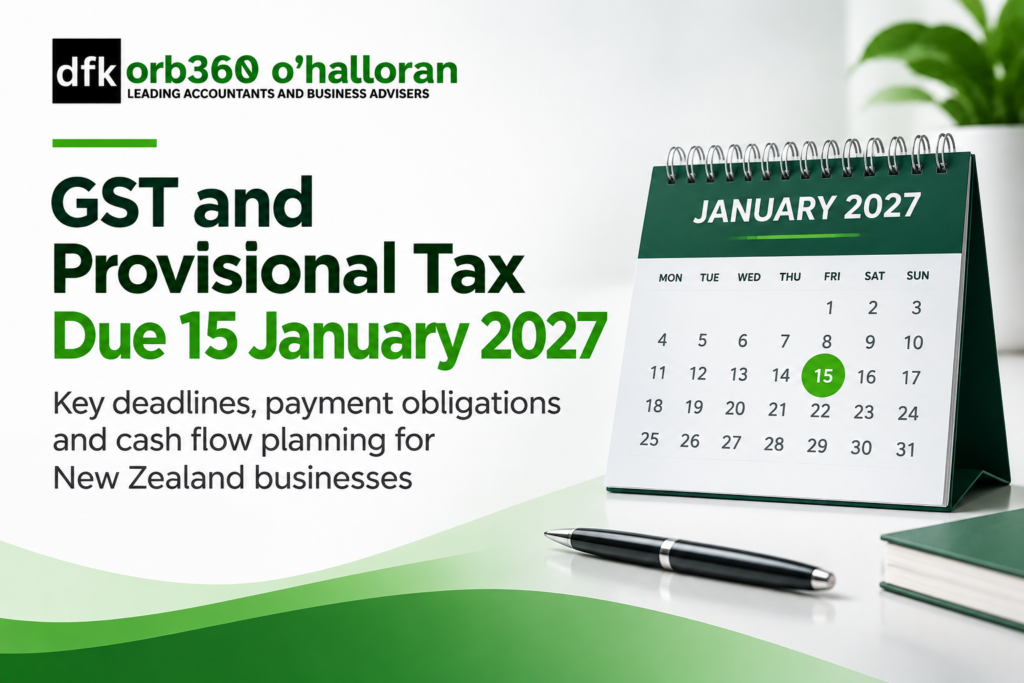
GST and provisional tax due 15 January 2027 is an important date for many New Zealand businesses preparing for their upcoming tax obligations. Businesses with a GST taxable period ending 30 November 2026 must file their GST return and pay any GST owing by this date. It is also a provisional tax instalment date for eligible taxpayers, depending on their balance date and payment method.
Understanding the January GST deadline in NZ and your provisional tax obligations can help you plan ahead, manage cash flow and avoid unnecessary payment pressure.
January 2027 GST and Provisional Tax Deadline
The GST return and payment for the taxable period ending 30 November 2026 are due on 15 January 2027. This is an exception to the usual GST due date of the 28th day of the month following the taxable period.
For taxpayers with a standard 31 March balance date using the standard or estimation method, 15 January 2027 is also the second provisional tax instalment date. Other payment methods and balance dates may have different requirements.
Businesses should review their tax records, confirm their obligations in myIR and plan cash flow ahead of the deadline.
Key Takeaways
- 15 January 2027: GST return and payment due for the taxable period ending 30 November 2026.
- Provisional tax: The same date is a provisional tax instalment date for eligible taxpayers.
- Not every business: Your GST filing frequency, balance date and provisional tax method determine whether you have a payment due.
- Cash flow: Preparing funds ahead of the deadline can help reduce financial pressure.
- Check myIR: Confirm your individual filing and payment dates with Inland Revenue.
GST and Provisional Tax Due 15 January 2027: Who Needs to Take Action?
The GST and provisional tax due 15 January 2027 deadline is relevant to two different tax obligations. Although they share the same date, GST and provisional tax are separate payments with different rules.
1. Businesses Filing GST for the Period Ending 30 November 2026
New Zealand businesses registered for GST must file returns according to their assigned taxable periods. The usual GST return and payment deadline is the 28th of the month following the end of a taxable period. However, Inland Revenue has a specific exception for the period ending 30 November.
For the taxable period ending 30 November 2026, the GST return and any payment owing are due on 15 January 2027.
This deadline is relevant to businesses whose GST taxable period ends on 30 November. It does not automatically apply to every GST-registered business.
2. Businesses and Taxpayers Paying Provisional Tax
Provisional tax allows eligible taxpayers to pay income tax throughout the year rather than waiting until their end-of-year tax return. It is generally relevant when a taxpayer’s residual income tax from the previous year is more than $5,000, subject to Inland Revenue’s rules.
For taxpayers with a standard 31 March balance date using the standard or estimation option, 15 January 2027 is the second of three provisional tax instalment dates for the 2027 tax year.
Other methods, including the ratio option and Accounting Income Method (AIM), have their own instalment arrangements. Your GST registration and filing frequency may also affect the dates that apply.
January GST Deadline NZ: Important Dates to Know
Understanding the January GST deadline in NZ is easier when you know which taxable period and payment method apply to your business.
| Tax obligation | Relevant date | Who it applies to |
|---|---|---|
| GST return and payment | 15 January 2027 | GST-registered taxpayers with a taxable period ending 30 November 2026. |
| Provisional tax instalment | 15 January 2027 | Eligible provisional taxpayers with a 31 March balance date using the standard or estimation method. |
| Ratio option provisional tax | 15 January 2027 | Eligible taxpayers using the ratio option, subject to their instalment arrangements. |
| AIM payment and filing | 15 January 2027 | Taxpayers using AIM, with the relevant date depending on their GST filing frequency and balance date. |
These dates are general guidance. Non-standard balance dates, six-monthly GST filing and other circumstances can change the applicable provisional tax instalments.
What Is the GST Filing Deadline and What Should You Prepare?
The GST filing deadline is the date by which a GST-registered business must submit its return and pay any amount owing. A GST return must be filed for every taxable period, including periods where there is no GST to pay.
For the taxable period ending 30 November 2026, the GST filing deadline is 15 January 2027.
GST Preparation Checklist
Before submitting your return, consider reviewing the following:
- Sales invoices and income records for the taxable period.
- Business expenses and supporting receipts.
- GST collected on sales and GST paid on eligible business purchases.
- Bank statements and accounting reconciliations.
- Any adjustments that may need to be included in the return.
- Previous GST returns and outstanding amounts.
Accurate and up-to-date records can help reduce errors and make the filing process more straightforward.
Provisional Tax January 2027: Understanding Your Payment
Provisional tax is an advance payment towards a taxpayer’s expected annual income tax liability. It is designed to spread tax payments throughout the year rather than leaving the full amount until the end of the tax year.
The amount and timing of provisional tax depend on the payment method selected and the taxpayer’s circumstances.
Standard Option
Under the standard option, provisional tax is generally calculated using the previous year’s residual income tax, with an applicable uplift. For a standard 31 March balance date, the usual instalment dates for the 2027 tax year are:
- 28 August 2026
- 15 January 2027
- 7 May 2027
Estimation Option
Under the estimation option, taxpayers estimate their expected residual income tax for the year. This can be useful when business income or profits are expected to change significantly.
However, estimates should be reasonable and reviewed as business circumstances change. Underestimating provisional tax can result in interest and potentially penalties.
Ratio Option
The ratio option calculates provisional tax using a percentage of GST taxable supplies. Eligible taxpayers generally pay six instalments during the year. The relevant instalment date in January is 15 January 2027.
Accounting Income Method (AIM)
AIM calculates provisional tax using accounting information and taxable profit. Payments and statements of activity generally align with GST filing dates. The dates depend on the taxpayer’s filing frequency and balance date.
Businesses should confirm their method and instalment dates through Inland Revenue rather than assuming that the same payment schedule applies to everyone.
GST Payment Date NZ: How to Avoid Last-Minute Problems
Knowing the GST payment date in NZ is only one part of meeting your tax obligations. Businesses also need to ensure that the funds are available and that returns are filed accurately and on time.
Some common issues that can create pressure around tax deadlines include:
- Delays in reconciling sales and expense records.
- Using GST funds to cover day-to-day operating expenses.
- Unexpected changes in revenue or business costs.
- Not accounting for provisional tax when preparing cash flow forecasts.
- Leaving return preparation and payment until the final few days.
Planning ahead gives businesses more time to identify discrepancies, review their obligations and arrange funds for upcoming payments.
Business Cash Flow Planning NZ: Preparing for January Tax Payments
Effective business cash flow planning in NZ can help businesses manage tax commitments while maintaining enough working capital for everyday operations.
When GST and provisional tax payments fall around the same time, businesses may need to plan for more than one tax obligation. This is particularly important for businesses managing payroll, supplier payments, rent, inventory and other operating costs.
1. Forecast Upcoming Cash Inflows and Outflows
Review expected customer payments, outstanding invoices, supplier costs, payroll and other business expenses. A cash flow forecast can help identify periods when available funds may be tight.
2. Set Aside Funds for GST
GST collected from customers should be considered when managing available business funds. Keeping an appropriate amount aside can help avoid a situation where the GST payment becomes difficult to meet.
3. Account for Provisional Tax
Include provisional tax instalments in your financial calendar and cash flow forecast. This can help prevent tax payments from becoming unexpected expenses.
4. Keep Financial Records Updated
Regular bookkeeping and reconciliations make it easier to understand your business’s financial position. They also help identify errors before filing deadlines approach.
5. Review Your Position Before the Deadline
Review your expected GST and provisional tax obligations before January. If your business income or financial circumstances have changed, consider whether your provisional tax position needs to be reviewed with an adviser.
What Happens If You Miss the GST or Provisional Tax Deadline?
Missing a tax deadline can lead to additional costs and administrative complications.
Late GST Returns and Payments
Inland Revenue may charge late filing and late payment penalties when GST obligations are not met. You cannot obtain an extension of time to file a GST return, so it is important to submit it by the due date.
Late Provisional Tax Payments
Late provisional tax payments may also result in penalties and interest. The consequences can depend on the taxpayer’s circumstances, payment method and timing of the shortfall.
If you think you may have difficulty meeting a payment, review your options and contact Inland Revenue or your tax adviser as early as possible.
How DFK Orb360 O’Halloran Can Help Your Business Prepare
Managing GST, provisional tax and cash flow requires more than remembering payment dates. Businesses need accurate financial information and a clear understanding of their tax obligations.
At DFK Orb360 O’Halloran, our team supports businesses with accounting, taxation and business advisory services. We help business owners understand their financial position, plan for upcoming obligations and make informed decisions.
Whether you need assistance reviewing your GST position, understanding provisional tax or improving your financial planning, speaking with an adviser can help you take a more organised approach.
Be Prepared for Your January Tax Payments
Make sure your business is ready for its upcoming GST and provisional tax obligations. Speak with our team at DFK Orb360 O’Halloran about your tax requirements and business cash flow planning.
Talk to Our TeamFrequently Asked Questions
1. When is GST and provisional tax due in January 2027?
The GST return and payment for the taxable period ending 30 November 2026 are due on 15 January 2027. The same date is a provisional tax instalment date for eligible taxpayers, depending on their balance date and payment method.
2. Who needs to pay GST by 15 January 2027?
GST-registered businesses whose taxable period ends on 30 November 2026 must file their GST return and pay any GST owing by 15 January 2027. Businesses with other taxable periods should check their own due dates.
3. Is provisional tax due on 15 January 2027?
Yes. For taxpayers with a standard 31 March balance date using the standard or estimation method, 15 January 2027 is the second provisional tax instalment date. Other methods and balance dates may have different arrangements.
4. Do all businesses have to pay GST and provisional tax on the same date?
No. The January GST deadline applies to the taxable period ending 30 November 2026. Provisional tax obligations depend on whether the taxpayer is required to pay provisional tax, their balance date and their payment method.
5. What is the usual GST filing deadline in New Zealand?
GST returns and payments are generally due on the 28th of the month following the end of the taxable period. The main exceptions include the period ending 31 March, which is due on 7 May, and the period ending 30 November, which is due on 15 January.
6. What happens if I miss the GST filing deadline?
Inland Revenue may charge late filing and payment penalties. GST returns must be filed for every taxable period, including nil returns, and an extension of time to file is not available.
7. How can businesses prepare for provisional tax in January 2027?
Businesses can prepare by reviewing their expected income, checking their provisional tax payment method, updating financial records and including the upcoming instalment in their cash flow forecast.
8. Where can I check my GST and provisional tax due dates?
You can check your tax obligations through your myIR account or refer to Inland Revenue’s official guidance. Your taxable period, balance date and provisional tax method determine the dates that apply.
Official Inland Revenue Resources
For the latest tax information and payment requirements, refer to these Inland Revenue resources:
- Filing GST returns – Inland Revenue
- Paying GST – Inland Revenue
- Provisional tax payment dates – Inland Revenue
- Standard provisional tax option – Inland Revenue
- Estimation provisional tax option – Inland Revenue
This article has been prepared for New Zealand businesses by DFK Orb360 O’Halloran. It is intended as general information and should not be treated as personalised tax advice. Tax obligations can vary depending on your business structure, taxable periods, balance date and payment method. Confirm your individual position with Inland Revenue or a qualified tax adviser.
Review: DFK Orb360 O’Halloran team – confirm internal review before publication.
Last updated: November 2026.
Speak with DFK Orb360 O’Halloran
Have questions about GST, provisional tax or managing your business finances? Speak with our team to discuss how we can support your business.
Speak With Our TeamGet in Touch With Our Team
Complete the form below and our team will be in touch.



 09 377 4238
 Level 2, 6 Kingdon Street, Newmarket, Auckland
 help@orb360.co.nz