

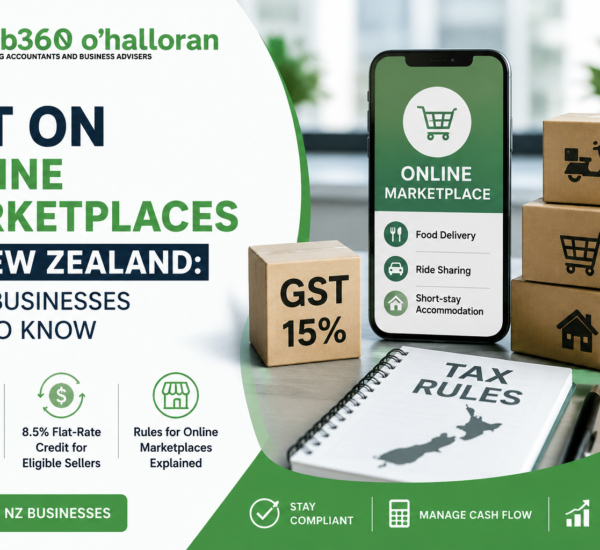
GST on Online Marketplaces in New Zealand: What Businesses Need to Know
New Zealand’s GST rules for online marketplaces can be complex, particularly for food delivery businesses, digital platforms, contractors and businesses operating through apps or websites.
A recent reported dispute involving Nelson delivery business YUMMi and Inland Revenue has highlighted an important issue for business owners: the way your business operates can affect how GST applies to your transactions.
If you are researching GST on online marketplaces NZ, the key question is not simply whether your business uses an app or website. You need to understand whether the arrangement meets the definition of an online marketplace, who is supplying the service and who is responsible for GST.
Understanding GST on online marketplaces NZ is particularly important for businesses operating through apps, websites, food delivery platforms and other digital marketplaces. The GST treatment can depend on how your platform is structured and who is considered to be supplying the service.
GST on Online Marketplaces NZ
In simple terms: New Zealand has special GST rules for certain services supplied through online marketplaces. These listed services include ride-sharing, food and beverage delivery, and short-stay and visitor accommodation.
- Online marketplaces facilitating listed services generally collect GST at the standard 15% rate.
- Eligible sellers who are not GST registered can receive an 8.5% flat-rate credit, with the remaining 6.5% paid to Inland Revenue.
- GST-registered sellers generally treat qualifying supplies through a GST-registered marketplace as zero-rated, while the marketplace accounts for GST on the customer supply.
- The marketplace rules do not apply to every website or app. A business that contracts directly with the customer and uses employees or contractors to perform its own delivery service may be treated as the supplier.
- Businesses operating both inside and outside a marketplace may need to apply different GST treatment to different supplies.
- The actual contracts, payment arrangements, customer relationship and platform structure matter when determining the correct GST treatment.
Bottom line: If your business operates through a digital platform, marketplace or delivery model, do not assume another company’s GST treatment automatically applies to you. Review your actual business structure and obtain professional advice where the GST position is unclear.
Quick Answer: How Does GST Work for Online Marketplaces in New Zealand?
New Zealand’s GST rules contain specific provisions for certain services supplied through online marketplaces.
The listed services include:
- Ride-sharing and ride-hailing
- Food and beverage delivery
- Short-stay and visitor accommodation
When listed services are supplied through a qualifying online marketplace, the marketplace may be treated as the supplier for GST purposes and may be responsible for collecting and returning GST.
However, not every website or app is an online marketplace for GST purposes. The facts and commercial arrangements need to be considered.
Inland Revenue explains that the marketplace rules do not apply where a business supplies its own delivery service directly to customers and uses employees or independent contractors to perform that delivery service.
The YUMMi Case: Why Business Structure Matters
A recent report about Nelson-based delivery business YUMMi has brought attention to the practical impact of New Zealand’s GST marketplace rules.
According to the report you provided, YUMMi founder George Evans has been disputing Inland Revenue’s treatment of his business and its classification for GST purposes.
The reported dispute concerns whether YUMMi should receive the same GST treatment as businesses operating under the online marketplace model.
It is important to distinguish between the reported dispute and the underlying tax rules. The existence of a dispute does not, by itself, establish that Inland Revenue has applied the law incorrectly.
The appropriate GST treatment depends on the actual facts, contractual arrangements, customer relationships and how the business operates.
But the case provides a useful lesson for other businesses:
Two businesses can appear similar to customers while having different GST obligations because their underlying business structures are different.
Business owners should therefore avoid assuming that another company’s GST treatment automatically applies to their own business.
GST on Online Marketplaces NZ: Food Delivery Businesses
Businesses involved in food delivery should pay particular attention to GST on online marketplaces NZ, because food and beverage delivery is one of the listed services covered by New Zealand’s marketplace GST rules.
What Is an Online Marketplace for GST Purposes?
An online marketplace is generally an electronic platform, such as a website, app or online portal, through which sellers provide services to customers.
However, GST treatment depends on more than simply having an app or website.
Inland Revenue says an online marketplace can be treated as the supplier of listed services where it does things such as:
- Authorising a charge for the supply of listed services to the customer
- Authorising delivery of the supply of listed services to the customer
- Setting terms or conditions under which the listed service is supplied
These factors can be important when determining whether the marketplace GST rules apply.
See Inland Revenue’s guidance on GST obligations for marketplaces.
Inland Revenue’s technical guidance also explains that a supply needs to be made through an electronic marketplace for the listed-services rules to apply.
Read QB 25/19: GST listed services rules and electronic marketplaces.
Which Services Are Covered by the Marketplace GST Rules?
The GST marketplace rules apply to specific listed services.
1. Ride-Sharing and Ride-Hailing
This covers certain transport services supplied through online marketplaces.
2. Food and Beverage Delivery
Food and beverage delivery is a listed service. Inland Revenue describes this as transporting food or beverages to customers for a fee. It does not include supplying the food and beverages themselves.
3. Short-Stay and Visitor Accommodation
Certain short-term accommodation supplied through online marketplaces is also covered by the marketplace GST rules.
View Inland Revenue’s marketplace rules for listed services.
How GST Works When a Listed Service Is Supplied Through a Marketplace
When the marketplace rules apply, GST treatment can be different from a normal direct sale.
A GST-registered online marketplace facilitating listed services generally collects GST at the standard 15% rate on the supply to the customer.
For a GST-registered underlying supplier, the supply to the marketplace is generally treated as zero-rated under the listed-services rules, while the marketplace accounts for GST on the supply to the customer.
The basic structure can therefore look like:
Customer
↓
Online Marketplace
↓
Service Provider
This is different from a business that contracts directly with the customer and then uses a contractor or employee to perform its own service.
Check Inland Revenue’s current GST guidance for listed services.
What Is the 8.5% Flat-Rate Credit?
One of the important features of the New Zealand marketplace GST rules is the flat-rate credit scheme.
Where an eligible seller of a listed service is not GST registered, the marketplace generally collects GST at 15%.
The marketplace then:
- Passes 8.5% of the supply value to the eligible seller as a flat-rate credit
- Pays the remaining 6.5% to Inland Revenue
The 8.5% credit is intended to recognise GST incurred on the seller’s costs associated with providing the listed service.
For example, on a $100 supply value, the marketplace GST would be $15. An eligible non-GST-registered seller may receive an $8.50 flat-rate credit, with $6.50 paid to Inland Revenue.
The actual application depends on whether the seller and marketplace meet the relevant requirements.
What Happens If the Business Is GST Registered?
If you are GST registered and provide a listed service through a GST-registered online marketplace, the GST treatment is different.
Inland Revenue states that listed services sold through a GST-registered online marketplace are generally treated as zero-rated supplies by the underlying GST-registered seller, while the marketplace accounts for GST on the supply to the customer.
You still need to:
- File GST returns
- Keep appropriate records
- Tell the marketplace your GST registration status
- Account correctly for other taxable supplies
- Claim eligible GST on business expenses
If you also provide services outside the marketplace, those supplies may be subject to the ordinary GST rules.
This is particularly important for businesses operating a hybrid model.
When Do the Marketplace GST Rules Not Apply?
This is one of the most important questions for businesses operating digital platforms.
Not every app or website is treated as an online marketplace.
Inland Revenue gives an example involving a business that contracts directly with customers for delivery services and then uses an employee or independent contractor to perform those deliveries.
In that situation, the business is the supplier of the service rather than the individual contractor or employee, so the marketplace rules do not apply.
Model A: Online Marketplace
Customer
↓
Online Marketplace
↓
Independent Service Provider
The marketplace GST rules may apply.
Model B: Direct Supplier
Customer
↓
Delivery Business
↓
Employee or Contractor Performs Delivery
The marketplace GST rules may not apply because the delivery business is the supplier.
The actual contracts and facts determine the appropriate treatment.
Why GST on Online Marketplaces Matters to Small Businesses
GST is not simply an accounting entry. For a small business, the GST treatment can affect cash flow, pricing, margins and profitability.
It can also affect:
- Customer pricing
- Commission structures
- Contractor payments
- Platform fees
- Cash-flow forecasting
- Business expansion
- Digital platform design
- Commercial contracts
If your business model changes, your GST treatment may also need to be reviewed.
For example, moving from a model where your platform simply connects customers with independent delivery providers to a model where your business directly supplies the delivery service could have GST implications.
The impact of GST on online marketplaces NZ goes beyond GST returns. It can affect pricing, margins, commissions, contractor arrangements, cash flow and the overall profitability of a growing business.
7 Questions Your Business Should Ask About Online Marketplace GST
-
Who contracts with the customer?
Is the customer contracting directly with the service provider or with your business? -
Who receives the customer’s payment?
Does your platform process the payment or does the underlying supplier receive it directly? -
Who sets the terms and conditions?
Your platform’s contractual terms may be relevant to the GST treatment. -
Who is responsible for delivering the service?
Does your business supply the service directly or facilitate a transaction? -
Are you supplying a listed service?
Is the service ride-sharing, food and beverage delivery or short-stay accommodation? -
Is the seller GST registered?
GST treatment can differ depending on the seller’s registration status. -
Does your business operate outside the marketplace as well?
Supplies made outside a qualifying marketplace may be subject to ordinary GST rules.
GST on Food Delivery: What Businesses Need to Know
Food delivery is particularly important because the GST rules distinguish between supplying food and providing the delivery service.
Inland Revenue states that food and beverage delivery means transporting food or beverages to customers and does not include supplying the food or beverages themselves.
This distinction matters for:
- Restaurants
- Delivery companies
- Food delivery platforms
- Independent delivery drivers
- Technology businesses
- Marketplace operators
If your business combines food sales, delivery services, platform fees and commissions, you may need to consider how each component is treated for GST.
What GST on Online Marketplaces Means for Startups and Digital Businesses
The YUMMi dispute provides a useful reminder that tax should be considered when designing a business model, rather than only after the business starts generating significant revenue.
If you’re building an online marketplace, consider the GST implications when designing:
- Customer contracts
- Supplier agreements
- Platform terms
- Payment flows
- Commission structures
- Pricing
- Refund policies
- Delivery arrangements
- Contractor agreements
Inland Revenue’s technical guidance explains that the listed-services rules require the supply to be made through an electronic marketplace and discusses how a marketplace can facilitate supplies between underlying suppliers and customers.
Read the Inland Revenue technical guidance on electronic marketplaces.
What Should a Business Do If It Is Unsure About Its GST Treatment?
If you’re unsure whether the marketplace GST rules apply, don’t simply copy the treatment used by another business.
Step 1: Map the Transaction
Document exactly what happens from the moment a customer places an order until the supplier or contractor is paid.
Step 2: Review the Contracts
Review your customer terms, supplier agreements and platform terms.
Step 3: Identify the Supplier
Determine who is legally and commercially supplying the service.
Step 4: Identify the Service
Establish whether the transaction involves a listed service.
Step 5: Review GST Registration
Consider whether the business and underlying suppliers are GST registered.
Step 6: Review the Payment Flow
Understand who charges the customer and who receives the money.
Step 7: Get Professional Advice
If the GST treatment remains unclear, get advice based on the actual structure and commercial arrangements.
In certain circumstances, businesses can also consider seeking a taxpayer ruling from Inland Revenue where they need certainty about how the tax law applies.
Why GST Advice Matters Before Your Business Scales
One of the biggest mistakes growing businesses can make is treating tax as an administrative issue rather than a business-planning issue.
A business might start with a relatively simple structure and then add:
- A mobile app
- Independent contractors
- Online payments
- Commission fees
- Multiple suppliers
- New regions
- Subscription services
- Delivery services
- Marketplace functionality
At that point, the original GST assumptions may no longer be appropriate.
Growth can change the complexity of your tax obligations.
Regular reviews with an accountant can help identify these changes before they become expensive compliance problems.
DFK Orb360 provides tax advisory services in New Zealand covering GST advisory, business tax planning, compliance and broader tax-risk considerations.
How DFK Orb360 Can Help With GST and Business Tax
If your business operates through an online marketplace, digital platform or complex delivery model, understanding your GST obligations can be challenging.
DFK Orb360 can help businesses review their accounting, GST and tax position and understand how business structure and commercial arrangements may affect their obligations.
Our team can assist with:
- GST registration and compliance
- GST return preparation
- Tax planning
- Business structure considerations
- Accounting and reporting
- Cash-flow management
- Business advisory
- IRD correspondence
- Reviewing complex business transactions
- Ongoing accounting support
You can also use DFK Orb360’s free NZ GST calculator for straightforward GST calculations.
The goal isn’t simply to tell you how much tax you owe.
It’s to help you understand why the rules apply, how they affect your business and what you should consider as your business grows.
Explore DFK Orb360’s GST services in New Zealand for GST registration, filing, compliance reviews and Inland Revenue support.
People Also Ask About GST on Online Marketplaces in New Zealand
Do online marketplaces have to charge GST in New Zealand?
GST-registered online marketplaces facilitating listed services generally collect and return GST at the standard 15% rate on those supplies. Listed services include ride-sharing, food and beverage delivery, and short-stay and visitor accommodation.
What is an online marketplace for GST purposes?
An online marketplace is an electronic platform through which sellers provide listed services to customers. Factors such as whether the platform facilitates the supply, authorises charges or delivery, or sets terms and conditions can be relevant to determining whether the marketplace rules apply.
Does GST apply to food delivery in New Zealand?
Yes. Food and beverage delivery is a listed service under New Zealand’s marketplace GST rules. Where the service is supplied through a qualifying online marketplace, special GST rules can apply.
What is the 8.5% flat-rate credit?
For eligible non-GST-registered sellers of listed services, the marketplace generally collects GST at 15%, passes 8.5% to the seller as a flat-rate credit and pays the remaining 6.5% to Inland Revenue.
Do marketplace GST rules apply to every app or website?
No. The marketplace GST rules do not apply in every situation. For example, where a business contracts directly with the customer for delivery and uses an employee or independent contractor to perform the service, the business may be treated as the supplier.
What happens if a business sells through and outside an online marketplace?
Different GST rules may apply to supplies made through a qualifying marketplace and supplies made outside one. Services that do not go through an online marketplace may be subject to ordinary GST rules.
How do I know whether my business is an online marketplace?
You need to consider the actual structure of your business, including who contracts with customers, who receives payments, who sets terms and conditions and who supplies the underlying service. Professional advice may be appropriate where the position is unclear.
Frequently Asked Questions About GST on Online Marketplaces NZ
Do online marketplaces have to charge GST in New Zealand?
GST-registered online marketplaces facilitating listed services generally collect and return GST at the standard 15% rate on those supplies. Listed services include ride-sharing, food and beverage delivery, and short-stay and visitor accommodation.
What is an online marketplace for GST purposes in New Zealand?
An online marketplace is an electronic platform through which sellers provide listed services to customers. Factors such as whether the platform facilitates the supply, authorises charges or delivery, or sets terms and conditions can be relevant to determining whether the marketplace rules apply.
Does GST apply to food delivery in New Zealand?
Yes. Food and beverage delivery is a listed service under New Zealand’s marketplace GST rules. Where the service is supplied through a qualifying online marketplace, special GST rules can apply.
What is the 8.5% flat-rate credit for online marketplace sellers?
For eligible non-GST-registered sellers of listed services, the marketplace generally collects GST at 15%, passes 8.5% to the seller as a flat-rate credit and pays the remaining 6.5% to Inland Revenue.
Do the marketplace GST rules apply to every website or app?
No. The marketplace GST rules do not apply in every situation. For example, where a business contracts directly with the customer for a delivery service and uses an employee or independent contractor to perform that service, the business is generally treated as the supplier.
Does GST apply differently if a seller is GST registered?
Yes. For listed services supplied through a GST-registered online marketplace, the underlying GST-registered seller generally treats the supply to the marketplace as zero-rated while the marketplace accounts for GST on the supply to the customer.
What happens if a business operates both through and outside an online marketplace?
Different GST rules may apply to supplies made through a qualifying online marketplace and supplies made outside one. Services that do not go through an online marketplace may be subject to ordinary GST rules.
Should a business get professional GST advice for an online marketplace?
Businesses operating digital platforms, delivery services, marketplaces or complex contractor arrangements may benefit from professional GST advice. The correct treatment depends on the actual contracts, payment flows, customer relationships and business structure.
Choosing the Right Advice for GST on Online Marketplaces NZ
For businesses operating through digital platforms, getting the right advice on GST on online marketplaces NZ can be important as the business grows. Marketplace arrangements can involve multiple parties, including customers, platform operators, contractors, suppliers and payment providers. Understanding who is making the supply, who receives the payment and how the contracts are structured can help clarify the GST obligations of each party.
This is particularly relevant for businesses involved in food delivery, online platforms, technology-enabled services and other marketplace models. The GST treatment may change as a business introduces new services, changes its pricing model, works with contractors or expands into new markets. Reviewing GST on online marketplaces NZ as part of your wider tax planning can therefore help business owners identify potential issues before they become costly compliance or cash-flow problems.
Rather than relying on how another marketplace operates, businesses should assess their own contracts, customer arrangements, payment flows and supplier relationships. Professional advice on GST on online marketplaces NZ can help establish which rules are relevant to the particular business model and whether any changes to the structure should be considered.
If you operate an online platform or delivery business, reviewing GST on online marketplaces NZ should form part of your regular tax and business planning, particularly when your revenue, contracts or operating model changes.
Need Help With GST on Your Online Marketplace?
If your business operates through a digital platform, food delivery marketplace, online marketplace or complex contractor model, getting the GST treatment right can help you avoid unexpected tax and cash-flow issues.
DFK Orb360 can help you understand your GST obligations, review your business structure and identify the key tax questions that may need to be addressed with Inland Revenue.
Get GST and Tax Advice for Your Business
Tell us a little about your business model and what you need help with. Our team can assess your requirements and discuss the accounting and tax support that may be appropriate.
- GST registration and compliance
- GST return preparation
- Online marketplace GST
- Food delivery GST
- Business tax planning
- Business structure and transaction reviews
- IRD correspondence
- Tax advisory
Talk to DFK Orb360
Complete the form below and our team will get in touch to discuss your accounting and tax requirements.
Need help with GST, tax or business structure? Speak with DFK Orb360 today.
Key Takeaway for New Zealand Business Owners
The YUMMi dispute highlights a broader issue that many growing businesses can face:
GST treatment depends on how your business actually operates—not simply what your business looks like to customers.
If you operate an online marketplace or provide food delivery, ride-sharing or short-stay accommodation through a platform, you need to understand whether the marketplace GST rules apply.
If you’re developing a new platform or changing your business model, consider the GST implications before the change happens.
A proactive tax review can help you understand your obligations, plan your cash flow and avoid discovering a tax problem after your business has already scaled.
Need help understanding GST for your business? Talk to DFK Orb360 about your accounting and tax requirements.
How GST on Online Marketplaces NZ Can Affect Your Business
The financial impact of GST on online marketplaces NZ can vary significantly depending on how your business earns revenue and how transactions move between customers, marketplace operators and service providers. A business that operates as an intermediary may have different GST obligations from a business that directly supplies the underlying service. Understanding this distinction is particularly important when reviewing pricing, commissions and profit margins.
For businesses involved in food delivery, GST on online marketplaces NZ can affect how delivery income, platform fees and payments to suppliers are treated. If your business uses independent contractors, the contractual relationship between your business, the contractor and the customer may also need to be considered when determining the correct GST treatment.
Another important consideration is growth. The way you handle GST on online marketplaces NZ when your business is small may need to be reviewed if you introduce a new platform, change your payment system, expand your services or begin working with additional suppliers. Changes to your commercial model can create new tax considerations.
Businesses should also consider GST on online marketplaces NZ when preparing financial forecasts. GST collected from customers is not necessarily business income that can be used freely. Understanding when GST is collected, when it needs to be returned and how marketplace credits or zero-rated supplies work can help businesses manage their cash flow more effectively.
If you are unsure about GST on online marketplaces NZ, comparing your business with another platform is not enough. The correct approach is to examine your own contracts, payment flows, customer arrangements and supplier relationships. This provides a much stronger basis for determining how the GST rules apply to your business.
Getting advice about GST on online marketplaces NZ before making significant changes to your business model can also help you identify potential compliance issues early. A review can be particularly valuable for businesses introducing digital platforms, delivery services, contractors or marketplace functionality for the first time.
Disclaimer
This article is intended for general information purposes only and does not constitute tax, accounting, legal or financial advice. GST rules and Inland Revenue guidance may change over time. The appropriate GST treatment depends on the specific facts, contracts and structure of each business. Professional advice should be obtained before making decisions based on the information in this article.


 09 377 4238
 Level 2, 6 Kingdon Street, Newmarket, Auckland
 help@orb360.co.nz