

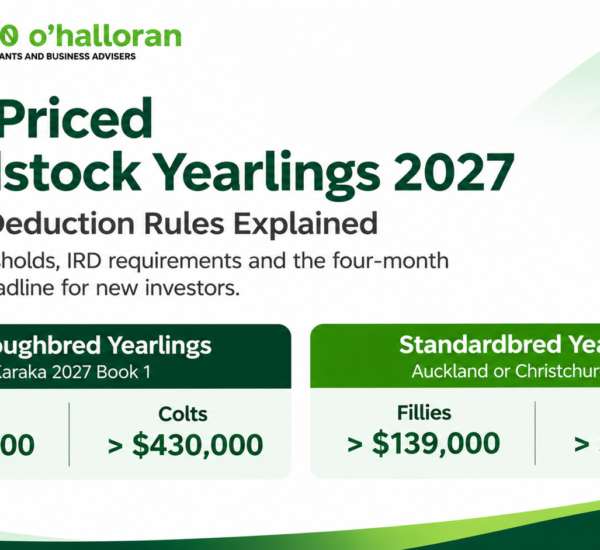
New Zealand’s Inland Revenue has announced the minimum purchase prices for high-priced thoroughbred and standardbred yearlings acquired at the country’s 2027 premier bloodstock sales. The announcement is particularly important for new investors who intend to enter the horse breeding industry and potentially claim income tax deductions under the special bloodstock tax rules.
The high-priced bloodstock yearlings 2027 thresholds apply to eligible thoroughbred yearlings purchased at Karaka Book 1 and standardbred yearlings purchased at the National Standardbred Yearling Sales in Auckland or Christchurch.
Eligible new investors may be able to claim income tax deductions as if they were already operating an established bloodstock breeding business. However, meeting the purchase-price threshold alone is not enough. Investors must demonstrate a genuine intention to breed the horse for profit and provide the required information to Inland Revenue within four months of acquisition.
High-Priced Bloodstock Yearlings 2027
Inland Revenue has announced the 2027 purchase-price thresholds for qualifying high-priced thoroughbred and standardbred yearlings in New Zealand. New investors purchasing eligible yearlings with the intention of breeding them for profit may qualify for income tax deductions under special bloodstock rules.
- Thoroughbred fillies: More than NZ$400,000 at Karaka 2027 Book 1.
- Thoroughbred colts: More than NZ$430,000 at Karaka 2027 Book 1.
- Standardbred fillies: More than NZ$139,000 at the 2027 National Standardbred Yearling Sales.
- Standardbred colts: More than NZ$172,000 at the 2027 National Standardbred Yearling Sales.
- Eligibility: The investor must intend to breed the yearling for profit and meet IRD’s requirements.
- Notification deadline: Evidence of the intention to breed for profit must be provided within four months of acquisition.
Important: Purchasing a yearling above the applicable threshold does not automatically guarantee a tax deduction. The investor must meet the relevant eligibility and documentation requirements.
What Are the High-Priced Bloodstock Yearling Rules for 2027?
The high-priced bloodstock rules allow qualifying new investors to claim income tax deductions for eligible yearlings acquired with the intention of establishing a profitable breeding activity.
Normally, tax deductions relating to bloodstock breeding activities are associated with an existing breeding business. The special rules provide an opportunity for new investors to qualify without necessarily having an established bloodstock breeding business at the time of purchase.
To qualify, the yearling must be purchased at one of the specified premier sales and its purchase price must be greater than the minimum threshold published by Inland Revenue for the relevant year.
For 2027, the thresholds differ depending on whether the horse is a thoroughbred or standardbred and whether it is a colt or filly.
2027 Bloodstock Yearling Purchase Price Thresholds
The following minimum purchase-price thresholds apply to eligible high-priced bloodstock yearlings acquired at the specified 2027 sales.
1. Thoroughbred Yearlings – Karaka 2027 Book 1
| Horse type | Minimum purchase-price threshold |
|---|---|
| Fillies | More than NZ$400,000 |
| Colts | More than NZ$430,000 |
The thresholds apply to thoroughbred yearlings purchased at Karaka 2027 from Book 1. Purchases at other sales should not be assumed to qualify under this particular concession.
2. Standardbred Yearlings – Auckland or Christchurch 2027
| Horse type | Minimum purchase-price threshold |
|---|---|
| Fillies | More than NZ$139,000 |
| Colts | More than NZ$172,000 |
These thresholds apply to standardbred yearlings purchased at the National Standardbred Yearling Sales in Auckland or Christchurch in 2027.
The horse must cost more than the published minimum purchase price. A purchase price equal to the threshold is not sufficient.
Official source: IRD – High-Priced Bloodstock Yearlings at Karaka or Christchurch 2027.
Who Can Claim Tax Deductions for High-Priced Bloodstock?
The special bloodstock tax rules are designed to encourage new investment in New Zealand’s horse breeding industry.
New investors may qualify for income tax deductions if they acquire an eligible high-priced yearling and intend to breed it for profit.
This may be relevant to:
- Individuals entering the thoroughbred breeding industry.
- New investors purchasing high-value yearlings.
- Investors participating in bloodstock breeding syndicates.
- Partnerships acquiring qualifying bloodstock.
- Investors who acquire a yearling individually and subsequently place it into a breeding syndicate.
- Investors planning to develop a future bloodstock breeding operation.
The yearling may be acquired through a breeding syndicate or syndicated after its purchase, subject to the relevant eligibility and notification requirements.
What Is the Four-Month IRD Notification Requirement?
One of the most important requirements for investors purchasing high-priced bloodstock yearlings in 2027 is the four-month notification deadline.
To qualify for the deductions, investors must provide Inland Revenue with evidence of their intention to make a profit from breeding the yearling within four months of acquiring it.
This means investors should begin preparing their documentation before or immediately after the purchase rather than waiting until the deadline approaches.
The evidence must demonstrate that the investor has a genuine commercial plan for the horse’s future breeding activity.
What Documents Does Inland Revenue Require?
Inland Revenue requires supporting information covering ownership, the proposed breeding activity and veterinary examinations.
1. Ownership and Purchase Documentation
Investors must provide information identifying the horse and its ownership structure.
- Sale and purchase documents.
- Lot number and sale name.
- Horse identification, including colt or filly, dam and sire details.
- IRD and GST numbers of the owner.
- Details of the entity and all individual owners if acquired through a syndicate or partnership.
- Physical address, telephone number and email address of the owners.
- Financial statements balance date.
- Founding documents, including the syndicate or partnership agreement where applicable.
- Notification of the intention to breed for profit.
2. Breeding Business Plan
A detailed breeding business plan is important because it helps demonstrate that the purchase is part of a genuine commercial breeding intention rather than simply a speculative investment.
The plan should cover:
- Business description: An explanation of the proposed breeding business and its objectives.
- Pre-purchase research: Research undertaken before buying the horse and the investor’s previous knowledge of the bloodstock industry.
- Location: Where the proposed breeding activity will take place.
- Development plan: How the horse will reach breeding condition, including its proposed racing and management arrangements where relevant.
- Breeding arrangements: Where and when breeding will commence and who will manage the process.
- Financial forecasts: Expected financial performance and commercial projections.
- Management involvement: Details of the racing, breeding or syndicate manager responsible for the horse.
3. Veterinary Documentation
IRD also requires veterinary evidence relating to the horse’s physical condition before purchase.
- Syndicates required to operate under the Bloodstock Syndication Code of Practice must provide a copy of the relevant veterinary certificate.
- Other syndicates must provide confirmation that an external physical examination was carried out by a veterinarian before purchase, together with the veterinarian’s details.
- Relevant communication within the syndicate before the deduction application should also be retained and provided where required.
Example: How the 2027 Bloodstock Threshold Works
Consider an investor purchasing a thoroughbred filly at Karaka 2027 Book 1 for NZ$450,000.
| Purchase details | Thoroughbred filly |
|---|---|
| Purchase sale | Karaka 2027 Book 1 |
| Purchase price | NZ$450,000 |
| 2027 filly threshold | More than NZ$400,000 |
| Amount above threshold | NZ$50,000 |
The purchase price is above the applicable threshold. However, the investor must also demonstrate an intention to breed the filly for profit and meet IRD’s notification and supporting documentation requirements.
If the investor satisfies the requirements, they may qualify for income tax deductions under the special bloodstock rules.
Can a Yearling Be Purchased Through a Syndicate?
Yes. Inland Revenue allows eligible new investors to acquire a qualifying yearling through a breeding syndicate or have the yearling syndicated after its purchase at the specified sale.
However, syndicate ownership creates additional documentation responsibilities.
Investors should ensure that the ownership structure, syndicate agreement, individual owner details, financial records and breeding arrangements are properly documented.
The breeding plan should also explain who is responsible for managing the horse, coordinating its development and arranging future breeding activity.
What Happens If the Investor Changes Their Intention?
An investor’s circumstances or plans may change after purchasing the yearling. For example, the horse may no longer be suitable for breeding, or the investor may decide not to proceed with the original breeding plan.
If the intention changes or the horse is no longer expected to be used for breeding for profit, Inland Revenue must be notified.
Depending on the circumstances, supporting information may include:
- Veterinary invoices recording the date of gelding or death.
- Export documentation if the horse is exported.
- Changes in ownership documentation.
- Communications relating to the change in breeding intention.
- Financial statements or an IR10 financial statements summary where no other financial statements have been prepared.
- Tax reconciliations and bloodstock schedules.
Investors should maintain clear records of any change in the horse’s intended use and seek advice about the resulting tax implications.
What Happens If the Yearling Is Sold Later?
The tax concession does not make a future sale tax-free.
Inland Revenue states that if the qualifying standout yearling is subsequently sold, investors will be taxed on the sale. This is an important consideration for investors who may be planning to sell the horse after its racing career or change their original investment strategy.
The potential tax consequences of a sale should therefore be considered as part of the investor’s overall financial and breeding plan.
What Should Bloodstock Investors Do Before Purchasing in 2027?
Investors considering a high-value yearling purchase should prepare before attending the 2027 sales. A well-documented plan can help demonstrate the commercial purpose of the investment and support the IRD notification process.
- Confirm that the intended sale is one of the specified eligible sales.
- Check the applicable purchase-price threshold for the horse’s type and sex.
- Review the horse’s pedigree and breeding potential.
- Arrange the required pre-purchase veterinary examination.
- Determine whether the horse will be owned individually, through a partnership or through a syndicate.
- Prepare the proposed breeding business plan.
- Develop financial forecasts and identify the people responsible for managing the horse.
- Maintain all purchase and ownership documentation.
- Record the acquisition date and calculate the four-month notification deadline.
- Provide the required evidence to Inland Revenue within the deadline.
- Maintain ongoing records and notify IRD if the breeding intention changes.
How DFK Orb360 O’Halloran Can Help With Bloodstock Tax Planning
Investing in high-priced bloodstock can involve significant financial commitments and specific tax compliance responsibilities. Understanding the eligibility rules before purchasing a yearling can help investors make informed decisions and prepare the necessary documentation.
DFK Orb360 O’Halloran supports New Zealand businesses and investors with accounting, tax compliance and business advisory services.
For investors considering bloodstock purchases, appropriate professional advice can help with reviewing the proposed ownership structure, understanding income tax implications, organising financial records and preparing for relevant tax reporting obligations.
Whether you are entering the bloodstock industry, participating in a breeding syndicate or reviewing an existing investment, understanding the tax treatment before making a significant purchase is important.
Planning to Invest in High-Priced Bloodstock in 2027?
Make sure you understand the tax rules before purchasing your yearling. From ownership structures and financial documentation to IRD notification requirements, preparing early can help you manage your tax compliance responsibilities.
Speak with DFK Orb360 O’Halloran about your investment, accounting and tax advisory requirements.
Discuss Your Tax Planning RequirementsProfessional accounting and tax advisory support for businesses and investors across New Zealand.
Frequently Asked Questions About High-Priced Bloodstock Yearlings 2027
1. What is considered a high-priced thoroughbred yearling in 2027?
For Karaka 2027 Book 1, a thoroughbred filly must cost more than NZ$400,000 and a colt must cost more than NZ$430,000 to meet the announced purchase-price threshold.
2. What is the standardbred yearling threshold for 2027?
For the 2027 National Standardbred Yearling Sales in Auckland or Christchurch, the purchase price must exceed NZ$139,000 for fillies and NZ$172,000 for colts.
3. Can a first-time bloodstock investor claim tax deductions?
Yes. A new investor may qualify for income tax deductions under the special bloodstock rules if they purchase an eligible high-priced yearling with the genuine intention of breeding it for profit and satisfy IRD’s requirements.
4. How long does an investor have to notify IRD?
Investors must provide Inland Revenue with evidence of their intention to breed the high-priced yearling for profit within four months of acquisition.
5. Does a horse have to be purchased at Karaka Book 1?
The thoroughbred concession applies to qualifying yearlings acquired at Karaka 2027 Book 1. The standardbred concession applies to qualifying yearlings acquired at the National Standardbred Yearling Sales in Auckland or Christchurch in 2027.
6. Can investors buy a yearling through a breeding syndicate?
Yes. A qualifying yearling can be acquired through a breeding syndicate or syndicated after purchase, provided the relevant eligibility, ownership and notification requirements are satisfied.
7. What must a bloodstock breeding business plan include?
The plan should describe the proposed business, research undertaken before purchase, the investor’s industry knowledge, location of the activity, the horse’s development and breeding arrangements, financial forecasts and the involvement of relevant managers.
8. Are veterinary reports required for high-priced bloodstock?
Yes. The requirements depend on the syndicate structure. Certain syndicates must provide the relevant veterinary certificate, while other syndicates must confirm that an external physical examination was completed by a veterinarian before purchase and provide the veterinarian’s details.
9. Are the proceeds from selling a qualifying yearling taxable?
Yes. Inland Revenue states that if a standout yearling is subsequently sold, investors will be taxed on the sale under the applicable bloodstock tax rules.
10. What should an investor do if they no longer intend to breed the horse?
The investor must notify Inland Revenue if their intention changes or the horse is no longer expected to be used for breeding for profit. Supporting documentation may be required, including veterinary invoices, export records, ownership changes and relevant financial records.
11. Can the tax deduction be claimed just because the purchase price exceeds the threshold?
No. Meeting the purchase-price threshold is only one part of the eligibility requirements. The investor must also demonstrate a genuine intention to breed the yearling for profit and provide the required evidence to Inland Revenue within four months of acquisition.
12. Where can investors get help with bloodstock tax requirements in New Zealand?
Investors can speak with an accountant or tax adviser familiar with New Zealand income tax and bloodstock rules. DFK Orb360 O’Halloran provides accounting, tax compliance and advisory support to businesses and investors across New Zealand.
Need Advice Before Your Next Bloodstock Investment?
A high-value yearling purchase deserves careful financial and tax planning. Discuss your proposed investment and tax compliance requirements with DFK Orb360 O’Halloran.
Contact DFK Orb360 O’HalloranOfficial IRD Sources and Further Reading
- IRD – High-Priced Bloodstock Yearlings at Karaka or Christchurch 2027
- IRD – Bloodstock Yearlings: New Investors
Disclaimer: This article is intended for general information only and should not be treated as tax, legal or financial advice. Eligibility for bloodstock tax deductions depends on the applicable legislation, purchase circumstances, genuine intention to breed for profit and Inland Revenue’s notification and evidence requirements. Investors should obtain professional advice before making significant bloodstock purchases or tax decisions.


 09 377 4238
 Level 2, 6 Kingdon Street, Newmarket, Auckland
 help@orb360.co.nz