

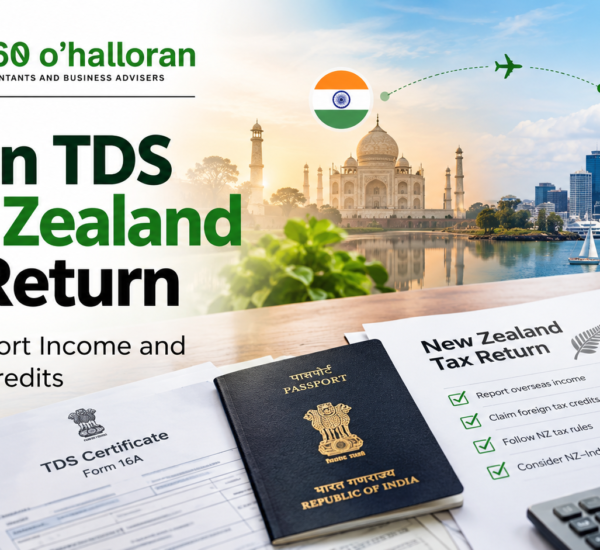
If you live in New Zealand and earn income in India, understanding how Indian Tax Deducted at Source (TDS) affects your New Zealand tax return is important. An Indian TDS New Zealand tax return may require you to report overseas income, reconcile Indian withholding tax and determine whether a foreign tax credit is available.
Tax deducted in India does not automatically remove your New Zealand reporting obligations. Depending on your tax residency, income type and applicable exemptions, you may need to declare the income in New Zealand even if the money remains in India.
This guide explains the reporting process, supporting documents, foreign tax credit rules and the role of the New Zealand–India Double Tax Agreement.
Indian TDS in a New Zealand Tax Return
When preparing an Indian TDS New Zealand tax return, first identify the Indian income, establish the tax deducted and check the applicable New Zealand reporting rules. New Zealand tax residents generally report worldwide income, subject to relevant exemptions and exceptions. Indian TDS may support a foreign tax credit claim, but the credit is not automatic and may be limited by New Zealand law and the applicable tax treaty. Keep Indian tax certificates, income statements and exchange-rate calculations to support your return.
What Is Indian TDS, and Why Does It Matter for a New Zealand Tax Return?
Tax Deducted at Source is an Indian tax withholding system under which tax is deducted from certain payments and paid to the Indian tax authorities. Depending on the payment and applicable Indian rules, TDS may apply to salary, interest, dividends, rent, professional fees and other specified income.
For a person with financial interests in both countries, the important question is how the underlying income should be treated under New Zealand tax law. The amount deducted in India is only one part of the calculation.
For example, an individual may receive interest from an Indian bank after TDS has been deducted. If the individual is a New Zealand tax resident, the interest may still need to be included in their New Zealand tax return. Any credit for Indian tax must then be assessed separately.
Read the official guidance from Inland Revenue on overseas income.
Do New Zealand Tax Residents Need to Declare Indian Income?
New Zealand tax residents generally need to report worldwide income, including relevant income earned in India. This can include bank interest, dividends, salary, rental income and other overseas earnings.
The correct treatment depends on the individual’s tax residency, the nature of the income and any applicable exemption or treaty provision. For example, some eligible new or returning residents may qualify for a temporary exemption on certain foreign income.
Examples of Indian income to review
- Bank interest: Interest earned on Indian bank deposits or accounts.
- Dividends: Distributions from Indian companies or investments.
- Employment income: Salary and other employment-related payments.
- Rental income: Income from property located in India.
- Other overseas income: Pensions and other payments, depending on the relevant tax rules.
These are examples, not a determination that every payment is taxable in New Zealand. Overseas residential rental income, for instance, has specific reporting instructions.
Check your circumstances against Inland Revenue’s guidance for New Zealand tax residents.
Can Indian TDS Be Claimed as a Foreign Tax Credit in New Zealand?
A foreign tax credit may be available where qualifying tax has been paid overseas on income that is also subject to tax in New Zealand. However, the amount of Indian TDS shown on a certificate is not automatically the amount you can claim.
The calculation generally needs to consider:
- The amount of qualifying foreign tax paid.
- The New Zealand tax attributable to the same income.
- Any applicable limitation under the New Zealand–India Double Tax Agreement.
- Whether the tax withheld is eligible for credit under New Zealand rules.
If the Indian tax can be recovered in India, was withheld incorrectly or does not qualify under New Zealand rules, the credit available may differ from the amount deducted.
Hypothetical example: Indian dividend income
Suppose you receive ₹100,000 in Indian dividends and ₹10,000 is deducted as TDS. The amount paid into your account is ₹90,000.
For your Indian TDS New Zealand tax return, the gross income, tax withheld and New Zealand-dollar equivalents should be reviewed separately. The ₹10,000 deduction does not, by itself, establish that you can claim a New Zealand tax credit for the full amount.
The actual result depends on the income’s tax treatment, qualifying foreign tax paid and applicable limitations. These figures are illustrative only and are not a calculation of your tax liability.
See Inland Revenue’s guidance on Double Tax Agreements and foreign tax credits.
How to Report Indian TDS in a New Zealand Tax Return
Step 1: Confirm your tax residency
Establish whether you were a New Zealand tax resident during the relevant tax period and when your residency began. Residency changes may affect which income needs to be considered.
Step 2: Identify each income category
Separate interest, dividends, salary, rental income and other payments. Different categories can have different tax and reporting rules.
Step 3: Reconcile gross income and Indian TDS
Compare bank statements, dividend statements, salary records and Indian tax certificates. Where tax was deducted before you received the payment, do not rely solely on the net deposit to determine the income amount.
Step 4: Convert the amounts into New Zealand dollars
Use an appropriate exchange-rate method in accordance with Inland Revenue’s guidance. Retain the source rates and calculations supporting the amounts included in your return.
Step 5: Complete the relevant tax return and overseas income summary
Individuals generally use the IR3 individual income tax return and, where required, the IR1261 Overseas income summary to report overseas income and relevant foreign tax credits. The IR1261 requires information to be organised by income type and jurisdiction.
Special reporting instructions apply to certain income categories, including overseas residential rental income. Follow the relevant instructions rather than assuming all overseas income should be entered in the same field.
Step 6: Calculate any eligible foreign tax credit
Assess whether the Indian tax qualifies for credit, whether the same income is taxable in New Zealand and whether treaty limitations apply. Keep a calculation explaining how the credit was determined.
Official resource: Reporting your overseas income — Inland Revenue.
Documents Needed for an Indian TDS New Zealand Tax Return
Keeping complete records helps you reconcile overseas income and assess whether a foreign tax credit is available. Depending on your circumstances, relevant documents may include:
- Form 16: An Indian TDS certificate generally associated with salary income.
- Form 16A: An Indian TDS certificate generally used for non-salary payments.
- Form 26AS and AIS: Indian tax records that can help reconcile reported income and tax deducted or collected.
- Income statements: Bank interest certificates, dividend statements, salary records and rental statements, as applicable.
- Indian tax return records: Relevant filings, assessments or refund information where available.
- Exchange-rate calculations: Records supporting the conversion of income and tax into New Zealand dollars.
- Foreign tax credit working: A calculation explaining the credit claimed and its basis.
These documents serve different purposes. A withholding certificate can support the amount of tax deducted, but it does not independently prove that the amount is fully creditable in New Zealand.
Refer to the India Income Tax Department’s guidance for individuals for information about relevant Indian tax records.
How the New Zealand–India Double Tax Agreement May Apply
The New Zealand–India Double Tax Agreement contains provisions addressing aspects of cross-border taxation. Depending on the income category and the taxpayer’s circumstances, the agreement may affect taxing rights, withholding tax treatment or relief from double taxation.
The treaty does not guarantee that every Indian TDS deduction can be fully claimed in New Zealand. The relevant treaty article must be considered alongside domestic tax rules and the facts of the case.
If tax was withheld in India at an amount that may not be permitted under the applicable rules, it may be necessary to investigate whether relief or a refund should be sought in India.
Official treaty resource: New Zealand–India tax treaty — Inland Revenue Tax Policy.
Common Mistakes When Reporting Indian TDS in New Zealand
Reporting only the net amount received
Tax may have been deducted before the payment reached your account. Reconcile the gross income and tax withheld separately.
Assuming all Indian TDS qualifies for a credit
The amount withheld in India is not necessarily the amount allowed under New Zealand foreign tax credit rules.
Using unsupported exchange rates
Keep a record of the exchange-rate method used and the supporting calculations for your New Zealand-dollar figures.
Overlooking income held in India
New Zealand tax residents generally cannot assume that income is excluded from reporting simply because it remains in an Indian bank account.
Ignoring residency changes or exemptions
Residency dates and eligibility for particular exemptions can affect the outcome. Check these before preparing your return.
Failing to retain evidence
Keep the certificates, statements and calculations needed to explain the figures reported and any credit claimed.
Frequently Asked Questions About Indian TDS and New Zealand Tax Returns
Do I need to declare Indian income if TDS has already been deducted?
If you are a New Zealand tax resident, you will generally need to report overseas income, subject to applicable exemptions and specific rules. Tax deducted in India does not automatically remove this obligation.
Can I claim the full Indian TDS amount as a New Zealand tax credit?
Not necessarily. The credit depends on qualifying foreign tax paid, New Zealand tax attributable to the same income and applicable treaty limitations.
Which forms are used to report overseas income in New Zealand?
Individuals generally use the IR3 return and, where required, the IR1261 Overseas income summary. The correct reporting treatment depends on the income category.
Can Form 16A or Form 26AS support my foreign tax credit claim?
These records can help substantiate Indian tax withholding. You should also retain the underlying income records and evidence needed to support the New Zealand reporting and credit calculation.
Does the New Zealand–India tax treaty guarantee relief from double taxation?
The treaty provides rules that may help relieve double taxation, but the result depends on the income type, residency and applicable provisions. A credit or refund should not be assumed without checking the relevant rules.
What if I receive both Indian rental income and bank interest?
Assess the two income categories separately. Overseas residential rental income has specific New Zealand reporting instructions, so it may not be reported in the same way as interest.
Need Help With Your Indian TDS New Zealand Tax Return?
Cross-border tax reporting can involve reconciling Indian withholding certificates, classifying overseas income, converting amounts into New Zealand dollars and assessing whether a foreign tax credit is available.
DFK Orb360 can discuss your cross-border tax reporting requirements and help clarify what information may be needed for your circumstances. The scope of assistance and available services will be confirmed following your enquiry.
Contact DFK Orb360 about your cross-border tax requirements.
Enquire With Our Team
Complete the form below to tell us about your Indian income and New Zealand tax reporting question.
Official Sources and Further Reading
People Also Ask: Indian TDS and New Zealand Tax Returns
Can DFK Orb360 help me report Indian TDS in my New Zealand tax return?
DFK Orb360 can discuss your cross-border tax reporting requirements, including how Indian income and tax deducted at source may need to be considered in a New Zealand tax return. Our team can help clarify the records and information required, assess the scope of assistance available and explain the next steps based on your circumstances.
Can DFK Orb360 help me claim a foreign tax credit for Indian TDS?
DFK Orb360 can discuss the New Zealand foreign tax credit rules that may apply to qualifying tax paid in India. Eligibility and the amount of any credit depend on the type of income, the tax paid, New Zealand tax law and the New Zealand–India Double Tax Agreement. A credit is not guaranteed.
What documents do I need for Indian TDS and New Zealand tax reporting?
Relevant documents may include Indian Form 16 or Form 16A, Form 26AS, Annual Information Statement (AIS), bank and dividend statements, salary or rental records, and calculations converting income and tax into New Zealand dollars. DFK Orb360 can discuss which records are relevant to your situation.
Do I need to declare Indian income in New Zealand if tax has already been deducted in India?
New Zealand tax residents generally need to report worldwide income, subject to applicable exemptions and specific rules. Indian TDS does not automatically remove the New Zealand reporting obligation. DFK Orb360 can discuss how your residency status and income type affect your reporting requirements.
Can DFK Orb360 help with the New Zealand–India Double Tax Agreement?
DFK Orb360 can discuss how the New Zealand–India Double Tax Agreement may be relevant to your cross-border tax position, including potential relief from double taxation. The outcome depends on the relevant treaty provisions, domestic tax rules and your individual circumstances.
What if Indian TDS was deducted incorrectly or I may be entitled to an Indian tax refund?
The appropriate treatment depends on why the tax was deducted and whether relief or a refund is available under Indian tax rules. The amount withheld may not automatically qualify for a New Zealand foreign tax credit. DFK Orb360 can discuss the New Zealand reporting implications and whether further advice or action in India may be needed.
How can I get help with cross-border tax reporting from DFK Orb360?
Contact DFK Orb360 through our contact page to outline your Indian income, TDS records and New Zealand tax reporting question. Our team can discuss your requirements and confirm the scope of assistance available.
How DFK Orb360 Can Help With Indian TDS and New Zealand Tax Reporting
Preparing an Indian TDS New Zealand tax return can involve several steps, from identifying overseas income to checking the tax deducted in India and assessing whether a foreign tax credit may be available. DFK Orb360 can discuss your cross-border tax reporting requirements and help clarify the information needed for your situation.
If you receive Indian salary income, bank interest, dividends or rental income while living in New Zealand, it is important to understand how each income category should be treated. DFK Orb360 can discuss the New Zealand reporting considerations, relevant records and potential tax issues that may need further review.
Cross-border income reporting
An accurate Indian TDS New Zealand tax return starts with identifying the type and amount of income earned in India. The gross income, tax withheld and net amount received may be different figures. Reviewing these amounts separately can help identify missing information before a New Zealand return is prepared.
Foreign tax credit considerations
Indian TDS may be relevant when assessing a foreign tax credit in New Zealand, but the full amount deducted in India is not automatically creditable. DFK Orb360 can discuss the relevant New Zealand rules and the New Zealand–India Double Tax Agreement as part of understanding your cross-border tax position.
Documentation and tax records
Supporting an Indian TDS New Zealand tax return may require Form 16, Form 16A, Form 26AS, AIS records, bank statements, dividend statements and other income documents. The appropriate records depend on your income sources. Keeping these documents organised can make it easier to reconcile income and withholding tax.
Understanding your next steps
If you are unsure how to report Indian income, whether tax deducted in India qualifies for relief, or which records are required, contact DFK Orb360 to discuss your requirements. The team can confirm the scope of assistance available based on your circumstances.
When Should You Seek Help With an Indian TDS New Zealand Tax Return?
Consider obtaining professional guidance if you have recently moved to New Zealand, receive income from multiple Indian sources, hold investments in India, own Indian rental property or are uncertain whether tax withheld in India can be credited against your New Zealand tax liability.
You may also need to review your position if the tax shown on an Indian certificate does not match your bank records, you believe too much tax has been deducted, or you need to correct an earlier overseas income declaration.
Each Indian TDS New Zealand tax return should be assessed using the taxpayer’s residency position, income type, supporting documents and the applicable rules. Seeking clarification before filing can help you identify reporting issues and understand whether further action is required.
What Information Should You Prepare Before Contacting DFK Orb360?
To help explain your Indian TDS New Zealand tax return requirements, prepare the following information where relevant:
- Your New Zealand tax residency dates and relevant tax year.
- The type of income received from India.
- Gross income and Indian TDS amounts for each income source.
- Available Form 16, Form 16A, Form 26AS or AIS records.
- Statements supporting interest, dividends, salary or rental income.
- Details of any Indian tax refund, adjustment or foreign tax credit already claimed.
You do not need to assume that every Indian tax deduction will qualify for relief. The purpose of gathering these records is to establish the facts and determine the appropriate reporting treatment.
For official guidance, refer to Inland Revenue’s overseas income reporting guidance and the New Zealand–India tax treaty information.
Important Information
This article provides general information only and is not personalised tax, legal or financial advice. Tax residency, overseas income treatment, foreign tax credit eligibility and treaty relief depend on the relevant law and individual circumstances. Confirm your position with a suitably qualified tax adviser before filing or amending a tax return.



 09 377 4238
 Level 2, 6 Kingdon Street, Newmarket, Auckland
 help@orb360.co.nz