

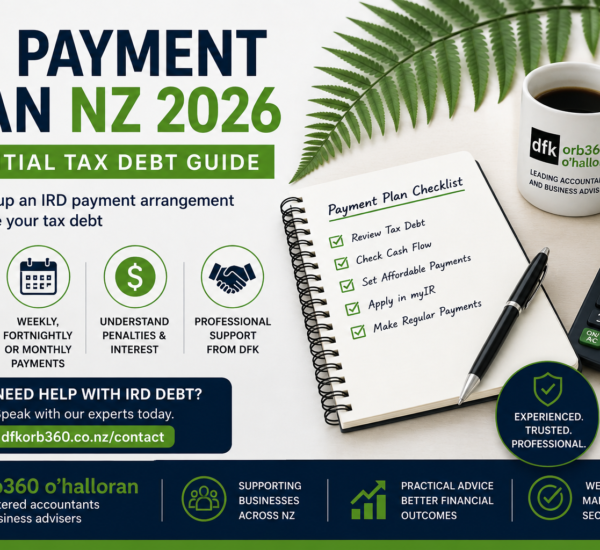
IRD Payment Plan NZ 2026: How to Set Up an IRD Payment Arrangement
If you owe money to Inland Revenue and cannot pay the full amount by the due date, you may be able to arrange an IRD payment plan NZ taxpayers can use to repay their debt over time.
Inland Revenue generally refers to this as an instalment arrangement. Depending on your circumstances, you may be able to make agreed payments weekly, fortnightly or monthly rather than paying the entire amount immediately.
This guide explains how an IRD payment plan works in New Zealand, who may need one, how to apply through myIR, what happens to penalties and interest, what information you may need, and when professional assistance from an accountant can make sense.
IRD Payment Plan NZ
An IRD payment plan, officially called an instalment arrangement, allows eligible taxpayers to repay money owed to Inland Revenue in agreed instalments instead of paying the full amount at once.
Inland Revenue says instalment arrangements can be used when you have debt you cannot pay in full or know you will not be able to pay by the due date.
Depending on the arrangement, repayments can be made:
- Weekly
- Fortnightly
- Monthly
You can apply for an instalment arrangement through myIR. Inland Revenue may consider your circumstances and the proposed repayment arrangement.
If you cannot pay your IRD debt in full, acting early is important. Ignoring the debt can result in further collection activity, while an agreed arrangement can provide a structured way to address the balance.
Apply for an instalment arrangement through official IRD guidance
Struggling to Pay Your IRD Debt?
If you are unable to pay your IRD debt in full, DFK Orb360 O’Halloran can review your financial position and help you understand your options for managing outstanding tax obligations.
Get IRD Debt HelpWhat Is an IRD Payment Plan in New Zealand?
An IRD payment plan NZ taxpayers may use is generally known as an instalment arrangement.
It allows a taxpayer who cannot pay an amount owed to Inland Revenue in full to request an arrangement to repay the debt over an agreed period.
Inland Revenue says instalment arrangements can be used for tax debt and can also apply to certain other amounts administered by IRD.
The key purpose is to create an agreed repayment schedule rather than leaving an unpaid balance without an arrangement.
For example, instead of paying a $20,000 tax debt immediately, an eligible taxpayer may request to repay the amount through agreed instalments.
The actual arrangement and repayment terms depend on the taxpayer’s circumstances and Inland Revenue’s requirements.
When Should You Consider an IRD Payment Plan?
You may need an IRD payment plan when you know that you cannot pay an amount owed to Inland Revenue by its due date.
This can happen for individuals and businesses for several reasons.
Common Situations That Can Lead to IRD Debt
- Unexpected income tax liability
- Provisional tax becoming difficult to fund
- GST cash-flow pressure
- PAYE obligations becoming overdue
- Business revenue falling
- Unexpected expenses
- Seasonal business cash-flow problems
- Accumulated tax debt from previous periods
- Late or missed tax payments
An IRD payment plan NZ arrangement can be useful when an individual or business has an outstanding tax balance but does not have enough cash available to pay the full amount immediately. Setting up a structured repayment arrangement can help you manage the debt while keeping track of your ongoing tax obligations.
If you already know that you cannot make the payment, it is generally better to review your options early rather than simply allowing the debt to remain unpaid.
What Types of IRD Debt Can a Payment Arrangement Cover?
An IRD payment plan NZ taxpayers use may relate to different types of amounts owed to Inland Revenue.
Depending on the circumstances, this may include:
- Income tax
- GST
- PAYE
- Provisional tax
- Other amounts administered by Inland Revenue
Inland Revenue specifically states that instalment arrangements can be used to manage tax and certain other payments.
The appropriate arrangement depends on the type of debt, your circumstances and your ability to meet the proposed repayments.
How to Set Up an IRD Payment Plan Through myIR
If you are looking for how to set up an IRD payment plan, one of the main options is to apply for an instalment arrangement through myIR.
Step 1: Log Into myIR
Start by signing into your myIR account and reviewing your current tax position.
Check the amount owing and identify which tax type and period the debt relates to.
Step 2: Review Your Outstanding Amount
Before requesting an arrangement, make sure you understand what you owe.
Check whether the balance includes:
- Original tax debt
- Late-payment penalties
- Interest
- Other amounts
Step 3: Determine What You Can Afford
Do not choose a repayment amount simply because it looks manageable for the next few weeks.
Consider your actual cash flow and upcoming obligations.
A business should consider upcoming:
- GST payments
- PAYE
- Wages
- Rent
- Supplier payments
- Operating expenses
- Provisional tax
Step 4: Apply for an Instalment Arrangement
Inland Revenue provides an online process for requesting an instalment arrangement through myIR.
You may be able to propose a repayment frequency such as weekly, fortnightly or monthly.
Step 5: Keep to the Agreed Payments
Once an arrangement is agreed, it is important to maintain the scheduled repayments.
Missing agreed payments can affect the arrangement and may result in further collection activity.
How Often Do You Have to Pay Under an IRD Payment Plan?
Inland Revenue states that instalment arrangements can involve repayments on a:
- Weekly basis
- Fortnightly basis
- Monthly basis
The appropriate frequency depends on the arrangement and the taxpayer’s circumstances.
For a business, matching the repayment schedule to actual cash-flow cycles can be important.
For example, a business with highly seasonal revenue may need to carefully consider how much it can realistically commit to each repayment period.
Who Can Apply for an IRD Payment Arrangement?
People and businesses that owe money to Inland Revenue may be able to request an instalment arrangement where they cannot pay the debt in full.
However, an application does not mean that every proposed arrangement will automatically be accepted exactly as requested.
Inland Revenue may consider the circumstances surrounding the debt and the proposed repayment plan.
This is why it is important to provide accurate information and propose repayments that are realistic.
What Information Do You Need for an IRD Payment Plan?
Before requesting an IRD payment plan NZ arrangement, it is useful to understand your complete financial position.
Depending on the situation, you may need information about:
- Total outstanding tax debt
- Tax type and tax period
- Current income
- Business revenue
- Operating expenses
- Cash available
- Upcoming tax liabilities
- Existing repayment commitments
- Outstanding tax returns
Having accurate information helps you determine what repayment amount is genuinely affordable.
Does Interest Continue on an IRD Payment Plan?
Setting up an IRD payment plan does not necessarily mean that all penalties and interest immediately stop.
Inland Revenue’s rules determine how penalties and interest apply to outstanding tax debt and individual circumstances.
IRD states that making regular agreed payments can reduce the amount of penalties you pay compared with leaving the debt unresolved.
Because the treatment of penalties and interest can depend on the circumstances, taxpayers should check the current IRD rules or obtain professional guidance where the debt is significant.
Read official IRD debt and insolvency information
What If You Cannot Afford the IRD Payment Plan?
If the repayment amount you initially considered is not affordable, do not simply stop making payments without communicating with Inland Revenue.
Review your actual cash flow and determine what amount you can realistically commit to.
If you are operating a business, consider preparing a short-term cash-flow forecast before discussing repayment options.
This can help identify:
- What cash is available now
- What tax obligations are coming due
- How much can realistically be allocated toward existing debt
- Whether new tax debt is likely to arise
If you cannot afford both your existing debt and upcoming tax obligations, the problem may require a broader tax and cash-flow strategy rather than simply setting up another repayment schedule.
IRD Payment Plans for Businesses
Businesses can face particular challenges when dealing with an IRD payment plan NZ arrangement.
A business may owe GST, PAYE, income tax or provisional tax while also needing to fund wages, suppliers and operating expenses.
This creates an important distinction between:
Paying old tax debt and Keeping up with new tax obligations.A repayment arrangement may help address an existing debt, but the business still needs to manage future tax liabilities.
Why Cash-Flow Forecasting Matters
A repayment plan should ideally be based on realistic cash-flow expectations.
A business that commits to an amount that is too high may fall behind again.
A business that commits to an amount that is too low may take longer to resolve the debt and could face additional costs.
This is where professional accounting and cash-flow planning can be particularly useful.
Can You Get an IRD Payment Plan If Your Tax Returns Are Overdue?
Having overdue returns can complicate an existing tax-debt situation.
If you have outstanding returns, you should identify and address them rather than focusing only on the amount currently showing as payable.
Inland Revenue’s current approach to overdue debt and returns emphasises resolving both outstanding debt and overdue returns. :contentReference[oaicite:2]{index=2}
For businesses, this is particularly important because missing returns can make it difficult to understand the true tax position.
What Happens If You Ignore Your IRD Debt?
Ignoring an IRD debt does not make the debt disappear.
Inland Revenue can take collection action when outstanding obligations remain unresolved.
Its current 2026 approach to overdue debt states that Inland Revenue may first contact customers to resolve debt through full payment or an instalment arrangement. If there is no response, further contact and collection action may follow. :contentReference[oaicite:3]{index=3}
Depending on the circumstances, unresolved tax debt can therefore become more serious over time.
Potential Consequences of Ignoring Tax Debt
- Additional penalties
- Interest
- Further Inland Revenue contact
- Collection activity
- Cash-flow pressure
- Potential enforcement action
If you know that you cannot pay, taking action early is generally more constructive than waiting for the debt to escalate.
When Should You Get Professional Help With an IRD Payment Plan?
You may be able to manage a straightforward repayment arrangement yourself through myIR.
However, professional support can be valuable when the tax debt is large, your business has cash-flow problems, or there are multiple tax issues involved.
Consider speaking with an accountant if:
- Your IRD debt is substantial
- You have multiple overdue tax returns
- You owe GST, PAYE and income tax
- Your business is experiencing cash-flow problems
- You have already defaulted on a repayment arrangement
- You have received collection correspondence
- You are unsure how much you actually owe
- You expect additional tax debt to arise
- You need help preparing financial information
For businesses, an IRD payment plan NZ arrangement should be considered alongside future GST, PAYE, income tax and provisional tax obligations. Repaying an old debt while allowing new tax debt to build up can create further cash-flow pressure.
How DFK Orb360 O’Halloran Can Help With IRD Debt
Setting up an IRD payment plan is only one part of resolving tax debt.
If your business continues generating new tax liabilities while repaying old debt, you may need a broader strategy covering cash flow, tax compliance and future tax obligations.
DFK Orb360 O’Halloran provides IRD debt and instalment-arrangement support, including reviewing outstanding tax liabilities, preparing financial information, supporting communication with Inland Revenue and helping clients develop practical repayment strategies.
Our team can also help identify whether overdue returns, cash-flow issues or future tax obligations need to be addressed alongside the existing debt.
DFK’s tax and IRD compliance services include support with IRD debt and instalment arrangements, IRD audits, tax compliance and broader tax advisory matters.
Need Help With Your IRD Payment Plan?
Don’t wait until your IRD debt becomes harder to manage. DFK Orb360 O’Halloran can review your position and help you understand your available options.
Get IRD Debt SupportDFK Orb360 O’Halloran can help businesses understand their options when considering an IRD payment plan NZ, including reviewing outstanding liabilities and assessing the impact of repayments on future cash flow.
Related DFK Orb360 IRD & Tax Resources
- IRD Debt Help NZ – Learn how DFK Orb360 supports clients with IRD debt reviews, repayment arrangements and tax compliance.
- Tax & IRD Compliance Services – Explore DFK’s IRD compliance, debt, instalment and audit support.
- What to Do If You Owe IRD Money NZ – A step-by-step guide to managing outstanding IRD debt.
- IRD Overdue Tax Message NZ – Understand what to do after receiving an overdue tax notification.
- IRD Liquidation NZ – Understand the risks businesses may face when significant tax debt remains unresolved.
- Contact DFK Orb360 O’Halloran – Speak with the DFK team about your accounting and tax requirements.
Frequently Asked Questions About IRD Payment Plans
What is an IRD payment plan in New Zealand?
An IRD payment plan NZ taxpayers can request is generally called an instalment arrangement. It allows eligible taxpayers to repay amounts owed to Inland Revenue through agreed instalments instead of paying the full amount immediately.
Can I set up an IRD payment plan through myIR?
Yes. Inland Revenue provides an online process through myIR for applying for an instalment arrangement.
How often can I make payments to IRD?
Inland Revenue says instalment arrangements can involve weekly, fortnightly or monthly payments, depending on the arrangement.
Can I get an IRD payment plan if I cannot pay my tax?
If you cannot pay an amount owed to Inland Revenue in full, you may be able to request an instalment arrangement. The arrangement depends on your circumstances and Inland Revenue’s requirements.
Does an IRD payment plan stop interest?
Not necessarily. Interest and penalties can continue to apply depending on the circumstances and applicable Inland Revenue rules. You should check your specific position with IRD or a qualified professional.
Can a business get an IRD payment plan?
Yes. Businesses that cannot pay outstanding GST, PAYE, income tax or other amounts may be able to request an instalment arrangement.
What happens if I miss an IRD payment?
Missing agreed repayments can affect your arrangement and may result in further collection action. If you expect difficulty making a scheduled payment, contact Inland Revenue or your adviser promptly.
Can an accountant negotiate an IRD payment plan?
An accountant or tax professional can help review your financial position, prepare relevant information and support communication with Inland Revenue. The final decision regarding an instalment arrangement remains with Inland Revenue.
Can IRD refuse a payment arrangement?
An instalment arrangement is not automatically guaranteed. Inland Revenue considers the circumstances and the proposed repayment arrangement. If your situation is complex, professional assistance may help you prepare a realistic repayment proposal.
What if I already have an IRD payment plan but cannot afford it?
If your financial circumstances have changed and you can no longer maintain the arrangement, do not simply stop paying. Review your cash flow and contact Inland Revenue or your accountant to discuss the situation and available options.
Final Takeaway: Act Early on IRD Tax Debt
An IRD payment plan NZ arrangement can provide a structured way to manage tax debt when paying the entire amount immediately is not realistic.
Inland Revenue allows taxpayers to apply for instalment arrangements and may agree to weekly, fortnightly or monthly repayments depending on the circumstances.
However, setting up a payment arrangement should be part of a wider plan if you have significant debt or ongoing cash-flow problems.
You need to consider both the existing debt and your future GST, PAYE, income tax and provisional tax obligations.
If you are unsure how to approach your IRD debt, DFK Orb360 O’Halloran can review your financial position and help you understand the practical options available.
Professional assistance can be particularly valuable when an IRD payment plan NZ involves significant business tax debt, multiple overdue returns or ongoing cash-flow difficulties.
Need Help Managing IRD Tax Debt?
Speak with DFK Orb360 O’Halloran about your IRD debt, payment arrangement and wider tax position.
Book a ConsultationOfficial IRD Sources
This guide has been prepared using current information published by Inland Revenue. IRD payment arrangements, penalties, interest and collection processes can change, so always check the latest official information for your circumstances.
Important Disclaimer
DFK Orb360 O’Halloran is an independent accounting and advisory firm and is not the official website of Inland Revenue or the New Zealand Government.
The information in this article is provided for general informational purposes and is based on information available at the time of publication. IRD rules, payment arrangements, penalties, interest and collection processes may change.
For official requirements and the latest government information, always refer to Inland Revenue. For assistance based on your individual financial circumstances, contact DFK Orb360 O’Halloran.
If you are considering an IRD payment plan NZ, acting early can give you more time to understand your financial position and communicate with Inland Revenue before the debt becomes more difficult to manage.



 09 377 4238
 Level 2, 6 Kingdon Street, Newmarket, Auckland
 help@orb360.co.nz