

An IRD tax investigation NZ can be a stressful experience for any business owner. Receiving a letter from Inland Revenue requesting financial records, GST returns, PAYE information or explanations about business transactions can raise immediate concerns about your tax position.
If your business is facing an IRD tax investigation in NZ, understanding what Inland Revenue is reviewing and how to respond is essential. From examining income tax returns and GST claims to reviewing payroll records and business expenses, an investigation can involve detailed scrutiny of your financial affairs.
Whether you have received an IRD investigation notice, an information request or are preparing for a potential audit, this guide explains the IRD tax investigation process in New Zealand, common reasons businesses are investigated and the steps you can take to protect your business.
Quick Answer: What Should You Do During an IRD Tax Investigation NZ?
If Inland Revenue contacts your business about an IRD tax investigation NZ, take the following steps:
- Read the Inland Revenue notice carefully.
- Identify the tax types and financial periods being reviewed.
- Check the information requested and response deadline.
- Gather relevant financial statements, invoices and tax records.
- Review your GST, income tax and PAYE information.
- Identify discrepancies that may require clarification.
- Seek professional accounting advice before submitting complex responses.
Responding accurately and within the specified timeframe is important. The right approach depends on the scope and circumstances of your IRD investigation.
1. What Is an IRD Tax Investigation NZ?
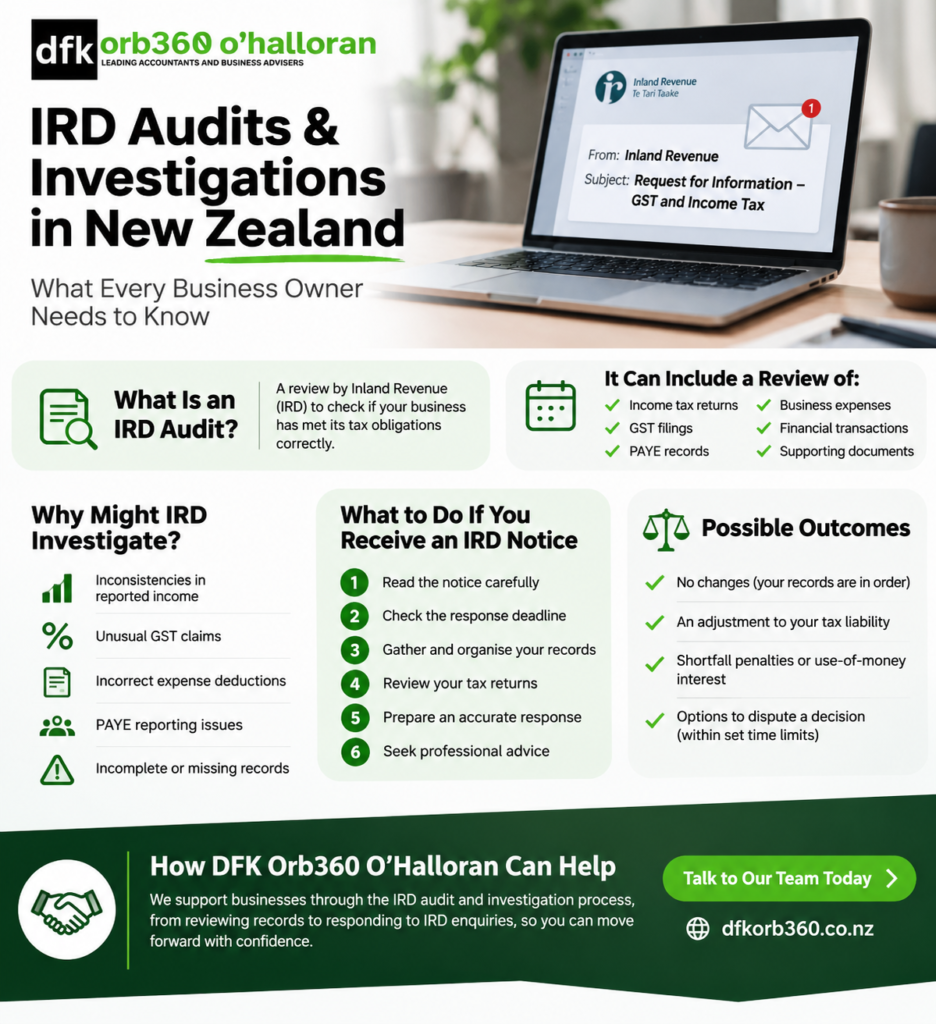
An IRD tax investigation NZ is an examination of a taxpayer’s financial and tax affairs by Inland Revenue to establish whether tax obligations have been met correctly.
Inland Revenue may examine different areas of your business, including:
- Company income tax returns.
- GST returns and input tax claims.
- PAYE and employer reporting.
- Business expenses and deductions.
- Financial statements and accounting records.
- Bank transactions and supporting documentation.
- Specific business transactions or tax treatments.
The scope of an IRD tax investigation depends on the issues Inland Revenue wants to examine. It may cover one tax type, particular transactions or multiple financial periods.
Is an IRD Risk Review the Same as an Audit?
No. An initial IRD risk review is not necessarily a formal audit. A risk review generally involves assessing information to identify potential compliance concerns. If further examination is necessary, Inland Revenue may proceed with an audit.
Receiving an IRD letter or information request does not automatically mean your business has done something wrong. The outcome depends on the information reviewed and the circumstances.
2. Why Does Inland Revenue Investigate Businesses in NZ?
There are several reasons why a business may be selected for an IRD tax investigation NZ. Inland Revenue uses information and risk-based compliance approaches to identify tax matters that may require closer examination.
Inconsistencies in Reported Business Income
Differences between reported income, accounting records, banking information and other relevant information may lead Inland Revenue to request explanations or supporting documents.
Unusual GST Claims or Refunds
GST returns containing unusual claims, refund patterns or discrepancies may receive further attention. IRD may request invoices, purchase records and GST reconciliations to verify the claims.
Incorrect Business Expense Deductions
Business expenses must be supported by appropriate records and meet the relevant tax requirements. Incorrectly classified, unsupported or improperly claimed expenses may require further examination.
PAYE and Payroll Reporting Issues
Employers must meet their PAYE and payroll reporting obligations. Differences between payroll information, employee payments and filed employer returns may result in questions from Inland Revenue.
Incomplete or Missing Financial Records
Missing invoices, incomplete accounting records and unexplained financial transactions can make it difficult to establish whether tax returns are accurate.
Important: These are potential compliance concerns, not proof of wrongdoing. The reason for an IRD investigation depends on the individual circumstances of the taxpayer.
3. What Is the IRD Tax Investigation Process in NZ?
Understanding the IRD tax investigation process can help business owners prepare for what happens next. Although each investigation is different, the process may involve the following stages.
Stage 1: Initial Contact from Inland Revenue
Inland Revenue may contact your business or authorised tax representative to explain the nature of its review, audit or information request.
Stage 2: Request for Financial Documents
IRD may request financial statements, GST returns, income tax records, payroll information, invoices, receipts and bank statements.
Stage 3: Review of Business Records
Inland Revenue examines the supplied information to verify transactions, identify discrepancies and assess whether tax obligations have been met.
Stage 4: Further Questions and Clarifications
If IRD identifies transactions or tax positions that require clarification, it may request additional documents or explanations.
Stage 5: Investigation Findings
Depending on the findings, Inland Revenue may determine that no adjustment is required or propose changes to the taxpayer’s tax position.
Stage 6: Resolution or Formal Dispute
If a tax adjustment or assessment is proposed, the taxpayer may have options to respond through the applicable tax disputes process. Specific requirements and deadlines apply.
The duration of an IRD tax investigation varies depending on the complexity of the matter, the number of tax periods involved and the volume of information requested.
4. What Documents Does IRD Request During a Tax Investigation?
During an IRD tax investigation NZ, Inland Revenue may request different types of financial and business records depending on the scope of its examination.
Income Tax Documents
- Company income tax returns.
- Financial statements.
- Profit and loss reports.
- General ledger information.
- Business income and expense schedules.
- Asset and depreciation records.
GST Documents
- GST returns.
- Sales and purchase records.
- Taxable supply information.
- GST reconciliation reports.
- Credit notes and adjustment documentation.
PAYE and Payroll Documents
- Payroll summaries.
- Employee payment records.
- PAYE calculations.
- Employer returns.
- Relevant employment documentation.
Banking and Supporting Financial Records
- Business bank statements.
- Supplier and customer invoices.
- Receipts and transaction records.
- Accounting system reports.
- Explanations for significant transactions.
New Zealand businesses generally need to retain tax records for at least seven tax years. This includes relevant electronic records.
Read the official IRD record-keeping guidance for further information.
5. How to Respond to an IRD Tax Investigation NZ: 7 Essential Steps
If your business receives an IRD investigation notice, your response should be organised, accurate and supported by appropriate financial documentation.
Step 1: Read the IRD Notice Carefully
Identify whether Inland Revenue has initiated a risk review, formal audit, information request or another compliance process. Understand exactly what IRD is asking your business to provide.
Step 2: Check the Response Deadline
Make a note of the deadline specified in the correspondence. If additional time or clarification is required, consider contacting IRD or your authorised representative promptly.
Step 3: Identify the Tax Periods Under Investigation
Establish which income tax years, GST periods, employer returns or transactions are being examined. This helps you organise the relevant financial records.
Step 4: Gather Supporting Financial Records
Collect the requested invoices, bank statements, GST reports, financial statements and accounting documents. Organise them by tax type and financial period.
Step 5: Review Your Tax Returns
Check your income tax returns, GST calculations, expense deductions and PAYE records for inconsistencies that may need explanation.
Step 6: Prepare Accurate Responses
Provide clear explanations supported by available records. Avoid guessing, making assumptions or submitting information that has not been properly checked.
Step 7: Seek Professional Accounting Advice
If the IRD investigation involves complex transactions, multiple tax periods, significant tax adjustments or possible penalties, professional accounting guidance can help you understand the issues and prepare an appropriate response.
6. What Happens If IRD Finds Errors During an Investigation?
An IRD tax investigation does not automatically result in additional tax or penalties. Inland Revenue considers the information and evidence available before determining the outcome.
Depending on the findings, possible outcomes include:
- No changes if the tax records and returns are considered correct.
- An adjustment to the taxpayer’s tax liability.
- Additional tax to pay.
- Use-of-money interest.
- Shortfall penalties, depending on the circumstances.
- Further compliance enquiries.
Can You Correct a Tax Mistake During an IRD Investigation?
If you discover an error in a tax return, it is important to understand the appropriate correction process.
Inland Revenue provides a voluntary disclosure process through which taxpayers can notify IRD of errors. The treatment and potential penalty implications depend on the timing and circumstances of the disclosure.
A voluntary disclosure should not be confused with simply providing an explanation during an existing audit. Seek appropriate advice before making a disclosure.
7. Can You Dispute an IRD Tax Investigation Outcome?
Yes. If you disagree with a tax assessment or decision resulting from an IRD tax investigation, you may be able to use Inland Revenue’s formal disputes process.
The taxpayer-initiated disputes process can apply when a taxpayer disagrees with a disputable decision or assessment, or wants to propose an adjustment to a tax return.
Formal disputes involve specific documentation, procedural stages and deadlines.
For example, IRD’s published guidance identifies a four-month period for a taxpayer-initiated Notice of Proposed Adjustment (NOPA) in the circumstances covered by that process. Different requirements and exceptions may apply.
It is important to seek advice promptly if you disagree with an assessment. Missing an applicable deadline may affect your ability to challenge the decision.
How DFK Orb360 O’Halloran Can Help With an IRD Tax Investigation NZ
Managing an IRD tax investigation NZ can involve detailed financial records, tax questions, information requests and important response deadlines. Having appropriate accounting support can help your business understand the process and prepare accurate information.
DFK Orb360 O’Halloran provides accounting, tax advisory and business advisory services to businesses and individuals across New Zealand.
Our IRD audit support services can assist with:
IRD Audit Preparation
Reviewing relevant accounting information and helping organise the documentation requested by Inland Revenue.
Financial Record Review
Examining relevant financial records, GST information, income tax details and supporting documents to identify matters that may require clarification.
Support With IRD Enquiries
Helping clients understand information requests and prepare appropriate responses based on their financial records and circumstances.
Tax Compliance Advice
Providing guidance on tax reporting, accounting records and compliance matters to support informed business decisions.
Ongoing Accounting and Business Advisory
Helping businesses strengthen their accounting processes and maintain better oversight of their financial and tax obligations.
Whether you have received an IRD information request, are preparing for an audit or need guidance on a complex tax matter, our team can discuss the support appropriate to your circumstances.
Frequently Asked Questions About IRD Tax Investigation NZ
1. What is an IRD tax investigation NZ?
An IRD tax investigation NZ is an examination of a taxpayer’s financial affairs by Inland Revenue to establish whether tax obligations have been met correctly.
2. Why is Inland Revenue investigating my business?
IRD may select a business for compliance activity based on information, potential discrepancies, compliance risks or wider audit programmes. The reason depends on the individual circumstances.
3. Does receiving an IRD letter mean my business is being audited?
Not necessarily. Inland Revenue may initially contact a business for a risk review, information request or another compliance matter. Read the communication carefully to understand its purpose.
4. Can IRD investigate previous financial years?
Yes. Inland Revenue may examine earlier tax periods, depending on the circumstances and applicable tax rules. Businesses should generally retain tax records for at least seven tax years.
5. What documents does IRD need during a tax investigation?
Depending on the scope, IRD may request income tax returns, GST returns, PAYE records, bank statements, invoices, receipts, accounting reports and other supporting financial documents.
6. Can IRD investigate a small business?
Yes. Small businesses have New Zealand tax obligations and may be selected for Inland Revenue compliance activity.
7. How long does an IRD tax investigation take?
There is no single timeframe. The duration depends on the complexity of the matter, the tax periods involved, the volume of records and whether further information is required.
8. Can an IRD tax investigation result in penalties?
It can. If a tax shortfall is identified, additional tax, use-of-money interest and shortfall penalties may apply depending on the circumstances.
9. Can an accountant communicate with IRD on my behalf?
An appropriately authorised tax agent or representative may communicate with Inland Revenue within the scope of their authority. Professional accounting support can also help organise information and prepare responses.
10. Can I challenge an IRD tax assessment?
You may be able to challenge a disputable assessment or decision through the formal tax disputes process. Specific requirements and deadlines apply.
11. Does an IRD audit always mean I have done something wrong?
No. An audit is a review of tax and business records. Its outcome depends on the information examined and the findings reached by Inland Revenue.
12. Where can I get professional IRD tax investigation support in NZ?
DFK Orb360 O’Halloran provides accounting and tax advisory support for businesses and individuals across New Zealand. Contact our team to discuss your circumstances and the assistance available.
Need Professional Support With an IRD Tax Investigation NZ?
An Inland Revenue investigation can involve detailed financial records, tax questions and important response deadlines. Understanding what IRD is reviewing and preparing accurate information are essential parts of managing the process.
DFK Orb360 O’Halloran supports businesses with accounting, tax compliance and advisory matters, including IRD audit support.
Have you received an IRD investigation notice or request for information?
Contact DFK Orb360 O’Halloran to discuss your situation and the professional support available.
Request Professional IRD Audit Support
Need help responding to an Inland Revenue enquiry or investigation? Complete the form below and our team can discuss your situation.
Disclaimer
This article provides general information about Inland Revenue audits and tax investigations in New Zealand. It is not a substitute for personalised accounting, tax or legal advice. The appropriate approach depends on the taxpayer’s circumstances, the scope of the investigation and applicable legislation and Inland Revenue guidance.



 09 377 4238
 Level 2, 6 Kingdon Street, Newmarket, Auckland
 help@orb360.co.nz