

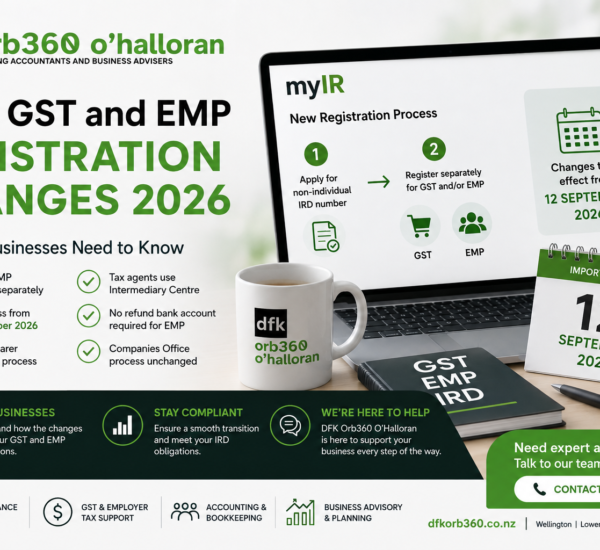
myIR GST and EMP Registration Changes 2026: What NZ Businesses Need to Know
Inland Revenue (IRD) is changing the way businesses register for GST and employer tax (EMP) through myIR from 12 September 2026. The change means businesses using the non-individual IRD number registration process will no longer be able to register for GST and EMP at the same time.
Instead, the business will need to complete its non-individual IRD number application first and then register separately for GST and/or EMP.
For businesses, employers, tax agents and advisers, understanding the myIR GST and EMP registration changes 2026 can help avoid confusion when setting up new tax accounts.
DFK Orb360 O’Halloran helps New Zealand businesses with GST, tax compliance, IRD matters, accounting and business advisory. If you’re unsure how these changes affect your business, our team can help you understand your registration and compliance requirements.
myIR GST and EMP Registration Changes 2026
From 12 September 2026, businesses applying for a non-individual IRD number will no longer be able to register for GST or employer tax (EMP) during the same application. The business must first complete its IRD number application and then apply separately for GST and/or EMP.
Tax agents and other intermediaries will access GST and EMP registrations through the Intermediary Centre under “client registration.” Restricted users will not have access to registrations in the Intermediary Centre.
IRD is also introducing a dedicated online registration for certain non-resident businesses dealing with GST on remote services and low-value imported goods.
Key Takeaways
- GST and EMP registration will be separated from the non-individual IRD number application.
- The changes take effect from 12 September 2026.
- Businesses will complete the IRD number application first.
- GST and EMP will then be registered separately.
- Tax agents will use the Intermediary Centre for client registrations.
- A refund bank account will no longer be required when registering for EMP.
- The Companies Office incorporation process is not changing.
- Businesses should review their registration process before the changes take effect.
Need Help With Your GST or IRD Registration?
Not sure how the new myIR registration process affects your business?
DFK Orb360 O’Halloran can help with GST registration, employer tax, IRD compliance, tax planning and ongoing accounting support.
Complete the form below and our team will get in touch.
What Are the myIR GST and EMP Registration Changes 2026?
The myIR GST and EMP registration changes 2026 change how businesses register for GST and employer tax when applying for a non-individual IRD number.
Previously, GST and EMP registration could be completed as part of the non-individual IRD number application process.
From 12 September 2026, that option will be removed. Businesses will need to complete their IRD number application first and then complete separate GST and EMP registrations where applicable.
IRD says the change is part of its work to organise business registration services into logical groups and reflects the relatively low number of customers using the combined registration option.
Read the official IRD announcement →
7 Important myIR GST and EMP Registration Changes for Businesses
1. GST Registration Will Be Separate
Businesses using the non-individual IRD number registration process will no longer be able to register for GST at the same time.
The IRD number application must be completed first, followed by the separate GST registration.
2. EMP Registration Will Be Separate
Employer tax registration will also be separated from the non-individual IRD number application.
If your business becomes an employer and needs an EMP account, you will need to complete the separate registration process after the IRD number application.
3. Tax Agents Will Use the Intermediary Centre
For tax agents and other intermediaries, GST and EMP registrations will be available through the Intermediary Centre under “client registration.”
This means accounting firms and tax advisers should become familiar with the updated workflow before the change takes effect.
4. EMP Registration No Longer Requires a Refund Bank Account
One of the changes is that a refund bank account will no longer be required when registering for EMP.
5. Restricted Users Will Not Have Registration Access
Restricted users will not have access to registrations within the Intermediary Centre.
Businesses and accounting firms using multiple myIR users should therefore review their user access and responsibilities.
6. A New Registration Is Being Introduced for Certain Overseas Businesses
IRD is introducing a dedicated online registration called “Register for GST as an overseas business.”
This applies to certain non-resident businesses dealing with GST on:
- Remote services (GORS)
- Low-value imported goods (LVIG)
7. The Companies Office Process Is Not Changing
The Companies Office process is not changing.
Companies incorporating through the Companies Office can still register for GST and EMP when applying for their company IRD number.
How Will the myIR Changes Affect NZ Businesses?
For most businesses, the biggest practical change is the order in which registration steps are completed.
Instead of completing the IRD number, GST and EMP registrations together, businesses using the affected process will need to complete the IRD number application first and then complete the relevant tax registrations separately.
This is particularly important when setting up a new business that intends to register for GST or employ staff soon after starting operations.
What Should Businesses Do Before 12 September 2026?
1. Review Your Tax Registration Requirements
Determine whether your business needs to register for GST, employer tax or other tax accounts.
2. Understand the New Registration Sequence
Make sure your team understands that the IRD number application comes first, followed by separate GST and EMP registrations.
3. Check Your myIR Access
If several people manage your business’s tax affairs, review who has access to myIR and what they are authorised to do.
4. Tax Agents Should Review Client Processes
Accounting firms and tax agents should familiarise themselves with the Intermediary Centre and the new client registration workflow.
5. Get Professional Advice If You’re Unsure
If you are unsure whether your business needs GST or EMP registration, speak with an accountant or tax adviser before registering.
Need Help With GST, EMP or IRD Compliance?
The myIR GST and EMP registration changes 2026 are only one part of your business’s wider tax and compliance responsibilities.
DFK Orb360 O’Halloran provides practical accounting and tax support for businesses across Wellington, Lower Hutt, Petone and throughout New Zealand.
Our team can help with:
- GST registration and GST returns
- Employer tax and PAYE support
- Business and personal tax returns
- IRD correspondence
- IRD compliance support
- Tax planning and advisory
- Financial reporting
- Bookkeeping and accounting
- Business advisory
People Also Ask About myIR GST and EMP Registration Changes 2026
Can I still register for GST when applying for a business IRD number?
From 12 September 2026, businesses using the non-individual IRD number registration process will no longer be able to register for GST during the same application. The IRD number application must be completed first, followed by a separate GST registration.
Can I still register for EMP when applying for an IRD number?
No. From 12 September 2026, EMP registration will be separated from the non-individual IRD number application. Businesses will need to complete the EMP registration separately.
When do the myIR GST and EMP registration changes 2026 start?
The myIR GST and EMP registration changes 2026 take effect from 12 September 2026.
Where will tax agents register clients for GST and EMP?
Tax agents and other intermediaries will use the Intermediary Centre under “client registration.”
Do I need a refund bank account to register for EMP?
No. IRD says a refund bank account will no longer be required when registering for EMP from 12 September 2026.
Are Companies Office registrations changing?
No. The Companies Office process is not changing. Companies can still register for GST and EMP when applying for their company IRD number through the Companies Office process.
What is the new GST registration for overseas businesses?
IRD is introducing a dedicated online registration called “Register for GST as an overseas business” for certain non-resident businesses dealing with GST on remote services and low-value imported goods.
Official Resources for GST and Employer Tax
For the latest requirements, businesses should check the official Inland Revenue information and confirm their individual circumstances with a qualified tax professional.
Not Sure How the New IRD Registration Rules Affect Your Business?
Setting up the right tax accounts is an important part of starting and running a compliant New Zealand business.
If you need help with GST registration, employer tax, myIR, tax compliance or wider accounting requirements, DFK Orb360 O’Halloran can help you understand your obligations and plan your next steps.
Don’t wait until an IRD issue becomes a problem.
Disclaimer
This article provides general information about the myIR GST and EMP registration changes announced by Inland Revenue. It is not personalised tax, legal, financial or accounting advice.
Tax requirements depend on your business structure, activities and individual circumstances. Always check the latest information with Inland Revenue or seek professional advice before making tax or registration decisions.



 09 377 4238
 Level 2, 6 Kingdon Street, Newmarket, Auckland
 help@orb360.co.nz