

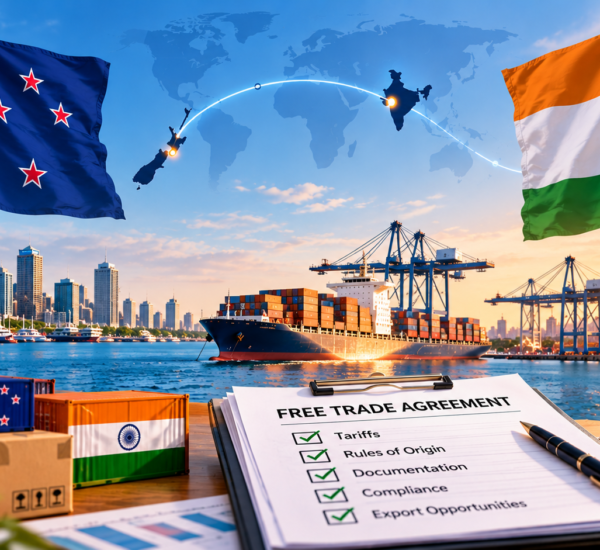
The New Zealand India Free Trade Agreement creates new opportunities for eligible exporters looking to access the Indian market. However, businesses should not assume that every product automatically qualifies for reduced or zero tariffs. Product classification, rules of origin, customs documentation and other import requirements can all affect whether a shipment receives preferential treatment.
New Zealand exporters should verify their product’s tariff treatment, confirm the correct HS code, check rules of origin, obtain the required supporting documentation, calculate landed costs, review Indian import requirements and assess their financial and tax position before shipping goods.
The New Zealand–India Free Trade Agreement entered into force on 20 October 2026. For businesses considering exporting to India, understanding how the agreement applies to individual products is an important part of planning a commercially viable expansion.
This guide explains seven practical steps New Zealand businesses should take before relying on FTA benefits and how DFK Orb360 O’Halloran Chartered Accountants can help with relevant business, accounting and tax considerations.
What Is the New Zealand India Free Trade Agreement?
The New Zealand India Free Trade Agreement is intended to improve trade and economic cooperation between the two countries. It provides preferential tariff treatment for eligible goods according to the agreement’s product schedules and applicable rules.
New Zealand’s Ministry of Foreign Affairs and Trade states that 95% of New Zealand’s current exports to India will receive tariff-free or significantly reduced-tariff treatment over time. The actual benefit for an individual exporter depends on the product, tariff schedule, eligibility conditions and implementation timeline.
Businesses should consult the official guidance before making pricing or shipping decisions:
- New Zealand–India Free Trade Agreement — MFAT
- New Zealand–India Free Trade Agreement — New Zealand Customs
7 Steps New Zealand Exporters Should Take Before Claiming FTA Benefits
1. Check Your Product’s Tariff Rate
Start by confirming the tariff treatment that applies to your specific product under the New Zealand India Free Trade Agreement. Tariff reductions may vary by product and may be phased in over time.
Do not assume that a general statement about tariff-free trade means your product qualifies immediately. Check the relevant schedule and confirm the rate that applies on the date of import.
2. Confirm Your Product’s HS Code
The Harmonised System (HS) code is used to classify traded goods for customs purposes. Correct classification is important because tariff treatment and import requirements can depend on the product’s classification.
Before shipping, review the product description, composition, intended use and relevant classification guidance. If classification is uncertain, seek advice from an appropriately qualified customs specialist.
3. Understand the Rules of Origin
Preferential tariff treatment is generally available only when goods meet the applicable rules of origin under the agreement. These rules determine whether a product qualifies based on factors such as where it was produced, the materials used and any relevant processing.
Businesses should understand the requirements for their product and maintain evidence to support any claim. Goods shipped from New Zealand do not necessarily qualify as originating goods simply because they are exported from New Zealand.
4. Prepare the Required Origin and Customs Documents
Exporters and importers should identify the origin documentation and customs information required to claim preferential treatment. Depending on the agreement and shipment, relevant records may include origin evidence, commercial invoices, packing lists, transport documents and other supporting information.
Check the official agreement and customs guidance for the precise requirements that apply to your transaction. Incorrect or incomplete documentation can delay clearance or affect eligibility for preferential rates.
5. Calculate the Full Landed Cost
Tariff savings are only one component of the total cost of exporting. Before agreeing on a selling price, calculate the expected landed cost of your goods in India.
| Cost component | What to check |
|---|---|
| Product cost | Manufacturing, sourcing and packaging costs. |
| Freight and insurance | Transport, shipping insurance and handling charges. |
| Customs duties | The applicable tariff rate and any eligible FTA preference. |
| Taxes and other charges | Applicable import taxes, customs fees and other charges. |
| Compliance costs | Required testing, documentation, product approvals and professional advice. |
| Foreign exchange | Currency conversion costs and potential exchange-rate fluctuations. |
A clear landed-cost calculation helps businesses assess pricing, margins and whether entering the Indian market is commercially viable.
6. Check Indian Import Regulations
Preferential tariffs do not remove all product regulations. Depending on the goods, exporters and their Indian import partners may need to consider product standards, labelling, testing, licences, biosecurity requirements or other regulatory approvals.
Requirements vary by product category. Confirm the applicable Indian import rules before production, dispatch or delivery commitments.
7. Review Your Business Structure, Tax and Cash Flow
International expansion can affect a business’s financial position, working capital and tax obligations. New Zealand exporters should consider the impact of payment terms, currency movements, freight costs, credit risk and the timing of customer receipts.
Businesses should also review the relevant New Zealand tax treatment, including GST where applicable, and consider whether their proposed activities create additional cross-border tax or reporting questions.
Where an expansion involves a local office, employees, a subsidiary or related-party transactions, seek appropriate advice on the potential implications in both jurisdictions.
Which New Zealand Industries Could Explore the Indian Market?
Depending on market demand and product eligibility, New Zealand businesses may investigate opportunities in areas such as:
- Horticulture and selected food products
- Forestry and timber products
- Wool and other eligible agricultural products
- Food ingredients and specialised products
- Agritech and related technologies
- Professional and digital services, subject to the relevant rules
The right opportunity depends on customer demand, competition, applicable regulations, distribution arrangements and the economics of serving the target market. Businesses should validate these factors before investing in expansion.
How Can DFK Orb360 Help With New Zealand–India Business Expansion?
Understanding the New Zealand India Free Trade Agreement is one part of an international growth strategy. Businesses also need to plan their financial structure, tax compliance, cash flow and ongoing reporting obligations.
DFK Orb360 O’Halloran Chartered Accountants can support businesses with relevant accounting and business advisory needs, including:
- Business establishment and structuring: Assessing suitable structures for business growth.
- Cross-border tax considerations: Reviewing relevant New Zealand tax issues and double tax agreement implications.
- GST, PAYE and compliance: Supporting applicable New Zealand registration, reporting and compliance requirements.
- Cash flow forecasting: Planning working capital and evaluating the financial impact of international trading.
- Market-entry financial planning: Reviewing costs, investment requirements and business risks.
- Ongoing accounting and advisory: Supporting financial planning as your business develops.
Customs classification, formal origin determinations and Indian legal or regulatory matters may require specialist advice from the relevant authorities or appropriately qualified professionals.
Planning to Export to India? Get Your Business Ready Before You Ship.
Don’t let overlooked tax obligations, unexpected costs or incomplete planning undermine your international expansion. Before committing to a shipment or entering a new market, make sure your business understands the financial and compliance considerations involved.
DFK Orb360 O’Halloran can help you assess your business structure, cash flow, accounting and relevant New Zealand tax considerations as you explore opportunities in India.
Tell us about your business, your expansion plans and the support you need. Our team can discuss the next steps relevant to your circumstances.
Prefer to speak with our team?
Email: help@orb360.co.nz
Phone: +64 9 377 4238
Frequently Asked Questions About the New Zealand India Free Trade Agreement
When did the New Zealand–India Free Trade Agreement come into force?
The agreement entered into force on 20 October 2026. Businesses should consult the official agreement and relevant tariff schedules to confirm the rules applicable to their products and transactions.
Do all New Zealand exports qualify for zero tariffs in India?
No. Preferential treatment depends on the relevant product schedule, implementation timeline and applicable eligibility conditions, including rules of origin. Exporters should verify the tariff rate for their specific product.
What is an HS code, and why does it matter?
An HS code is a classification code used in international trade. It helps determine how goods are classified for customs purposes and can affect tariff treatment and import requirements.
What are rules of origin under a free trade agreement?
Rules of origin determine whether goods qualify as originating in a country or territory under the agreement. They may consider where goods are produced, their materials and the processing undertaken.
Does the New Zealand–India FTA eliminate all import taxes?
No. The agreement provides preferential tariff treatment for eligible goods, but other applicable taxes, customs procedures, fees and product regulations may still apply.
What documents should exporters prepare before shipping to India?
Depending on the transaction, documents may include commercial invoices, packing lists, transport documents, origin evidence and other customs or regulatory records. Exporters should verify the precise requirements for their products and shipments.
Can an accountant help with exporting from New Zealand to India?
An accountant or business adviser can help review business structures, cash flow, financial planning and relevant tax obligations. Customs classification and formal tariff eligibility should be checked with the appropriate customs authorities or specialists.
How can DFK Orb360 help New Zealand businesses exploring India?
DFK Orb360 O’Halloran Chartered Accountants can assist with accounting, business structuring, cash flow forecasting, relevant tax considerations and market-entry financial planning. The scope of support depends on the business’s circumstances.
Take the Next Step Towards International Growth
The New Zealand India Free Trade Agreement may create opportunities for eligible exporters, but successful expansion starts with informed decisions and careful planning.
Whether you are preparing your first shipment, evaluating a new market or reviewing your financial readiness, DFK Orb360 O’Halloran can help you understand the relevant business and accounting considerations.
Complete the form below to request a free consultation with our team.
Book a Free Consultation
Share your details and tell us about your business expansion plans. The DFK Orb360 team can follow up to discuss your accounting and business advisory needs.
This article provides general information only and is not a substitute for personalised tax, legal, customs or trade advice. Tariff eligibility, origin requirements and tax treatment depend on the specific products, transactions and applicable rules. Verify requirements with the relevant authorities before relying on preferential treatment.



 09 377 4238
 Level 2, 6 Kingdon Street, Newmarket, Auckland
 help@orb360.co.nz