

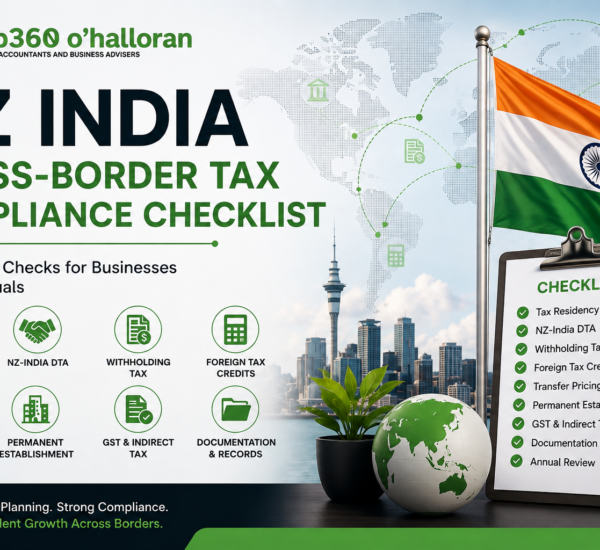
NZ India Cross-Border Tax Compliance Checklist: 15 Essential Checks
Businesses and individuals dealing with income, investments, employees or transactions between New Zealand and India can face tax obligations in both countries.
This NZ India cross-border tax compliance checklist provides a practical framework for reviewing the main issues, including tax residency, the NZ-India Double Tax Agreement, withholding tax, foreign income, foreign tax credits, permanent establishment, transfer pricing and record keeping.
New Zealand and India have a Double Tax Agreement that has been in force since 1986, with subsequent protocols updating the agreement.
Important: Cross-border tax treatment depends on the facts of each individual or business. This checklist provides general information and is not personalised tax advice.
NZ India Cross-Border Tax Compliance Checklist
The NZ India cross-border tax compliance checklist helps businesses and individuals identify the major tax issues that can arise when financial activities, services, employees, investments or business operations involve both countries.
The most important areas to review are:
- Tax residency
- NZ-India Double Tax Agreement
- Income classification
- Permanent establishment
- Withholding tax
- Foreign income reporting
- Foreign tax credits
- Transfer pricing
- Related-party transactions
- GST and indirect taxes
- Cross-border employees
- International payments
- Tax documentation
- Filing obligations
- Annual compliance reviews
New Zealand tax residents generally pay tax on worldwide income, including relevant overseas income. If the same income is taxed in another country, a foreign tax credit may be available, subject to applicable limits.
How to Use the NZ India Cross-Border Tax Compliance Checklist
The NZ India cross-border tax compliance checklist can be used before entering into new cross-border transactions, establishing a company, hiring employees or making payments between New Zealand and India.
Start by confirming tax residency and identifying the type of income or transaction involved. Then review the NZ-India Double Tax Agreement, withholding tax, foreign tax credits and any permanent establishment implications.
For businesses with related entities, the NZ India cross-border tax compliance checklist should also include transfer pricing, intercompany agreements and supporting documentation.
Quick Answer: What Should Be Checked for NZ-India Cross-Border Tax Compliance?
A business or individual with financial or commercial connections between New Zealand and India should review tax residency, the applicable tax treaty, income classification, withholding tax, foreign tax credits and reporting requirements.
Businesses should also consider permanent establishment, transfer pricing, related-party transactions, GST, employees and cross-border financing.
Why Do You Need an NZ India Cross-Border Tax Compliance Checklist?
Cross-border tax problems often occur because businesses focus on one tax issue while overlooking another.
For example, a New Zealand company paying an Indian related company may need to consider whether withholding tax applies, whether the payment is covered by the DTA, whether transfer pricing rules apply, whether GST is relevant and whether the arrangement could create a permanent establishment.
A structured NZ India cross-border tax compliance checklist helps ensure these issues are reviewed together.
1. Confirm Your Tax Residency
Tax residency should be the starting point of any NZ India cross-border tax compliance checklist.
Your tax residency can affect which country can tax your income, whether worldwide income must be reported, whether treaty benefits are available and whether foreign tax credits can be claimed.
Tax Residency Checklist
- ☐ Determine your New Zealand tax residency
- ☐ Determine your Indian tax residency where relevant
- ☐ Check whether dual residency could arise
- ☐ Review the DTA residence provisions
- ☐ Keep supporting residency documentation
2. Identify Every Type of NZ-India Income
The next step in the NZ India cross-border tax compliance checklist is identifying exactly what money is moving between the countries.
Possible income categories include:
- Business profits
- Dividends
- Interest
- Royalties
- Technical or professional service fees
- Employment income
- Rental income
- Investment income
- Capital gains
- Other cross-border payments
This classification matters because different treaty provisions and domestic tax rules can apply to different types of income.
3. Review the NZ-India Double Tax Agreement
The NZ-India DTA is central to many cross-border tax situations.
The agreement covers matters including:
- Residence
- Business profits
- Permanent establishments
- Dividends
- Interest
- Royalties
- Employment income
- Other income
- Double-tax relief
NZ-India DTA Checklist
- ☐ Identify the relevant treaty article
- ☐ Confirm treaty residence
- ☐ Determine which country has taxing rights
- ☐ Check treaty withholding limits
- ☐ Review double-tax relief
- ☐ Check special treaty requirements
A DTA does not automatically mean that income is tax-free. It generally coordinates taxing rights and provides mechanisms for relieving double taxation.
4. Check for a Permanent Establishment
A permanent establishment, or PE, can be a major issue when a company expands between New Zealand and India.
Having customers in another country does not automatically mean a business has a PE there. The actual activities and circumstances need to be examined.
Potential PE Factors
- Offices
- Branches
- Fixed places of business
- Employees
- Agents
- Contract activities
- Services performed locally
- Business operations
PE Checklist
- ☐ Does the business have premises overseas?
- ☐ Are employees regularly working there?
- ☐ Are contracts negotiated or concluded there?
- ☐ Does an agent operate on behalf of the business?
- ☐ Are services performed in the other country?
- ☐ Could the activities create a taxable presence?
5. Review NZ India Withholding Tax
Withholding tax should be reviewed before making certain payments across the border.
For NZ DTA purposes, IRD’s current table lists the following rates for India:
| Payment | DTA Rate Shown by IRD |
|---|---|
| Interest | 10% |
| Dividends | 15% |
| Royalties | 10% |
These rates should not be applied blindly. The payment must first be correctly classified and the relevant domestic and treaty rules considered.
Withholding Tax Checklist
- ☐ Identify the payment
- ☐ Confirm recipient’s tax residence
- ☐ Check the DTA
- ☐ Determine whether withholding applies
- ☐ Confirm the correct rate
- ☐ Keep evidence supporting the rate
- ☐ File and pay withholding correctly
6. Don’t Assume There Is One NZ India Tax Rate
A common cross-border mistake is searching for one universal NZ India tax rate.
There isn’t one.
The applicable treatment can depend on:
Type of income + residence + domestic law + DTA + transaction facts
For example, interest, dividends and royalties can have different treaty outcomes.
This is why an NZ India cross-border tax compliance checklist should identify the payment type before determining the tax treatment.
7. Check Foreign Tax Credits
Double taxation can occur when the same income is taxed in both countries.
New Zealand’s rules can provide foreign tax credits where overseas tax has been paid on income that is also taxable in New Zealand, subject to applicable limitations.
Foreign Tax Credit Checklist
- ☐ Identify the overseas income
- ☐ Confirm Indian tax paid
- ☐ Keep evidence of Indian tax paid
- ☐ Determine NZ tax on the same income
- ☐ Review the DTA
- ☐ Calculate the allowable credit
- ☐ Include the relevant information in the NZ tax return
A foreign tax credit is not necessarily a dollar-for-dollar refund of all foreign tax paid. Limits can apply.
8. Report Indian Income Correctly in New Zealand
If you are a New Zealand tax resident, overseas income may need to be included in your NZ tax return.
Examples include:
- Indian bank interest
- Indian dividends
- Indian rental income
- Indian business income
- Overseas salary
- Foreign pensions
- Other overseas investment income
Relevant overseas income may need to be reported in New Zealand even where the income remains overseas.
9. Review Transfer Pricing
Transfer pricing becomes particularly important where a New Zealand company and Indian company are related.
Examples include:
- NZ parent and Indian subsidiary
- Indian parent and NZ subsidiary
- Management fees
- IT services
- Marketing services
- Royalties
- Intercompany loans
- Guarantees
- Intellectual property arrangements
- Goods supplied between related entities
Relevant associated-party transactions should be reviewed under applicable arm’s-length requirements.
Transfer Pricing Checklist
- ☐ Identify related-party transactions
- ☐ Review intercompany agreements
- ☐ Identify functions, assets and risks
- ☐ Determine pricing methodology
- ☐ Keep supporting calculations
- ☐ Review arrangements annually
10. Review Cross-Border Management and Service Fees
Consider an Indian parent company charging its New Zealand subsidiary for IT and management services.
The business should be able to demonstrate:
- What service was provided?
- Who provided it?
- Who benefited?
- How was the fee calculated?
- Why is the fee commercially reasonable?
A clear paper trail can be important if the arrangement is later reviewed.
11. Check Cross-Border Loans and Interest
Related-party financing between NZ and India can create additional tax issues.
- Interest withholding tax
- Transfer pricing
- Interest limitation rules
- Thin capitalisation
- Debt versus equity
- Loan agreements
- Guarantee arrangements
Financing Checklist
- ☐ Written loan agreement
- ☐ Commercial interest rate
- ☐ Transfer pricing review
- ☐ Withholding tax review
- ☐ Interest limitation review
- ☐ Relevant thin-capitalisation review
- ☐ Supporting documentation
12. Review GST and Indirect Taxes
Income tax is only one part of NZ India cross-border tax compliance.
Businesses should separately consider:
- New Zealand GST
- Indian GST
- Import taxes
- Export requirements
- Customs
- Digital services
- Place-of-supply rules
The treatment can depend on what is being supplied, where the supplier is located, where the customer is located and where services are performed.
An income-tax treaty should not be assumed to resolve GST issues.
13. Check Employees Working Between NZ and India
Employees travelling or working between New Zealand and India can create tax issues for both the employee and employer.
Review:
- Tax residency
- Physical work location
- Days spent in each country
- Employer location
- Payroll
- Withholding
- Treaty employment provisions
- Permanent-establishment risk
Employee Checklist
- ☐ Track travel days
- ☐ Determine tax residence
- ☐ Review treaty provisions
- ☐ Review payroll obligations
- ☐ Assess PE risk
- ☐ Keep employment records
14. Maintain Your NZ India Tax Documentation
Good documentation should be a core part of your NZ India cross-border tax compliance checklist.
Corporate Records
- Company registration
- Ownership structure
- Group structure
- Shareholding information
Tax Records
- NZ tax returns
- Indian tax returns
- Tax residency certificates
- Foreign tax payment records
- Withholding certificates
Transaction Records
- Contracts
- Invoices
- Service agreements
- Loan agreements
- Intercompany agreements
- Royalty agreements
Operational Records
- Employee travel
- Work locations
- Customer agreements
- PE analysis
15. Review NZ India Tax Compliance Every Year
Cross-border tax compliance should not be treated as a one-time exercise.
Your position may change when:
- A subsidiary is established
- Employees relocate
- A new service is introduced
- Intercompany fees change
- Financing changes
- Ownership changes
- The company expands
- Tax legislation changes
- Treaty provisions change
Annual Review Question
Has anything changed in our ownership, people, transactions, business activities or tax residency since last year?
If yes, your NZ India cross-border tax compliance checklist should be reviewed again.
15-Point NZ India Cross-Border Tax Compliance Checklist
Use this NZ India cross-border tax compliance checklist as a starting point when reviewing your international tax position. The exact requirements will depend on your business structure, transactions and tax residency.
NZ India Cross-Border Tax Compliance Checklist
| Compliance Area | Check |
|---|---|
| NZ and Indian tax residency | ☐ |
| NZ-India DTA | ☐ |
| Income classification | ☐ |
| Permanent establishment | ☐ |
| Withholding tax | ☐ |
| Foreign income reporting | ☐ |
| Foreign tax credits | ☐ |
| Transfer pricing | ☐ |
| Related-party transactions | ☐ |
| Cross-border services | ☐ |
| Financing | ☐ |
| GST and indirect tax | ☐ |
| Employees and contractors | ☐ |
| Tax documentation | ☐ |
| Annual review | ☐ |
Example: NZ Company Paying an Indian Parent
Imagine a New Zealand company pays its Indian parent for IT and management services.
Before treating the payment as an ordinary business expense, the company should ask:
Step 1 — What Is the Payment For?
Identify the actual service being provided.
Step 2 — Are the Companies Related?
If yes, transfer pricing may need to be considered.
Step 3 — Is Withholding Tax Relevant?
Review the payment under domestic law and the NZ-India DTA.
Step 4 — Is the Amount Arm’s Length?
Maintain evidence supporting the pricing.
Step 5 — Could There Be a PE?
Consider the activities of Indian employees or representatives working in New Zealand.
Step 6 — Is GST Relevant?
Review GST separately from income tax.
Example: NZ Resident Receiving Indian Business Income
Suppose a New Zealand tax resident owns an Indian business or receives income from India.
The person may need to consider:
- Indian tax
- NZ worldwide-income rules
- NZ-India DTA
- Foreign tax credits
- Indian withholding
- Business structure
- NZ reporting
- Supporting documentation
Common NZ-India Tax Compliance Mistakes
Assuming the DTA Means No Tax
A DTA generally allocates taxing rights and provides mechanisms for relieving double taxation. It does not automatically make income tax-free.
Using the Wrong Withholding Rate
The correct rate depends on the nature of the payment and applicable domestic and treaty rules.
Forgetting Overseas Income
NZ tax residents generally need to consider worldwide income.
Claiming Foreign Tax Credits Without Evidence
Foreign tax paid needs to be properly supported.
Ignoring Transfer Pricing
Related-party cross-border transactions should be reviewed carefully.
Assuming a Customer Automatically Creates a PE
Customer location alone does not necessarily establish a permanent establishment.
Treating GST and Income Tax as the Same
They are separate tax systems and should be assessed separately.
What Documents Should You Keep?
A good cross-border tax file may include:
- Tax residency certificates
- NZ tax returns
- Indian tax returns
- Contracts
- Invoices
- Intercompany agreements
- Loan agreements
- Withholding certificates
- Foreign tax payment evidence
- Transfer pricing documentation
- Employee travel records
- Corporate structure information
When Should You Get Professional NZ-India Tax Advice?
Consider professional advice if:
- You are expanding into India
- An Indian company is expanding into NZ
- You have related companies in both countries
- You receive significant Indian income
- You have employees working across borders
- You are making substantial cross-border payments
- You pay royalties or technical fees
- You have intercompany loans
- You may have a PE
- You need foreign tax credits
- You are restructuring your international business
How DFK Orb360 Can Help With NZ-India Cross-Border Tax
Cross-border tax compliance becomes more complicated when a business has operations, employees, shareholders, related companies or income in both New Zealand and India.
DFK Orb360 can help businesses assess areas including:
- Cross-border tax compliance
- NZ-India tax planning
- Double taxation
- Foreign tax credits
- Withholding tax
- Transfer pricing
- Business structures
- Permanent establishment
- International accounting
- Cross-border transactions
- NZ tax reporting
Need Help With Your NZ-India Tax Position?
If your business operates between New Zealand and India, getting your structure reviewed before significant transactions occur can help identify potential compliance issues early.
Who Should Use This NZ India Cross-Border Tax Compliance Checklist?
The NZ India cross-border tax compliance checklist can be useful for a range of taxpayers and businesses, including:
- New Zealand companies expanding into India
- Indian companies establishing operations in New Zealand
- NZ residents receiving income from India
- Businesses with NZ and Indian subsidiaries
- Companies making payments to related entities overseas
- Businesses employing people across both countries
- Investors with cross-border income
- Businesses involved in international trade
People Also Ask: NZ-India Cross-Border Tax
What is NZ India cross-border tax?
NZ India cross-border tax refers to the tax rules that apply when an individual or business has income, transactions, investments, employees or business operations connected with both countries.
Does New Zealand have a tax treaty with India?
Yes. New Zealand and India have a Double Tax Agreement that has been in force since 1986, with subsequent protocols updating the agreement.
Do NZ tax residents pay tax on Indian income?
Generally, NZ tax residents pay tax on worldwide income, which can include relevant Indian income.
Can Indian tax be claimed as a foreign tax credit in NZ?
Potentially. NZ foreign tax credit rules and the NZ-India DTA can provide relief where the same income is taxed in both countries, subject to applicable limitations.
What is the NZ India withholding tax rate?
There is no single rate for every cross-border payment. The applicable rate depends on the type of payment, recipient status and relevant domestic and treaty rules.
Does the NZ India DTA prevent double taxation?
The DTA provides mechanisms for relieving double taxation, including provisions that can allow foreign tax credits.
Can an Indian company create a permanent establishment in NZ?
Potentially. The answer depends on the company’s activities, the treaty and New Zealand’s domestic rules.
Does transfer pricing apply to NZ India transactions?
It can apply to relevant cross-border transactions between associated parties. Businesses should review arm’s-length requirements and documentation.
Do NZ companies have to withhold tax when paying Indian companies?
Potentially. The obligation depends on the type of payment, recipient status and applicable domestic and treaty rules.
What documents should I keep for NZ India tax compliance?
Keep contracts, invoices, tax returns, residency certificates, withholding evidence, foreign tax records, intercompany agreements, financing documents and transfer-pricing support where relevant.
Final NZ India Cross-Border Tax Compliance Checklist
- ☐ Have we confirmed our tax residency?
- ☐ Have we identified all NZ-India income and transactions?
- ☐ Have we reviewed the NZ-India DTA?
- ☐ Have we assessed PE risk?
- ☐ Have we checked withholding tax?
- ☐ Have we reported overseas income correctly?
- ☐ Have we calculated foreign tax credits correctly?
- ☐ Have we reviewed related-party transactions?
- ☐ Is our transfer pricing supportable?
- ☐ Have we reviewed GST?
- ☐ Have we reviewed cross-border employees?
- ☐ Do we have sufficient documentation?
- ☐ Have we reviewed our international structure for the current year?
Key Takeaway
The NZ India cross-border tax compliance checklist is designed to help businesses and individuals identify the major tax issues that can arise when financial activities span New Zealand and India.
The most important areas are tax residency, the NZ-India DTA, income classification, withholding tax, foreign tax credits, permanent establishment, transfer pricing, GST and documentation.
New Zealand tax residents generally need to consider worldwide income, while the NZ-India DTA can affect how particular types of income are taxed and how double taxation is relieved.
If your business has significant NZ-India transactions, obtaining professional advice before making major payments, restructuring or expanding can help identify potential tax risks early.
Official Sources
Tax Disclaimer
This article provides general information about New Zealand-India cross-border taxation. It is not personalised tax, accounting, financial or legal advice.
Tax laws, treaty provisions and administrative requirements can change. The appropriate treatment depends on the specific circumstances of each taxpayer and transaction.
Always check current Inland Revenue guidance and applicable legislation, or obtain professional advice before relying on a particular tax treatment.