

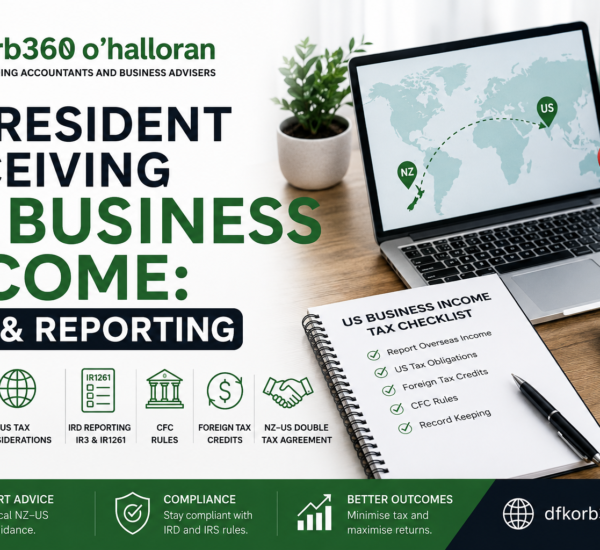
NZ Resident Receiving US Business Income: Tax & Reporting
If you are a NZ resident receiving US business income, understanding your tax and reporting obligations is important. Receiving payments from a US business or operating a business with US customers can create tax considerations in both New Zealand and the United States.
Your obligations can depend on how the income is earned, where you perform your work, the structure of the business, your New Zealand tax residency, the source of the income and whether US tax has already been paid.
This guide explains the key NZ and US tax considerations for New Zealand residents receiving US business income, including IRD reporting, US tax, CFC rules, foreign tax credits and the NZ-US Double Tax Agreement.
Important: This article provides general information and is not personalised tax, accounting, financial or legal advice. Cross-border tax outcomes depend on individual circumstances.
NZ Resident Receiving US Business Income
A NZ resident receiving US business income generally needs to consider New Zealand tax on overseas income as well as any US tax obligations that may apply. New Zealand tax residents generally need to consider their worldwide income, even where the income remains overseas.
The correct treatment depends on how the income is earned. The position can differ if you operate a US business personally, receive income through a US company or LLC, receive partnership income, or provide services to a US business from New Zealand.
For NZ tax purposes, overseas income generally needs to be reported to Inland Revenue. Individuals with overseas income may need to complete an Overseas Income Summary (IR1261) alongside their IR3 return, depending on their circumstances.
US tax obligations depend on the nature and source of the income and whether you are considered to be engaged in a US trade or business. Income effectively connected with a US trade or business can generally be subject to US tax, while certain US-source passive income can be subject to withholding.
Where the same income is taxed in both countries, New Zealand may allow a foreign tax credit, subject to applicable rules and limitations.
Key Takeaways
- NZ tax residents generally need to consider worldwide income.
- US business income may need to be reported to IRD.
- An IR3 and Overseas Income Summary may be required.
- The US tax position depends on the business activity, income source and structure.
- US effectively connected income can be subject to US tax.
- US-source passive income can have different withholding treatment.
- A US LLC or company can create additional NZ tax considerations.
- CFC rules may apply where a NZ resident has sufficient ownership or control of a foreign company.
- Foreign tax credits may help relieve qualifying double taxation.
- The NZ-US Double Tax Agreement can affect how certain income is taxed.
In short: If you are a NZ resident receiving US business income, do not assume that US payments are taxable only in America. Your New Zealand tax residency, business structure, location of your activities and the type of income all need to be considered.
Need Help With US Business Income?
Are you a NZ resident receiving US business income and unsure about your IRD reporting, US tax obligations or foreign tax credits?
Speak with the DFK Orb360 O’Halloran team about your NZ-US tax position.
What Is US Business Income for a NZ Resident?
US business income can arise in several different ways.
For example, you might:
- Own a US company
- Own a US LLC
- Be a partner in a US partnership
- Operate a business that sells to US customers
- Provide consulting services to a US company
- Receive commissions from US clients
- Receive distributions from a US business
- Receive income from a US business you operate remotely from New Zealand
These situations can have very different tax consequences.
The first question is therefore not simply “Is the customer in the US?”
Instead, you need to establish:
- Who earns the income?
- Where are the services performed?
- What type of entity receives the income?
- Where is the business managed?
- Where is the income sourced?
- Is the income taxable in the US?
- How is the income treated under NZ tax law?
- Does the NZ-US Double Tax Agreement apply?
Does New Zealand Tax US Business Income?
Generally, NZ tax residents need to consider their worldwide income.
This means a NZ resident receiving US business income should not automatically assume that income is outside the New Zealand tax system.
For example, suppose you live in Wellington and operate a consulting business from New Zealand.
Your clients are located in the United States and pay you in USD into a US bank account.
You may still have New Zealand tax obligations because you are performing the business activity from New Zealand.
The location of the customer alone does not determine your NZ tax obligations.
For more information, see IRD’s guidance on overseas income .
How Do I Report US Business Income to IRD?
If you are a NZ tax resident receiving overseas income, you generally need to consider whether the income must be reported to Inland Revenue.
Individuals receiving overseas income may need to complete an Overseas Income Summary (IR1261) along with their IR3 return.
Reported information can include:
- Type of income
- Amount earned
- Overseas jurisdiction
- Foreign tax paid
- Foreign tax credits claimed
US dollars may also need to be converted into New Zealand dollars using an appropriate exchange-rate method.
IRD explains the reporting requirements for overseas income here: Reporting overseas income to IRD .
You can also read our related article: NZ Tax Resident With US Income: Tax & Foreign Tax Credits .
Do I Need to File an IR3 for US Business Income?
If you are an individual NZ tax resident receiving overseas income, an IR3 Individual Income Tax Return may be required.
IRD states that NZ residents receiving overseas income generally need to consider filing an IR3 and completing the Overseas Income Summary.
Your requirements can depend on:
- Your tax residency
- The type of business income
- Your business structure
- Whether you are self-employed
- Whether you own a foreign company
- Whether CFC rules apply
- Whether foreign tax was paid
It is important to distinguish between personal business income and income earned by a separate legal entity.
What If I Run My US Business From New Zealand?
This is one of the most important situations for NZ residents.
Imagine that you:
- Live permanently in New Zealand
- Have a US company
- Have US customers
- Use a US bank account
- Invoice US customers
- Perform your work from your home in New Zealand
It may be tempting to assume that because the company and customers are in the US, the income is US income only.
That assumption can be incorrect.
The location where business activities are actually performed and where the business is managed can be highly relevant.
You may need to consider:
- NZ income tax
- US federal tax
- US state tax
- CFC rules
- Permanent establishment rules
- Entity classification
- Related-party transactions
- GST
- Foreign tax credits
- The NZ-US Double Tax Agreement
Does the US Tax NZ Residents Receiving US Business Income?
Potentially.
US tax treatment depends heavily on whether the income is connected with a US trade or business and on the nature and source of the income.
The IRS explains that a foreign person engaged in a US trade or business can have Effectively Connected Income (ECI) that is taxable in the United States.
See IRS guidance on Effectively Connected Income .
This means the US tax analysis cannot be based solely on where you personally live.
What Is Effectively Connected Income?
Effectively Connected Income (ECI) is generally income that is effectively connected with a US trade or business.
For a nonresident alien, ECI is generally taxed on a net basis after allowable deductions at applicable graduated rates.
Examples can include income connected with:
- A US business
- Services performed in the US
- Certain US business activities
- Certain partnership interests
- Certain US real property activities
The IRS provides further information about the taxation of nonresident aliens: Taxation of Nonresident Aliens .
What Is FDAP Income?
Another important US tax concept is FDAP income, meaning Fixed, Determinable, Annual, or Periodical income.
It can include certain:
- Interest
- Dividends
- Rents
- Royalties
- Other passive income
The IRS states that US-source FDAP income that is not effectively connected with a US trade or business is generally subject to a 30% withholding rate unless a lower treaty rate or exemption applies.
See IRS guidance on income of nonresident aliens .
This is different from ECI, which is why identifying the type of income is important.
Do NZ Residents Need to File a US Tax Return?
Possibly.
US filing requirements depend on your circumstances.
For example, a nonresident alien who is engaged or considered to be engaged in a US trade or business may generally need to file Form 1040-NR.
See IRS information about Form 1040-NR .
The exact filing requirement can depend on:
- Your US tax status
- Type of income
- US business activities
- Amount of income
- Treaty position
- Whether tax was withheld
- Whether deductions or credits are being claimed
Do not assume that having a US customer automatically means you need a US personal tax return.
Likewise, do not assume that no US return is required simply because you live in New Zealand.
What If My US Customers Pay Me Into a US Bank Account?
The location of the bank account does not automatically determine where the income is taxable.
For example, imagine:
- You live in Auckland.
- You provide marketing services from Auckland.
- Your clients are based in the United States.
- Your clients pay USD into a US bank account.
- You later transfer the funds to New Zealand.
The fact that the money first went into a US bank account does not by itself determine the NZ tax treatment.
Your tax residency, the nature of the services and applicable source and treaty rules need to be considered.
What If I Receive Income Through a US LLC?
A US LLC requires particular care.
An LLC can have different classifications for US tax purposes depending on its ownership and elections.
For example, an LLC can potentially be treated as:
- A disregarded entity
- A partnership
- A corporation
The US classification does not necessarily mean that New Zealand will automatically treat the entity in exactly the same way.
Therefore, a NZ resident receiving US business income through an LLC should have the structure reviewed from both a New Zealand and US tax perspective.
If you are considering setting up an LLC, obtaining advice before incorporation can help identify potential cross-border tax issues early.
Could NZ Controlled Foreign Company Rules Apply?
Yes, potentially.
CFC rules can be important where a NZ resident owns or controls a foreign company.
IRD explains that CFCs are overseas companies controlled by NZ residents and that individuals with an income interest of 10% or more in a CFC may need to consider the CFC rules.
The treatment can depend on whether the foreign company is considered an active or non-active business.
See IRD’s Controlled Foreign Company guidance .
What If My US Company Keeps the Profits?
Leaving profits in a US company does not automatically mean there are no NZ tax considerations.
If the US entity is a foreign company controlled by NZ residents, CFC rules may need to be considered.
The analysis can depend on:
- Ownership
- Control
- Type of income
- Business activity
- Whether the company qualifies as active
- Whether an exemption applies
- The company’s tax residence
Therefore, do not automatically assume:
“The money stayed in the US, so I don’t have to report it in NZ.”
That may be incorrect depending on the structure and applicable tax rules.
Can I Claim US Tax Paid Against My NZ Tax?
Potentially, yes.
Where the same income has been taxed in both countries, New Zealand may allow a foreign tax credit, subject to applicable rules and limitations.
IRD explains that foreign tax credits can be limited by factors including:
- Tax paid to the overseas country
- NZ tax payable on the same income
- The amount allowed under the applicable Double Tax Agreement
You should keep evidence of foreign tax paid, such as US tax returns, withholding statements and tax payment records.
See IRD’s guidance on foreign tax credits .
How Does the NZ-US Double Tax Agreement Help?
The NZ-US Double Tax Agreement can help determine how certain types of cross-border income are taxed and how double taxation can be relieved.
However, the treaty does not mean that every US business payment is automatically exempt from NZ tax.
The relevant treaty provisions can depend on the type of income, including:
- Business profits
- Employment income
- Dividends
- Interest
- Royalties
- Permanent establishments
- Tax residency
- Foreign tax credits
Read our related guide: NZ-US Double Tax Agreement: How It Works .
What Records Should a NZ Resident Receiving US Business Income Keep?
Good records are essential for cross-border tax compliance.
Keep copies of:
- US invoices
- Customer contracts
- Business bank statements
- US bank statements
- Payment processor statements
- US tax returns
- US tax forms
- IRS correspondence
- NZ tax returns
- IR1261 forms
- Foreign tax credit calculations
- Exchange-rate calculations
- Business expenses
- Ownership documents
- LLC operating agreements
- Company incorporation documents
- Dividend statements
- Partnership statements
How Should US Income Be Converted to NZ Dollars?
If you receive US dollars, you generally need to convert the relevant income and expenses into New Zealand dollars for NZ tax reporting.
The appropriate exchange-rate method can depend on the circumstances and type of income.
Keep records showing:
- Date income was received
- USD amount
- Exchange rate used
- NZD equivalent
- Source of the exchange rate
Consistency and supporting documentation are important when preparing your NZ tax return.
What About GST on US Business Income?
GST should not automatically be ignored simply because your customers are located in the United States.
If you operate a business from New Zealand and supply services to overseas customers, you should consider whether the supplies are subject to New Zealand GST and whether zero-rating rules apply.
The GST treatment depends on the specific supply and circumstances.
See IRD’s GST guidance .
7 Common Tax Mistakes NZ Residents Make With US Business Income
1. Assuming US Customers Mean US-Only Tax
Where your customers are located is only one part of the tax analysis.
2. Forgetting to Report Overseas Income to IRD
NZ tax residents generally need to consider reporting relevant overseas income.
3. Ignoring US Filing Requirements
US filing obligations can arise depending on your activities and income.
4. Assuming a US LLC Is Automatically Tax-Efficient
The NZ and US tax treatment of an LLC can differ.
5. Leaving Profits Offshore Without Reviewing CFC Rules
Retaining profits in a foreign company does not automatically remove NZ tax considerations.
6. Claiming the Wrong Foreign Tax Credit
Foreign tax credits are subject to specific rules and limitations.
7. Mixing Personal and Business Transactions
Using business accounts for personal expenses can make accounting and tax reporting more difficult.
NZ Resident Receiving US Business Income: Tax Checklist
Before filing your NZ or US tax returns, ask:
- ☐ Am I a NZ tax resident?
- ☐ What type of US business income did I receive?
- ☐ Am I operating the business personally or through an entity?
- ☐ Where are my services physically performed?
- ☐ Where is the business managed?
- ☐ Do I have a US trade or business?
- ☐ Could the income be ECI?
- ☐ Could US withholding apply?
- ☐ Do I need to file a US tax return?
- ☐ Does the NZ-US Double Tax Agreement apply?
- ☐ Could NZ CFC rules apply?
- ☐ Have I reported the income on my NZ return?
- ☐ Do I need an IR1261?
- ☐ Did I pay US tax?
- ☐ Can I claim a foreign tax credit?
- ☐ Do I have evidence of US tax paid?
- ☐ Have I converted income and expenses correctly into NZD?
- ☐ Have I considered GST?
When Should You Get Professional NZ-US Tax Advice?
Professional advice can be particularly useful if you:
- Receive regular US business income
- Operate a US company
- Own a US LLC
- Own a significant interest in a US company
- Work for US customers from New Zealand
- Have US employees
- Maintain a US office
- Receive US dividends
- Receive US partnership income
- Pay US tax
- Need to claim foreign tax credits
- Have received an IRS notice
- Have received an IRD notice
- Recently moved to New Zealand
- Are a US citizen living in New Zealand
Cross-border tax becomes particularly complicated when business structure, tax residency and income source overlap.
Getting professional advice before filing can help identify potential issues early.
How DFK Orb360 Can Help With US Business Income
If you are a NZ resident receiving US business income, DFK Orb360 O’Halloran can help you understand your New Zealand tax and reporting obligations.
Our services can include:
- International tax advice
- Overseas income reporting
- NZ tax returns
- IR1261 reporting
- Foreign tax credit calculations
- CFC considerations
- Cross-border business tax
- US business structuring considerations
- Accounting and reporting
- IRD correspondence
- Tax planning
Whether you operate a US business from New Zealand or simply receive income from a US business, getting the NZ tax treatment right is important.
Need help with your US business income?
Talk to DFK Orb360 O’Halloran about your NZ-US tax position →
People Also Ask: NZ Resident Receiving US Business Income
Does a NZ resident have to pay tax on US business income?
Generally, a NZ tax resident needs to consider worldwide income for NZ tax purposes, including relevant US business income. The exact treatment depends on the type of income and how the business is structured.
Do I need to report US business income to IRD?
Generally, NZ residents receiving overseas income need to consider reporting it to Inland Revenue. Depending on the circumstances, an IR3 and Overseas Income Summary may be required.
Do I need to pay tax in both NZ and the US?
Potentially. The US and NZ may both have taxing rights depending on the income and circumstances. Foreign tax credits and the NZ-US Double Tax Agreement can help relieve qualifying double taxation.
Do I need a US tax return if I live in New Zealand?
Possibly. US filing obligations depend on your US tax status, business activities, income and other circumstances. A nonresident alien engaged in a US trade or business may generally need to file Form 1040-NR.
Is US business income automatically US-source income?
Not necessarily. The source and tax treatment of business income depend on the nature of the activity and applicable US tax rules. Where services are performed and whether the income is connected with a US trade or business can be important factors.
Can I claim US tax paid as a NZ tax credit?
Potentially. NZ may allow a foreign tax credit for qualifying overseas tax paid, subject to applicable limits and the relevant treaty. Evidence of foreign tax paid should be retained.
Does a US LLC have to be reported in New Zealand?
The answer depends on the LLC’s ownership, classification, income and activities. A NZ resident’s interest in a foreign company may also require consideration under NZ’s CFC rules.
What is ECI in US tax?
Effectively Connected Income is generally income connected with a US trade or business. For a nonresident alien, ECI is generally taxed on a net basis at applicable rates after allowable deductions.
Final Takeaway: NZ Resident Receiving US Business Income
Being a NZ resident receiving US business income can create tax and reporting obligations in both countries.
The most important points are:
- NZ tax residents generally need to consider worldwide income.
- US business income may need to be reported to IRD.
- An IR3 and IR1261 may be required.
- US tax obligations depend on the business activity and income type.
- ECI can be taxable in the US.
- Certain US-source income may be subject to withholding.
- CFC rules can apply to certain foreign companies controlled by NZ residents.
- Foreign tax credits may provide relief from qualifying double taxation.
- The NZ-US Double Tax Agreement can affect the outcome.
- Accurate records are essential.
If you receive business income from the United States while living in New Zealand, don’t wait until filing time to determine how the income should be treated.
Getting the structure and reporting right early can help you avoid costly cross-border tax mistakes.
Talk to DFK Orb360 O’Halloran about your NZ-US business income and tax obligations →
Tax Disclaimer
This article provides general information about New Zealand and US tax matters and is not personalised tax, accounting, financial or legal advice.
International tax rules can change, and the correct treatment depends on your residency status, business structure, ownership, income type, business activities and applicable legislation or treaty provisions.
Before making tax or business-structuring decisions, consider obtaining advice from appropriately qualified New Zealand and US tax professionals.



 09 377 4238
 Level 2, 6 Kingdon Street, Newmarket, Auckland
 help@orb360.co.nz