
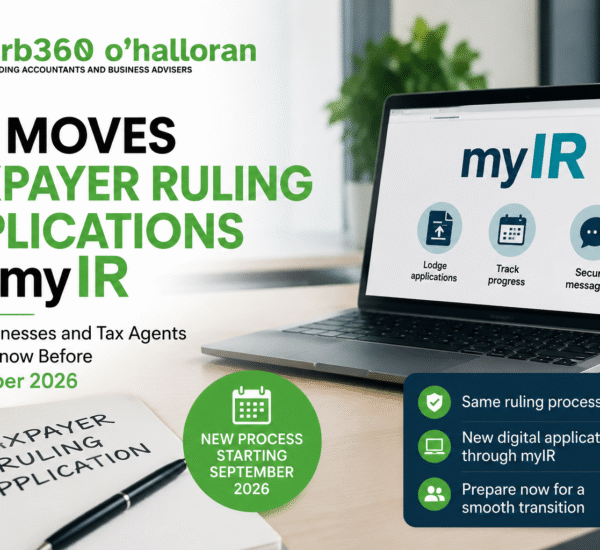
From September 2026, Inland Revenue (IRD) will require most taxpayer ruling applications to be submitted through myIR instead of email or paper-based channels. The ruling process itself is not changing, but businesses, accountants, and tax advisers will need to use myIR when lodging ruling applications and requesting pre-lodgement meetings.
Taxpayer ruling applications allow businesses and taxpayers to obtain certainty from Inland Revenue about how tax laws apply to a particular transaction, arrangement, or situation. From September 2026, most taxpayer ruling applications will be submitted through myIR as part of Inland Revenue’s digital transformation initiative.
The transition to Taxpayer Ruling Applications myIR is expected to become mandatory from September 2026. Businesses that regularly seek rulings should begin preparing well before implementation.
A taxpayer ruling is a formal decision issued by Inland Revenue that explains how New Zealand tax legislation applies to a specific transaction or arrangement.
Businesses often seek rulings when dealing with:
A ruling provides certainty before a transaction occurs, helping businesses reduce risk and improve compliance.
Official IRD update: Changes to How Taxpayer Ruling Applications Are Submitted
The move forms part of Inland Revenue’s ongoing digital transformation programme.
By moving taxpayer ruling applications to myIR, IRD aims to:
Many businesses already use myIR to manage tax obligations, making the platform a logical place for ruling applications.
Private rulings provide certainty about how tax laws apply to a specific taxpayer.
Product rulings generally apply to products, investments, or arrangements involving multiple participants.
Status rulings determine the tax classification of an entity, arrangement, or transaction.
Requests for pre-lodgement meetings will also move to myIR.
One of the most important aspects of this update is that the actual taxpayer ruling process remains unchanged.
The following continue to operate as before:
The primary change relates only to how applications are submitted.
Ensure authorised personnel have access to the organisation’s myIR account.
Review and update contact details to ensure communications are received promptly.
Businesses that regularly seek taxpayer rulings should update compliance and document management processes.
Finance teams, tax managers, accountants, and advisers should become familiar with the new digital workflow.
Taxpayer Ruling Applications myIR will provide a centralised digital process for lodging applications, tracking communications, and managing interactions with Inland Revenue.
Tax professionals are among the most frequent users of taxpayer rulings.
Firms such as DFK Orb360 should review:
This transition provides an opportunity to improve efficiency while continuing to deliver high-quality tax advisory services.
Obtaining certainty before entering into significant transactions remains one of the most effective ways to manage tax risk.
Whether a business is considering a restructure, acquisition, international expansion, or major investment, taxpayer rulings can provide valuable guidance and reduce uncertainty.
As Inland Revenue continues its digital transformation, Taxpayer Ruling Applications myIR will become an important part of how businesses, accountants, and tax advisers interact with the ruling system.
Related DFK Orb360 resources:
A taxpayer ruling is a formal decision from Inland Revenue that explains how New Zealand tax law applies to a particular transaction, arrangement, or taxpayer situation.
Most taxpayer ruling applications are expected to move to myIR from September 2026.
No. The technical assessment process, eligibility requirements, and legislative framework remain unchanged. Only the application submission method is changing.
Businesses, tax agents, accountants, tax advisers, and organisations that regularly seek taxpayer rulings will be most affected.
General enquiries may still be handled through existing channels, but ruling applications will generally need to be submitted through myIR.
Taxpayer rulings help businesses obtain certainty before entering into complex transactions, reducing tax risk and improving compliance.
DFK Orb360 O’Halloran
Get practical accounting, tax and business advisory support from our experienced team, wherever you operate in New Zealand.
Complete the enquiry form below and our team can discuss your business requirements.
DFK Orb360 is a New Zealand accounting, tax, and advisory firm helping businesses navigate tax compliance, business growth, restructuring, investments, and strategic financial decisions.
Our experienced team works closely with businesses across a wide range of industries, providing practical advice that supports sustainable growth and compliance.
Although the new myIR taxpayer ruling application process does not become mandatory until September 2026, businesses should begin preparing now.
Early preparation can help businesses avoid delays and ensure a smooth transition once the new process becomes mandatory.
“`

Copyright © 2025 Marketing Transformers | All Rights Reserved.


 09 377 4238
 Level 2, 6 Kingdon Street, Newmarket, Auckland
 help@orb360.co.nz