
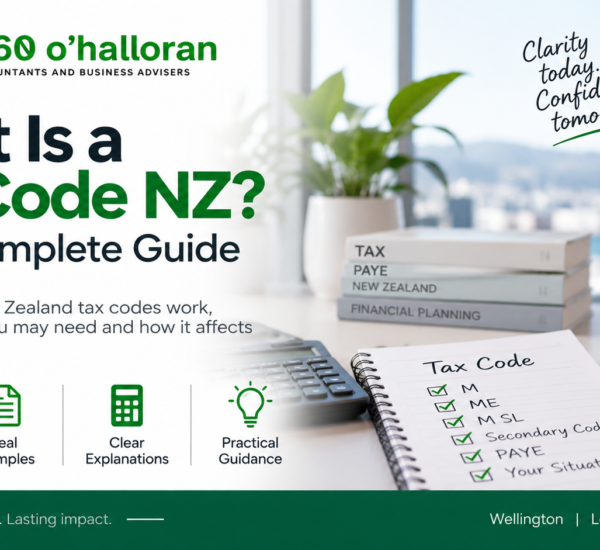
A tax code NZ tells your employer how much PAYE tax to deduct from your salary or wages.
Using the correct tax code helps ensure the right amount of income tax is deducted throughout the year. The most common code is M, while other codes apply for secondary jobs, student loans, KiwiSaver and specific employment situations.
If you use the wrong tax code, you may pay too much or too little tax, which could result in an Inland Revenue bill or refund at the end of the tax year.
If you’ve started a new job, changed employers or taken on a second job, you’ve probably been asked to choose a tax code NZ.
Many people assume a tax code is the same as a tax bracket, but they’re completely different. A tax code NZ tells your employer how much PAYE tax to deduct, while tax brackets determine the actual income tax rates applied to your earnings.
This guide explains everything you need to know about what is a tax code NZ, including the M tax code, ME tax code, secondary tax codes and how to choose the correct one.
Our chartered accountants help employees, contractors and business owners understand PAYE, payroll and tax obligations across New Zealand.
A tax code NZ is a code that tells your employer how much PAYE income tax should be deducted from your salary or wages.
Every employee in New Zealand is required to provide the correct tax code when starting employment. Your employer uses this code to calculate PAYE deductions before paying your wages.
Your tax code depends on factors including:
Choosing the correct tax code NZ helps avoid paying the wrong amount of tax during the year.
A tax code is not a tax rate. Instead, it tells Inland Revenue which PAYE deduction table applies to your income.
For example, two employees earning the same salary may have different PAYE deductions because one has a student loan while the other does not.
| Determines | Tax Code | Tax Bracket |
|---|---|---|
| PAYE deduction | ✅ Yes | ❌ No |
| Income tax rate | ❌ No | ✅ Yes |
| Main job status | ✅ Yes | ❌ No |
| Student loan | ✅ Yes | ❌ No |
This is why understanding what is a tax code NZ is important for every employee.
| Tax Code | Used For |
|---|---|
| M | Main salary or wage income |
| ME | Main income with Independent Earner Tax Credit |
| M SL | Main job with student loan |
| ME SL | Main job with IETC and student loan |
| SB | Secondary employment |
| S | Higher secondary income bracket |
| SH | Higher secondary tax rate |
| ST | Top secondary income bracket |
The M tax code NZ is the most common tax code and is generally used for your main job.
You would usually use the M tax code if:
The M tax code does not change your income tax rate—it simply applies the standard PAYE deductions for your main employment.
The ME tax code is used when your main income qualifies for the Independent Earner Tax Credit (IETC).
The Independent Earner Tax Credit may apply if you meet Inland Revenue’s eligibility requirements and your annual income falls within the qualifying range.
If you’re unsure whether you qualify, your employer or accountant can help determine the correct tax code NZ.
If you have more than one job, your second employer will usually use a secondary tax code NZ.
Common secondary tax codes include:
The correct secondary tax code depends on the amount you earn from your primary income.
Using the wrong secondary tax code NZ may result in paying too much or too little PAYE during the year.
Your correct tax code NZ depends on your employment situation.
| Your Situation | Likely Tax Code |
|---|---|
| One full-time job | M |
| Main job + Student Loan | M SL |
| Main job + IETC | ME |
| Second job | SB / S / SH / ST |
| Contractor (Schedular Payments) | WT |
If you’re unsure, Inland Revenue provides a tax code questionnaire that helps determine the correct code.
One of the biggest misconceptions is that your second job is automatically taxed more.
In reality, your second employer uses a secondary tax code NZ because your total income may place you into a higher PAYE deduction category.
The tax code itself doesn’t increase your tax—it simply aims to deduct the correct amount throughout the year.
Using the wrong tax code NZ can create problems later.
This could result in an Inland Revenue refund after your tax assessment.
This could leave you with an unexpected tax bill at the end of the financial year.
Updating your tax code as soon as your circumstances change is the best way to avoid both situations.
You should update your tax code NZ whenever your employment situation changes.
Common reasons include:
Most employers will ask you to complete a new Tax Code Declaration (IR330) form.
These two terms are often confused.
| Tax Code | Tax Bracket |
|---|---|
| Used for PAYE deductions | Used for income tax rates |
| Employer applies it | IRD applies progressive tax rates |
| Based on employment circumstances | Based on taxable income |
If you’re reading our guide on NZ Tax Brackets 2026, remember that your tax bracket determines your income tax rate, while your tax code determines payroll deductions.
Your employer uses your tax code NZ alongside Inland Revenue’s PAYE tables.
PAYE deductions may include:
This is why two employees with identical salaries can receive different take-home pay.
Your secondary employer usually requires a secondary tax code.
A new job often requires a new IR330 declaration.
They serve completely different purposes.
Student loan borrowers generally require an SL variation of their tax code.
Before submitting your IR330, ask yourself:
Answering these questions helps determine the correct tax code NZ.
Choosing the correct tax code NZ is important for both employees and employers. DFK Orb360 O’Halloran supports businesses across Wellington, Lower Hutt, Petone, Upper Hutt and Auckland with payroll, PAYE compliance, GST and accounting services.
Whether you’re hiring your first employee or managing a growing team, professional payroll advice can help ensure tax deductions are accurate.
Speak with DFK Orb360 O’Halloran for payroll, PAYE and accounting support across New Zealand.
A tax code NZ tells your employer how much PAYE tax should be deducted from your salary or wages.
Your tax code depends on whether it’s your main job, whether you have multiple employers, student loan obligations and your eligibility for certain tax credits.
The M tax code is generally used for your primary salary or wage income.
The ME tax code applies to eligible employees receiving the Independent Earner Tax Credit.
Secondary tax codes such as SB, S, SH and ST are generally used for second jobs.
You may pay too much or too little PAYE, potentially resulting in a tax refund or tax bill.
Yes. You can complete a new IR330 Tax Code Declaration through your employer whenever your circumstances change.
No. A tax code determines PAYE deductions, while tax brackets determine income tax rates.
Yes. Most second jobs require a secondary tax code based on your total income.
Yes. A chartered accountant can help ensure your PAYE and payroll setup is accurate and compliant.
A tax code NZ for a new employee depends on their main source of income and personal circumstances. Your employer uses the information on your Tax Code Declaration to calculate the appropriate PAYE deductions from your wages.
If you have two jobs, your main job will generally use a main tax code while your other employment may use a secondary tax code. The correct code depends on your income and circumstances.
The M tax code is generally used for a person’s main source of income when the requirements for that code are met. It is one of the commonly used PAYE tax codes in New Zealand.
If your employer uses the wrong tax code, the amount of PAYE deducted from your pay may be incorrect. Check your circumstances and update your tax code when necessary so your payroll deductions reflect the correct information.
You generally should not assume that the same tax code applies to every job. Your main source of income and additional employment can have different tax-code requirements.
Your tax code affects how PAYE is deducted from your employment income during the year. It helps your employer calculate deductions based on your circumstances, although the final amount of tax you owe depends on your overall taxable income and applicable rules.
You normally provide your employer with an updated Tax Code Declaration when your circumstances require a different tax code. Your employer can then use the updated information for future payroll calculations.
A tax code NZ tells your employer how to calculate PAYE deductions from your employment income. Providing the correct information helps your employer apply the appropriate payroll deductions.
The appropriate tax code for your main job depends on your individual circumstances. Employees should use the current Inland Revenue guidance and complete their Tax Code Declaration accurately.
M and ME are both main-income tax codes, but ME is associated with eligibility for the independent earner tax credit. Whether ME applies depends on your income and eligibility requirements.
Yes, your tax code can change if your income or personal circumstances change. You should review your tax-code position when circumstances such as taking another job or changing your main source of income occur.
Inland Revenue provides the official guidance for New Zealand tax codes and PAYE deductions. If your circumstances are complicated, professional tax advice can help you understand which rules apply.
For the most up-to-date information about tax codes, PAYE and employee tax obligations, you can refer to Inland Revenue’s official resources:
Understanding what is a tax code NZ is essential for ensuring the correct amount of PAYE tax is deducted from your income throughout the year.
Remember that your tax code is different from your tax bracket. Your tax code determines payroll deductions, while your tax bracket determines how your taxable income is taxed.
If you’re unsure which tax code applies to your circumstances, professional advice can help prevent costly payroll and tax mistakes.
DFK Orb360 O’Halloran provides payroll, PAYE, GST and tax advisory services for businesses across New Zealand.
Contact Our Chartered AccountantsThis article provides general information only and should not be relied upon as tax or legal advice. Tax codes depend on individual circumstances, and Inland Revenue requirements may change over time. Always seek professional advice for your specific situation.

PAYE deductions can include income tax and the ACC earners’ levy. You can check the current requirements in the Inland Revenue guide to tax codes .

Copyright © 2025 Marketing Transformers | All Rights Reserved.


 09 377 4238
 Level 2, 6 Kingdon Street, Newmarket, Auckland
 help@orb360.co.nz