What Triggers an IRD Audit in New Zealand?
Many New Zealand businesses and individuals are unsure what actually triggers an IRD audit.
While an audit does not always indicate wrongdoing, Inland Revenue regularly reviews tax filings
to ensure compliance with New Zealand tax laws.
What Triggers an IRD Audit in New Zealand is a common question for businesses and individuals seeking to understand how Inland Revenue selects tax returns for review.
Understanding common audit triggers can help reduce risk, improve record-keeping, and prepare
you to respond appropriately if Inland Revenue contacts you.
Common IRD Audit Triggers in New Zealand
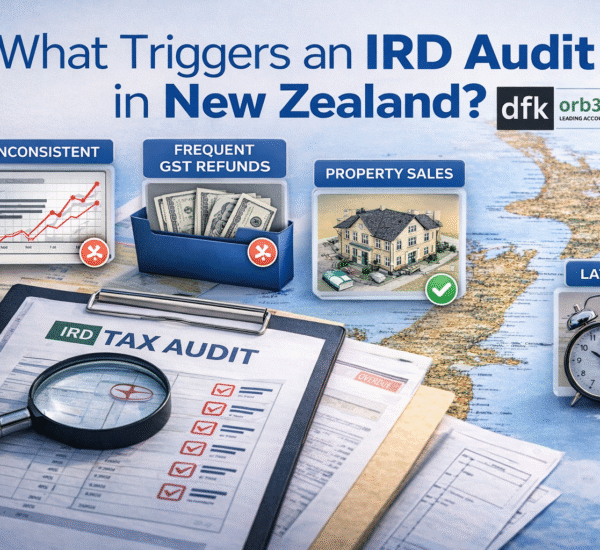
Inconsistent or Unusual Income Reporting
Significant changes in income, repeated losses, or figures that fall outside industry benchmarks
may trigger an IRD review. Contractors, small business owners, and property investors are commonly reviewed.
Understanding What Triggers an IRD Audit in New Zealand can help taxpayers reduce compliance risks and prepare appropriate documentation.
Frequent GST Refund Claims
Regular GST refunds, particularly where expenses consistently exceed income, can prompt Inland Revenue
to request additional documentation or initiate a review.
Late or Missing Tax Returns
Repeated late filing or failure to file tax or GST returns increases the likelihood of IRD scrutiny.
Compliance behaviour plays a role in audit selection.
Property Transactions and Tax Treatment
Property sales, changes in property use, or incorrect application of the bright-line test are common
focus areas for IRD audits.
Industry-Specific Risk Areas
Some industries face higher audit activity due to cash-heavy operations or historical compliance risks.
IRD often compares returns against industry benchmarks.
What Happens During an IRD Audit?
An IRD audit typically begins with a written request for information. This may include:
- Financial statements
- Bank records
- GST workings
- Invoices and contracts
Audits can range from limited reviews to detailed examinations, depending on the issue identified.
General guidance on IRD audit processes is available on the
Inland Revenue website.
How to Prepare If Inland Revenue Contacts You
Before responding to IRD, it is important to review the request carefully, ensure records are complete,
and avoid providing speculative or inconsistent explanations.
Educational resources on IRD compliance and audit readiness are available at
IRD Guru, which provides guidance for businesses and individuals
navigating tax and IRD matters in New Zealand.
When Professional IRD Support May Be Needed
In more complex situations, professional assistance may be appropriate, particularly where multiple
tax years are under review or there is uncertainty around tax treatment.
In such cases, working with experienced tax professionals can help ensure communication and responses
are handled appropriately. Professional IRD audit and compliance services are available through
DFK ORB360.
IRD Guru (https://irdguru.co.nz) is an educational resource designed to help New Zealand businesses and individuals better understand tax compliance, IRD processes, and audit-related risks.
By publishing practical guides on topics such as What Triggers an IRD Audit in New Zealand, GST obligations, and record-keeping requirements, IRD Guru supports informed decision-making and proactive compliance awareness.
What usually triggers an IRD audit in New Zealand?
Common triggers include inconsistent income reporting, frequent GST refunds, late tax filings,
property transactions, and industry-specific risk factors.
Does an IRD audit mean I have done something wrong?
No. An IRD audit does not automatically mean there is a problem. Many audits are routine reviews
to confirm compliance.
How long does an IRD audit usually take?
The duration varies depending on the complexity of the matter. Some audits are resolved quickly,
while others may take several months.
Should I respond to IRD on my own?
Simple requests can sometimes be handled independently, but professional support is recommended
for complex audits, multiple years under review, or potential penalties.
Where can I get help with IRD audits and compliance?
IRD Guru provides educational guidance, while professional compliance and audit support is available
through qualified accounting firms such as DFK ORB360.




 09 377 4238
 Level 2, 6 Kingdon Street, Newmarket, Auckland
 help@orb360.co.nz