

Financial Forecasting NZ: How to Plan Your Business Finances
Quick Answer: What Is Financial Forecasting?
Financial forecasting NZ businesses use is the process of estimating future revenue, expenses, cash flow and profitability using historical financial information, current business conditions and reasonable assumptions about the future.
A financial forecast can help business owners understand what may happen to their finances over the coming months or years and prepare for different scenarios before making important decisions.
Financial forecasting can be used alongside budgeting, cash-flow forecasting, profitability analysis and financial modelling to support business planning and growth.
Why Financial Forecasting Matters for NZ Businesses
Running a business involves making decisions about revenue, costs, staffing, investment and growth without knowing exactly what will happen in the future.
Financial forecasting NZ businesses use can provide a structured way to estimate how those decisions could affect future financial performance.
Instead of looking only at historical financial statements, a forecast asks: What could our financial position look like if current assumptions continue?
A forecast can help business owners consider:
- Expected revenue
- Operating expenses
- Cash inflows and outflows
- Profitability
- Working capital requirements
- Tax and GST obligations
- Staffing requirements
- Planned investments
- Debt and financing requirements
- Potential growth opportunities
Forecasting does not predict the future with certainty. Instead, it provides a structured estimate that can be updated as new information becomes available.
Financial Forecast vs Business Budget
A financial forecast and a business budget are closely related, but they are not exactly the same.
A budget generally sets out what a business plans or expects to achieve over a defined period. It may establish targets for revenue, expenses, profit and investment.
A forecast is often updated as actual business performance changes. It can therefore provide an evolving view of where the business may be heading.
For example, a business may create an annual budget at the beginning of its financial year. After several months, actual sales may be higher or lower than expected. The business can then update its forecast using the latest information.
Your business budget can therefore provide the original plan, while financial forecasting can help you understand how the expected outcome is changing.
1. Start With Historical Financial Data
A useful financial forecast NZ businesses can rely on should begin with the best available financial information.
Historical accounting records can help identify patterns in revenue, expenses, margins and cash flow.
Depending on the business, useful information may include:
- Previous revenue
- Gross profit margins
- Operating expenses
- Payroll costs
- Supplier costs
- Accounts receivable
- Accounts payable
- Seasonal sales patterns
- Previous tax and GST payments
- Existing loan or finance commitments
Historical data should not simply be copied into a forecast. Business owners should consider whether previous trends are still relevant.
For example, a business that experienced unusually strong sales because of a one-off event should not necessarily assume the same level of revenue will continue.
2. Forecast Your Revenue
Revenue is one of the most important components of a financial forecast.
Instead of choosing an arbitrary annual sales figure, consider how the revenue estimate is built.
Depending on your business model, you could consider:
- Number of customers
- Average transaction value
- Units sold
- Recurring revenue
- Existing contracts
- Expected new customers
- Customer retention
- Seasonal demand
- Planned price changes
- Sales pipeline
A useful approach is to break the revenue forecast into smaller categories rather than forecasting one total number.
For example, a professional services business could forecast revenue based on expected billable hours, utilisation and average hourly rates, while a retail business might forecast units sold and average selling price.
3. Estimate Fixed and Variable Costs
Revenue is only one side of a financial forecast. Costs also need to be estimated carefully.
Fixed costs may include expenses such as rent, insurance, software subscriptions and certain salaries or recurring overheads.
Variable costs can change as sales or production volumes change. These may include materials, packaging, sales commissions, transaction fees and certain delivery costs.
Separating costs into meaningful categories can make a business financial forecasting NZ model easier to understand.
It can also help business owners model what may happen if revenue increases or decreases.
For example, if sales increase by 15%, some variable costs may also increase, while certain fixed costs may remain relatively stable.
4. Forecast Cash Flow
Profit and cash are not the same thing. A business can report a profit while still experiencing short-term cash-flow pressure.
This is why cash flow should form an important part of your financial planning.
A cash-flow forecast considers when money is expected to enter and leave the business.
It can include:
- Customer payments
- Supplier payments
- Payroll
- GST payments
- Income tax payments
- Loan repayments
- Equipment purchases
- Rent and other overheads
- Planned investments
For more information, see our guide to Cash Flow Forecasting NZ .
5. Account for Tax and GST
Tax obligations should be considered when preparing a financial forecast.
Depending on the business structure and circumstances, this can include planning for income tax, GST, payroll-related obligations and other applicable payments.
A business that forecasts revenue and operating expenses without considering significant future tax payments may overestimate the amount of cash available for other purposes.
Tax should therefore be considered as part of the broader financial planning process rather than treated as an afterthought.
The exact tax treatment and timing can vary between businesses, so forecasts should be based on the business’s actual circumstances and appropriate professional advice where required.
6. Create Different Financial Scenarios
One of the most useful features of financial forecasting is the ability to model different possible outcomes.
Instead of preparing only one forecast, consider creating scenarios such as:
- Base-case scenario
- Higher-growth scenario
- Lower-sales scenario
- Higher-cost scenario
- Expansion scenario
For example, you could model what happens if revenue falls by 10%, supplier costs increase by 5% or the business hires two additional employees.
Scenario planning can help business owners understand the potential financial impact of decisions before committing significant resources.
It can also highlight how much cash or working capital may be required under different circumstances.
7. Compare Forecasts With Actual Results
A forecast is most useful when it is reviewed against actual financial performance.
Each month or quarter, compare the forecast with what actually happened.
Look for differences in:
- Revenue
- Gross margins
- Operating costs
- Payroll
- Cash flow
- Debtor collections
- Supplier costs
- Profitability
The purpose is not simply to identify that the forecast was wrong. The more useful question is why the result was different.
If actual revenue is consistently below the forecast, the underlying sales assumptions may need to be reconsidered. If costs are consistently higher, the business may need to update its cost assumptions or investigate the cause.
Financial Forecasting for Small Businesses
Small businesses do not necessarily need complicated financial models.
A simple monthly forecast can provide useful information if it is based on realistic assumptions and updated regularly.
A small business forecast could track:
- Expected monthly sales
- Expected customer payments
- Fixed operating costs
- Variable costs
- Staff costs
- GST and tax requirements
- Loan repayments
- Expected closing cash position
The level of detail should reflect the needs and complexity of the business. The goal is to create information that can actually support decisions rather than a model that is unnecessarily difficult to maintain.
Financial Forecasting for Startups
Startups may have limited historical data, which makes forecasting more challenging.
A startup may need to build its forecast using assumptions about:
- Expected customer acquisition
- Pricing
- Sales volume
- Customer retention
- Staffing requirements
- Marketing expenditure
- Technology costs
- Premises and equipment
- Funding requirements
- Working capital
Because these assumptions can change quickly, startup financial forecasts should be reviewed regularly.
Scenario modelling can be particularly useful where there is uncertainty about how quickly the business will acquire customers or generate revenue.
Financial Forecasting and Business Growth
Growth can create both opportunities and financial pressure.
Hiring additional employees, purchasing equipment, increasing inventory, opening a new location or investing in marketing can require cash before additional revenue is generated.
A business forecast NZ owners use before making a major investment can help estimate:
- Additional revenue requirements
- Additional operating costs
- Cash-flow requirements
- Potential profitability
- Funding requirements
- Potential financial risks
This can help turn a growth idea into a more structured financial plan.
Financial Forecasting vs Cash-Flow Forecasting
Financial forecasting and cash-flow forecasting are closely connected, but they have different purposes.
A broader financial forecast may include revenue, expenses, profitability, assets, liabilities and other financial measures.
Cash-flow forecasting focuses specifically on the expected timing of cash entering and leaving the business.
For example, a business may forecast $1 million of annual revenue but still experience a cash shortage if customers pay slowly while wages, suppliers, GST and other expenses need to be paid earlier.
Using both types of forecasts can therefore provide a more complete view of future financial performance.
Financial Forecasting and Business Profitability
A financial forecast can help business owners understand whether expected revenue and costs are likely to support their desired level of profitability.
This is particularly useful when combined with a business profitability analysis .
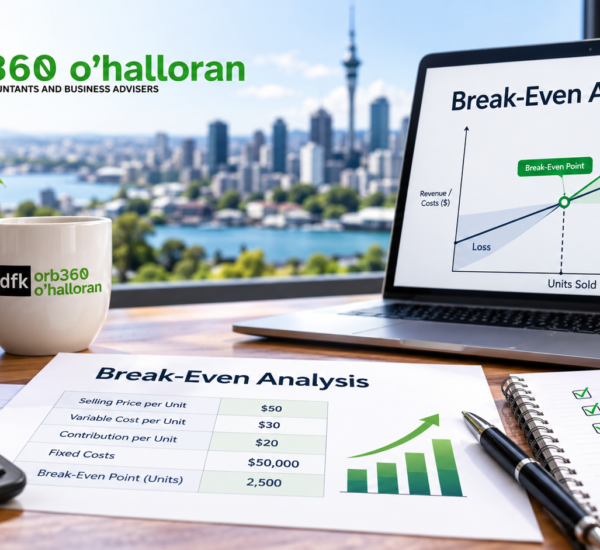
You can also use your forecast alongside break-even analysis to understand how much sales volume may be required to cover costs and how changes in pricing or expenses could affect profitability.
How Financial Forecasting Supports Better Business Decisions
A good forecast does not make business decisions for you. Instead, it provides financial information that can help you evaluate different options.
For example, before hiring an employee, you could model the additional salary and related costs against expected additional revenue.
Before opening another location, you could estimate the additional rent, staffing, marketing and operating costs alongside expected sales.
Before purchasing equipment, you could consider the upfront investment, financing costs, expected productivity improvements and potential revenue impact.
This type of scenario-based financial planning NZ businesses use can make financial assumptions more visible before a decision is implemented.
How an Accountant Can Help With Financial Forecasting
An accountant can help business owners develop a financial forecast using financial records, business assumptions and expected future activities.
Depending on your requirements, this may include:
- Reviewing historical financial performance
- Preparing revenue forecasts
- Estimating fixed and variable costs
- Preparing cash-flow forecasts
- Reviewing profitability assumptions
- Building financial scenarios
- Preparing management reports
- Reviewing actual results against forecasts
- Supporting financial modelling
- Assessing the financial impact of growth plans
For businesses requiring more detailed strategic financial support, DFK Orb360 O’Halloran also provides Outsourced CFO support in Wellington , including financial modelling, budgeting, forecasting and profitability analysis.
Financial Forecasting Support in Auckland and Wellington
DFK Orb360 O’Halloran supports businesses across New Zealand with accounting, tax, financial reporting, budgeting and business advisory services.
Our Auckland locations include Newmarket and Rosedale, while our Wellington presence includes Petone and support across the wider Wellington region.
Whether you are managing an established business, starting a new venture or planning expansion, a structured financial forecast can help you understand the financial implications of your plans.
Financial Forecasting Checklist
Use this checklist when preparing or reviewing your business forecast:
☐ Review historical financial performance
☐ Identify key revenue drivers
☐ Forecast expected sales
☐ Review fixed and variable costs
☐ Include expected staff and operating expenses
☐ Plan for GST and tax obligations
☐ Prepare a cash-flow forecast
☐ Create realistic financial scenarios
☐ Compare forecast results with actual performance
☐ Update assumptions when business conditions change
☐ Review the forecast regularly
People Also Ask: Financial Forecasting NZ
What is financial forecasting in NZ?
Financial forecasting NZ businesses use is the process of estimating future revenue, expenses, cash flow and profitability using historical information and assumptions about future business conditions. A forecast can help owners plan ahead and evaluate different financial scenarios.
Why is financial forecasting important for businesses?
Financial forecasting helps businesses estimate future financial performance, identify potential cash-flow requirements, plan expenses and evaluate growth decisions. It can also highlight potential financial pressures before they become immediate problems.
What should be included in a financial forecast?
A financial forecast can include expected revenue, fixed and variable costs, operating expenses, cash inflows and outflows, tax obligations, financing costs, profitability and planned investments. The exact information required depends on the business.
What is the difference between a financial forecast and a budget?
A budget generally represents a planned financial position for a defined period, while a forecast can be updated as actual results and business assumptions change. Businesses can use both tools together for financial planning.
How do you create a financial forecast for a small business?
Start by reviewing historical financial information, then estimate revenue, fixed costs, variable costs, cash flow and other expected financial obligations. Create realistic assumptions, model different scenarios and compare the forecast with actual results regularly.
Can financial forecasting help with business growth?
Yes. A financial forecast can help estimate the revenue, costs, cash requirements and potential profitability associated with growth plans such as hiring staff, purchasing equipment, increasing inventory or opening a new location.
How often should a business update its financial forecast?
The appropriate frequency depends on the size and complexity of the business. Many businesses benefit from reviewing forecasts regularly and updating them when significant changes occur in revenue, costs, staffing, pricing or business plans.
What is financial forecasting for small businesses?
Financial forecasting for small businesses is the process of estimating future revenue, expenses, cash flow and profitability using available financial information and realistic assumptions. A simple monthly forecast can be useful without requiring a complex financial model.
Can an accountant prepare a financial forecast?
Yes. An accountant can help prepare financial forecasts using historical financial records and business assumptions. They can also assist with scenario modelling, cash-flow forecasting, profitability analysis and financial planning.
Frequently Asked Questions About Financial Forecasting
Can a financial forecast predict exactly what will happen?
No. A financial forecast is an estimate based on assumptions and available information. Actual results can differ because of changes in sales, costs, customer behaviour, economic conditions and other factors.
How far ahead should a business forecast?
The appropriate forecasting period depends on the business and the purpose of the forecast. Businesses may use short-term monthly forecasts for cash management alongside longer-term forecasts for budgeting, investment and strategic planning.
Should a financial forecast include cash flow?
Cash flow is an important part of financial planning and can be included alongside broader revenue, expense and profitability forecasts. A separate cash-flow forecast can provide more detailed information about the timing of cash receipts and payments.
What happens if actual results are different from the forecast?
Differences between actual and forecast results should be reviewed to understand the underlying reasons. The business can then update its assumptions and revise the forecast where appropriate.
Is financial forecasting useful for established businesses?
Yes. Established businesses can use financial forecasting to plan cash requirements, staffing, investment, expansion, profitability and other future financial decisions.
Final Thoughts
Financial forecasting NZ businesses use can provide a clearer view of where the business may be heading financially.
By combining historical financial information with realistic assumptions about future revenue, costs, cash flow and business activity, owners can create a practical framework for financial planning.
The most useful forecasts are not necessarily the most complicated. They are forecasts that are based on sensible assumptions, reviewed regularly and updated when actual business conditions change.
When used alongside budgeting, cash-flow forecasting, profitability analysis and break-even analysis, financial forecasting can become a useful part of ongoing business decision-making.
Need Help With Your Financial Forecast?
A clear financial forecast can help you understand future revenue, costs, cash flow and profitability before making important business decisions.
Want help preparing or reviewing your business financial forecast? Tell the DFK Orb360 O’Halloran team about your business and we’ll be in touch.
DFK Orb360 O’Halloran provides accounting, tax and business advisory services to businesses across New Zealand.
Useful Business Financial Resources
For practical guidance on business finance and financial planning, visit Business.govt.nz .
You can also review the Business.govt.nz financial modelling resources when developing financial projections and business scenarios.
For cash-flow planning, see the Business.govt.nz cash-flow forecasting guidance .
Disclaimer: This article provides general information only and should not be treated as financial, tax, accounting or business advice for your specific circumstances. Business owners should consider their individual circumstances and seek professional advice where appropriate.


 09 377 4238
 Level 2, 6 Kingdon Street, Newmarket, Auckland
 help@orb360.co.nz