

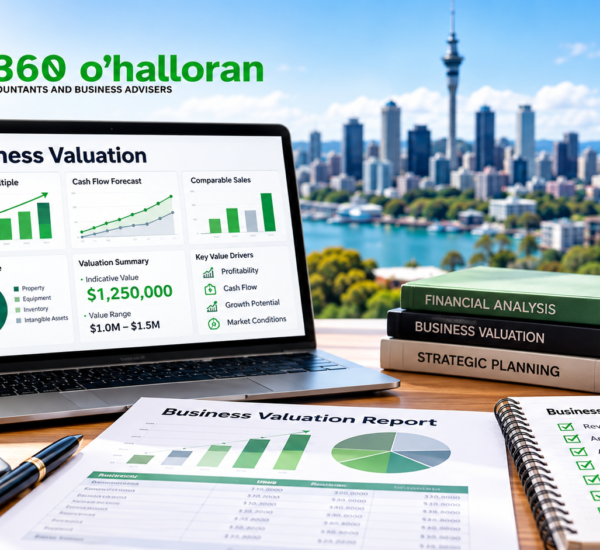
Business Valuation NZ: How Much Is Your Business Worth?
Understanding what your business is worth can help you make informed decisions about growth, investment, succession and a potential sale. However, a business valuation involves more than looking at annual revenue or the balance in your bank account.
An effective business valuation NZ process considers profitability, cash flow, assets, liabilities, commercial risks, future earnings and the market for comparable businesses.
Whether you own a small business in Auckland, operate a growing company in Wellington or are preparing to sell a business elsewhere in New Zealand, understanding valuation methods can help you assess your financial position and prepare for important decisions.
This guide explains seven essential business valuation considerations, the main valuation methods used in New Zealand and how professional accounting and business advisory support can help.
Quick Answer: How Do You Value a Business in NZ?
A business valuation estimates the economic value of a business at a particular date and for a defined purpose. Common methods include earnings multiples, EBITDA multiples, discounted cash flow, asset-based valuation and comparisons with similar business transactions.
The appropriate method depends on the business’s size, industry, profitability, assets, financial history, growth prospects and the purpose of the valuation.
For a small business, an indicative valuation may begin with maintainable earnings, adjusted for unusual expenses, owner remuneration, debt and business-specific risks. A formal valuation may require a more detailed assessment and a suitably qualified independent valuer.
What Is Business Valuation?
Business valuation is the process of estimating the financial value of a business or an ownership interest in that business.
The result may be used to support a business sale, acquisition, succession plan, shareholder transaction, investment decision or another commercial purpose.
Importantly, a valuation is not necessarily the same as the price a buyer will pay. The final transaction price may be affected by negotiations, financing, commercial terms, buyer-specific opportunities and market conditions.
What Factors Affect Business Value?
- Historical revenue and profitability
- Maintainable earnings and future growth
- Cash flow and working capital requirements
- Business assets and liabilities
- Customer concentration and recurring revenue
- Industry conditions and competitive position
- Management capability and dependence on the owner
- Contracts, intellectual property and business systems
- Financial reporting quality
- Risks associated with the business
A reliable business valuation NZ assessment considers these factors together rather than relying on a single financial figure.
Why Business Valuation Matters for NZ Businesses
Knowing the estimated value of your business can be useful even when you are not planning to sell it.
A valuation can identify financial strengths, operational weaknesses and risks that may affect long-term business performance.
When Might You Need a Business Valuation?
- Preparing to sell your business
- Buying an existing business
- Bringing in a new shareholder or investor
- Planning an ownership transition
- Reviewing succession options
- Considering a merger or acquisition
- Planning a management buyout
- Assessing growth and expansion opportunities
- Supporting financing discussions
- Resolving certain shareholder or commercial disputes
The valuation’s purpose matters because different circumstances may require different valuation assumptions, standards and levels of independence.
7 Essential Business Valuation NZ Methods and Considerations
There is no single formula that accurately values every New Zealand business. The following seven methods and considerations explain how business value may be assessed.
1. Understand the Asset-Based Valuation Method
An asset-based valuation considers the value of a business’s assets after deducting relevant liabilities.
Assets may include property, equipment, inventory, investments and other identifiable resources.
Depending on the purpose of the valuation, book values may need to be adjusted to reflect appropriate market or realisable values.
When Is Asset-Based Valuation Useful?
This approach may be relevant to asset-intensive businesses, investment-holding entities or businesses where the underlying assets are a significant component of value.
However, asset value alone may not adequately reflect goodwill, customer relationships, brand strength or future earnings.
2. Review Earnings-Based Valuation
Earnings-based valuation estimates business value using an appropriate measure of sustainable or maintainable earnings.
Historical profits are often adjusted to remove genuinely non-recurring items and reflect commercially appropriate ongoing expenses.
For owner-operated businesses, adjustments to owner remuneration may be necessary to distinguish the owner’s labour from the return generated by the business itself.
An earnings multiple may then be applied, taking account of business-specific risks, growth prospects and available market evidence.
The appropriate earnings measure and multiple depend on the valuation circumstances.
3. Understand EBITDA Multiples
EBITDA stands for earnings before interest, tax, depreciation and amortisation.
EBITDA multiples are commonly discussed when assessing the enterprise value of certain operating businesses.
However, EBITDA does not directly measure free cash flow. It excludes capital expenditure, working capital movements and other financial considerations that may materially affect value.
A business valuation using EBITDA should also distinguish between enterprise value and equity value.
For example, relevant debt and cash adjustments may be needed when moving from enterprise value to the value attributable to shareholders.
4. Consider Discounted Cash Flow Valuation
Discounted cash flow, commonly called DCF, estimates business value by forecasting future cash flows and discounting them to their present value.
The method requires assumptions about revenue, operating expenses, working capital, capital expenditure, growth and risk.
DCF can be useful when a business has a credible financial forecast and its future cash flows can be estimated with reasonable support.
However, valuation results can be highly sensitive to assumptions about future growth, discount rates and terminal value.
Businesses considering this method may benefit from reviewing their financial modelling and financial forecasting before relying on projected results.
5. Compare Similar Business Transactions
A market-based valuation considers evidence from transactions involving comparable businesses or relevant market multiples.
Comparisons may consider industry, business size, profitability, growth, customer base, geography and transaction terms.
Comparable transaction information can be difficult to obtain for privately owned New Zealand businesses.
Even where transaction data is available, adjustments may be needed because two businesses in the same industry can have significantly different financial and operational characteristics.
6. Assess Revenue and Profitability
Revenue provides useful information about business activity, but high revenue does not automatically mean a high business value.
A business with strong sales but weak margins, high customer concentration or substantial working capital requirements may have significant valuation risks.
A financial review should consider:
- Revenue trends
- Gross profit margins
- Operating profit
- Recurring versus one-off income
- Customer and supplier concentration
- Debt and financing costs
- Cash conversion
- Capital expenditure requirements
Reviewing business profitability and cash flow forecasting can help owners understand the financial drivers that may influence business value.
7. Account for Business Risk and Future Growth
Business valuation is forward-looking as well as historical.
A prospective buyer or investor may assess whether the business can maintain its earnings and generate future cash flow.
Important considerations include:
- Reliance on the existing owner
- Quality and depth of management
- Customer retention
- Revenue diversification
- Documented processes and systems
- Competitive position
- Contractual obligations
- Regulatory and industry risks
- Realistic growth opportunities
A credible growth plan should be supported by realistic assumptions, appropriate financial forecasts and a clear understanding of the resources required.
How to Value a Small Business in NZ
Small business valuation NZ assessments often require particular attention to owner involvement, maintainable earnings, customer relationships and financial reporting quality.
In an owner-operated business, the owner may perform several roles that would otherwise require paid employees.
The valuation should consider the ongoing cost of replacing those responsibilities, where relevant.
What Information Is Needed?
- Recent financial statements
- Current management accounts
- Tax returns and relevant tax records
- Details of business assets and liabilities
- Revenue by customer or service line
- Owner remuneration and related-party transactions
- Details of unusual or non-recurring expenses
- Business contracts and lease agreements
- Financial forecasts and budgets
- Information about operational and commercial risks
Organised financial records make it easier to analyse historical performance and identify adjustments that may be needed.
A structured business budget can also support discussions about future performance and financial requirements.
Business Valuation NZ Example: Understanding an Earnings Multiple
Consider a hypothetical New Zealand business with adjusted maintainable annual earnings of NZ$200,000.
If an appropriate valuation analysis supports an illustrative earnings multiple of three, the initial calculation would be:
NZ$200,000 × 3 = NZ$600,000
This is a simplified example, not a recommended multiple or an estimate of what any particular business is worth.
The valuation would still need to consider the earnings measure used, debt, surplus cash, working capital, asset requirements, commercial risks and the purpose of the valuation.
Depending on the valuation basis, the calculated amount may represent enterprise value rather than the amount ultimately attributable to shareholders.
How Can You Improve the Value of Your Business?
Improving business value generally involves strengthening sustainable financial performance while addressing risks that may affect future earnings and cash flow.
Improve Profit Margins
Review pricing, direct costs, operating expenses and the profitability of individual products, services or customers.
Strengthen Cash Flow
Monitor debtor collection, inventory, payment terms and working capital. A profitable business can still face cash flow pressures.
Reduce Owner Dependence
Document important processes and build management capability so the business is less reliant on one individual.
Improve Financial Reporting
Maintain accurate accounts, prepare regular management reports and investigate significant differences between budgets and actual results.
Develop Realistic Growth Plans
Use financial forecasting and scenario modelling to assess whether proposed expansion is commercially and financially sustainable.
These measures do not guarantee a higher sale price, but they can help business owners better understand and manage important valuation drivers.
Business Valuation Before Selling a Business in NZ
If you are preparing to sell your business, a valuation can help establish an informed basis for discussing price and transaction expectations.
Potential buyers are likely to review historical financial performance, earnings sustainability, cash flow, liabilities, contracts and operational risks.
How Should You Prepare?
- Review and reconcile financial records
- Separate personal and business expenses
- Document unusual financial adjustments
- Review outstanding debts and tax obligations
- Assess customer and supplier concentration
- Prepare realistic financial forecasts
- Identify operational risks
- Understand potential tax implications
- Obtain appropriate legal and valuation advice
Sale structure matters. Selling company shares may have different financial, legal and tax consequences from selling business assets.
Appropriate advice should be obtained before entering into a transaction.
Business Valuation Before Buying a Business in NZ
Buyers should distinguish between the seller’s asking price and an independently supported assessment of business value.
A valuation may form part of wider financial, commercial, tax and legal due diligence.
Questions to Ask Before Buying
- Are the reported earnings sustainable?
- How much working capital is required?
- Are there significant upcoming capital expenses?
- How dependent is the business on its current owner?
- Are major customers or suppliers at risk?
- What debt or liabilities are being assumed?
- Are financial forecasts supported by evidence?
- What is included in the proposed purchase price?
A valuation does not replace comprehensive due diligence, but it can help structure the financial assessment of a proposed acquisition.
Business Valuation for Franchising and Business Expansion
Business owners considering franchising may need to understand the financial performance of their existing operation and the economics of potential franchise locations.
A valuation of the existing business is different from a financial model assessing the commercial feasibility of a proposed franchise system.
Franchise planning may require analysis of setup costs, royalties, operating margins, working capital and the financial performance of individual franchise units.
Read our guide to franchise financial modelling NZ to understand the financial information that may be needed before expanding through franchising.
Business Valuation vs Financial Modelling: What’s the Difference?
Financial modelling estimates the potential financial outcomes of different business assumptions.
Business valuation uses relevant financial and commercial information to estimate the value of a business or ownership interest.
| Business Valuation | Financial Modelling |
|---|---|
| Estimates business or equity value | Projects financial performance |
| May support sale or ownership decisions | May support planning and scenario analysis |
| Considers valuation methods and market evidence | Uses financial assumptions and forecasts |
| May use forecast cash flows | Can produce forecasts used in valuation |
A well-supported financial model can provide important inputs for certain valuation approaches, particularly discounted cash flow.
How Can an Accountant Help With Business Valuation NZ?
Accounting and business advisory support can help owners organise the financial information needed to understand business performance and prepare for valuation discussions.
Depending on the engagement, this may include:
- Reviewing historical financial statements
- Analysing revenue and profitability trends
- Identifying unusual financial items
- Reviewing working capital and cash flow
- Preparing financial forecasts
- Developing financial models
- Assessing the financial implications of growth
- Preparing financial information for a sale or acquisition
- Identifying matters requiring specialist valuation advice
DFK Orb360 O’Halloran provides accounting, tax and business advisory support to New Zealand businesses.
If you require a formal or independent valuation, confirm the scope, qualifications and independence requirements appropriate to your circumstances.
Growing businesses that need ongoing strategic financial support can also explore our outsourced CFO Wellington guide.
Business Valuation Support in Auckland and Wellington
Looking for business valuation NZ guidance from an accounting and business advisory team? DFK Orb360 O’Halloran supports businesses through its Auckland and Wellington-region offices, with remote services available across New Zealand.
Our team can assist with accounting, financial reporting, forecasting and business advisory matters relevant to valuation preparation. The scope of any formal valuation engagement should be confirmed separately.
Business Valuation Preparation in Auckland
DFK Orb360 has Auckland offices in Newmarket and Rosedale. These locations are accessible to businesses across Auckland CBD, Newmarket, the North Shore and surrounding suburbs.
Newmarket Office
Level 2, 6 Kingdon StreetNewmarket, Auckland
Phone: 09 377 4238
Rosedale Office
1D/43 Omega StreetRosedale, Auckland 0632
Phone: 09 442 5767
Business Valuation Preparation in Wellington and Lower Hutt
Businesses searching for business valuation Wellington support can contact DFK Orb360’s Wellington-region office in Petone, Lower Hutt.
The team supports businesses with accounting, financial planning and advisory services that may be relevant to a business sale, acquisition, succession plan or growth strategy.
Petone Office
48 Richmond StPetone, Lower Hutt
Phone: 04 555 0401
Can I Access Business Advisory Support Remotely?
Yes. DFK Orb360 supports businesses outside Auckland and Wellington through remote accounting and advisory services.
Business Valuation NZ Checklist
Before starting a valuation discussion, consider whether you have the following information available.
- Recent annual financial statements
- Up-to-date management accounts
- Revenue and profit analysis
- Details of owner remuneration
- Records of unusual or non-recurring expenses
- Business assets and liabilities
- Cash flow information
- Working capital requirements
- Current budgets and financial forecasts
- Customer and supplier information
- Material business contracts
- Details of business risks
- Information about expected growth
- A clearly defined purpose for the valuation
If you are considering selling or acquiring a business, you should also clarify the proposed transaction structure and obtain appropriate legal and tax advice.
People Also Ask: Business Valuation NZ
How is a business valued in New Zealand?
A business valuation NZ assessment may use earnings multiples, discounted cash flow, asset-based methods or comparable business transactions. The method depends on the business, available financial information and valuation purpose.
How do I calculate what my business is worth?
Start by reviewing maintainable earnings, assets, liabilities, cash flow and commercial risks. A valuation method appropriate to your business can then be applied. A simple earnings multiple may provide an initial illustration but is not a substitute for a properly supported valuation.
Can I value my own small business?
You can prepare an indicative assessment using your financial records and relevant valuation methods. However, a formal transaction, dispute or other specialist purpose may require an appropriately qualified independent valuer.
Is a business worth three times its profit?
Not necessarily. There is no universal profit multiple for New Zealand businesses. The relevant earnings measure, growth prospects, industry, commercial risks and market evidence all affect the valuation.
What increases the value of a small business?
Sustainable earnings, reliable cash flow, diversified customers, effective management, strong financial records and reduced owner dependence may contribute positively to business value.
Where can I get business valuation support in Auckland?
DFK Orb360 O’Halloran has Auckland offices in Newmarket and Rosedale. Its accounting and business advisory team can assist with financial information and planning relevant to valuation preparation. Confirm the scope of any formal valuation separately.
Where can I get business valuation support in Wellington?
DFK Orb360 O’Halloran has a Wellington-region office in Petone, Lower Hutt. The team provides accounting and business advisory support for businesses across Wellington and surrounding areas.
Frequently Asked Questions About Business Valuation NZ
1. How much does a business valuation cost in NZ?
The cost depends on the business’s complexity, the purpose of the valuation, the available financial information and the level of analysis or reporting required. Obtain a written scope and fee estimate from the provider.
2. How long does a business valuation take?
Timing depends on the scope of the engagement, business complexity, quality of records and whether additional information is required. Formal valuations may take longer than indicative financial assessments.
3. Is business valuation the same as the selling price?
No. A valuation estimates business value using specified assumptions and methods. The actual selling price depends on negotiations, buyer demand, financing, transaction terms and other commercial factors.
4. Do I need a formal valuation to sell my business?
Not every sale requires a formal independent valuation. However, a professional valuation may be appropriate depending on the transaction, ownership structure and circumstances. Obtain advice before deciding what level of assessment is needed.
5. Can financial forecasting improve a business valuation?
Credible financial forecasts can provide important information about future performance, particularly when using a discounted cash flow method. Forecasts should be based on supportable assumptions and reviewed for uncertainty.
6. What is the difference between enterprise value and equity value?
Enterprise value generally represents the value of the operating business attributable to its capital providers. Equity value represents the value attributable to shareholders after appropriate adjustments, which may include debt and cash.
7. Can an accountant help me prepare to sell my business?
An accountant can help organise financial records, analyse profitability, prepare forecasts, review relevant tax considerations and identify financial matters requiring further professional advice.
Final Thoughts: Understanding Your Business Worth
A well-supported business valuation NZ assessment can provide useful information for business owners planning a sale, acquisition, ownership transition or future growth.
The most appropriate valuation method depends on the business and the purpose of the assessment. Financial performance, cash flow, commercial risks and future prospects all deserve careful consideration.
Maintaining accurate financial records and preparing realistic forecasts can help you approach valuation discussions with better information.
Planning to Sell, Buy or Grow Your Business?
Understanding your financial performance is an important part of preparing for business valuation, succession or investment decisions.
DFK Orb360 O’Halloran provides accounting, tax and business advisory support to New Zealand businesses.
Tell us about your business and what you would like to achieve. Complete the form below and our team will be in touch to discuss your requirements.
DFK Orb360 O’Halloran provides accounting, tax and business advisory services across New Zealand. The availability and scope of any formal valuation engagement should be confirmed with our team.
Useful New Zealand Business Resources
The following official resources provide further information about operating, buying and selling a business in New Zealand.
- Business.govt.nz — New Zealand Government information for business owners, including business planning and ownership changes.
- Inland Revenue — Official information about New Zealand tax obligations and business transactions.
- New Zealand Companies Register — Official company registration information.
Important Information
This article provides general information only and does not constitute a formal business valuation, investment advice, legal advice or advice tailored to your circumstances.
Business valuation results depend on the purpose, valuation date, assumptions, available evidence and method used. Illustrative examples in this article should not be treated as valuation benchmarks.
Obtain appropriate professional advice before making a significant business, financial or ownership decision.


 09 377 4238
 Level 2, 6 Kingdon Street, Newmarket, Auckland
 help@orb360.co.nz