

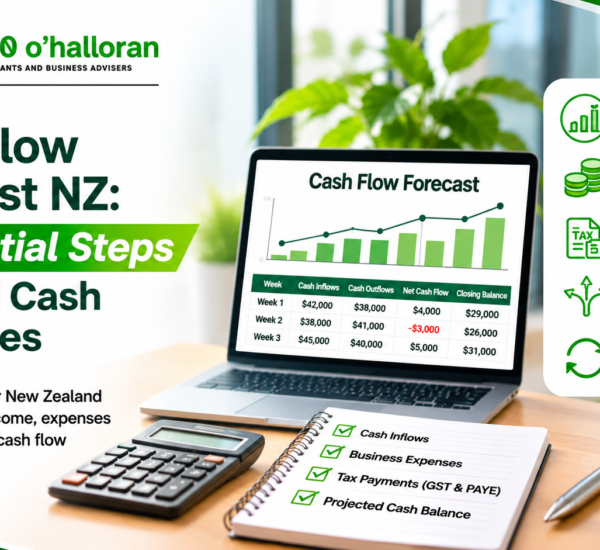
Your business may be generating sales, winning new customers and showing a profit, but are you confident you will have enough money available to pay your bills next month?
For many New Zealand small businesses, managing cash flow is one of the biggest challenges of running a business. Late customer payments, seasonal sales, rising operating costs and unexpected expenses can put pressure on available cash, even when the business appears profitable.
A Cash Flow Forecast NZ approach helps business owners estimate how much money will come into and go out of their business over a future period. It provides a clearer picture of potential cash shortages, upcoming expenses and opportunities to plan ahead.
Whether you operate a small business, manage an established SME or work as a self-employed professional, understanding your future cash position can help you make more informed financial decisions.
A cash flow forecast is a financial planning tool that estimates the money expected to enter and leave a business over a future period. It considers the opening cash balance, expected income, planned expenses and projected closing balance. New Zealand SMEs can use cash flow forecasting to identify potential cash shortages, prepare for tax and supplier payments, plan business investments and make better financial decisions.
- A cash flow forecast estimates future business income and expenses.
- Profit and available cash are not the same thing.
- Include customer payments, operating expenses, payroll, tax payments and loan repayments.
- Use realistic assumptions rather than relying on optimistic sales estimates.
- Prepare different scenarios to understand potential cash shortages.
- Compare actual cash flow against your forecast and update it regularly.
- Professional accounting support can help improve the accuracy and usefulness of your forecasts.
What Is a Cash Flow Forecast in NZ?
A cash flow forecast is an estimate of the money your business expects to receive and pay out over a specific future period. It helps you understand how much cash may be available after accounting for expected income and expenses.
A typical cash flow forecast includes:
- Opening cash balance: The money available in your business accounts at the beginning of the period.
- Expected cash inflows: Money expected from customer payments, sales, loans, investments or other sources.
- Expected cash outflows: Payments for wages, suppliers, rent, operating costs, tax and loan repayments.
- Net cash flow: The difference between expected cash received and cash paid out.
- Closing cash balance: The projected amount remaining at the end of the period.
For New Zealand businesses, a cash flow forecast can be prepared using a spreadsheet, accounting software or a financial forecasting model.
It can cover a weekly, monthly, quarterly or longer period, depending on your business requirements. Short-term forecasts can help manage day-to-day payments, while longer forecasts can support business growth and investment decisions.
Why Is Cash Flow Forecasting Important for Small Businesses?
Cash flow forecasting helps business owners look beyond their current bank balance and understand what their financial position may look like in the weeks or months ahead.
A business may record strong sales but still experience cash shortages if customers take longer to pay invoices or significant expenses become due before customer payments arrive.
With a reliable Cash Flow Forecast NZ process, businesses can:
- Identify potential cash shortages before they happen.
- Prepare for supplier payments, payroll and operating expenses.
- Plan for GST, PAYE and other tax obligations.
- Understand whether they can afford to hire additional employees.
- Evaluate equipment purchases and business investments.
- Prepare for seasonal changes in sales.
- Understand whether additional finance may be needed.
- Make more informed decisions about expansion and growth.
7 Essential Steps to Create a Cash Flow Forecast NZ
1. Start With Your Current Business Cash Position
The first step in creating a cash flow forecast is understanding how much money your business currently has available.
Start by reviewing your business bank accounts and identifying the opening cash balance for the forecasting period.
Also review outstanding customer invoices, supplier bills, upcoming payments and any other financial commitments that could affect your available cash.
Collect the following information:
- Current business bank balances.
- Outstanding customer invoices.
- Supplier payments due.
- Existing loan repayments.
- Upcoming payroll commitments.
- Expected tax and other statutory payments.
Using accurate starting figures is essential. If your opening balance or outstanding commitments are incorrect, the rest of your cash flow forecast may also be unreliable.
2. Estimate Your Expected Cash Inflows
Next, estimate how much money your business expects to receive during the forecasting period.
Do not simply use your total sales figures. A sale does not necessarily mean that cash has already reached your business bank account.
For example, if you invoice a customer in November but expect payment in January, your forecast should generally reflect the expected January receipt rather than treating the invoice as November cash received.
Consider these potential cash inflows:
- Cash and electronic sales.
- Expected customer invoice payments.
- Recurring contracts and subscription payments.
- Rental or investment income, where applicable.
- Approved business loans or other funding.
- Owner contributions or other planned cash injections.
Review historical sales, customer payment patterns, seasonal demand and confirmed contracts when estimating future income.
For newer businesses without much historical data, use reasonable industry benchmarks and professional guidance to develop your estimates.
3. Calculate Your Expected Business Expenses
Once you have estimated cash inflows, identify the money your business expects to pay out.
Many businesses underestimate expenses by including only regular monthly bills and overlooking irregular or one-off payments.
Your Cash Flow Forecast NZ should include both fixed and variable expenses.
Fixed expenses may include:
- Rent and office costs.
- Employee salaries and wages.
- Insurance premiums.
- Software subscriptions.
- Regular loan repayments.
Variable and other expenses may include:
- Inventory and raw materials.
- Supplier payments.
- Marketing and advertising costs.
- Utilities and transport.
- Equipment purchases.
- Repairs and maintenance.
- Professional and accounting fees.
Remember to account for the timing of payments. An expense may be recorded in one accounting period but paid in another.
4. Include GST, PAYE and Other Tax Payments
Tax obligations can have a significant effect on the cash available to run your business.
New Zealand businesses should consider their relevant GST, PAYE, income tax and provisional tax payment commitments when preparing a cash flow forecast.
Depending on your business structure and tax position, payment amounts and due dates may differ.
Review your upcoming obligations through your accounting records and myIR account, and ensure the forecast reflects the expected timing of payments.
It is also important to avoid treating GST collected from customers as unrestricted business income. Amounts collected may need to be accounted for when calculating your available cash.
5. Prepare Different Cash Flow Scenarios
One of the most useful parts of cash flow forecasting is understanding how your business may perform under different conditions.
Rather than preparing just one forecast, consider three possible scenarios:
- Optimistic scenario: Sales increase, customers pay on time and expenses remain controlled.
- Realistic scenario: Income and expenses follow your most reasonable expectations.
- Pessimistic scenario: Sales decline, customers delay payments or unexpected costs arise.
For example, what happens if a major customer pays 30 days late? What if supplier costs increase? Can your business still cover payroll and rent if sales fall temporarily?
Preparing different scenarios helps you identify risks before they affect your ability to make payments.
6. Calculate Your Projected Closing Cash Balance
After estimating income and expenses, calculate the projected cash position for each period.
The basic cash flow forecast formula is:
Closing Cash Balance = Opening Cash Balance + Total Cash Inflows − Total Cash Outflows
This calculation shows the estimated cash available at the end of the selected period.
For example, consider a New Zealand small business with the following illustrative monthly figures:
| Cash flow item | Amount (NZD) |
|---|---|
| Opening cash balance | $25,000 |
| Expected customer payments | $42,000 |
| Other cash inflows | $3,000 |
| Total cash available | $70,000 |
| Supplier payments | $18,000 |
| Payroll | $22,000 |
| Rent and operating expenses | $8,000 |
| Tax and other payments | $7,000 |
| Total cash outflows | $55,000 |
| Projected closing cash balance | $15,000 |
In this example, the business is projected to finish the month with $15,000 in cash.
However, the timing of payments still matters. If payroll and supplier bills are due before customers pay their invoices, the business could experience a temporary cash shortage even if its monthly closing balance is positive.
This is why businesses should review cash flow across individual weeks or other appropriate intervals, not just monthly totals.
7. Review and Update Your Cash Flow Forecast Regularly
A cash flow forecast should not be prepared once and then forgotten.
Business conditions change. Customer payments may be delayed, sales may increase or decrease, suppliers may change their prices and unexpected expenses may arise.
Review your forecast regularly and compare projected figures with actual business results.
Consider these actions:
- Update expected customer payment dates.
- Record actual cash received and paid.
- Review upcoming supplier and payroll commitments.
- Adjust sales estimates when business conditions change.
- Identify future periods where cash may become tight.
- Review whether planned investments remain affordable.
For many SMEs, a weekly review of short-term cash flow combined with a monthly rolling forecast can provide useful financial visibility.
Cash Flow Forecast NZ: Common Mistakes Businesses Should Avoid
Even a well-structured forecast can become unreliable if the assumptions and figures are inaccurate.
Watch out for these common cash flow forecasting mistakes:
1. Overestimating Future Sales
Assuming every sales opportunity will become a confirmed payment can create an unrealistic cash position. Use reasonable estimates based on confirmed work, past sales and customer payment patterns.
2. Ignoring Late Customer Payments
Not all customers pay on time. Consider your actual debtor payment history when estimating when money will enter your business account.
3. Forgetting One-Off Expenses
Equipment purchases, insurance renewals, repairs and annual subscriptions can create significant cash outflows that are easy to overlook.
4. Confusing Profit With Cash Flow
A business can be profitable on paper but still experience cash shortages. Profit calculations and cash flow forecasts measure different aspects of business performance.
5. Not Accounting for Tax Payments
Failing to plan for GST, PAYE and income tax commitments can leave insufficient cash available when payments are due.
6. Failing to Update the Forecast
Outdated forecasts may no longer reflect actual business conditions. Regular updates help maintain useful estimates.
How Can a Cash Flow Forecast Calculator Help Your Business?
A cash flow forecast calculator helps business owners organise expected cash inflows and outflows and estimate their future cash position.
Depending on the calculator, you may be able to enter:
- Opening business cash balance.
- Expected monthly sales and customer receipts.
- Other income and funding.
- Fixed and variable business expenses.
- Payroll and supplier payments.
- Tax and loan commitments.
The calculator uses these figures to estimate your projected cash balance across the selected period.
A spreadsheet or accounting software can also be used to create a more detailed forecast. For businesses with complex payment cycles, multiple income streams or significant upcoming commitments, professional financial forecasting support may help improve the quality of the analysis.
New Zealand business owners can also explore the Business.govt.nz cash flow forecasting guide for further guidance.
Download Your Free 3-Week Cash Flow Planner
Want to understand where your business cash is going over the next three weeks? DFK Orb360 O’Halloran offers a free, editable Excel cash flow planner designed for New Zealand small and medium-sized businesses.
Use this practical template to:
- Track your opening and closing cash balances.
- Record expected customer payments and other income.
- Monitor supplier invoices, wages and operating expenses.
- Plan upcoming GST, PAYE and other tax-related payments.
- Identify potential cash shortages and plan your next steps.
Take control of your short-term business finances and make more informed decisions.
Download Your Free Cash Flow Planner →Need additional support? Speak with DFK Orb360 O’Halloran about cash flow planning and business advisory services.
How DFK Orb360 Can Help With Cash Flow Planning
Understanding your cash position is important for making confident business decisions. However, preparing a useful forecast involves more than entering sales and expenses into a spreadsheet.
Your forecast should reflect the timing of customer payments, supplier commitments, operating expenses, tax obligations and future business plans.
DFK Orb360 O’Halloran supports New Zealand businesses with accounting and business advisory services. Depending on your requirements, professional support can help you:
- Understand your business’s financial position.
- Review income, expenses and cash flow patterns.
- Identify potential cash shortages and financial pressure points.
- Evaluate upcoming business costs and commitments.
- Improve budgeting and financial planning.
- Use financial information to make better business decisions.
Explore DFK Orb360’s financial forecasting support for SMEs and business accounting services in New Zealand.
Effective Cash Flow Forecast NZ planning gives business owners greater visibility over their future financial position. By regularly reviewing expected income, expenses, customer payments and tax commitments, SMEs can identify potential cash shortages and make informed decisions. Whether you are managing an established business or planning for growth, a reliable cash flow forecast can help you prepare for upcoming financial challenges.
People Also Ask: Cash Flow Forecast NZ
1. What is a cash flow forecast for a small business?
A cash flow forecast is an estimate of the money a small business expects to receive and pay out over a future period. It includes the opening cash balance, expected income, planned expenses and projected closing balance. It helps business owners understand whether they are likely to have enough cash to meet upcoming commitments.
2. How do I create a cash flow forecast in NZ?
To create a cash flow forecast in NZ, start with your current bank balance, estimate expected customer payments and other income, list upcoming business expenses, include relevant tax payments and calculate your projected closing cash balance. Review and update the forecast regularly as actual business figures change.
3. What should be included in a cash flow forecast?
A cash flow forecast should include opening cash balances, expected sales receipts, outstanding customer payments, other income, supplier costs, wages, rent, operating expenses, tax payments, loan repayments and other expected cash movements. The exact items depend on your business activities.
4. How far ahead should a small business forecast cash flow?
The forecasting period depends on the business and its planning needs. Some businesses prepare weekly forecasts to manage immediate payments, while others use monthly forecasts to plan several months or a year ahead. A rolling forecast can help businesses adjust their estimates as new information becomes available.
5. What is the difference between profit and cash flow?
Profit measures the difference between revenue and expenses under accounting rules, while cash flow tracks money actually received and paid. A profitable business can still experience cash shortages if customers pay late, inventory costs are high or significant payments become due before cash is received.
6. How can I predict a cash shortage in my business?
Estimate future cash inflows and outflows, including the dates when customer payments and business expenses are expected. Calculate the projected closing cash balance for each period. If the balance falls below the amount needed to meet upcoming payments, your forecast may indicate a potential cash shortage.
7. How often should I update my cash flow forecast?
Many small businesses benefit from reviewing short-term cash flow weekly and updating their longer-term forecast monthly. Businesses with seasonal income, delayed customer payments or changing expenses may need more frequent reviews.
8. Can an accountant help with cash flow forecasting?
Yes. An accountant can help review historical financial information, assess expected income and expenses, identify cash flow risks and prepare forecasts that support business planning. Professional advice can be especially useful when a business is considering expansion, hiring staff, purchasing assets or arranging finance.
9. Is a cash flow forecast the same as a cash flow statement?
No. A cash flow statement generally reports cash movements that have already occurred during a past period. A cash flow forecast estimates future cash receipts and payments. Both provide useful information about a business’s financial position.
Take Control of Your Business Cash Flow
Waiting until your business bank balance becomes low can make financial decisions more difficult. A well-maintained Cash Flow Forecast NZ gives you a clearer view of expected income, upcoming expenses and potential cash shortages.
Whether you want to improve day-to-day cash management, prepare for growth or understand your future financial commitments, starting with a realistic forecast can make a meaningful difference.
Need Better Visibility Over Your Business Cash Flow?
Understand your financial position, identify potential cash flow challenges and plan ahead with the right accounting and business advisory support.
Speak with DFK Orb360 O’Halloran about your business’s financial planning requirements.
Book a Free ConsultationSend Us an Enquiry
Complete the form below and the DFK Orb360 team can get in touch about your business accounting and financial planning requirements.
Published: 2 November 2026
Content note: This article provides general business information and is not personalised financial, accounting or tax advice. Forecasts are estimates and actual results may differ. Consult a qualified professional about your business circumstances.


 09 377 4238
 Level 2, 6 Kingdon Street, Newmarket, Auckland
 help@orb360.co.nz