

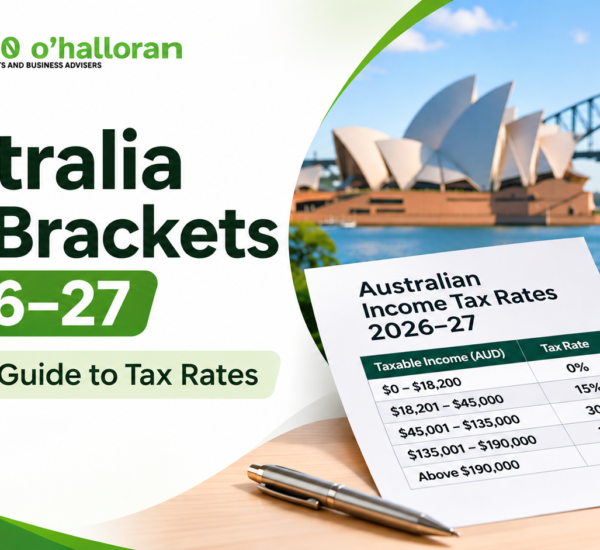
Australia tax brackets determine how much income tax individuals pay based on their annual taxable income and tax residency status. For the 2026–27 financial year, Australia has different tax rates for residents and foreign residents, with additional considerations such as the Medicare levy.
Understanding Australian income tax rates is particularly important for New Zealand residents working in Australia, individuals earning income across both countries, business owners with Australian operations and investors with international financial interests.
In this guide, DFK Orb360 O’Halloran explains the Australian tax brackets for 2026–27, how progressive tax rates work, the Medicare levy and what New Zealand residents should consider when earning income in Australia.
Australia Tax Brackets 2026–27
Australia uses a progressive income tax system, meaning different portions of taxable income are taxed at different rates.
- Australian residents receive a tax-free threshold of AUD $18,200.
- Resident marginal tax rates range from 15% to 45% for 2026–27.
- Most Australian tax residents also pay a 2% Medicare levy.
- Foreign residents generally pay tax from their first dollar of Australian taxable income and do not receive the resident tax-free threshold.
- New Zealand tax residents earning Australian income may have tax obligations in both countries, subject to the Australia–New Zealand Double Tax Agreement and foreign tax credit rules.
Tax residency, income type and individual circumstances determine which rules apply.
Key Takeaways
- Australia’s 2026–27 financial year runs from 1 July 2026 to 30 June 2027.
- The resident tax-free threshold remains AUD $18,200.
- The 15% marginal rate applies to taxable income between AUD $18,201 and $45,000.
- The highest resident marginal tax rate is 45% for income above AUD $190,000.
- The Medicare levy is generally an additional 2% for Australian residents, subject to exemptions and reductions.
- New Zealand residents with Australian income should consider tax residency and double taxation rules.
What Are the Australia Tax Brackets for 2026–27?
The Australia tax brackets for the 2026–27 financial year determine how much income tax Australian resident individuals pay on their taxable income.
Australia applies a progressive tax system. This means that income is divided into different bands, with each portion taxed at its corresponding marginal rate. Moving into a higher tax bracket does not mean all your income is taxed at the higher rate.
Australian Resident Income Tax Rates for 2026–27
The following table shows the general income tax rates for Australian resident individuals for the financial year from 1 July 2026 to 30 June 2027.
| Taxable income (AUD) | Tax rate |
|---|---|
| $0 – $18,200 | 0% |
| $18,201 – $45,000 | 15% |
| $45,001 – $135,000 | 30% |
| $135,001 – $190,000 | 37% |
| Above $190,000 | 45% |
These are marginal income tax rates and do not include the Medicare levy or any applicable tax offsets. Your final tax liability may differ depending on deductions, offsets and other individual circumstances.
How Does Australia’s Progressive Tax System Work?
Australia’s progressive income tax system means that different portions of your taxable income are taxed at different rates.
For example, an individual earning AUD $60,000 does not pay 30% tax on their entire income. Instead, the first AUD $18,200 is tax-free, the next portion is taxed at 15%, and only the income above AUD $45,000 is taxed at 30%.
Example: Calculating Tax on an AUD $60,000 Salary
Assumed annual taxable income: AUD $60,000
| Income portion | Calculation | Tax payable |
|---|---|---|
| First $18,200 | 0% tax | $0 |
| Next $26,800 | $26,800 × 15% | $4,020 |
| Remaining $15,000 | $15,000 × 30% | $4,500 |
| Total | $8,520 |
Estimated income tax: AUD $8,520.
This calculation excludes the Medicare levy, tax offsets, deductions and other adjustments.
What Is the Medicare Levy in Australia?
The Medicare levy is an additional contribution that helps fund Australia’s public healthcare system. For most Australian resident taxpayers, the general Medicare levy is 2% of taxable income.
This levy is separate from the income tax rates shown in the Australia tax brackets table.
Who Pays the Medicare Levy?
Most Australian resident taxpayers are required to pay the Medicare levy. However, exemptions and reductions may apply depending on income, family circumstances and eligibility.
Foreign residents generally do not pay the Medicare levy.
Some higher-income taxpayers who do not have an appropriate level of private hospital insurance may also be subject to the Medicare levy surcharge.
Australian Tax Rates for Non-Residents in 2026–27
Australia applies different income tax rates to foreign residents compared with Australian tax residents.
Foreign residents generally pay tax on Australian-sourced income, rather than worldwide income. They do not receive the Australian resident tax-free threshold and generally do not pay the Medicare levy.
Foreign Resident Tax Brackets for 2026–27
| Taxable income (AUD) | Tax rate |
|---|---|
| $0 – $135,000 | 30% |
| $135,001 – $190,000 | 37% |
| Above $190,000 | 45% |
These general rates may not apply to every type of income. Special rules can apply to working holiday makers, temporary residents, certain investment income and other categories of taxpayers.
Australian Tax Resident vs Foreign Resident: What Is the Difference?
One of the most important considerations when calculating Australian income tax is determining your tax residency status.
Australian tax residency is not necessarily the same as your citizenship, visa status or immigration residency. The Australian Taxation Office considers an individual’s circumstances and relevant residency tests.
| Area | Australian tax resident | Foreign tax resident |
|---|---|---|
| Tax-free threshold | Generally eligible | Generally not eligible |
| Income subject to Australian tax | Generally worldwide income | Generally Australian-sourced income |
| Starting marginal rate | 0% up to $18,200 | Generally 30% from the first dollar |
| Medicare levy | Generally applies, subject to rules | Generally does not apply |
It is important to establish your tax residency status before applying the Australian tax brackets to your income.
How Do Australian Tax Brackets Affect New Zealand Residents?
New Zealand and Australia have separate income tax systems. If you are a New Zealand tax resident earning income in Australia, you may need to consider tax obligations in both countries.
New Zealand tax residents are generally required to declare their worldwide taxable income, including certain income earned overseas. Australian income may also be subject to Australian tax depending on its source and the applicable tax rules.
1. Working in Australia While Living in New Zealand
If you live in New Zealand but work in Australia, your tax position may depend on where the work is physically performed, your tax residency status and the Australia–New Zealand Double Tax Agreement.
For example, someone who lives in New Zealand and travels to Australia for employment may have different obligations from someone who relocates to Australia and becomes an Australian tax resident.
2. Earning Australian Investment Income
New Zealand residents with Australian investments may receive dividends, interest, rental income or other investment returns.
The tax treatment depends on the type of income, the investor’s tax residency and the relevant tax treaty provisions. Some income may be subject to Australian withholding tax, while New Zealand reporting obligations may also apply.
3. Avoiding Double Taxation
The Australia–New Zealand Double Tax Agreement helps determine which country has taxing rights over particular types of income and provides mechanisms to reduce double taxation.
New Zealand residents may be eligible to claim a foreign tax credit for qualifying Australian tax paid on the same income. The credit is subject to limitations and documentation requirements.
Australia vs New Zealand: Understanding the Tax Systems
Australia and New Zealand both use progressive personal income tax systems, but their tax brackets, thresholds and additional levies differ.
For individuals earning income across both countries, it is important to understand which country’s rules apply and how double taxation relief works.
Rather than comparing headline tax rates alone, consider:
- Tax residency in each country.
- The source and type of income.
- Applicable tax-free thresholds.
- Medicare levy and other additional charges.
- Available deductions and tax offsets.
- Double Tax Agreement provisions.
- Foreign tax credits and reporting requirements.
A comparison should also account for differences in income years, social security arrangements and individual circumstances.
Common Mistakes to Avoid When Understanding Australian Income Tax Rates
When researching Australia tax brackets, individuals and businesses should avoid making assumptions based only on their salary or the headline tax rate.
- Confusing marginal and effective tax rates: Your marginal tax rate applies to the next dollar earned, not necessarily your entire income.
- Ignoring the Medicare levy: The levy may increase the total tax payable for Australian residents.
- Assuming everyone receives the tax-free threshold: Foreign residents generally do not qualify for the resident threshold.
- Overlooking tax residency: Your residency status can significantly change your Australian tax obligations.
- Ignoring overseas income: New Zealand residents may have reporting obligations for worldwide taxable income.
- Assuming tax paid overseas settles everything: Foreign tax credit rules and double tax treaty provisions need to be considered.
What Should New Zealand Businesses and Investors Consider?
For New Zealand businesses with Australian operations, employees, customers or investments, cross-border tax planning can involve more than personal income tax brackets.
Businesses and investors may need to consider:
- Australian business income and permanent establishment considerations.
- Employment and payroll tax obligations.
- Australian Goods and Services Tax (GST).
- Australian company tax obligations.
- Dividend and withholding tax treatment.
- Foreign investment reporting and taxation.
- New Zealand foreign income reporting and tax credits.
Understanding the tax rules before entering the Australian market or making an overseas investment can help identify potential compliance obligations and financial risks.
How DFK Orb360 O’Halloran Can Help
Cross-border income and investment arrangements can create tax obligations in more than one country. Understanding the interaction between Australian tax rules and New Zealand tax residency is important when making financial and business decisions.
At DFK Orb360 O’Halloran, our team provides accounting, taxation and business advisory support to New Zealand businesses and individuals.
If you earn income overseas, have Australian business interests or need to understand your New Zealand tax reporting obligations, speaking with an adviser can help you identify the relevant considerations.
Need Guidance on Australian or New Zealand Tax Obligations?
Whether you earn income in Australia, hold overseas investments or operate across both markets, speak with our team at DFK Orb360 O’Halloran about your accounting and tax requirements.
Speak With Our TeamPeople Also Ask: Australia Tax Brackets
1. What are the Australia tax brackets for 2026–27?
For Australian residents in 2026–27, the general marginal tax rates are 0% on income up to AUD $18,200, 15% from $18,201 to $45,000, 30% from $45,001 to $135,000, 37% from $135,001 to $190,000 and 45% above $190,000. These rates exclude the Medicare levy.
2. What is the tax-free threshold in Australia?
The Australian resident tax-free threshold is generally AUD $18,200. This means eligible Australian tax residents do not pay ordinary income tax on the first $18,200 of taxable income, subject to the relevant tax rules.
3. What is the highest income tax rate in Australia?
The highest general marginal income tax rate for Australian residents in 2026–27 is 45%. It applies to the portion of taxable income above AUD $190,000. The Medicare levy may also apply.
4. Do Australian tax brackets include Medicare levy?
No. The standard Australian income tax brackets do not include the Medicare levy. Most Australian resident taxpayers pay an additional levy of 2%, subject to income thresholds, exemptions and reductions.
5. What are the tax rates for non-residents in Australia?
Foreign residents generally pay 30% on Australian taxable income up to AUD $135,000, 37% between $135,001 and $190,000 and 45% above $190,000 for 2026–27. Foreign residents generally do not receive the tax-free threshold or pay the Medicare levy.
6. Do New Zealand residents pay tax on income earned in Australia?
New Zealand tax residents generally have to report worldwide taxable income, including relevant Australian income. Australian tax may also apply depending on the income source and applicable treaty rules. Foreign tax credits may help reduce double taxation.
7. What is the Australian financial year for tax purposes?
The Australian financial year generally runs from 1 July to 30 June. The 2026–27 financial year therefore runs from 1 July 2026 to 30 June 2027.
8. Is Australian income tax calculated on gross or taxable income?
Australian income tax is generally calculated on taxable income, which is assessable income less allowable deductions. Tax offsets and other adjustments may then affect the final tax payable.
9. Do Australian tax residents pay tax on overseas income?
Australian tax residents generally declare worldwide income, subject to applicable exemptions and special rules. Foreign income tax offsets may be available where tax has already been paid overseas.
10. How can I compare Australian and New Zealand tax rates?
To compare Australian and New Zealand tax rates accurately, consider tax residency, taxable income, deductions, levies, tax credits and the relevant tax year. A comparison of headline marginal rates alone may not reflect your final tax position.
Official Tax Resources
For the latest Australian and New Zealand tax information, refer to the following official resources:
- Australian Taxation Office – Resident tax rates
- Australian Taxation Office – Foreign resident tax rates
- Australian Taxation Office – Medicare levy
- Inland Revenue NZ – New Zealand tax residents and double tax agreements
- Inland Revenue NZ – Investing overseas
This article has been prepared for general information by DFK Orb360 O’Halloran. It provides an overview of Australian personal income tax rates for the 2026–27 financial year and selected considerations for New Zealand residents.
It is not personalised tax, legal or financial advice. Australian and New Zealand tax obligations depend on residency status, income type, applicable legislation and individual circumstances.
Review: DFK Orb360 O’Halloran team – confirm internal review before publication.
Last updated: November 2026.
Speak With DFK Orb360 O’Halloran
Have questions about overseas income, international investments or your New Zealand tax obligations? Speak with our team to discuss your accounting and business advisory requirements.
Contact Our TeamGet in Touch With Our Team
Complete the form below and our team will be in touch.



 09 377 4238
 Level 2, 6 Kingdon Street, Newmarket, Auckland
 help@orb360.co.nz