
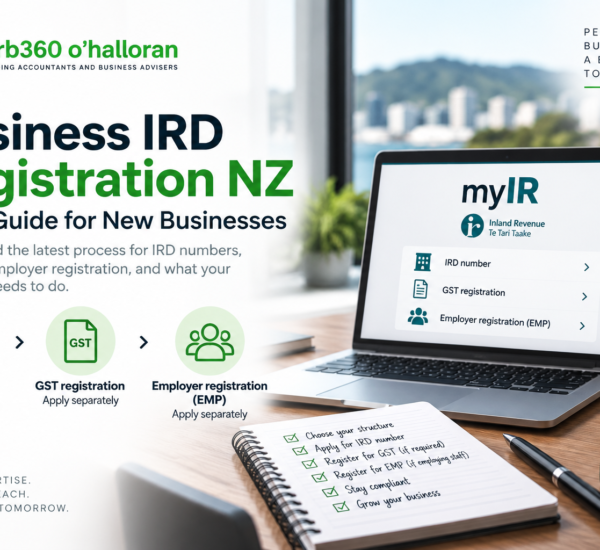
Business IRD registration NZ changed in September 2026, with Inland Revenue separating GST and employer tax registration from the non-individual IRD number application process.
From 12 September 2026, businesses applying for a non-individual IRD number must complete that application first and then separately apply for GST and employer tax (EMP) registration where required.
GST and EMP registrations are now available through the Intermediary Centre under “client registration”. The Companies Office process has not changed, meaning companies incorporating through the Companies Office can still register for GST and EMP as part of that process.
For anyone starting a business, setting up a company, registering for GST or becoming an employer, understanding the latest business IRD registration NZ process can help avoid delays and registration mistakes.
Starting a business in New Zealand involves more than choosing a business structure and registering your company. You may also need to obtain an IRD number, register for GST and set up employer tax obligations if you plan to employ staff.
In September 2026, Inland Revenue changed the way some of these business tax accounts are registered through myIR.
From 12 September 2026, GST and employer tax (EMP) registration are no longer available as part of the non-individual IRD number application process.
This means that businesses completing business IRD registration NZ need to understand which registration is required, when to complete it and where to access the relevant service.
Getting your IRD, GST and employer registrations right from the beginning can help you avoid unnecessary compliance problems later. DFK Orb360 O’Halloran can help you understand your business tax registration and ongoing accounting requirements.
Business IRD registration NZ refers to obtaining an IRD number for a business or organisation and setting up the relevant tax accounts with Inland Revenue.
An IRD number identifies a business or organisation for its tax-related activities. Depending on the business structure and activities, additional tax registrations may be required.
These can include:
IRD states that companies, partnerships, trusts, estates, clubs, societies and other organisations may require an IRD number. Self-employed individuals generally use their personal IRD number for their business activities. :contentReference[oaicite:1]{index=1}
The most important change is that GST and EMP registration have been separated from the non-individual IRD number application process.
Before 12 September 2026, eligible businesses could register for GST and EMP while applying for a non-individual IRD number.
Under the new process:
IRD says the changes are part of its work to organise business account registration services into logical groups. :contentReference[oaicite:2]{index=2}
| Area | What Changed? |
|---|---|
| Business IRD number | Complete the non-individual IRD number application first. |
| GST registration | Apply separately after the IRD number application. |
| EMP registration | Apply separately after the IRD number application. |
| Intermediary Centre | GST and EMP registrations are available under “client registration”. |
| EMP refund bank account | A refund bank account is no longer required when registering for EMP. |
| Restricted users | Restricted users do not have access to registration services in the Intermediary Centre. |
| Companies Office | The Companies Office registration process remains unchanged. |
| Overseas GST | A dedicated online registration is available for relevant overseas businesses. |
An IRD number may be required by a range of businesses and organisations.
IRD’s guidance includes:
A self-employed individual generally uses their existing personal IRD number for their business rather than obtaining a separate business IRD number. :contentReference[oaicite:3]{index=3}
If your business or organisation needs its own IRD number, IRD provides an online application process through myIR.
Before applying, establish whether you are operating as a sole trader, partnership, company, trust or another type of organisation.
Your structure affects how your business is registered and which tax obligations may apply.
IRD’s current guidance states that you need to register a myIR account for a business or organisation before applying for its IRD number online. :contentReference[oaicite:4]{index=4}
If you are in business, IRD requires the relevant Business Industry Classification (BIC) code as part of the application process. :contentReference[oaicite:5]{index=5}
Make sure you have the required supporting documents before beginning the application.
The documents required depend on the type of business or organisation and whether the entity is considered New Zealand resident or offshore.
Eligible New Zealand resident businesses and organisations can apply online through myIR.
IRD may contact you if additional information is required. If you apply online, IRD says it can email the IRD number to you. :contentReference[oaicite:6]{index=6}
GST registration is now a separate step from the non-individual IRD number application.
This is one of the most important aspects of the 2026 changes.
If your business needs to register for GST, you should assess your GST obligations and complete the separate GST registration process.
Businesses should not assume that obtaining an IRD number automatically means they are registered for GST.
Whether GST registration is required depends on the business’s activities and circumstances.
If you are unsure whether your business needs to register for GST, professional tax advice can help you understand the applicable requirements.
If your business employs staff, you may also need to register as an employer with Inland Revenue.
Under the 2026 changes, EMP registration is completed separately from the non-individual IRD number application.
This means a business that is establishing its payroll should make employer registration a separate step in its setup process.
Businesses should also consider their ongoing responsibilities for PAYE, payday filing, employee deductions and other employer obligations.
myIR is Inland Revenue’s online service through which businesses and organisations can manage their tax information and interact with IRD.
For business IRD registration NZ, myIR can be used to manage relevant registration and tax account processes.
The 2026 changes mean that certain business tax accounts are being organised into separate registration services rather than being grouped together in one application.
IRD previously announced that other business tax accounts were also being separated into logical groups, including international exchange and withholding tax accounts. :contentReference[oaicite:7]{index=7}
Accountants, tax agents and other intermediaries should be aware of the new registration pathway.
IRD states that GST and EMP registrations are available through the Intermediary Centre under “client registration.”
This means advisers managing business registrations for clients should use the appropriate registration service rather than expecting GST or EMP registration to appear within the non-individual IRD number application.
Restricted users do not have access to registration services in the Intermediary Centre. :contentReference[oaicite:8]{index=8}
| Registration | Before 12 September 2026 | From 12 September 2026 |
|---|---|---|
| Non-individual IRD number | Available through the registration process | Complete first |
| GST | Could be included in the registration process | Complete separately |
| EMP | Could be included in the registration process | Complete separately |
| GST/EMP for clients | Existing registration workflow | Intermediary Centre → Client registration |
| EMP refund bank account | Required | No longer required |
| Companies Office | Existing process | No change |
No. The Companies Office process has not changed as a result of these myIR registration changes.
IRD states that customers incorporating a company through the Companies Office can still register for GST and EMP when applying for an IRD number through that process.
This distinction is important because the separation mainly affects the non-individual registration process through myIR. :contentReference[oaicite:9]{index=9}
IRD has also introduced a dedicated online registration process for certain overseas businesses registering for GST.
The new registration is called “Register for GST as an overseas business.”
It applies to relevant non-resident businesses dealing with:
The dedicated registration provides a specific process for these businesses and includes GST information as part of the registration. :contentReference[oaicite:10]{index=10}
The practical effect of the 2026 changes is that business owners should think about tax registration as a series of steps rather than one combined process.
A typical setup may involve:
If you’re starting a new business, use this checklist to organise your tax setup:
Under the new process, GST registration is separate from the non-individual IRD number application.
If your business plans to employ staff, make sure you separately assess whether EMP registration is required.
IRD requires supporting information and documentation for business and organisation IRD number applications. Preparing these documents before applying can help avoid unnecessary delays. :contentReference[oaicite:11]{index=11}
Your business structure affects how your IRD number and tax obligations are managed.
Obtaining an IRD number or registering for GST does not remove the need to meet ongoing tax filing, payment, record-keeping and reporting obligations.
| Business Structure | IRD Number Consideration |
|---|---|
| Sole trader | Generally uses their existing personal IRD number for business activities. |
| Partnership | The partnership has its own IRD number and each partner also needs a personal IRD number. |
| Company | The company has its own IRD number. |
| Trust | A trust generally requires its own IRD number. |
IRD’s requirements depend on the type and circumstances of the business or organisation. :contentReference[oaicite:12]{index=12}
Professional accounting advice can be useful if you are:
An accountant can help you understand the registration requirements and make sure your tax setup aligns with the way your business operates.
DFK Orb360 O’Halloran provides Chartered Accounting, tax, GST and business advisory services for businesses across Wellington, Auckland and New Zealand.
Our team can help businesses with:
DFK’s Wellington-region office is located in Petone, Lower Hutt, and we support businesses across Wellington, Lower Hutt, Upper Hutt, Porirua and surrounding areas. Our Auckland offices provide support for businesses across the Auckland region.
Understanding business IRD registration NZ requirements can be difficult when you are also setting up your company, GST, payroll and accounting systems.
DFK Orb360 O’Halloran can help you understand your tax registration requirements and ongoing compliance obligations.
Business IRD registration NZ involves obtaining an IRD number for a business or organisation and registering for the relevant tax accounts that apply to its activities.
The requirement depends on the business structure and circumstances. Companies, partnerships, trusts and various other organisations generally have their own IRD number, while a sole trader generally uses their personal IRD number. :contentReference[oaicite:13]{index=13}
Eligible New Zealand businesses and organisations can apply for an IRD number online through myIR. You will need to provide the required information and supporting documents. :contentReference[oaicite:14]{index=14}
From 12 September 2026, GST registration is no longer available as part of the non-individual IRD number application. GST registration must be completed separately. :contentReference[oaicite:15]{index=15}
From 12 September 2026, EMP registration must be completed separately from the non-individual IRD number application. :contentReference[oaicite:16]{index=16}
GST and EMP registrations are available through the Intermediary Centre under “client registration.” :contentReference[oaicite:17]{index=17}
No. IRD states that the Companies Office process has not changed and companies incorporating through the Companies Office can still register for GST and EMP through that process. :contentReference[oaicite:18]{index=18}
Generally, a sole trader uses their personal IRD number for their business activities. Other business structures may have their own IRD numbers. :contentReference[oaicite:19]{index=19}
GST registration depends on your business activities and circumstances. If you are unsure whether GST registration applies, obtain guidance based on your specific situation.
A business employing staff may need to register as an employer with Inland Revenue. Employer tax obligations should be reviewed before you begin employing staff.
The documents depend on the type of business or organisation and whether the entity is considered New Zealand resident or offshore. IRD provides a document checklist as part of its business IRD number application guidance. :contentReference[oaicite:20]{index=20}
Yes. An accountant can help you understand your business structure, IRD number requirements, GST obligations, employer registration and ongoing tax compliance.
You can contact Inland Revenue or speak with a qualified New Zealand Chartered Accountant. Professional guidance can be particularly useful when establishing a company, registering for GST or setting up employer obligations.
For the latest requirements, always check Inland Revenue’s official guidance.
The business IRD registration NZ process has changed for non-individual registrations following Inland Revenue’s September 2026 update.
The main point for businesses is straightforward: complete the non-individual IRD number application first, then complete separate GST and EMP registrations where required.
Businesses should also remember that obtaining an IRD number or registering for GST is only part of their ongoing tax compliance responsibilities.
If you are starting a business, changing your structure, registering for GST or preparing to employ staff, getting your tax setup right from the beginning can help create a stronger foundation for your business.
DFK Orb360 O’Halloran provides Chartered Accounting, GST, tax and business advisory support for businesses across Wellington, Auckland and New Zealand.
Book a ConsultationThis article provides general information about business IRD registration and the 2026 changes to the myIR registration process. It does not constitute personalised tax, accounting, legal or financial advice.
Tax registration requirements depend on your business structure, activities and circumstances. Always check the latest Inland Revenue information or speak with a qualified professional before making tax or registration decisions.
Last reviewed: 16 September 2026

DFK Orb360 O’Halloran provides Chartered Accounting, tax and business advisory services from offices in Auckland and the Wellington region. Our Auckland offices are located in Newmarket and Rosedale, while our Wellington-region office is located in Petone, Lower Hutt.
From accounting and GST compliance to tax planning, business advisory and outsourced CFO support, our teams work with businesses and individuals based in Auckland, Wellington and surrounding areas.
If you are searching for accountants Auckland, chartered accountants Auckland, accountants Wellington or chartered accountants Wellington, you can connect with a local DFK Orb360 O’Halloran team or arrange a consultation remotely.
DFK Orb360 O’Halloran has two Auckland offices, giving businesses across Auckland access to accounting, tax and business advisory support.
Our Newmarket office is located at Level 2, 6 Kingdon Street, Newmarket, Auckland. The office supports business owners, professionals, investors and growing organisations with accounting, taxation, GST, financial reporting and business advisory services.
Businesses looking for an accountant in Newmarket, accounting firm in Auckland or chartered accountant Auckland can work with our Newmarket team for both compliance and wider financial advice.
Explore our Newmarket Auckland Chartered Accounting services
Our Rosedale office is located at 1D/43 Omega Street, Rosedale, Auckland 0632. The office serves businesses across Auckland’s North Shore with accounting, taxation, GST, bookkeeping, business advisory and Inland Revenue compliance support.
If you are searching for an accountant in Rosedale, North Shore accountant or chartered accountant North Shore, our Rosedale team provides local professional accounting support.
Explore our Rosedale Auckland Chartered Accounting services
Our Auckland teams support clients across the wider Auckland region, including businesses located on the North Shore, Central Auckland and surrounding areas.
Depending on your requirements, you can work with DFK Orb360 O’Halloran for:
DFK Orb360 O’Halloran’s Wellington-region office is located in Petone, Lower Hutt. From this location, our team supports businesses and individuals across Wellington, Lower Hutt and the surrounding region.
If you are searching for accountants Wellington, chartered accountants Wellington, a tax accountant Wellington or a business accountant Wellington, you can meet with our team at our Petone office or arrange a remote consultation.
Our Wellington-region office is located at 48 Richmond Street, Petone, Lower Hutt. The Petone office provides access to accounting, tax, GST, business advisory and Inland Revenue support for businesses across the Wellington region.
The location is particularly convenient for businesses based in Petone, Lower Hutt and the wider Hutt Valley, while our team also works with clients throughout Wellington.
Explore our Lower Hutt accounting services
Our Petone team supports clients across the wider Wellington region, including:
Our service area is not limited to these locations. If your business is elsewhere in the Wellington region, contact our team to discuss your requirements.
Businesses working with our Wellington-region team can access a range of accounting and advisory services, including:
| Location | Office | Suitable For |
|---|---|---|
| Auckland Central | Newmarket | Businesses, professionals, investors and growing organisations across Auckland |
| Auckland North Shore | Rosedale | Businesses and individuals across Rosedale, Albany, the North Shore and surrounding Auckland areas |
| Wellington Region | Petone, Lower Hutt | Businesses and individuals across Wellington, Lower Hutt, Upper Hutt, Porirua and surrounding areas |
Working with a local accounting team can make ongoing communication easier while giving you access to professional accounting and business advisory expertise.
A local Chartered Accountant can support more than annual tax compliance. Depending on your circumstances, your accounting team may also help with GST, cash flow, management reporting, tax planning, business growth, financial forecasting and strategic decisions.
DFK Orb360 O’Halloran combines local office access with cloud accounting and remote consultations, allowing clients to work with the team even when they are not located immediately next to an office.
Whether you are searching for an accountant Auckland, accountant Wellington, accountant Lower Hutt, accountant Petone, accountant Rosedale or accountant Newmarket, DFK Orb360 O’Halloran has local offices in Auckland and the Wellington region.
You can visit one of our offices or speak with our team remotely about your accounting, tax or business advisory requirements.
DFK Orb360 O’Halloran has offices in Newmarket and Rosedale in Auckland, and Petone in Lower Hutt for the Wellington region.
DFK Orb360’s Wellington-region office is located at 48 Richmond Street, Petone, Lower Hutt. The team supports clients across Wellington and the surrounding region and can also provide remote consultations.
DFK Orb360 O’Halloran has two Auckland offices: Newmarket and Rosedale. The Newmarket office is at Level 2, 6 Kingdon Street, while the Rosedale office is at 1D/43 Omega Street.
DFK Orb360’s Wellington-region office is located in Petone, Lower Hutt, at 48 Richmond Street. The team supports businesses and individuals throughout Wellington and surrounding areas.
Yes. DFK Orb360 has a physical office in Petone, Lower Hutt and provides accounting, tax and business advisory services to clients across Lower Hutt and the wider Wellington region.
Yes. DFK Orb360’s Wellington-region team supports clients in Upper Hutt as well as Lower Hutt, Petone, Wellington, Porirua and surrounding areas.
Yes. DFK Orb360 provides accounting and business advisory support to clients in Porirua and the wider Wellington region from its Petone office.
Yes. DFK Orb360’s Rosedale office supports businesses across Auckland’s North Shore with accounting, tax, GST, bookkeeping and business advisory services.
Yes. DFK Orb360 can provide remote accounting, tax and business advisory support to clients across New Zealand.
DFK Orb360 provides accounting, tax advisory, GST, financial reporting, payroll, cloud accounting, business advisory and outsourced CFO services. The services available can depend on your business requirements.
Yes. Clients can arrange consultations with the DFK Orb360 team at the relevant Auckland or Wellington-region office, subject to appointment availability.
Whether your business is based in Auckland, Wellington, Lower Hutt, Petone, Upper Hutt, Porirua or elsewhere in New Zealand, our Chartered Accounting and business advisory team can help.
Book a Consultation
Copyright © 2025 Marketing Transformers | All Rights Reserved.


 09 377 4238
 Level 2, 6 Kingdon Street, Newmarket, Auckland
 help@orb360.co.nz