

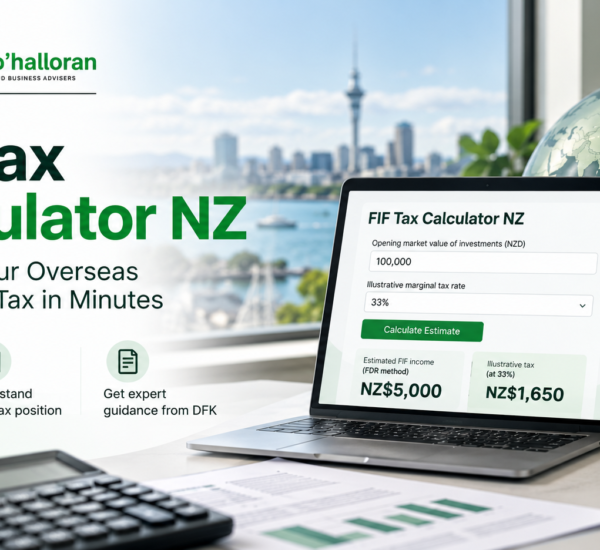
FIF tax calculator NZ: If you are a New Zealand tax resident investing in overseas shares, international ETFs or foreign investment funds, understanding your Foreign Investment Fund (FIF) income can help you prepare for your tax obligations. Use the illustrative calculator below to estimate income under the Fair Dividend Rate (FDR) method, then learn when you may need a more detailed calculation.
FIF tax can be complex because the calculation depends on your investment type, tax residency, eligibility for exemptions and the method that applies to your portfolio. DFK Orb360 O’Halloran helps clients across New Zealand understand accounting and tax requirements, including questions relating to overseas investments.
Want help understanding your FIF position? Contact DFK Orb360 to discuss your overseas investment tax obligations.
FIF Tax Calculator NZ: Estimate Your FIF Income
This illustrative calculator estimates FIF income under a simplified FDR calculation. Enter the opening market value of eligible investments in New Zealand dollars and your marginal tax rate to see an indicative result.
FIF income estimator — FDR method
Select the marginal rate that you want to use for an illustration. Your actual tax rate and liability depend on your total taxable income and circumstances.
This estimator applies 5% to the opening value entered. It does not determine whether FDR is available or account for all required adjustments, exemptions, foreign currency issues, method restrictions or your full income tax position. It is not an official IRD calculator or a tax assessment.
Need a calculation for your actual portfolio? Use Inland Revenue’s official FIF calculator to calculate supported methods and follow the relevant instructions.
What Is FIF Tax in New Zealand?
FIF stands for Foreign Investment Fund. New Zealand's FIF rules can apply to certain overseas investments held by New Zealand tax residents. These rules determine how income from qualifying foreign investments is calculated and reported for tax purposes.
Depending on the investment and the investor's circumstances, the rules may apply to overseas shares, certain foreign ETFs, managed funds and other qualifying interests. Not every overseas asset is a FIF, and different tax rules can apply to overseas bank deposits, rental properties and other assets.
How Does the FIF Tax Calculator Work?
The estimator above uses a simplified version of the Fair Dividend Rate method. Under the standard FDR approach, the calculation commonly starts with 5% of the opening market value of eligible investments, subject to the applicable rules and adjustments.
For example, if eligible investments have an opening market value of NZ$100,000 and the simplified 5% calculation applies:
- Opening market value: NZ$100,000
- Illustrative FDR percentage: 5%
- Illustrative FIF income: NZ$5,000
The NZ$5,000 is an illustrative amount of FIF income, not the final tax bill. The tax payable depends on your full taxable income, the relevant tax rules and your circumstances. The simple calculator does not check whether FDR is available for your investments.
Which FIF Calculation Methods Can Apply?
Fair Dividend Rate (FDR)
The FDR method commonly calculates income using 5% of the opening market value of eligible investments, subject to statutory rules and adjustments. It can result in FIF income even if you have not received cash dividends or sold the investments.
Comparative Value (CV)
The CV method uses opening and closing values and relevant transactions during the year, including purchases, sales and distributions. Eligibility and restrictions apply, so it is not always available as a freely chosen alternative to FDR.
Cost Method
The Cost Method may be available in qualifying circumstances when the required market value cannot be established. Prescribed cost-based rules apply, and supporting valuation information may be required.
Other FIF methods
Other methods include the Deemed Rate of Return, Revenue Account Method and attributable FIF income method. Their eligibility requirements differ, and the appropriate calculation may require more detailed information about the investment and investor.
Inland Revenue's official online calculator supports FDR, CV and Cost Method calculations. It does not provide an online calculation tool for every FIF method.
Does the NZ$50,000 FIF Threshold Apply to You?
Eligible individual investors may qualify for a de minimis exemption where the total cost of relevant FIF interests stays within the applicable threshold during the income year. Under the currently published guidance reviewed for this article, Inland Revenue refers to a NZ$50,000 cost threshold. Eligibility and measurement rules apply, and other tax obligations may remain.
Proposed changes to the FIF rules have been included in the Taxation (Annual Rates for 2026–27, FBT Simplification, Foreign Investment Funds, and Remedial Measures) Bill. As at 12 October 2026, Inland Revenue reported that the Bill was at the select committee stage. Proposed changes should not be treated as enacted law unless Parliament passes them and the relevant provisions take effect.
Check the current rules for the income year that applies to you before relying on a threshold or exemption. If you have investments near the threshold, professional advice may help you understand how the rules apply.
What Information Do You Need for a FIF Calculation?
Depending on the method, you may need:
- The name and type of each overseas investment.
- Opening market values and other relevant valuation information.
- Purchase costs, sale proceeds and transaction dates.
- Dividend and distribution records.
- Foreign currency conversion details.
- Information about tax residency and potentially applicable exemptions.
- Records of overseas tax paid, where relevant.
Keep your brokerage statements and calculation workings with your tax records. If you hold several investments, have changed tax residency or invest through a trust or company, your calculation may need additional analysis.
Common FIF Tax Calculator Mistakes
- Using a simple 5% estimate without checking FDR eligibility.
- Confusing FIF income with the final amount of tax payable.
- Assuming every overseas ETF or share is taxed in the same way.
- Using the wrong income year or outdated tax information.
- Ignoring required adjustments, transaction records or currency conversions.
- Assuming that no sale or dividend means there is no FIF income.
- Relying on an exemption without checking the relevant eligibility conditions.
How DFK Orb360 Can Help With FIF Tax in NZ
Calculating FIF income can be complicated when you hold multiple overseas investments, receive foreign dividends, invest across different jurisdictions or are unsure which calculation method applies.
DFK Orb360 O’Halloran provides accounting, tax and business advisory services to clients across New Zealand. Our team can discuss your circumstances and help you understand the relevant requirements, including:
- Reviewing whether the FIF rules may apply to your investments.
- Considering whether a relevant exemption may be available.
- Understanding applicable calculation methods and their restrictions.
- Preparing for tax return and disclosure requirements.
- Reviewing records and calculations for your tax filing.
- Considering cross-border tax issues and foreign tax credits where relevant.
Have overseas shares, international ETFs or foreign investment funds? Do not rely on a basic estimate if you are uncertain about your actual tax obligations.
Contact DFK Orb360 to discuss your FIF tax position and the support you may need.
Speak to DFK Orb360 about your overseas investment tax obligations →
Frequently Asked Questions About FIF Tax Calculator NZ
Is there an official FIF tax calculator in New Zealand?
Yes. Inland Revenue provides an online FIF calculator for supported calculation methods, including Fair Dividend Rate, Comparative Value and Cost Method calculations. The tool is intended for eligible users and does not cover every possible FIF method or tax situation.
How do I calculate FIF income in NZ?
First determine whether your investment falls within the FIF rules and whether an exemption applies. Then identify the permitted calculation method and gather the required investment values and transaction records. For eligible investments using FDR, the standard calculation commonly starts with 5% of opening market value, subject to the applicable rules and adjustments.
Does the FIF calculator tell me how much tax I will pay?
A FIF calculator determines or estimates FIF income under a particular method. It does not necessarily calculate your final tax bill, which depends on your wider taxable income and circumstances. The estimator on this page provides an illustration only.
Can I use the FIF calculator if my investments cost less than NZ$50,000?
Eligibility depends on the applicable de minimis rules, the cost of relevant investments and your circumstances. Eligible individuals may qualify for an exemption, but other tax rules may still apply. Check current Inland Revenue guidance before deciding whether you need a FIF calculation.
Do I need to sell overseas shares before FIF income applies?
No. Some FIF calculation methods can attribute income without a sale or cash dividend. The result depends on the method, investment and applicable exemptions.
Can DFK Orb360 help me calculate FIF income?
DFK Orb360 O’Halloran provides accounting and tax services to clients across New Zealand. If you are unsure which FIF method applies or how to prepare your tax information, contact our team to discuss your circumstances.
Official FIF Tax Resources
- Inland Revenue: Calculate my FIF income
- Inland Revenue: Foreign investment funds
- Inland Revenue: FIF exemptions
- Inland Revenue Tax Policy: 2026–27 tax Bill and proposed changes
About This Guide
Publisher: DFK Orb360 O’Halloran Chartered Accountants
Last updated: 22 October 2026
This guide provides general information about New Zealand's Foreign Investment Fund rules and an illustrative FDR calculation. It is not personalised tax, legal or investment advice. Tax treatment depends on individual circumstances and the law applicable to the relevant income year.



 09 377 4238
 Level 2, 6 Kingdon Street, Newmarket, Auckland
 help@orb360.co.nz