

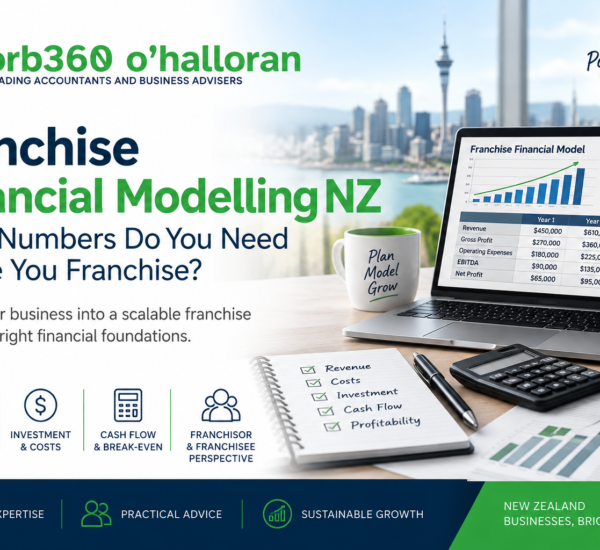
Franchise Financial Modelling NZ: What Numbers Do You Need Before You Franchise?
Franchise financial modelling NZ is an important part of deciding whether a business is financially ready to franchise.
A successful business does not automatically make a successful franchise. Before recruiting franchisees, setting franchise fees or expanding into new locations, business owners need to understand the financial economics of the franchise model.
How much will a franchise location cost to establish? What revenue does a franchisee need to generate? How long could it take to reach break-even? What will the franchisor earn? How much working capital will be required?
These are the types of questions that franchise financial modelling should answer.
This guide explains the key numbers to include in a franchise financial model and how New Zealand business owners can use financial modelling to assess franchise viability, investment requirements and growth potential.
Quick Answer: What Is Franchise Financial Modelling NZ?
Franchise financial modelling NZ is the process of creating financial projections to assess the expected performance, costs, investment requirements, cash flow and profitability of a franchise business model.
The model can be used by a franchisor to understand whether the overall franchise system is financially sustainable and by prospective franchisees to understand the potential economics of operating an individual franchise.
A useful model should not only show an attractive outcome. It should test realistic assumptions and different scenarios, including lower-than-expected sales, higher costs and changes in operating conditions.
Why Is Franchise Financial Modelling Important?
Franchise financial modelling helps turn a franchise concept into a measurable financial plan.
Without proper modelling, a business owner may underestimate the investment required, overestimate franchisee profitability or set franchise fees and royalties without fully understanding their impact on the business model.
Financial modelling can help answer questions such as:
- Is the franchise model financially viable?
- How much does a franchise location need to invest?
- What level of revenue is required to break even?
- What could a franchisee realistically earn?
- How much working capital may be required?
- How sensitive is profitability to higher costs?
- How should franchise fees and royalties affect the model?
- How many locations can the franchisor realistically support?
- What happens if sales are lower than expected?
- How quickly can the franchise network scale?
Franchisor Financial Model vs Franchisee Financial Model
Franchise financial modelling NZ should consider both the franchisor and franchisee perspectives.
| Franchisor Financial Model | Franchisee Financial Model |
|---|---|
| Franchise development costs | Initial franchise investment |
| Franchise fees | Franchise fee |
| Royalty income | Royalty expenses |
| Franchisee recruitment costs | Premises and fit-out costs |
| Training and support costs | Equipment and technology |
| Head office costs | Staff and wages |
| Network marketing costs | Marketing expenses |
| Network growth | Revenue and profitability |
| Franchisor cash flow | Franchisee cash flow |
Looking at only one side can provide an incomplete picture. A franchise needs to work commercially for the franchisee while also providing a sustainable model for the franchisor.
1. Revenue Assumptions
Revenue is one of the most important inputs in franchise financial modelling NZ.
Revenue assumptions should be based on evidence rather than optimistic expectations.
Consider:
- Average transaction value
- Number of customers
- Sales volume
- Customer frequency
- Conversion rates
- Seasonality
- Location characteristics
- Trading hours
- Capacity limitations
If the existing business has historical sales data, this can provide a useful starting point. However, a new franchise location may perform differently from an established location.
Financial projections should therefore clearly identify the assumptions being used.
2. Gross Profit and Gross Margin
Gross margin is critical when assessing franchise profitability.
A business can generate strong revenue but still produce weak profits if the cost of goods or service delivery is too high.
Depending on the industry, the model may need to account for:
- Cost of goods sold
- Materials
- Supplier costs
- Inventory wastage
- Direct labour
- Shipping or delivery
- Production costs
Franchise financial modelling should test whether the expected gross margin is realistic and sustainable across different locations.
3. Operating Expenses
A franchise financial model needs a realistic view of ongoing operating expenses.
Common costs may include:
- Rent
- Wages
- Utilities
- Insurance
- Accounting
- Software
- Marketing
- Repairs and maintenance
- Vehicle costs
- Professional services
- Banking and payment fees
Small differences in operating costs can have a significant impact on franchise profitability.
4. Labour and Staffing Costs
Labour is often one of the largest operating expenses in a franchise business.
Your financial model should consider the staffing structure required to operate a typical franchise location.
Questions to consider include:
- How many employees are required?
- What roles are needed?
- What are the expected wage costs?
- How many staff are required during peak periods?
- What happens if wages increase?
- Can the franchise operate efficiently with the proposed staffing model?
Underestimating labour costs can make projected franchise profitability look considerably better than the actual result.
5. Rent and Occupancy Costs
For location-based franchises, rent and occupancy costs can materially affect financial performance.
Auckland and Wellington, for example, contain different commercial property markets and customer demographics. A franchise financial model should therefore account for location-specific assumptions rather than applying one rent figure to every potential territory.
Consider:
- Base rent
- Outgoings
- Lease incentives
- Fit-out costs
- Location size
- Foot traffic
- Customer demographics
- Expected sales capacity
6. Initial Franchise Investment
Franchise financial modelling NZ should clearly identify how much capital a prospective franchisee may need to establish the business.
Depending on the franchise, the initial investment could include:
- Initial franchise fee
- Legal and professional costs
- Premises costs
- Lease costs
- Fit-out
- Equipment
- Technology
- Vehicles
- Initial inventory
- Marketing launch costs
- Training costs
- Working capital
Providing a realistic picture of initial investment is important when evaluating whether the franchise opportunity is commercially viable.
7. Working Capital Requirements
Working capital is one of the most important numbers in franchise financial modelling NZ.
A franchise may require sufficient cash to cover operating expenses before the business reaches stable revenue levels.
Working capital requirements may include:
- Wages
- Rent
- Supplier payments
- Utilities
- Marketing
- Insurance
- Tax obligations
- Unexpected expenses
A financial model should consider how much cash may be needed during the initial months of operation and what happens if the business takes longer than expected to reach break-even.
8. Franchise Fees and Royalties
Franchise fees and royalties need to be incorporated into both the franchisor and franchisee financial models.
A franchisor may receive revenue through different sources depending on its franchise structure.
Potential revenue streams may include:
- Initial franchise fees
- Ongoing royalties
- Marketing contributions
- Product margins
- Technology fees
- Other agreed service fees
From the franchisee’s perspective, these costs reduce the revenue available to cover operating expenses and generate profit.
The financial model should therefore test whether the franchise remains commercially viable after all applicable fees.
9. Break-Even Analysis
Break-even analysis shows the level of sales required for a franchise business to cover its costs.
This is an essential part of franchise financial modelling because it helps business owners understand the minimum performance required before the business begins generating operating profit.
A break-even analysis can help answer:
- How much revenue is required each month?
- How many customers are needed?
- What average transaction value is required?
- How much gross margin is necessary?
- How sensitive is break-even to higher costs?
Understanding the break-even point can also help prospective franchisees assess the level of financial risk involved.
10. Cash Flow Forecasting
Profit and cash flow are not the same thing, so franchise financial modelling should include a cash flow forecast.
A franchise can appear profitable on paper but experience cash shortages because customers pay later, inventory must be purchased upfront or large expenses occur before revenue is received.
A cash flow forecast should consider:
- Cash received
- Supplier payments
- Wages
- Rent
- Tax payments
- Loan repayments
- Equipment purchases
- Marketing expenditure
- Seasonal changes
Cash flow forecasting can help identify potential funding requirements before they become urgent.
11. Best-Case, Base-Case and Downside Scenarios
A strong franchise financial model should not rely on one set of assumptions.
Scenario analysis allows you to test how the franchise performs under different conditions.
| Scenario | What to Test |
|---|---|
| Base Case | Realistic expected revenue and operating costs. |
| Upside Case | Higher sales and stronger operating performance. |
| Downside Case | Lower revenue or slower customer growth. |
| Cost Increase Case | Higher wages, rent, supplier costs or other expenses. |
Scenario modelling helps business owners understand how resilient the franchise model is before committing to expansion.
12. How to Model Franchisee Profitability
Franchisee profitability should be based on realistic assumptions rather than simply copying the financial performance of the original business.
A franchisee financial model may include:
- Expected sales
- Gross margin
- Operating expenses
- Franchise fees
- Royalties
- Marketing contributions
- Staff costs
- Rent
- Working capital
- Owner remuneration
- Loan repayments
- Operating profit
The model should clearly distinguish between assumptions and actual historical results.
13. Franchisor Financial Modelling
Franchise financial modelling NZ should also examine the economics of the franchisor.
As the franchise network grows, the franchisor may incur significant costs to recruit, train and support franchisees.
These may include:
- Franchise recruitment
- Training
- Head office salaries
- Technology
- Marketing
- Operations support
- Auditing
- Franchise management
- Professional services
The franchisor should understand how many franchise locations may be required to support the head office infrastructure and achieve its growth objectives.
14. Franchise Territory Planning and Financial Modelling
Territory planning and financial modelling should work together.
Different locations can have different customer demographics, rent levels, competition, population density and revenue potential.
For example, a franchise model designed for Auckland may need different assumptions from one designed for Wellington or a smaller regional market.
Territory planning can help franchisors:
- Identify potential markets
- Estimate revenue opportunities
- Compare location costs
- Plan network expansion
- Reduce potential territory conflicts
- Prioritise high-potential markets
15. Financial Modelling for Auckland and Wellington Franchises
Franchise financial modelling NZ should take local market conditions into account when a business plans to expand across Auckland, Wellington or other regions.
A franchise business in Auckland may face different rent, labour, customer and competition assumptions from a business operating in Wellington.
For businesses expanding through the Wellington region, financial modelling may also need to consider markets such as Petone, Lower Hutt, Upper Hutt and surrounding areas.
The objective is not to create completely different business models for every location. Instead, the financial model should identify the assumptions that can change from one territory to another.
Common Franchise Financial Modelling Mistakes
Poor assumptions can make an otherwise sophisticated financial model misleading.
Common mistakes include:
- Overestimating revenue: Assuming every new location will immediately perform like the established business.
- Underestimating costs: Leaving out expenses such as insurance, technology, maintenance or professional fees.
- Ignoring working capital: Assuming the business will generate enough cash immediately.
- Using unrealistic labour assumptions: Building a model around staffing levels that are not practical.
- Ignoring seasonality: Using an average monthly revenue figure when the business has significant seasonal variations.
- Not modelling downside scenarios: Looking only at the expected or optimistic outcome.
- Mixing franchisor and franchisee economics: Failing to distinguish between the financial position of the network owner and individual franchise locations.
- Ignoring location differences: Applying identical assumptions across every territory.
What Numbers Should a Franchise Financial Model Include?
A comprehensive franchise financial model should bring the key financial assumptions together in one place.
| Financial Area | Key Numbers |
|---|---|
| Revenue | Sales, customers, average transaction value and growth. |
| Gross Margin | Cost of goods, direct costs and gross profit. |
| Operating Costs | Rent, wages, marketing, technology and overheads. |
| Initial Investment | Franchise fee, fit-out, equipment, stock and professional costs. |
| Working Capital | Cash required to operate during the initial period. |
| Break-Even | Revenue and sales required to cover costs. |
| Cash Flow | Cash inflows, outflows and funding requirements. |
| Profitability | Operating profit and potential return. |
| Scenario Analysis | Base, upside, downside and cost-increase scenarios. |
| Franchisor Economics | Fees, royalties, support costs and network growth. |
10-Point Franchise Financial Modelling Checklist
Before moving ahead with franchise expansion, ask whether you have addressed these ten areas:
- Have you documented your revenue assumptions?
- Have you calculated realistic gross margins?
- Have you identified all major operating expenses?
- Have you calculated the initial franchise investment?
- Have you estimated working capital requirements?
- Have you calculated the franchise break-even point?
- Have you prepared a cash flow forecast?
- Have you modelled franchise fees and royalties?
- Have you tested upside and downside scenarios?
- Have you assessed both franchisor and franchisee profitability?
When Should You Complete Franchise Financial Modelling?
Franchise financial modelling should be completed before major franchise expansion decisions are made.
Ideally, financial modelling should form part of the franchise feasibility and preparation process rather than being created after franchisees have already been recruited.
Completing the model early can help identify weaknesses in the business model and give the franchisor an opportunity to address them before scaling.
How DFK Orb360 Helps With Franchise Financial Modelling NZ
DFK Orb360 O’Halloran combines accounting, financial strategy and business advisory expertise to help businesses prepare for sustainable franchise growth.
Our franchise specialist approach can help business owners examine the financial foundations of their business before moving into franchise expansion.
This can include:
- Business financial analysis
- Franchise financial modelling
- Financial projections
- Profitability analysis
- Cash flow forecasting
- Working capital planning
- Franchise feasibility assessment
- Business growth planning
- Franchisor financial modelling
- Franchisee financial modelling
DFK’s franchise approach also considers the broader business requirements around strategy, systems, franchisee recruitment, territory planning and franchise performance.
Franchise Financial Modelling NZ for Growing Businesses
Franchise financial modelling NZ is not simply about producing a spreadsheet.
The real purpose is to understand whether the franchise model works financially and what needs to happen for the business to scale sustainably.
A strong financial model can help business owners move from assumptions to evidence-based decision-making.
It can also provide a framework for discussions with prospective franchisees, professional advisers and other stakeholders.
Thinking About Franchising Your Auckland or Wellington Business?
If you are considering turning your successful business into a franchise network, financial modelling should be one of the first areas you assess.
Whether your business operates in Auckland, Wellington, Petone, Lower Hutt or elsewhere in New Zealand, understanding the financial economics of your franchise model can help you make more informed expansion decisions.
DFK Orb360 O’Halloran can help you assess the numbers behind your franchise strategy and identify the financial requirements for sustainable growth.
Book a complimentary conversation with our franchise and business advisory team.
Frequently Asked Questions About Franchise Financial Modelling NZ
What is franchise financial modelling NZ?
Franchise financial modelling NZ is the process of creating financial projections for a franchise model. It can assess revenue, expenses, investment, working capital, cash flow, break-even and profitability for both franchisors and franchisees.
Why is franchise financial modelling important?
Franchise financial modelling helps determine whether a franchise model is financially viable before significant expansion. It can identify potential costs, investment requirements, profitability risks and funding needs.
What should a franchise financial model include?
A franchise financial model should typically include revenue, gross margin, operating costs, initial investment, working capital, franchise fees, royalties, cash flow, break-even and profitability assumptions.
What is the difference between a franchisor and franchisee financial model?
A franchisor model examines the economics of operating and supporting the franchise network, while a franchisee model examines the financial performance and investment requirements of an individual franchise location.
How do you calculate franchisee profitability?
Franchisee profitability can be estimated by modelling expected revenue against the costs of operating the franchise, including wages, rent, supplies, marketing, royalties, franchise fees and other operating expenses.
Why is working capital important in a franchise model?
Working capital provides the cash needed to cover operating expenses while a new franchise location establishes its revenue base. A model should consider the possibility that break-even may take longer than expected.
What is break-even analysis in franchising?
Break-even analysis estimates the level of revenue or sales required for a franchise business to cover its costs. It helps franchisees and franchisors understand the minimum performance needed before generating operating profit.
Should franchise financial modelling include different scenarios?
Yes. A strong franchise financial model should normally test multiple scenarios. Base-case, upside, downside and higher-cost scenarios can help demonstrate how sensitive the franchise is to changes in revenue and expenses.
How much does franchise financial modelling cost in NZ?
The cost varies depending on the complexity of the business, number of locations, level of financial analysis and scope of the franchise model. A professional adviser can determine the appropriate modelling scope based on the business.
Can an accountant help with franchise financial modelling NZ?
Yes. An accountant or business adviser with franchise experience can help analyse financial performance, develop projections, assess profitability, model cash flow and evaluate investment requirements.
Do Auckland and Wellington franchises need different financial models?
The underlying franchise model may remain the same, but location-specific assumptions can differ. Rent, labour, customer demand, competition and other operating costs can vary between Auckland, Wellington and other New Zealand markets.
When should I create a franchise financial model?
Ideally, franchise financial modelling should be completed before significant franchise expansion decisions are made. It can form part of the franchise readiness, feasibility and business planning process.
Can DFK Orb360 help with franchise financial modelling NZ?
Yes. DFK Orb360 O’Halloran provides accounting and business advisory support including financial analysis, financial modelling, cash flow forecasting, business planning and franchise growth strategy.
External Franchise Resources
Business owners considering franchising should also review reputable New Zealand resources and obtain appropriate professional advice.
Franchise Association of New Zealand (FANZ): The Franchise Association provides information and resources for businesses considering franchising and promotes best-practice approaches within the New Zealand franchise sector.
Learn more about franchising your business from FANZ
Business.govt.nz: The New Zealand Government’s business portal provides guidance for people considering buying or operating a franchise and information about seeking professional advice.
Read the Business.govt.nz guide to buying a business or franchise
Related DFK Orb360 Resources
- How to Franchise a Business NZ: Complete Step-by-Step Guide
- Is Your Business Ready to Franchise NZ? 15-Point Checklist
- Franchise Specialist Services
- Outsourced CFO Services
- Tax Advisory NZ
- Contact DFK Orb360 O’Halloran
Final Takeaway: Franchise Financial Modelling NZ
Franchise financial modelling NZ can help business owners understand whether their franchise strategy is financially sustainable before they commit to significant expansion.
The model should go beyond revenue projections. It should consider investment, gross margins, operating expenses, labour, rent, working capital, franchise fees, royalties, cash flow, break-even and different scenarios.
Most importantly, the model should make sense from both sides of the franchise relationship: the franchisor needs a sustainable network, while the franchisee needs a commercially viable business opportunity.
If you are preparing to franchise your business, getting the numbers right before expansion can help you identify potential issues early and build a stronger foundation for growth.
Ready to assess the financial potential of your franchise model?
Book a Franchise Consultation →
Disclaimer
This article provides general information about franchise financial modelling and should not be considered legal, accounting, financial or franchise-specific advice. Every business has different circumstances. Business owners should obtain appropriate professional advice before establishing, purchasing or expanding a franchise.



 09 377 4238
 Level 2, 6 Kingdon Street, Newmarket, Auckland
 help@orb360.co.nz