

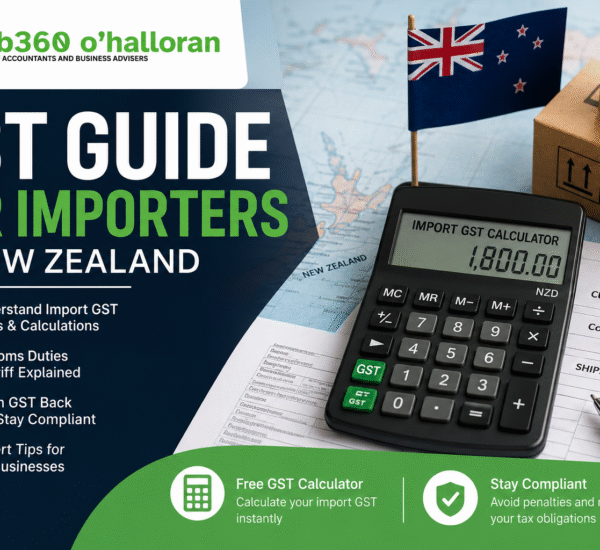
Ultimate GST Guide for Importers in New Zealand
Published Date: 12 May 2026
Importing goods into New Zealand creates valuable opportunities for retailers, ecommerce businesses, wholesalers, and manufacturers. However, understanding GST obligations, customs duties, and import compliance is essential for maintaining profitability and avoiding costly tax mistakes.
This comprehensive GST Guide for Importers in New Zealand explains how import GST works, how businesses can claim GST deductions, customs duty rules, ecommerce import obligations, and compliance requirements under the Inland Revenue Department (IRD) and the New Zealand Customs Service.
GST Guide for Importers in New Zealand: Understanding GST Rules and Compliance
Goods and Services Tax (GST) is a consumption tax applied to most goods and services sold or consumed in New Zealand. When goods are imported into New Zealand, GST is generally charged at the border before the goods are released by Customs.
Import GST commonly applies to:
- Retail inventory imports
- Wholesale product imports
- Ecommerce business stock
- Commercial machinery
- Manufacturing materials
- Business equipment
The standard GST rate in New Zealand is:
15%
How Import GST Is Calculated
Import GST is calculated based on the total landed cost of imported goods entering New Zealand.
This usually includes:
- Customs value of goods
- Freight costs
- Insurance costs
- Customs duties
Import GST formula:
Import GST = 15% × (Customs Value + Duty + Freight + Insurance)
For example:
- Goods value: NZD 10,000
- Freight and insurance: NZD 1,500
- Duty: NZD 500
GST calculation:
15% × NZD 12,000 = NZD 1,800 GST
GST Calculator for Importers in New Zealand
Estimate your import GST using the standard New Zealand import GST formula below.
Import GST Formula
Import GST = 15% × (Customs Value + Duty + Freight + Insurance)
Example Calculation
- Goods Value: NZD 10,000
- Customs Duty: NZD 500
- Freight Costs: NZD 1,200
- Insurance: NZD 300
Estimated Import GST: NZD 1,800
Disclaimer: This calculator provides an estimated GST amount only. Actual GST and customs charges may vary depending on product classification, duties, exemptions, and Customs assessments.
Who Needs to Pay GST on Imports?
Import GST obligations may apply to:
- Retail businesses
- Amazon sellers
- Shopify stores
- Manufacturers
- Wholesalers
- Dropshipping businesses
- International trading companies
Businesses importing goods into New Zealand for commercial purposes should assess GST registration and reporting obligations carefully.
Why This GST Guide for Importers in New Zealand Matters
GST Guide for Importers in New Zealand: Import Tax Calculations Explained
Common Mistakes Businesses Make in GST Guide for Importers in New Zealand
GST Registration Requirements for Importers
Businesses generally need GST registration if annual taxable turnover exceeds:
NZD 60,000 within a 12-month period
GST registration may allow businesses to:
- Claim GST deductions on imports
- Improve tax compliance
- Maintain professional accounting records
- Manage cash flow more effectively
Official guidance: IRD GST Registration Information
Claiming GST on Imported Goods
GST-registered businesses can generally recover eligible import GST through GST returns.
Businesses should maintain:
- Customs import entries
- Shipping invoices
- Supplier invoices
- Tax invoices
- Freight records
- Import documentation
Strong documentation is essential for successful GST claims and audit readiness.
Understanding Customs Duties and Tariffs
Some imported goods may also attract customs duties depending on:
- Product classification
- Country of origin
- Trade agreements
- Tariff codes
Free Trade Agreements (FTAs) may reduce or eliminate customs duties for qualifying imports.
Useful resource: NZ Customs Duty Estimator
Low-Value Imported Goods and Ecommerce GST Rules
New Zealand introduced rules requiring many offshore suppliers and ecommerce marketplaces to collect GST on low-value imported goods sold to New Zealand customers.
These rules commonly affect:
- International ecommerce sellers
- Online marketplaces
- Dropshipping businesses
- Overseas suppliers
Low-value goods generally refer to imports valued under NZD 1,000.
AI-Driven Compliance and Digital GST Reporting
Tax authorities increasingly use digital reporting systems and data analytics to monitor import activity and GST compliance.
Businesses should consider:
- Cloud accounting software
- Automated GST tracking
- Digital bookkeeping systems
- Integrated ecommerce reporting
These systems help improve:
- Tax accuracy
- Cash flow visibility
- Compliance efficiency
- Audit readiness
Common GST Mistakes Importers Should Avoid
Incorrect Customs Valuation
Undervaluing imported goods may trigger audits and penalties.
Missing Documentation
Poor record keeping can affect GST deduction claims.
Ignoring GST Registration Requirements
Businesses exceeding GST thresholds without registration may face compliance issues.
Incorrect Tariff Classification
Wrong tariff codes may result in overpaying or underpaying duties.
Internal Resources for NZ Businesses
How DFK Orb360 Helps Importers in New Zealand
DFK Orb360 supports importers, ecommerce businesses, wholesalers, and international traders with:
- GST advisory and compliance
- Import tax planning
- Business structuring
- Cash flow management
- International tax support
- Accounting and reporting services
Professional GST planning helps businesses reduce compliance risks while improving operational efficiency.
Final Thoughts on GST for Importers in New Zealand
Importing goods into New Zealand offers strong business growth opportunities, but businesses must understand GST obligations, customs duties, and compliance requirements to operate successfully.
Accurate reporting, strong documentation, and proactive tax planning can help businesses maintain compliance and improve long-term profitability.
Working with experienced advisors can help importers manage risk and navigate changing tax regulations confidently.
Frequently Asked Questions
Do I pay GST on imported goods in New Zealand?
Yes, GST is generally charged on imported goods entering New Zealand.
Can businesses claim import GST back?
GST-registered businesses can usually claim eligible import GST deductions.
What is the GST rate in New Zealand?
The standard GST rate is 15%.
Do all imported goods attract customs duty?
No, customs duty depends on tariff classification and trade agreements.
What records should importers maintain?
Businesses should maintain invoices, customs entries, shipping documents, GST records, and freight invoices.



 09 377 4238
 Level 2, 6 Kingdon Street, Newmarket, Auckland
 help@orb360.co.nz